A toy storage bench, a staircase-shaped box, and a raised garden bed can all look very different, but they share a powerful math idea: each can be built from smaller box-shaped parts. When a solid figure is made from two rectangular prisms that do not overlap, you can find its total volume by finding the volume of each part and then adding. This is one of the most useful ways to measure real objects.
Sometimes a solid figure is a single box shape, and finding its volume is quick. But many real objects are not one perfect box. They may have a step, an extra section, or a raised top. Instead of giving up, mathematicians break the solid into simpler pieces. If those pieces are two right rectangular prisms that do not overlap, the total volume is just the sum of the two smaller volumes.
This works because volume measures space. If one part fills a certain amount of space and another part fills a different amount of space, then together they fill both amounts of space. There is no extra space being counted if the parts do not overlap.
You already know area is measured in square units, such as square centimeters. Volume is similar, but it measures space in three dimensions, so it uses cubic units such as cubic centimeters, written as \(\textrm{cm}^3\).
That idea connects multiplication and addition. Multiplication helps find the volume of each prism. Addition helps combine the parts into one total.
A right rectangular prism is a box-shaped solid with rectangular faces. A cereal box, a brick, and a shipping box are common examples. To find the volume of a right rectangular prism, multiply its length, width, and height:
\[V = l \times w \times h\]
Here, \(l\) is length, \(w\) is width, and \(h\) is height. The answer is in cubic units.
For example, if a prism has length \(6\) units, width \(4\) units, and height \(3\) units, then its volume is \(6 \times 4 \times 3 = 72\) cubic units. That means \(72\) unit cubes would fill the prism.
Volume is the amount of space inside a solid figure. Additive means that when non-overlapping parts are combined, their volumes can be added to get the total volume.
Suppose a solid figure is made of two box-shaped parts. If the parts do not overlap, then the total composite solid has volume equal to the volume of part \(A\) plus the volume of part \(B\), as [Figure 1] illustrates. In symbols, if the two prisms do not overlap, then \(V_{\textrm{total}} = V_A + V_B\).
The phrase non-overlapping is important. It means the parts may touch, but they do not take up the same space. If you counted overlapping space twice, the answer would be too large.
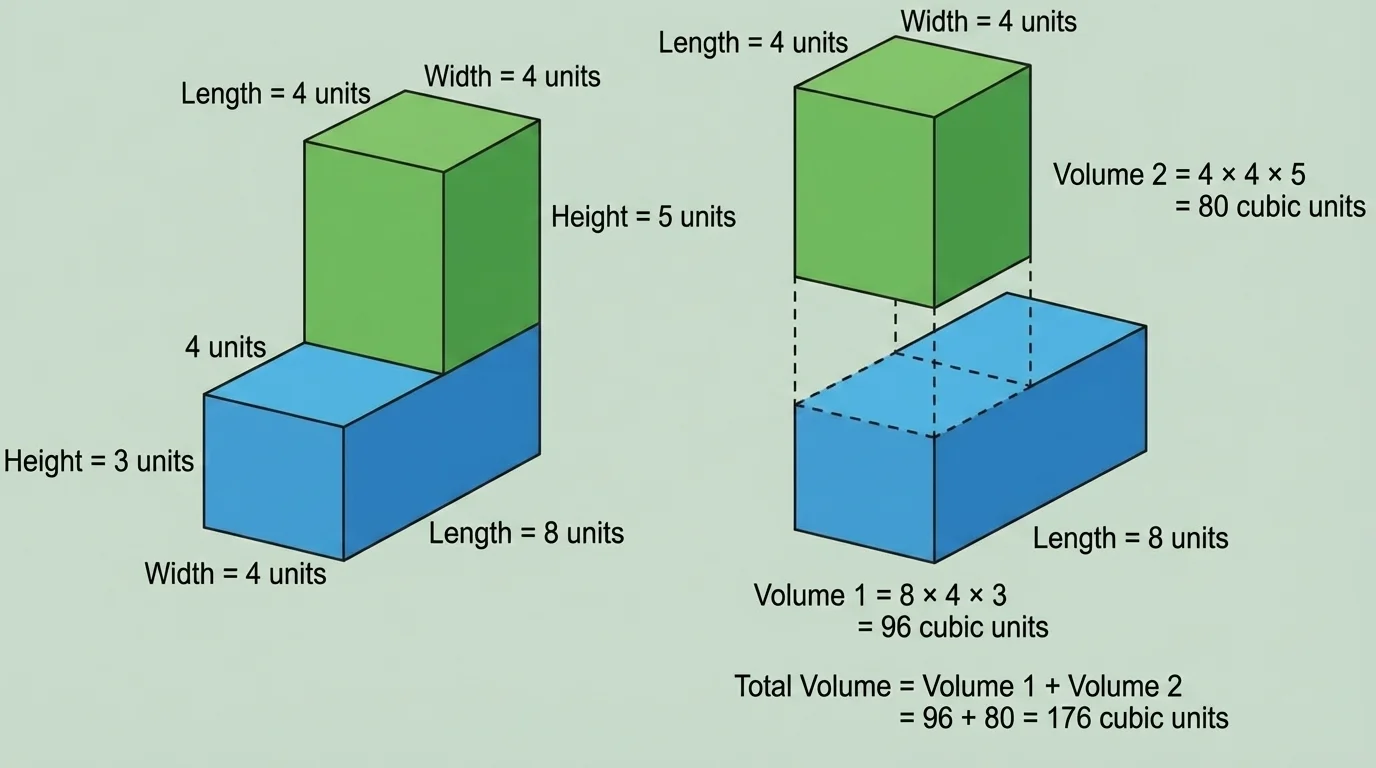
When you look at a more complicated solid, ask yourself, "Can I split this into two rectangular prisms?" If the answer is yes, then you can find the volume of each prism and add the results.
Another way to think about it is with building blocks. If one block arrangement uses \(24\) cubes and another attached arrangement uses \(18\) cubes, then together they use \(24 + 18 = 42\) cubes, as long as no cubes are counted twice.
How addition and multiplication work together
Multiplication helps you count layers of cubes in one prism efficiently. Addition helps you combine the totals from two prisms into one total for the whole figure. So volume can be related to multiplication and to addition at the same time.
To find the volume of a solid made of two rectangular prisms, use this method.
First, identify the two prisms inside the larger figure. Second, write the dimensions of each prism. Third, find each volume using \(V = l \times w \times h\). Fourth, add the two volumes. Finally, label the answer with cubic units.
Sometimes the two prisms have the same height. Sometimes they are stacked and have different heights. In every case, the key idea is the same: split carefully and add only once.
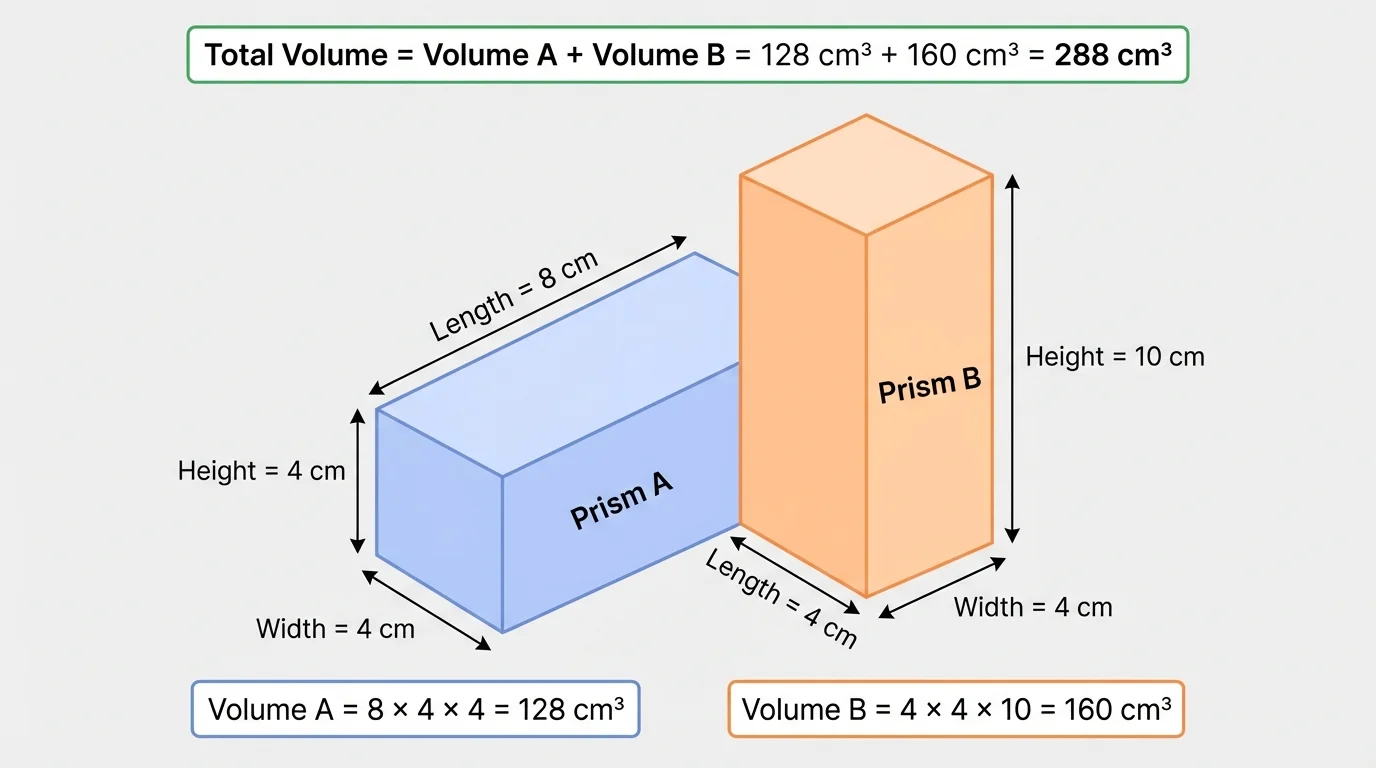
An L-shaped solid can be tricky at first, but it becomes much simpler when split into two prisms, as shown in [Figure 2]. In this example, both prisms have the same height.
Suppose Prism \(A\) has dimensions \(8\) units by \(3\) units by \(2\) units. Prism \(B\) has dimensions \(4\) units by \(2\) units by \(2\) units.
Worked example: L-shaped solid
Step 1: Find the volume of Prism \(A\).
Use \(V = l \times w \times h\).
\(V_A = 8 \times 3 \times 2 = 48\)
Step 2: Find the volume of Prism \(B\).
\(V_B = 4 \times 2 \times 2 = 16\)
Step 3: Add the two volumes.
\(V_{\textrm{total}} = 48 + 16 = 64\)
So the volume of the composite solid is \(64\) cubic units.
Notice that the shape is not a single rectangular prism. But because it is made of two non-overlapping prisms, we can still find the volume exactly. The partition in [Figure 2] makes the hidden simple shapes easier to see.
Now consider a stacked figure. The bottom prism measures \(10\) centimeters by \(5\) centimeters by \(3\) centimeters. A smaller top prism sits on one side of it and measures \(4\) centimeters by \(5\) centimeters by \(2\) centimeters.
Worked example: Two-level solid
Step 1: Find the volume of the bottom prism.
\(V_1 = 10 \times 5 \times 3 = 150\)
Step 2: Find the volume of the top prism.
\(V_2 = 4 \times 5 \times 2 = 40\)
Step 3: Add the volumes.
\(V_{\textrm{total}} = 150 + 40 = 190\)
The total volume is \(190\) cubic centimeters, written as \(190\textrm{ cm}^3\).
This example shows that the two prisms do not have to be side by side. They can also be stacked, as long as they do not overlap in space.
Architects and builders often think about solids as combinations of rectangular prisms. This helps them estimate how much concrete, wood, or storage space is needed.
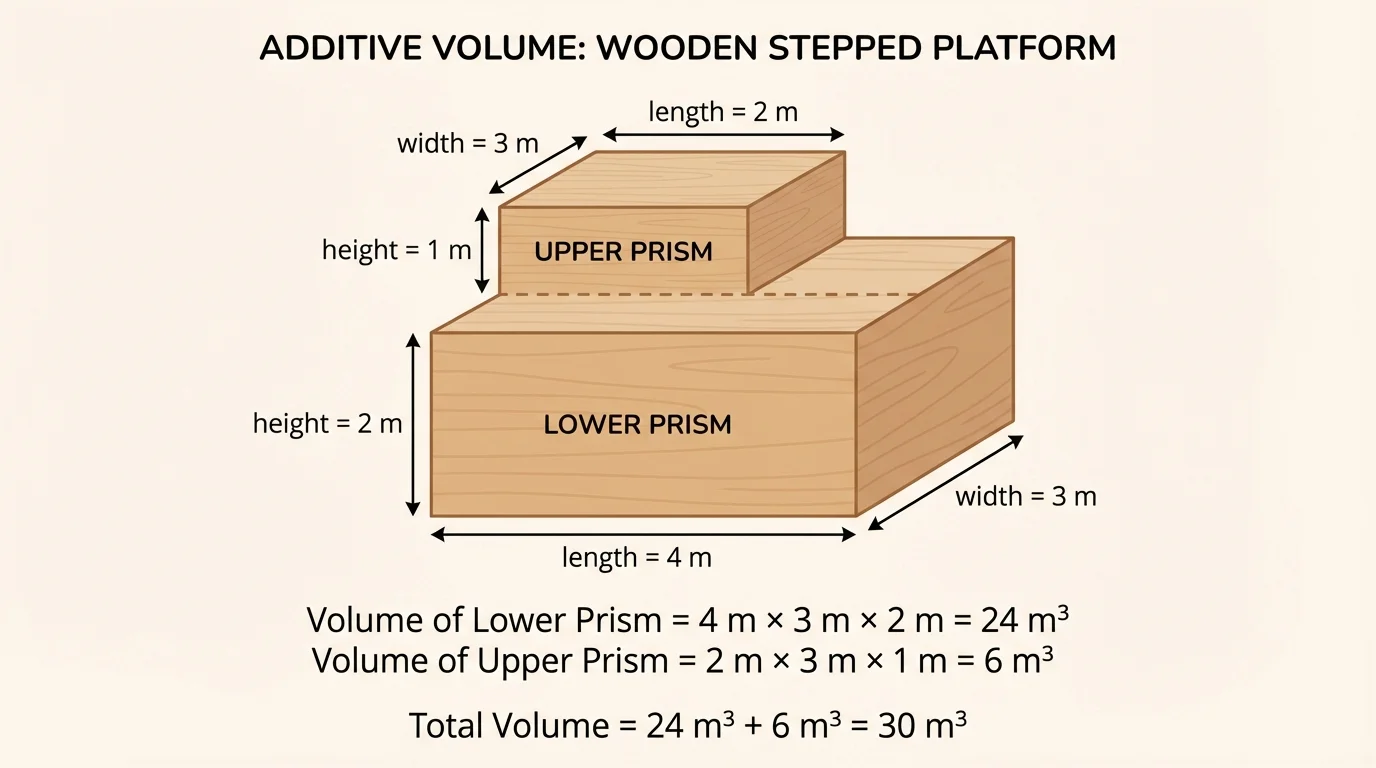
A school is building a wooden display platform with two levels. The lower section is \(12\) feet long, \(6\) feet wide, and \(1\) foot high. The raised back section is \(5\) feet long, \(6\) feet wide, and \(2\) feet high. This kind of stepped platform appears in real life, and shows one example. Volume helps determine how much space the wood structure occupies.
Worked example: Display platform
Step 1: Find the volume of the lower section.
\(V_1 = 12 \times 6 \times 1 = 72\)
Step 2: Find the volume of the raised section.
\(V_2 = 5 \times 6 \times 2 = 60\)
Step 3: Add the volumes.
\(V_{\textrm{total}} = 72 + 60 = 132\)
The platform has a volume of \[132\textrm{ ft}^3\]
In a real project, that total could help workers estimate material, storage, or how much space the structure will take up. The stepped shape in [Figure 3] is not a single prism, but splitting it into two prisms makes the calculation manageable.
One common mistake is forgetting that each prism needs three dimensions. If a student multiplies only two dimensions, that gives area, not volume.
Another common mistake is using dimensions that do not belong together. Be careful to match the correct length, width, and height for each prism. In composite figures, some dimensions belong only to one part of the solid.
A third common mistake is double-counting space. Remember the idea from [Figure 1]: additive volume works when the prisms are non-overlapping. If a part of the solid is counted in both prisms, the total will be too large.
Also check units carefully. If the dimensions are in inches, the answer must be in cubic inches, \(\textrm{in}^3\). If the dimensions are in meters, the answer must be in cubic meters, \(\textrm{m}^3\).
For more complex word problems, a table can help keep track of the two prisms before doing the multiplication.
| Prism | Length | Width | Height | Volume |
|---|---|---|---|---|
| A | \(8\) | \(3\) | \(2\) | \(8 \times 3 \times 2 = 48\) |
| B | \(4\) | \(2\) | \(2\) | \(4 \times 2 \times 2 = 16\) |
| Total | \(48 + 16 = 64\) cubic units | |||
Table 1. Dimensions and volumes for two prisms that make one composite solid.
Tables are especially helpful when several numbers appear in a word problem. They reduce confusion and make each prism easier to track.
Volume by addition appears in many real situations. A storage organizer may have a larger bottom section and a smaller top section. A garden box may have a raised area at one end. A shipping design may combine two box-like sections. In each case, the total space can be found by adding the volumes of two prisms.
Suppose a packing crate is shaped like two attached rectangular boxes. If one part has volume \(90\) cubic inches and the other has volume \(36\) cubic inches, then the entire crate has volume \(90 + 36 = 126\) cubic inches.
An aquarium stand or shelf can also use this idea. If builders know the volume of the solid wood sections, they can estimate materials more accurately. That is why recognizing simple shapes inside a complex object is such a valuable skill.
"Break a hard shape into easy shapes."
— A smart geometry strategy
Sometimes the hardest part is not the multiplying or adding. The hardest part is seeing where one prism ends and the other begins. Practice looking for straight cuts that turn a complicated shape into two boxes.
Ask yourself these questions: Are there two rectangular prism parts? Do they overlap? What are the dimensions of each part? What unit should the final answer use?
When students become confident with this process, they can solve many measurement problems that at first seem much harder than they really are.
The big idea is that volume is not just a formula to memorize. It is also a way of thinking about space. Multiplication tells how much space is in each prism, and addition combines those amounts to describe the whole solid.
