If two friends share pizzas cut in different ways, one into halves and one into thirds, you cannot just count the pieces and be done. A half-piece and a third-piece are not the same size. That is exactly why adding fractions with different denominators takes careful thinking: the pieces must match before the math makes sense.
[Figure 1] A denominator tells how many equal parts make one whole. A numerator tells how many of those parts are being counted. When two fractions have different denominators, they are talking about different-sized parts. \(\dfrac{1}{2}\) and \(\dfrac{1}{3}\) are not pieces of the same size, so we cannot directly combine them.
To add or subtract fractions correctly, we replace them with equivalent fractions. Equivalent fractions name the same amount in different ways. For example, \(\dfrac{1}{2}=\dfrac{2}{4}=\dfrac{3}{6}\). The value stays the same, but the pieces are renamed.
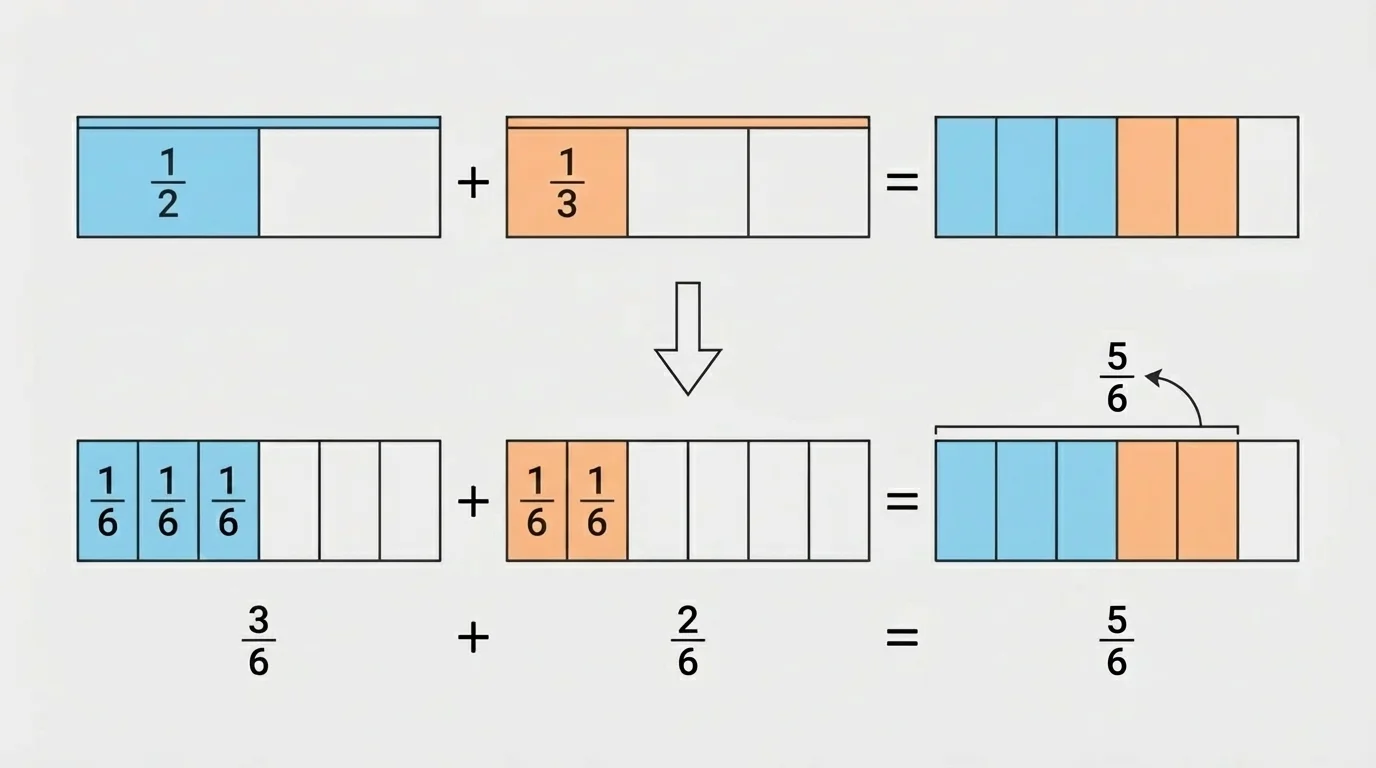
Once the parts are the same size, the fractions can be added or subtracted. For example, \(\dfrac{1}{2}+\dfrac{1}{3}\) becomes \(\dfrac{3}{6}+\dfrac{2}{6}=\dfrac{5}{6}\). The key idea is simple: same-sized parts can be combined; different-sized parts cannot.
Unlike denominators means the denominators are different, such as \(\dfrac{2}{3}\) and \(\dfrac{5}{4}\).
Common denominator is a denominator that two or more fractions can all use, such as \(12\) for thirds and fourths.
Least common denominator is the smallest common denominator that works for all the fractions.
A common denominator does not change the amount in a fraction. It only changes the name of the fraction so the pieces match.
[Figure 2] To find a common denominator, look for a number that both denominators divide evenly. One way is to list multiples. A common denominator for \(\dfrac{1}{4}\) and \(\dfrac{5}{6}\) must be a multiple of \(4\) and also a multiple of \(6\).
Multiples of \(4\) are \(4, 8, 12, 16, ...\). Multiples of \(6\) are \(6, 12, 18, ...\). The first one they share is \(12\), so \(12\) is the least common denominator.
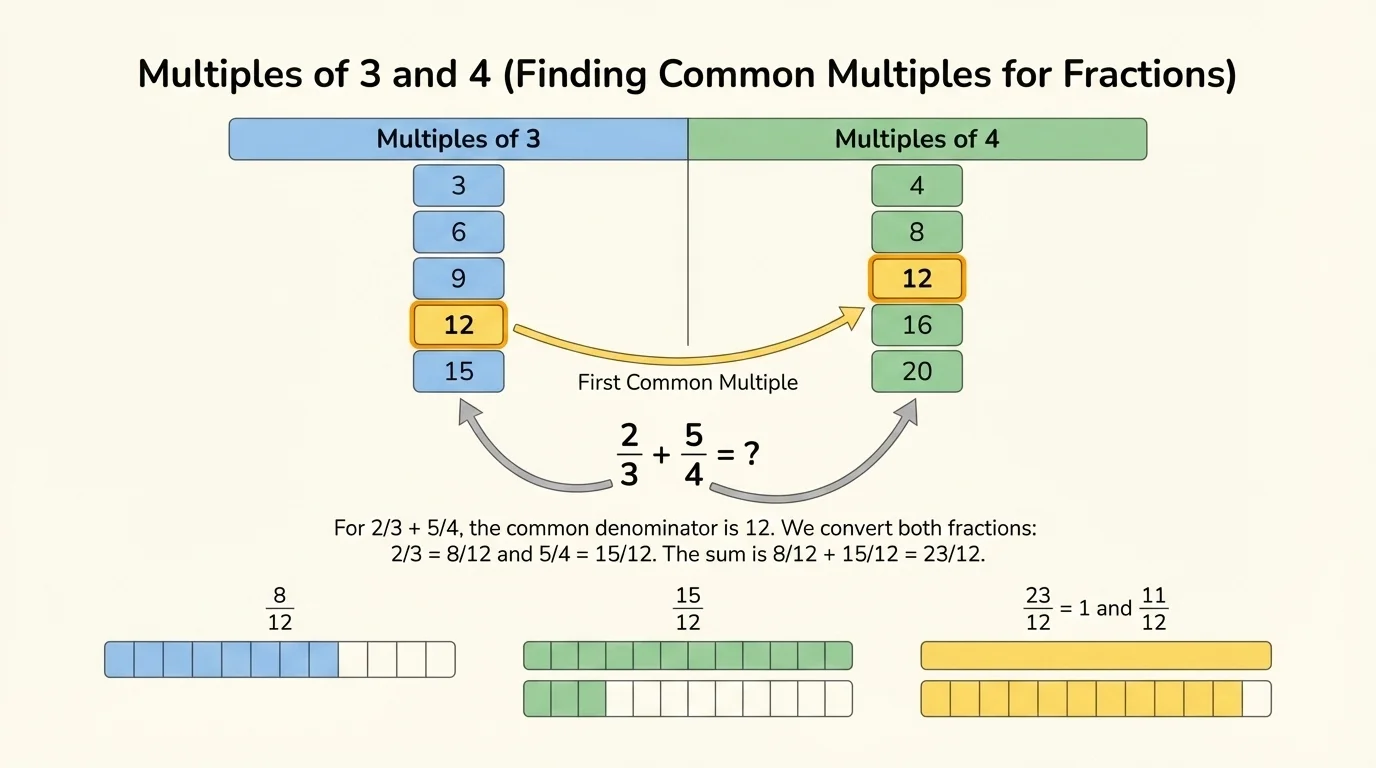
Now rename each fraction using denominator \(12\). Since \(4 \times 3 = 12\), multiply the numerator and denominator of \(\dfrac{1}{4}\) by \(3\): \(\dfrac{1}{4}=\dfrac{3}{12}\). Since \(6 \times 2 = 12\), multiply the numerator and denominator of \(\dfrac{5}{6}\) by \(2\): \(\dfrac{5}{6}=\dfrac{10}{12}\).
Now the fractions have like denominators, so they are ready for addition or subtraction. This renaming step is the heart of the method.
You already know how to add and subtract fractions with like denominators. For example, \(\dfrac{3}{8}+\dfrac{2}{8}=\dfrac{5}{8}\) and \(\dfrac{7}{10}-\dfrac{3}{10}=\dfrac{4}{10}\). The new skill is making unlike denominators become like denominators first.
Sometimes more than one common denominator works. For \(\dfrac{1}{2}\) and \(\dfrac{1}{3}\), \(6\), \(12\), and \(18\) are all common denominators. Usually the least common denominator keeps the numbers smaller and easier to work with.
After renaming both fractions with a common denominator, add the numerators and keep the denominator the same. This is because you are counting equal-sized pieces.
Solved example 1
Find \(\dfrac{2}{3}+\dfrac{5}{4}\).
Step 1: Find a common denominator.
The denominators are \(3\) and \(4\). A common denominator is \(12\).
Step 2: Rewrite each fraction as an equivalent fraction.
\(\dfrac{2}{3}=\dfrac{8}{12}\) because \(\dfrac{2\times 4}{3\times 4}=\dfrac{8}{12}\).
\(\dfrac{5}{4}=\dfrac{15}{12}\) because \(\dfrac{5\times 3}{4\times 3}=\dfrac{15}{12}\).
Step 3: Add the numerators.
\(\dfrac{8}{12}+\dfrac{15}{12}=\dfrac{23}{12}\).
The sum is \[\frac{23}{12}\]
This can also be written as the mixed number \(1\dfrac{11}{12}\).
This sum is greater than one whole, and that is perfectly fine. Fraction sums do not have to stay below \(1\).
There is also a general pattern. For any fractions \(\dfrac{a}{b}\) and \(\dfrac{c}{d}\), one common denominator is \(bd\). Then
\[\frac{a}{b}+\frac{c}{d}=\frac{ad+bc}{bd}\]
This formula works because \(\dfrac{a}{b}=\dfrac{ad}{bd}\) and \(\dfrac{c}{d}=\dfrac{bc}{bd}\). Then we add \(ad\) and \(bc\).
Solved example 2
Find \(\dfrac{3}{5}+\dfrac{1}{2}\).
Step 1: Find a common denominator.
The least common denominator of \(5\) and \(2\) is \(10\).
Step 2: Rename each fraction.
\(\dfrac{3}{5}=\dfrac{6}{10}\) and \(\dfrac{1}{2}=\dfrac{5}{10}\).
Step 3: Add.
\(\dfrac{6}{10}+\dfrac{5}{10}=\dfrac{11}{10}\).
The sum is \[\frac{11}{10}=1\frac{1}{10}\]
Notice that the denominator stayed \(10\) after the addition. Only the numerators changed.
Subtraction follows the same idea: rename first, then subtract the numerators. You still need like denominators because you are subtracting equal-sized parts.
Why the denominator stays the same
When you subtract \(\dfrac{9}{12}-\dfrac{5}{12}\), you are not changing the size of each piece. You still have twelfths. You are only changing how many twelfths are left. That is why the denominator remains \(12\).
This is similar to measurement. If you have \(9\) pieces each worth one-twelfth of a whole and remove \(5\) such pieces, the remaining pieces are still twelfths.
Solved example 3
Find \(\dfrac{7}{8}-\dfrac{1}{6}\).
Step 1: Find the least common denominator.
The least common denominator of \(8\) and \(6\) is \(24\).
Step 2: Rewrite each fraction.
\(\dfrac{7}{8}=\dfrac{21}{24}\) and \(\dfrac{1}{6}=\dfrac{4}{24}\).
Step 3: Subtract the numerators.
\(\dfrac{21}{24}-\dfrac{4}{24}=\dfrac{17}{24}\).
The difference is \[\frac{17}{24}\]
Because \(\dfrac{17}{24}\) is already in simplest form, no more changes are needed.
We can also write a general subtraction pattern using denominator \(bd\): \(\dfrac{a}{b}-\dfrac{c}{d}=\dfrac{ad-bc}{bd}\). The method is the same as addition, except now you subtract the second numerator after renaming.
A mixed number has a whole-number part and a fraction part, such as \(2\dfrac{1}{3}\). You can add and subtract mixed numbers in more than one correct way. Sometimes it is easiest to keep the whole numbers and fractions separate. Sometimes it is easier to change the mixed numbers to improper fractions first.
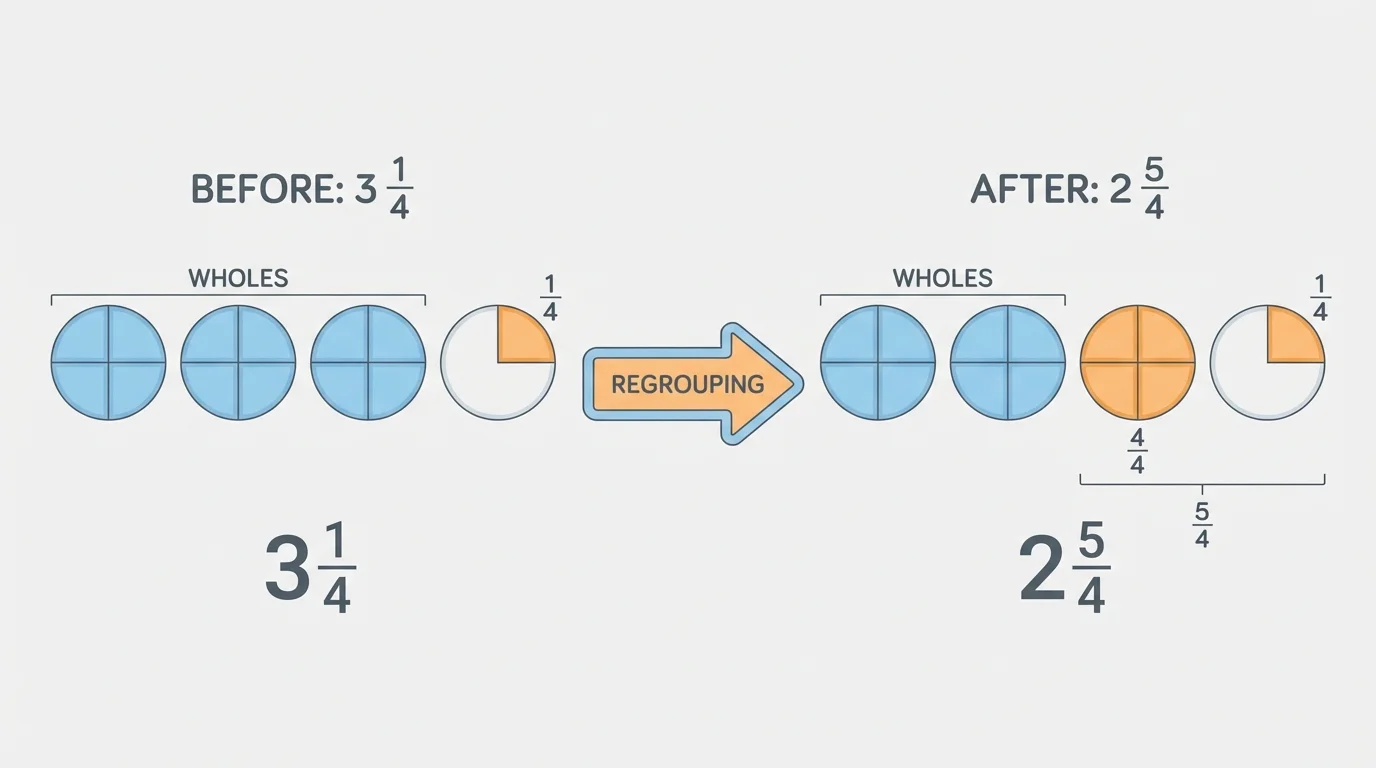
When subtracting mixed numbers, regrouping may be needed. As [Figure 3] illustrates, one whole can be renamed as fractional parts so the subtraction can work when the top fractional part is too small.
For example, in \(3\dfrac{1}{4}-1\dfrac{2}{3}\), the fraction \(\dfrac{1}{4}\) is smaller than \(\dfrac{2}{3}\), so we regroup one whole from the \(3\). Then \(3\dfrac{1}{4}\) becomes \(2+\dfrac{5}{4}\), which is still the same amount.
Solved example 4
Find \(1\dfrac{2}{3}+2\dfrac{3}{4}\).
Step 1: Add the whole numbers.
\(1+2=3\).
Step 2: Add the fractions using a common denominator.
The least common denominator of \(3\) and \(4\) is \(12\).
\(\dfrac{2}{3}=\dfrac{8}{12}\) and \(\dfrac{3}{4}=\dfrac{9}{12}\).
Then \(\dfrac{8}{12}+\dfrac{9}{12}=\dfrac{17}{12}=1\dfrac{5}{12}\).
Step 3: Combine the whole-number parts.
\(3+1\dfrac{5}{12}=4\dfrac{5}{12}\).
The sum is \[4\frac{5}{12}\]
Another way to solve that problem is to turn both mixed numbers into improper fractions first: \(1\dfrac{2}{3}=\dfrac{5}{3}\) and \(2\dfrac{3}{4}=\dfrac{11}{4}\). Then add the fractions as usual. Both methods lead to the same answer.
Solved example 5
Find \(3\dfrac{1}{4}-1\dfrac{2}{3}\).
Step 1: Notice that \(\dfrac{1}{4}\) is smaller than \(\dfrac{2}{3}\), so regroup.
\(3\dfrac{1}{4}=2+\dfrac{5}{4}\).
Step 2: Subtract the whole-number parts.
\(2-1=1\).
Step 3: Subtract the fractions.
Use denominator \(12\): \(\dfrac{5}{4}=\dfrac{15}{12}\) and \(\dfrac{2}{3}=\dfrac{8}{12}\).
Then \(\dfrac{15}{12}-\dfrac{8}{12}=\dfrac{7}{12}\).
Step 4: Combine the results.
\(1+\dfrac{7}{12}=1\dfrac{7}{12}\).
The difference is \[1\frac{7}{12}\]
That regrouping idea is the same one used in whole-number subtraction. You are trading one whole for fractional parts of the same value, just as we saw earlier in [Figure 3].
You can always use the product of the denominators as a common denominator. For \(\dfrac{1}{6}\) and \(\dfrac{1}{8}\), the product is \(48\), so it works. But the least common denominator is \(24\), which is smaller and easier.
The table below compares two ways to choose a common denominator.
| Fractions | Product of Denominators | Least Common Denominator |
|---|---|---|
| \(\dfrac{1}{3}\) and \(\dfrac{1}{4}\) | \(12\) | \(12\) |
| \(\dfrac{1}{6}\) and \(\dfrac{1}{8}\) | \(48\) | \(24\) |
| \(\dfrac{2}{5}\) and \(\dfrac{3}{10}\) | \(50\) | \(10\) |
Table 1. Comparison of using the product of denominators and using the least common denominator.
Using the least common denominator is not required every time, but it usually makes the work neater.
Fractions are used constantly in music. Notes can last for \(\dfrac{1}{2}\), \(\dfrac{1}{4}\), or \(\dfrac{1}{8}\) of a measure, so musicians often combine and compare fractional parts without even thinking about it.
That is one reason common denominators matter outside math class: they help compare and combine parts of a whole in a fair way.
One common mistake is adding both numerators and denominators, such as saying \(\dfrac{1}{2}+\dfrac{1}{3}=\dfrac{2}{5}\). That is incorrect because halves and thirds are different-sized parts.
Another mistake is forgetting to simplify. For example, \(\dfrac{4}{12}\) should be simplified to \(\dfrac{1}{3}\). A final answer should usually be in simplest form unless there is a reason to keep another form.
A third mistake happens with mixed-number subtraction when students try to subtract the fractions before regrouping. If the top fraction is smaller, regroup first.
Quick self-check questions
Ask yourself: Are the denominators the same? Did I change both numerator and denominator when making equivalent fractions? Did I keep the denominator the same when I added or subtracted? Can the answer be simplified or written as a mixed number?
These simple checks catch many errors before they become final answers.
Fractions with unlike denominators appear in daily life more often than many people expect. In cooking, a recipe might need \(\dfrac{2}{3}\) cup of one ingredient and \(\dfrac{1}{4}\) cup of another added together to find the total amount used. In woodworking, lengths such as \(1\dfrac{1}{2}\) inches and \(\dfrac{3}{8}\) inch may need to be combined or compared. In sports timing and distance, parts of laps or portions of an hour are often fractional.
Suppose a runner completes \(\dfrac{3}{4}\) of a lap and then another \(\dfrac{2}{3}\) of a lap during drills. To know the total distance in laps, rename both fractions: \(\dfrac{3}{4}=\dfrac{9}{12}\) and \(\dfrac{2}{3}=\dfrac{8}{12}\). Then \(\dfrac{9}{12}+\dfrac{8}{12}=\dfrac{17}{12}=1\dfrac{5}{12}\) laps.
In baking, if you have \(2\dfrac{1}{2}\) cups of flour and use \(1\dfrac{3}{4}\) cups, the amount left is \(2\dfrac{1}{2}-1\dfrac{3}{4}\). Rename \(\dfrac{1}{2}\) as \(\dfrac{2}{4}\), regroup if needed, and subtract to find \(\dfrac{3}{4}\) cup left. Problems like these show that equivalent fractions are not just a classroom trick; they are a tool for making measurements match.
"Fractions make sense when the pieces are the same size."
That single idea explains the whole topic. Once the pieces match, the calculation becomes straightforward.
