A rectangle does not stop having area just because its sides are fractions. A small phone screen, a slice of brownie, or a piece of fabric can easily measure something like \(\dfrac{3}{4}\) of a unit by \(\dfrac{2}{3}\) of a unit. The key idea is that the same area idea you already know still works, and it leads to a powerful rule: to find the area, you can multiply the side lengths.
You already know that for a rectangle with whole-number side lengths, the area is found by multiplying length and width. For example, a rectangle that is \(4\) units by \(3\) units has area \(4 \times 3 = 12\) square units.
This works because the rectangle can be covered exactly by \(12\) unit squares. Each square is \(1\) unit by \(1\) unit, so each one has area \(1\) square unit.
Now suppose the side lengths are fractions instead of whole numbers. The rectangle is smaller, so regular unit squares may be too large to fit exactly. But we can still tile the rectangle with smaller equal squares or equal rectangles. Once we choose the right-sized tile, we can count pieces and find the area.
You already know two important facts: multiplying tells how many equal groups there are, and area measures how much surface a shape covers. In this lesson, those two ideas connect.
When side lengths are fractional, the tiles we use are often unit fraction pieces. A unit fraction has a numerator of \(1\), such as \(\dfrac{1}{2}\), \(\dfrac{1}{3}\), or \(\dfrac{1}{8}\).
A rectangle can be split into equal rows and columns, as shown in [Figure 1], so that each small piece has fractional side lengths. If one side is divided into \(3\) equal parts, each part is \(\dfrac{1}{3}\) of a unit. If the other side is divided into \(4\) equal parts, each part is \(\dfrac{1}{4}\) of a unit.
Then each small tile is a tiny rectangle measuring \(\dfrac{1}{3}\) unit by \(\dfrac{1}{4}\) unit. Its area is \(\dfrac{1}{12}\) of a square unit, because \(3 \times 4 = 12\) of these tiny tiles fit into one full unit square.
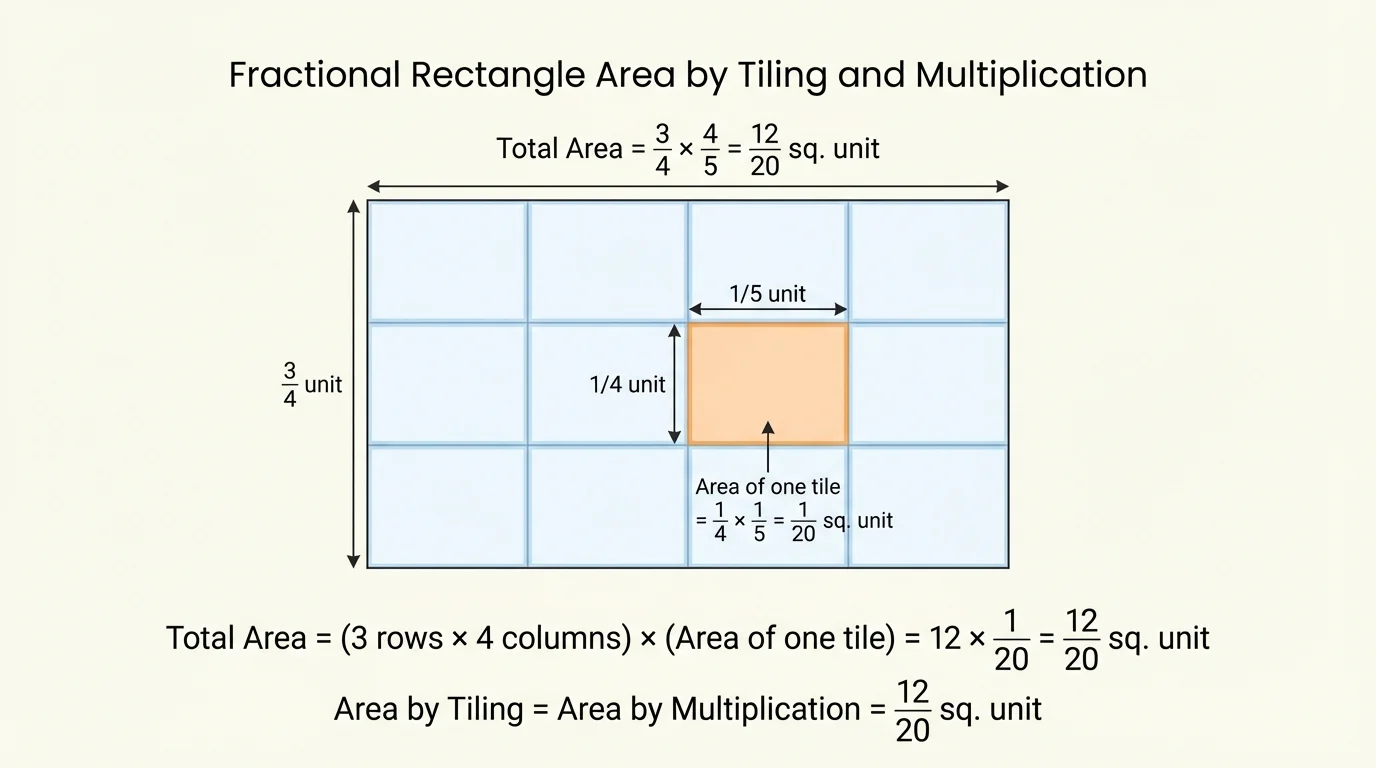
This idea is important: when we split one unit into \(3\) equal parts one way and \(4\) equal parts the other way, the whole unit square gets cut into \(12\) equal smaller rectangles. That is why a tile with side lengths \(\dfrac{1}{3}\) and \(\dfrac{1}{4}\) has area \(\dfrac{1}{12}\) square unit.
A tile in math is a shape used to cover a region without gaps or overlaps. In fraction area models, tiles help us see multiplication instead of only memorizing a rule.
Fraction area model is a rectangle divided into equal parts to show a product. The side lengths tell how many parts are taken along each side, and the shaded or counted small pieces show the product.
Unit square is a square with side length \(1\) unit, so its area is \(1\) square unit.
Notice that not every tile has to be a square. Sometimes the smallest repeated piece is a tiny rectangle. What matters is that all the pieces are equal and cover the larger rectangle exactly.
Suppose a rectangle has side lengths \(\dfrac{a}{b}\) and \(\dfrac{c}{d}\). Divide one unit into \(b\) equal parts in one direction and \(d\) equal parts in the other direction. Then each tiny tile has area \(\dfrac{1}{bd}\) square unit.
Now count how many tiny tiles fit into the rectangle. Along one side, \(\dfrac{a}{b}\) means \(a\) parts of size \(\dfrac{1}{b}\). Along the other side, \(\dfrac{c}{d}\) means \(c\) parts of size \(\dfrac{1}{d}\). So the rectangle contains \(a \times c\) tiny tiles.
Each tile has area \(\dfrac{1}{bd}\), so the total area is
\[\frac{a \times c}{b \times d}\]
That is exactly the same as multiplying the side lengths:
\[\frac{a}{b} \times \frac{c}{d} = \frac{ac}{bd}\]
This is not just a shortcut. It comes from counting equal area pieces.
Why multiplying fractions makes sense
When you multiply whole numbers, you can think of rows and columns. Fraction multiplication uses the same idea, but the rows and columns are fractional parts of a unit. The numerators count how many parts you use, and the denominators tell how many equal parts the whole is split into.
If one side length is a whole number and the other is a fraction, the same rule works. A whole number can be written as a fraction with denominator \(1\). For example, \(3 = \dfrac{3}{1}\), so
\[3 \times \frac{2}{5} = \frac{3}{1} \times \frac{2}{5} = \frac{6}{5}\]
As an area, that means a rectangle \(3\) units long and \(\dfrac{2}{5}\) unit wide has area \(\dfrac{6}{5}\) square units, which is also \(1\dfrac{1}{5}\) square units.
The grid in [Figure 2] turns both fractions into countable rows and columns. Find the area of a rectangle with side lengths \(\dfrac{3}{4}\) unit and \(\dfrac{2}{3}\) unit.
Worked example: \(\dfrac{3}{4} \times \dfrac{2}{3}\)
Step 1: Decide how to tile the rectangle.
Split one unit into \(4\) equal parts in one direction and \(3\) equal parts in the other direction. Then each tiny tile is \(\dfrac{1}{4}\) by \(\dfrac{1}{3}\), so each tile has area \(\dfrac{1}{12}\) square unit.
Step 2: Count how many tiny tiles are in the rectangle.
The side length \(\dfrac{3}{4}\) uses \(3\) parts out of \(4\). The side length \(\dfrac{2}{3}\) uses \(2\) parts out of \(3\). So the rectangle has \(3 \times 2 = 6\) tiny tiles.
Step 3: Find the total area.
Since each tile has area \(\dfrac{1}{12}\), the total area is \(6 \times \dfrac{1}{12} = \dfrac{6}{12} = \dfrac{1}{2}\).
So the area is
\[\frac{3}{4} \times \frac{2}{3} = \frac{1}{2}\]
This example can be surprising to many students: the area of two fractions can be smaller than either side length. That makes sense because multiplying by a fraction less than \(1\) shrinks the size.
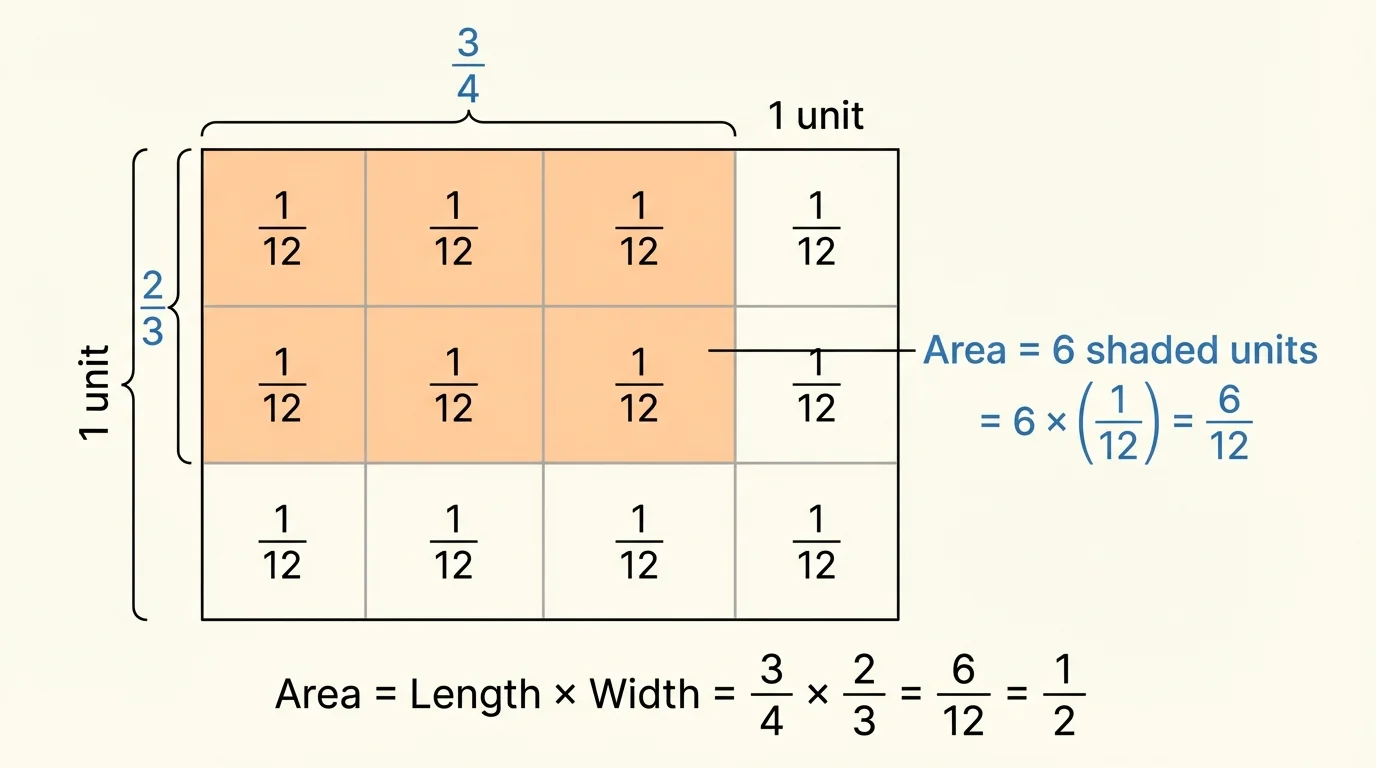
Using multiplication gives the same result right away: \(\dfrac{3}{4} \times \dfrac{2}{3} = \dfrac{6}{12} = \dfrac{1}{2}\). The tiles explain why the rule works, and the multiplication gives a fast way to calculate.
Now find the area of a rectangle with side lengths \(2\dfrac{1}{2}\) units and \(\dfrac{3}{4}\) unit.
Worked example: \(2\dfrac{1}{2} \times \dfrac{3}{4}\)
Step 1: Rewrite the mixed number as an improper fraction.
\(2\dfrac{1}{2} = \dfrac{5}{2}\).
Step 2: Multiply the fractions.
\(\dfrac{5}{2} \times \dfrac{3}{4} = \dfrac{15}{8}\).
Step 3: Write the answer as a mixed number if helpful.
\(\dfrac{15}{8} = 1\dfrac{7}{8}\).
The area is
\[2\frac{1}{2} \times \frac{3}{4} = \frac{15}{8} = 1\frac{7}{8}\]
You can also think of this as \(2\) full units of length plus another \(\dfrac{1}{2}\) unit, all with width \(\dfrac{3}{4}\). Then the area is \(2 \times \dfrac{3}{4} + \dfrac{1}{2} \times \dfrac{3}{4} = \dfrac{6}{4} + \dfrac{3}{8} = \dfrac{12}{8} + \dfrac{3}{8} = \dfrac{15}{8}\).
This shows another useful idea: fraction multiplication and area connect nicely with addition and decomposition.
Find the area of a rectangle with side lengths \(\dfrac{5}{6}\) unit and \(\dfrac{4}{5}\) unit.
Worked example: \(\dfrac{5}{6} \times \dfrac{4}{5}\)
Step 1: Multiply the numerators.
\(5 \times 4 = 20\).
Step 2: Multiply the denominators.
\(6 \times 5 = 30\).
Step 3: Simplify the fraction.
\(\dfrac{20}{30} = \dfrac{2}{3}\).
The area is
\[\frac{5}{6} \times \frac{4}{5} = \frac{2}{3}\]
If you tiled this rectangle, you would divide one side into \(6\) parts and the other into \(5\) parts, making \(30\) tiny equal pieces. The rectangle would cover \(20\) of those \(30\) pieces, which is \(\dfrac{20}{30}\), or \(\dfrac{2}{3}\).
Area models are one reason fraction multiplication is more than a rule to memorize. They show that the product is based on counting equal parts of a whole region.
Simplifying at the end does not change the area. It only writes the same amount in a simpler form.
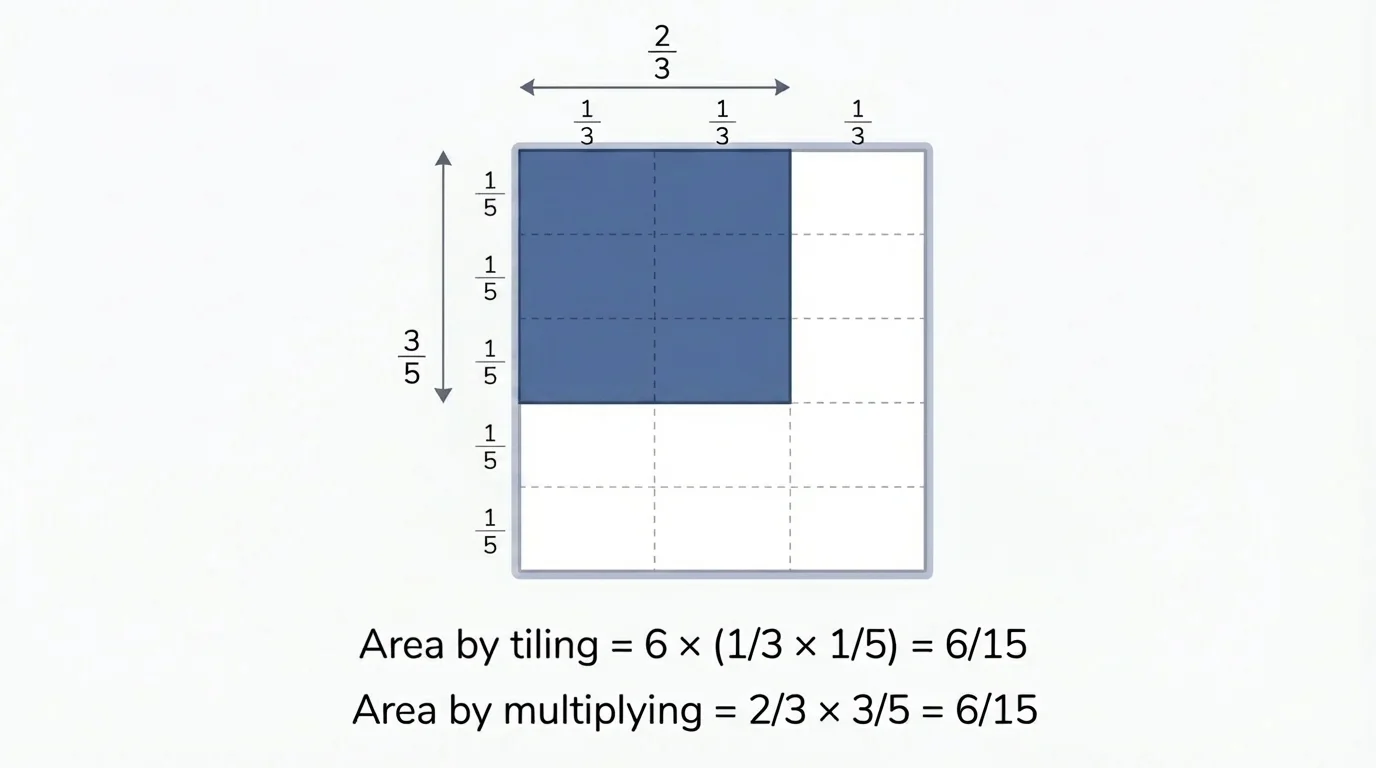
The overlap model in [Figure 3] shows why multiplying numerators and denominators makes sense. Start with one full unit rectangle. Shade \(\dfrac{2}{3}\) of it in one direction, and shade \(\dfrac{3}{5}\) of it in the other direction using a different pattern.
The part that overlaps belongs to both shadings. Since the rectangle is divided into \(3 \times 5 = 15\) equal small parts, and \(2 \times 3 = 6\) of them overlap, the overlap area is \(\dfrac{6}{15} = \dfrac{2}{5}\).
So, as area,
\[\frac{2}{3} \times \frac{3}{5} = \frac{6}{15} = \frac{2}{5}\]
This visual idea is especially helpful because it shows that multiplication of fractions can mean part of a part. Taking \(\dfrac{3}{5}\) of \(\dfrac{2}{3}\) means finding a fraction of something that is already fractional.
Look back at [Figure 1]. The tiny rectangles there already showed that splitting both directions creates a new, smaller unit of area. The overlap in [Figure 3] uses the same idea in a full unit rectangle.
Fractional area appears in real life more often than you might expect. A craft project might use a piece of paper that is \(\dfrac{3}{4}\) foot by \(\dfrac{2}{3}\) foot. A gardener might plant herbs in a small rectangular section of soil. A builder might cut a board or tile to a fractional size.
Suppose a small rug covers a space that is \(1\dfrac{1}{2}\) meters by \(\dfrac{2}{3}\) meter. The area is \(\dfrac{3}{2} \times \dfrac{2}{3} = 1\) square meter. That means even mixed-number measurements can result in a whole-number area.
Suppose a baker spreads icing over a rectangular cookie that is \(\dfrac{4}{5}\) foot by \(\dfrac{1}{2}\) foot. The area is \(\dfrac{4}{5} \times \dfrac{1}{2} = \dfrac{4}{10} = \dfrac{2}{5}\) square foot. Knowing area helps estimate how much icing is needed.
Why the unit matters
When side lengths are measured in units, area is measured in square units. If lengths are in feet, area is in square feet. If lengths are in meters, area is in square meters. Fraction products tell how much surface is covered, not just how long a side is.
The area model from [Figure 2] can help in these situations because it turns a measurement problem into a counting problem. Even when you do not draw every tiny tile, the picture stays in your mind.
One common mistake is adding fractions instead of multiplying them. For area of a rectangle, you multiply the side lengths. If the sides are \(\dfrac{1}{2}\) and \(\dfrac{3}{4}\), the area is not \(\dfrac{1}{2} + \dfrac{3}{4}\). It is \(\dfrac{1}{2} \times \dfrac{3}{4} = \dfrac{3}{8}\).
Another mistake is forgetting what the denominator means. In \(\dfrac{3}{4} \times \dfrac{2}{3}\), the denominator \(4\) tells how many equal parts one side is divided into, and the denominator \(3\) tells how many equal parts the other side is divided into. Together, they create \(12\) equal small area parts.
Students also sometimes forget to convert mixed numbers before multiplying. For example, \(1\dfrac{2}{3}\) should be rewritten as \(\dfrac{5}{3}\) before multiplying by another fraction.
It is also important to simplify your answer when possible. A rectangle with area \(\dfrac{8}{12}\) square unit has the same area as \(\dfrac{2}{3}\) square unit, but the simplified form is usually easier to understand.
| Side lengths | Multiply | Area |
|---|---|---|
| \(\dfrac{1}{2}\) and \(\dfrac{3}{4}\) | \(\dfrac{1}{2} \times \dfrac{3}{4} = \dfrac{3}{8}\) | \(\dfrac{3}{8}\) square unit |
| \(\dfrac{3}{4}\) and \(\dfrac{2}{3}\) | \(\dfrac{3}{4} \times \dfrac{2}{3} = \dfrac{1}{2}\) | \(\dfrac{1}{2}\) square unit |
| \(2\dfrac{1}{2}\) and \(\dfrac{3}{4}\) | \(\dfrac{5}{2} \times \dfrac{3}{4} = \dfrac{15}{8}\) | \(1\dfrac{7}{8}\) square units |
| \(\dfrac{5}{6}\) and \(\dfrac{4}{5}\) | \(\dfrac{5}{6} \times \dfrac{4}{5} = \dfrac{2}{3}\) | \(\dfrac{2}{3}\) square unit |
Table 1. Examples of rectangle areas found by multiplying fractional side lengths.
The big idea is simple and powerful: area can always be understood by covering a rectangle with equal pieces. With fractions, the pieces are smaller, but the reasoning stays the same.
"Multiplying fractions is not magic; it is counting equal parts of equal parts."
That is why rectangular area models are so useful. They turn an abstract product into something you can see, count, and understand.
