Multiplication does not always make numbers bigger. That sounds strange at first, but it is true. If you multiply by \(2\), the result grows. If you multiply by \(1\), it stays the same. If you multiply by \(\dfrac{1}{2}\), it gets smaller. This idea is easier to understand when you think of multiplication as scaling, or resizing.
When we compare the size of a product to the size of one factor, we do not need to carry out the whole multiplication. We only need to ask one question: What is the size of the other factor? That question tells us whether the product will be larger, smaller, or the same.
[Figure 1] You may already know multiplication as repeated addition. For example, \(4 \times 3\) means \(3 + 3 + 3 + 3\). But multiplication can also mean resizing one number by another number. If you start with \(8\) and multiply by \(2\), you make it twice as large. If you start with \(8\) and multiply by \(\dfrac{1}{2}\), you make it half as large. This resizing idea is very important for fractions.
Think of one factor as the starting number being changed by the other factor. If the other factor is more than \(1\), the number stretches. If it is less than \(1\) but greater than \(0\), the number shrinks. If it is exactly \(1\), the number stays the same.
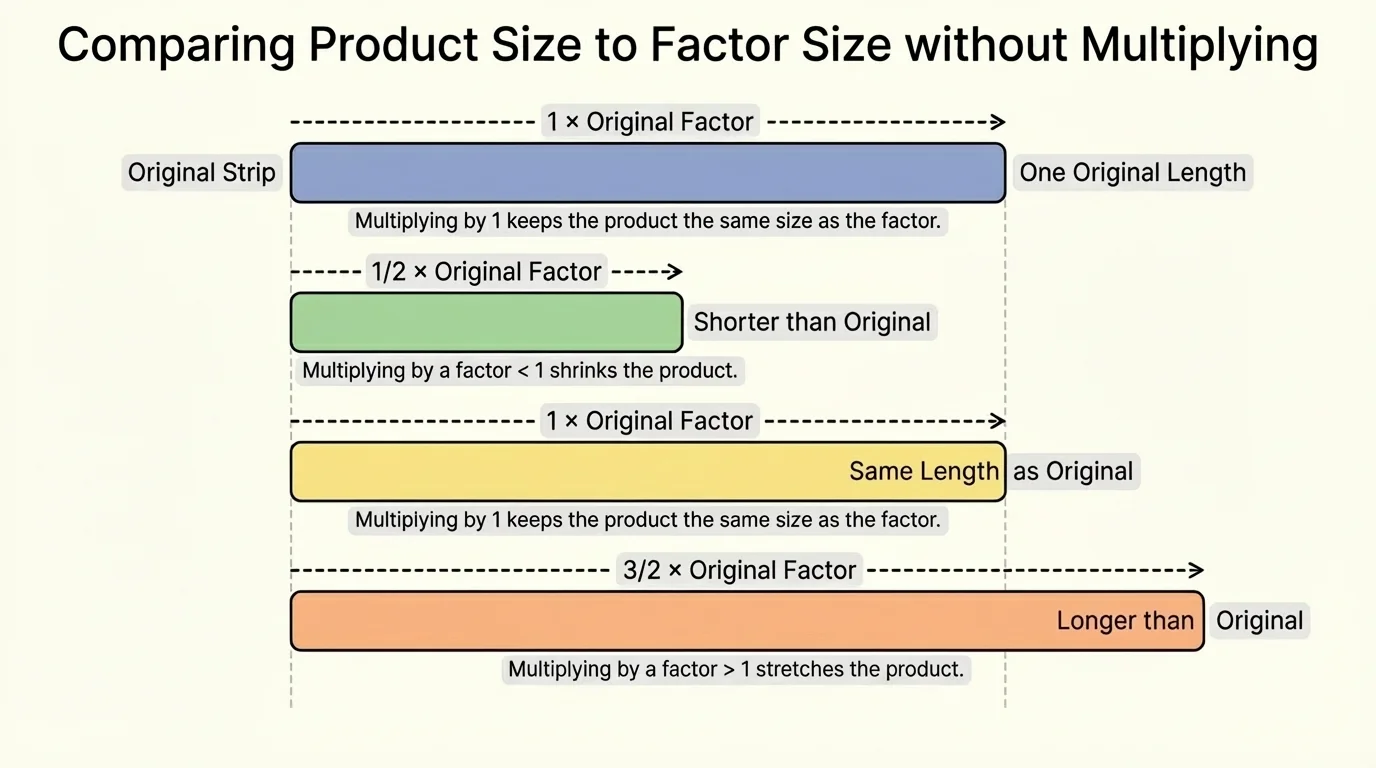
Scaling means resizing a quantity by multiplying it by another number.
Factor is a number being multiplied.
Product is the result of multiplication.
Suppose the original length of a ribbon is \(12\) inches. If you multiply by \(2\), the new length is larger than \(12\). If you multiply by \(1\), it is still \(12\). If you multiply by \(\dfrac{1}{3}\), the new length is smaller than \(12\). You can tell all of that before computing any exact answer.
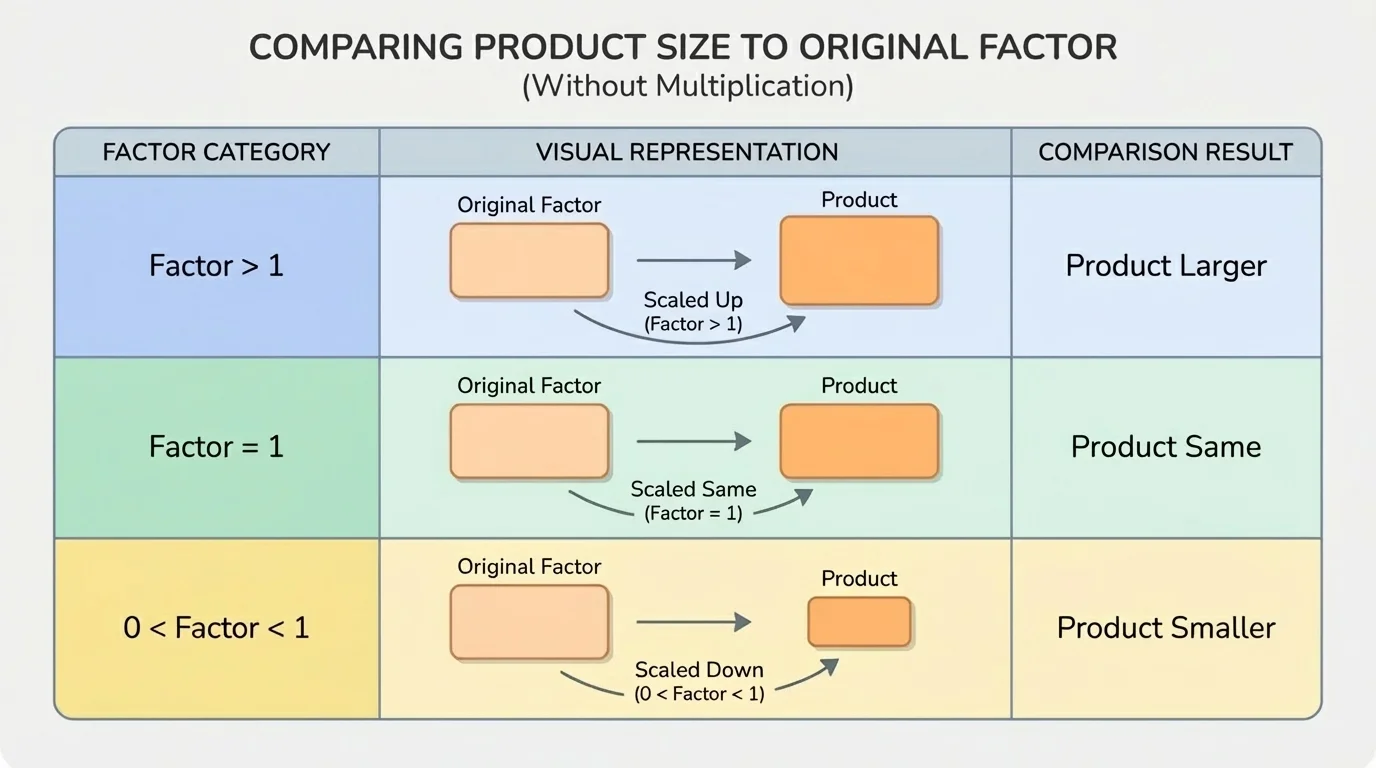
[Figure 2] The three cases below show how the size of the other factor determines whether the product is larger than, equal to, or smaller than the factor you are comparing it to.
There are three main cases to remember. These cases help you compare a product to one factor by looking only at the other factor.
Case 1: If the other factor is greater than \(1\), then the product is greater than the factor you are comparing it to.
For example, in \(7 \times \dfrac{5}{4}\), the factor \(\dfrac{5}{4}\) is greater than \(1\). So the product must be greater than \(7\). You do not need to calculate the exact product to know that.
Case 2: If the other factor is equal to \(1\), then the product is equal to the factor you are comparing it to.
For example, in \(9 \times 1\), the product is equal to \(9\).
Case 3: If the other factor is between \(0\) and \(1\), then the product is less than the factor you are comparing it to.
For example, in \(10 \times \dfrac{3}{5}\), the factor \(\dfrac{3}{5}\) is between \(0\) and \(1\). So the product must be less than \(10\).
This is why multiplying by fractions can be surprising. Many students first learn multiplication with whole numbers like \(3\), \(4\), and \(10\), where products often get larger. But when fractions are involved, multiplication can make a number smaller.
You already know that \(1\) whole can be written as fractions such as \(\dfrac{2}{2}\), \(\dfrac{3}{3}\), and \(\dfrac{7}{7}\). Any fraction equal to \(1\) keeps a quantity the same when used as a factor.
Now focus on the exact skill: compare the size of the product to the size of one factor on the basis of the size of the other factor, without performing the multiplication.
Suppose you want to compare \(6 \times \dfrac{4}{5}\) to \(6\). The factor \(\dfrac{4}{5}\) is less than \(1\). That means the product is less than \(6\).
Suppose you want to compare \(6 \times \dfrac{7}{5}\) to \(6\). The factor \(\dfrac{7}{5}\) is greater than \(1\). That means the product is greater than \(6\).
Suppose you want to compare \(6 \times \dfrac{6}{6}\) to \(6\). The factor \(\dfrac{6}{6} = 1\). That means the product is equal to \(6\).
You can do the same kind of thinking no matter which factor you compare the product to. In \(\dfrac{3}{4} \times 8\), if you compare the product to \(8\), the factor \(\dfrac{3}{4}\) is less than \(1\), so the product is less than \(8\). If you compare the product to \(\dfrac{3}{4}\), the factor \(8\) is greater than \(1\), so the product is greater than \(\dfrac{3}{4}\).
The comparison rule
To compare a product to one factor, look at the other factor.
A fraction is not always less than \(1\). Fractions such as \(\dfrac{5}{4}\), \(\dfrac{9}{8}\), and \(\dfrac{7}{3}\) are greater than \(1\). These fractions enlarge a quantity because they represent more than one whole.
For example, \(12 \times \dfrac{5}{4}\) must be greater than \(12\) because \(\dfrac{5}{4}\) is greater than \(1\). Also, \(12 \times \dfrac{4}{4}\) is equal to \(12\) because \(\dfrac{4}{4} = 1\).
Mixed numbers also work as scale factors. Since \(1\dfrac{1}{2}\) is greater than \(1\), the product \(9 \times 1\dfrac{1}{2}\) is greater than \(9\). Since \(\dfrac{2}{3}\) is less than \(1\), the product \(9 \times \dfrac{2}{3}\) is less than \(9\).
Decimals follow the same rule. If the other factor is \(1.8\), the product is larger. If the other factor is \(1.0\), the product is the same. If the other factor is \(0.4\), the product is smaller.
Use the comparison rule again and again until it feels natural. You are deciding about size, not calculating the exact product.
Worked example 1
Compare \(8 \times \dfrac{3}{4}\) to \(8\) without multiplying.
Step 1: Identify the factor you are comparing to.
We are comparing the product to \(8\).
Step 2: Look at the other factor.
The other factor is \(\dfrac{3}{4}\).
Step 3: Decide whether that factor is less than, equal to, or greater than \(1\).
Since \(\dfrac{3}{4} < 1\), the product must be less than \(8\).
Answer: \(8 \times \dfrac{3}{4} < 8\).
Notice that no multiplication was needed. We only checked the size of \(\dfrac{3}{4}\).
Worked example 2
Compare \(\dfrac{2}{5} \times 6\) to \(\dfrac{2}{5}\) without multiplying.
Step 1: Identify the factor you are comparing to.
We are comparing the product to \(\dfrac{2}{5}\).
Step 2: Look at the other factor.
The other factor is \(6\).
Step 3: Compare that factor to \(1\).
Since \(6 > 1\), the product must be greater than \(\dfrac{2}{5}\).
Answer: \(\dfrac{2}{5} \times 6 > \dfrac{2}{5}\).
This example shows that the product can be greater than one factor even when the other factor is a fraction less than \(1\). It depends on which factor you are comparing to.
Worked example 3
Compare \(15 \times 1\dfrac{2}{3}\) to \(15\) without multiplying.
Step 1: Look at the other factor.
The other factor is \(1\dfrac{2}{3}\).
Step 2: Compare it to \(1\).
Since \(1\dfrac{2}{3} > 1\), the product is greater than \(15\).
Answer: \(15 \times 1\dfrac{2}{3} > 15\).
Mixed numbers greater than \(1\) enlarge the quantity, just like improper fractions greater than \(1\).
Worked example 4
Compare \(24 \times 1\) to \(24\).
Step 1: Look at the other factor.
The other factor is \(1\).
Step 2: Use the rule for multiplying by \(1\).
Multiplying by \(1\) keeps the number the same.
Answer: \(24 \times 1 = 24\).
Here the product is exactly equal to the factor because the scale factor is \(1\).
Worked example 5
Compare \(5.2 \times 0.9\) to \(5.2\) without multiplying.
Step 1: Look at the other factor.
The other factor is \(0.9\).
Step 2: Compare it to \(1\).
Since \(0 < 0.9 < 1\), the product is less than \(5.2\).
Answer: \(5.2 \times 0.9 < 5.2\).
One common mistake is thinking that multiplication always makes numbers bigger. That is only true when the other factor is greater than \(1\). As we saw earlier in [Figure 1], factors between \(0\) and \(1\) shrink a quantity.
Another mistake is forgetting which factor you are comparing to. In \(\dfrac{1}{2} \times 10\), the product is less than \(10\), but it is greater than \(\dfrac{1}{2}\). The answer depends on which factor is being used for comparison.
A third mistake is assuming every fraction is less than \(1\). Fractions like \(\dfrac{6}{5}\) and \(\dfrac{11}{10}\) are greater than \(1\), so they make the other factor larger.
| Other factor | What happens to the factor you compare to |
|---|---|
| Greater than \(1\) | Product is greater |
| Equal to \(1\) | Product is equal |
| Between \(0\) and \(1\) | Product is less |
Table 1. How the size of the other factor determines the size of the product.
Photographers and designers use scaling all the time. When they reduce an image by a factor such as \(0.5\), every length becomes half as large. When they enlarge by a factor such as \(2\), every length doubles.
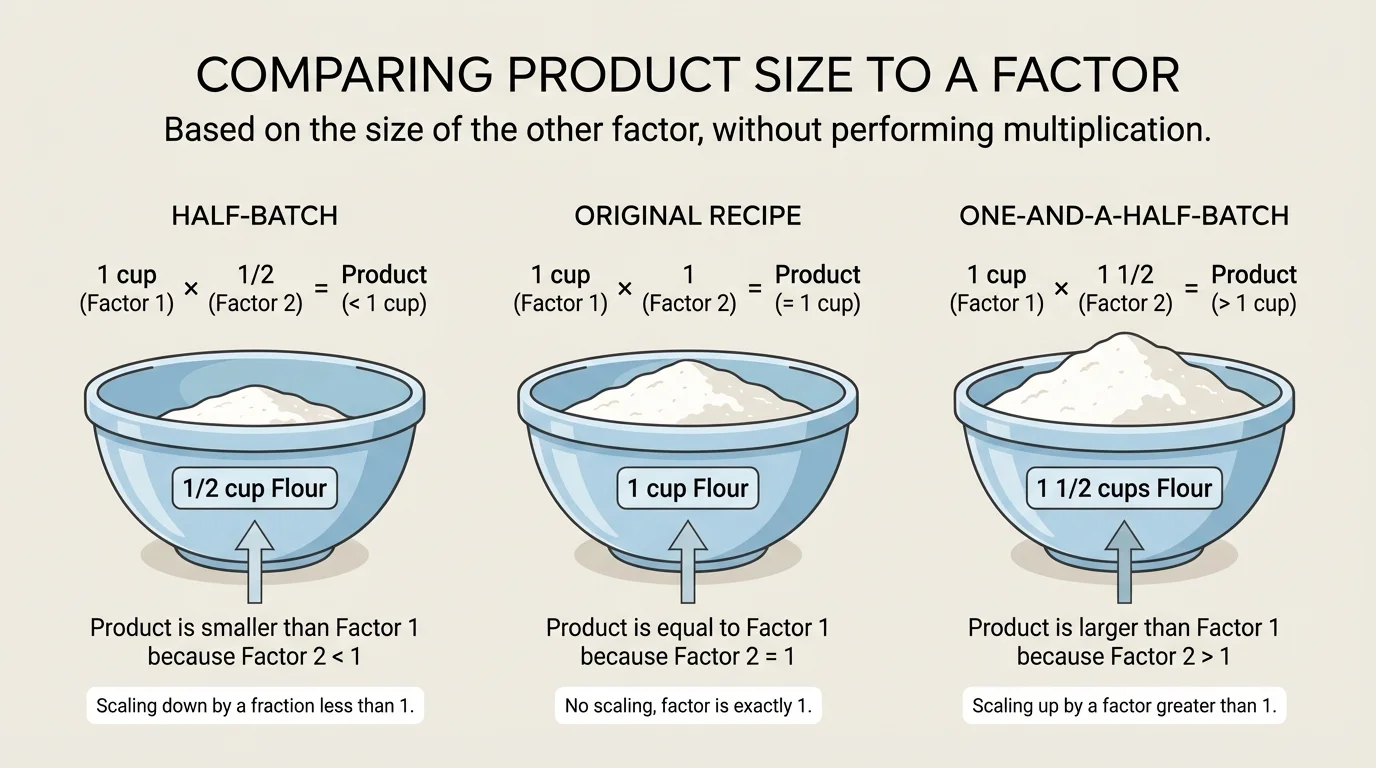
[Figure 3] Scaling appears in cooking, sports, shopping, maps, and technology. In a recipe, if you make half a batch, you multiply each ingredient by \(\dfrac{1}{2}\). That means each amount becomes smaller. If you make \(1\dfrac{1}{2}\) batches, each amount becomes larger.
Suppose a recipe uses \(2\) cups of flour. Without multiplying, you know that \(2 \times \dfrac{1}{2}\) is less than \(2\) cups, and \(2 \times 1\dfrac{1}{2}\) is greater than \(2\) cups.
Money gives another example. If a store gives a \(\dfrac{1}{4}\) discount, you are finding a fraction of the original price. The discount amount is less than the original price because \(\dfrac{1}{4} < 1\).
On a map, a scale can shrink real distances. If a drawing uses a scale factor less than \(1\), the picture is smaller than the actual object. If a model maker enlarges a tiny design by a factor greater than \(1\), the new model becomes larger. This is the same idea shown in [Figure 3], where one amount is reduced and another is enlarged.
In sports training, an athlete may run \(0.8\) of the usual distance on a light practice day. Since \(0.8 < 1\), the practice distance is less than the usual distance. On a harder training day, running \(1.2\) times the usual distance gives a longer workout because \(1.2 > 1\).
Here is the big pattern: the number \(1\) is the turning point. Factors greater than \(1\) enlarge. Factors equal to \(1\) keep the same size. Factors between \(0\) and \(1\) reduce.
This pattern works for whole numbers, fractions, mixed numbers, and decimals. For example, \(3\), \(\dfrac{9}{8}\), and \(1.4\) all make a quantity larger because each is greater than \(1\). The numbers \(1\), \(\dfrac{5}{5}\), and \(1.0\) keep a quantity the same. The numbers \(\dfrac{2}{3}\), \(\dfrac{7}{10}\), and \(0.25\) make a quantity smaller.
Once you understand this, you can reason quickly. For example, you know immediately that \(14 \times \dfrac{13}{10} > 14\), that \(14 \times \dfrac{10}{10} = 14\), and that \(14 \times \dfrac{3}{10} < 14\), even before doing any multiplication.
"To compare a product to one factor, look at the size of the other factor."
This idea is one of the most useful ways to think about multiplication with fractions. It turns multiplication into a question about size and helps you make smart predictions before calculating exact answers.
