If you have only \(\dfrac{1}{2}\) of a chocolate bar and need to share it fairly among \(3\) people, each person gets a very small piece. But if you have \(2\) cups of raisins and want to know how many \(\dfrac{1}{3}\)-cup servings you can make, the answer is much bigger than \(2\). That is the interesting part of fraction division: sometimes division makes the amount smaller, and sometimes it tells how many small groups fit, so the answer can be larger.
To solve these problems well, you need to notice what is being divided and what size group is being used. In this lesson, you will learn how to divide a fraction by a whole number and how to divide a whole number by a fraction of the form \(\dfrac{1}{n}\). You will use pictures, reasoning, and equations together.
A unit fraction is a fraction with \(1\) in the numerator, such as \(\dfrac{1}{2}\), \(\dfrac{1}{3}\), or \(\dfrac{1}{8}\). A whole number is a counting number such as \(1\), \(2\), \(3\), and so on.
Unit fraction means one part when a whole is split into equal parts. For example, \(\dfrac{1}{4}\) means one of \(4\) equal parts.
Division can mean either sharing equally or finding how many groups of a certain size fit into an amount.
These two meanings of division are both important. If \(\dfrac{1}{2}\) pound of chocolate is shared equally among \(3\) people, division means sharing equally. If \(2\) cups of raisins are packed into \(\dfrac{1}{3}\)-cup servings, division means counting groups.
[Figure 1] shows what happens when you divide a unit fraction by a whole number. You are taking a small amount and splitting it into even smaller equal parts. Here, \(\dfrac{1}{2}\) of a whole is first one large part, and then that part is shared equally among \(3\) people, creating pieces of size \(\dfrac{1}{6}\).
Think about the equation:
\[\frac{1}{2} \div 3 = \frac{1}{6}\]
Why does this make sense? One whole cut into \(2\) equal parts gives halves. If each half is then cut into \(3\) equal parts, the whole is now cut into \(2 \times 3 = 6\) equal parts. So each new piece is \(\dfrac{1}{6}\) of the whole.
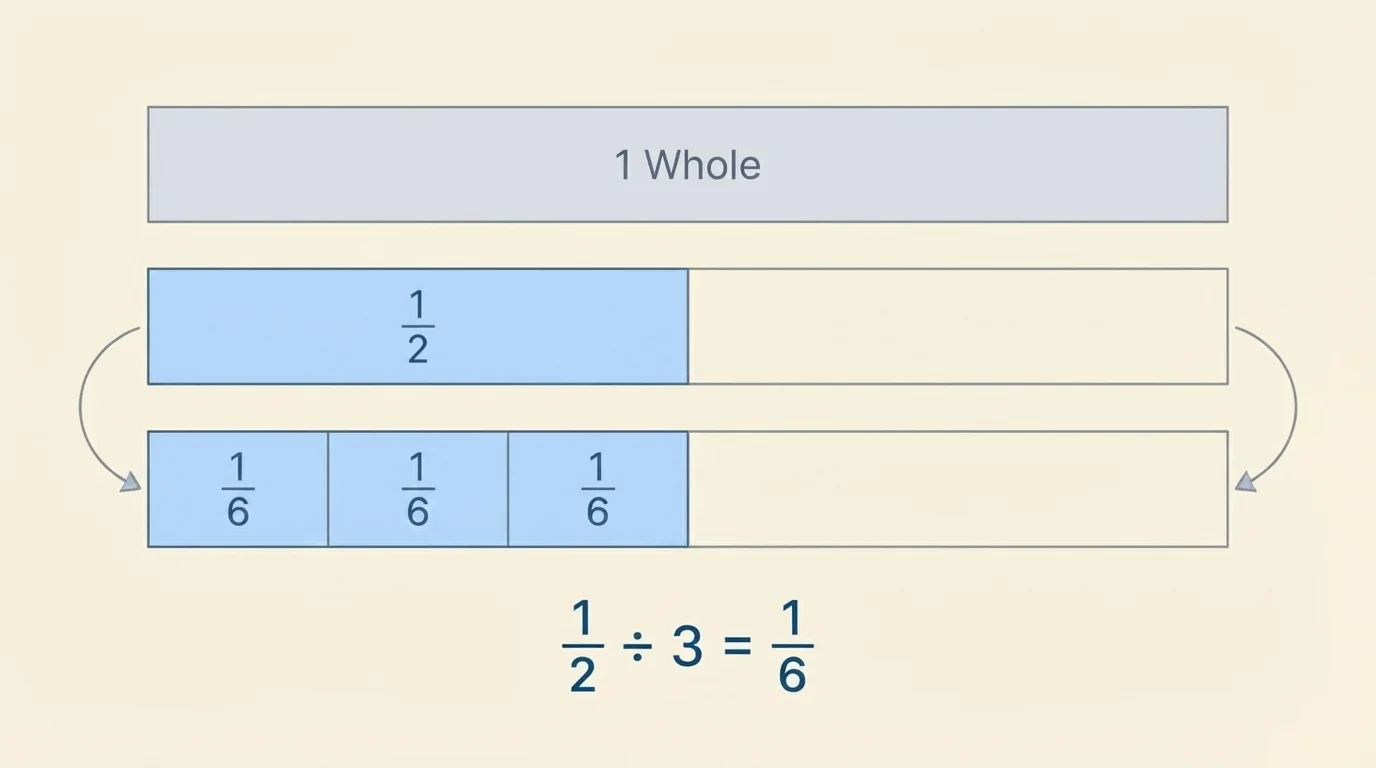
You can also reason with multiplication. If each person gets \(\dfrac{1}{6}\) pound and there are \(3\) people, then altogether they get \(3 \times \dfrac{1}{6} = \dfrac{3}{6} = \dfrac{1}{2}\) pound. That checks the answer.
A useful pattern appears here:
\[\frac{1}{n} \div k = \frac{1}{nk}\]
This means that dividing a unit fraction by a whole number makes the pieces smaller because the whole is partitioned into more equal parts.
[Figure 2] shows the opposite kind of problem. It is not asking how to share \(2\) cups equally. Instead, it asks how many groups of size \(\dfrac{1}{3}\) cup fit into \(2\) cups.
The equation is
\[2 \div \frac{1}{3} = 6\]
Why? Each whole cup contains \(3\) one-third-cup servings. So \(2\) cups contain \(2 \times 3 = 6\) servings of size \(\dfrac{1}{3}\).
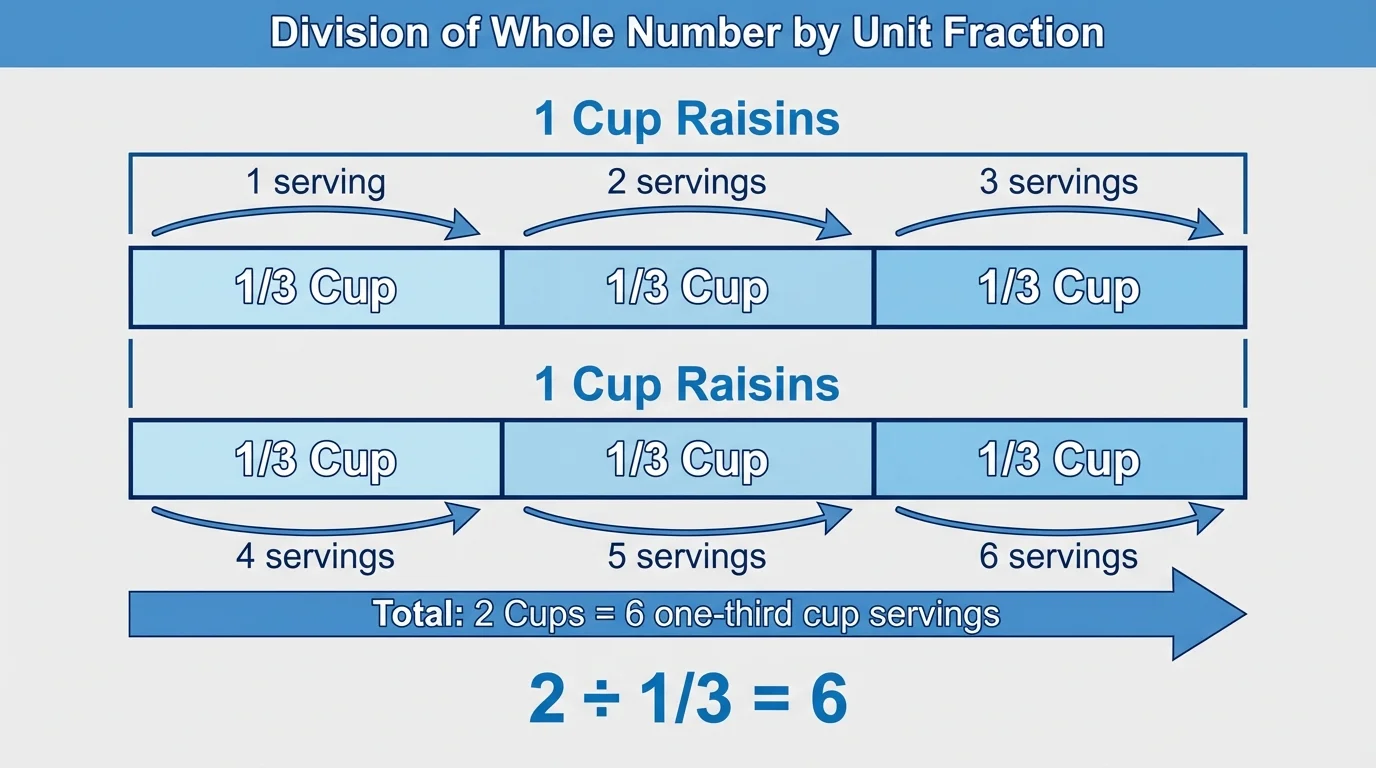
Notice how different this is from the earlier problem. Here, the answer is a whole number greater than \(2\) because you are counting many small groups inside a larger amount.
A pattern for this kind of problem is
\[m \div \frac{1}{n} = m \times n\]
For example, \(4 \div \dfrac{1}{2} = 8\), because there are \(8\) halves in \(4\) wholes. This idea connects division and multiplication.
Multiplication can check division. If \(a \div b = c\), then \(c \times b = a\). For example, if \(2 \div \dfrac{1}{3} = 6\), then \(6 \times \dfrac{1}{3} = 2\).
This check is very helpful, especially when the answer seems surprising. Many students first think \(2 \div \dfrac{1}{3}\) should be less than \(2\), but division does not always make numbers smaller. It depends on whether you are splitting into equal shares or counting groups of a certain size.
[Figure 3] introduces the two kinds of situations side by side. In one model, a fraction is being shared into smaller equal parts. In the other model, a whole number is being packed into unit-fraction-size groups.
Looking at the picture helps you decide what the division means before doing any calculation.
A fraction model is a picture that represents fractions. Common fraction models include strip models, area models, and number lines. For this topic, strip models are especially useful because you can easily see parts being split or counted.
Listen for clues in the wording. If a problem says shared equally among, it usually means you divide the amount into equal shares. If a problem says how many \(\dfrac{1}{n}\)-size servings or how many pieces of length \(\dfrac{1}{n}\), it usually means you count how many groups fit.
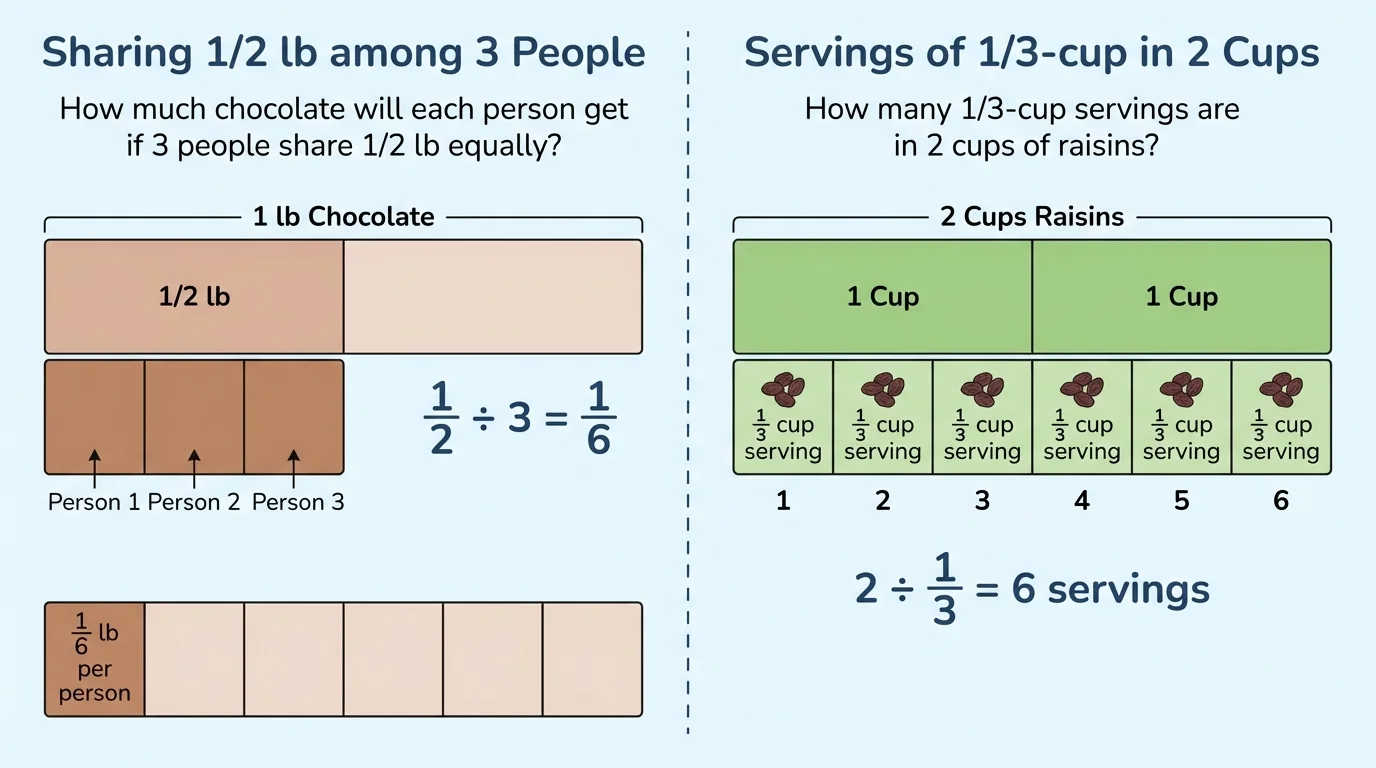
Later, when you solve more complicated fraction division, these models will still help. As seen earlier in [Figure 1], sharing a fraction among several people means partitioning the already-shaded part into smaller equal pieces. And as the bars in [Figure 2] display, dividing by a unit fraction means counting how many of those small pieces fill the amount.
Worked example 1
How much chocolate does each person get if \(3\) people share \(\dfrac{1}{2}\) pound of chocolate equally?
Step 1: Identify what is happening.
\(\dfrac{1}{2}\) pound is being shared equally among \(3\) people, so the equation is \(\dfrac{1}{2} \div 3\).
Step 2: Use a fraction model idea.
One whole split into \(2\) equal parts gives halves. Split that half into \(3\) equal parts. The whole is now split into \(6\) equal parts.
Step 3: Write the answer.
Each person gets \(\dfrac{1}{6}\) pound.
\[\frac{1}{2} \div 3 = \frac{1}{6}\]
Check: \(3 \times \dfrac{1}{6} = \dfrac{3}{6} = \dfrac{1}{2}\).
This example shows that sharing a fraction among several people makes even smaller fractions.
Worked example 2
How many \(\dfrac{1}{3}\)-cup servings are in \(2\) cups of raisins?
Step 1: Identify what is happening.
You are finding how many groups of size \(\dfrac{1}{3}\) cup fit into \(2\) cups, so the equation is \(2 \div \dfrac{1}{3}\).
Step 2: Reason with groups.
Each cup contains \(3\) groups of size \(\dfrac{1}{3}\). Therefore \(2\) cups contain \(2 \times 3 = 6\) such groups.
Step 3: Write the answer.
There are \(6\) servings.
\[2 \div \frac{1}{3} = 6\]
Check: \(6 \times \dfrac{1}{3} = 2\).
This is why dividing by a unit fraction can give a larger answer: many small servings fit inside the total amount.
Worked example 3
A ribbon \(\dfrac{1}{4}\) meter long is cut equally into \(2\) pieces. How long is each piece?
Step 1: Write the division expression.
The ribbon length is \(\dfrac{1}{4}\) meter, and it is shared into \(2\) equal pieces: \(\dfrac{1}{4} \div 2\).
Step 2: Reason with equal parts.
If one whole is split into \(4\) equal parts, each part is a fourth. Splitting each fourth into \(2\) equal pieces makes eighths.
Step 3: Solve.
Each piece is \(\dfrac{1}{8}\) meter long.
\[\frac{1}{4} \div 2 = \frac{1}{8}\]
Check: \(2 \times \dfrac{1}{8} = \dfrac{2}{8} = \dfrac{1}{4}\).
Length problems work the same way as food-sharing problems because division depends on the structure of the situation, not the object involved.
Worked example 4
How many \(\dfrac{1}{5}\)-mile laps are in \(3\) miles?
Step 1: Decide the meaning of division.
This asks how many groups of size \(\dfrac{1}{5}\) mile fit into \(3\) miles, so the expression is \(3 \div \dfrac{1}{5}\).
Step 2: Count unit fractions in each whole.
There are \(5\) one-fifth-mile laps in each mile. Therefore \(3\) miles have \(3 \times 5 = 15\) laps.
Step 3: State the answer.
There are \(15\) laps.
\[3 \div \frac{1}{5} = 15\]
Check: \(15 \times \dfrac{1}{5} = 3\).
Sports examples like this are good reminders that fractions are used to measure distance, time, and rate in everyday life.
There are two very important patterns to remember.
For dividing a unit fraction by a whole number:
\[\frac{1}{n} \div k = \frac{1}{nk}\]
For dividing a whole number by a unit fraction:
\[m \div \frac{1}{n} = mn\]
The first pattern makes sense because the pieces become smaller. The second pattern makes sense because you are counting many \(\dfrac{1}{n}\)-sized groups in each whole.
Why multiplication helps
Division and multiplication are related. If you are unsure about a division answer, multiply the answer by the divisor. If the result matches the starting amount, your answer is correct. This is especially useful when the divisor is a unit fraction and the quotient looks surprisingly large.
For example, if someone says \(4 \div \dfrac{1}{2} = 2\), check it: \(2 \times \dfrac{1}{2} = 1\), not \(4\). So that answer cannot be correct. The correct answer is \(8\), because \(8 \times \dfrac{1}{2} = 4\).
A recipe can quietly use both meanings of division. You might split \(\dfrac{1}{2}\) cup of frosting among \(4\) cupcakes, and also ask how many \(\dfrac{1}{4}\)-cup scoops fit into \(2\) cups of batter.
This is one reason cooking is such a good place to practice fractions. Measuring and sharing happen all the time.
Fraction division appears in many situations. In cooking, you may divide a small amount of ingredient among several dishes or count how many serving sizes fit in a container. In crafts, you might cut a short piece of fabric or ribbon into equal smaller pieces. In sports, you can count how many fractional laps fit in a race distance. In building or design, lengths are often measured in fractional units.
As [Figure 3] illustrates, the words in the problem guide your thinking. If the question asks for each share, you are usually dividing a quantity into equal parts. If the question asks how many servings or how many pieces, you are usually counting groups of a unit fraction.
| Situation | Expression | Meaning |
|---|---|---|
| Share \(\dfrac{1}{2}\) liter equally among \(4\) bottles | \(\dfrac{1}{2} \div 4\) | Find the size of each share |
| Find how many \(\dfrac{1}{4}\)-hour periods are in \(2\) hours | \(2 \div \dfrac{1}{4}\) | Count how many groups fit |
| Cut \(\dfrac{1}{3}\) meter of wire into \(2\) equal pieces | \(\dfrac{1}{3} \div 2\) | Find the size of each share |
| Find how many \(\dfrac{1}{2}\)-yard pieces are in \(5\) yards | \(5 \div \dfrac{1}{2}\) | Count how many groups fit |
Table 1. Examples showing the two meanings of division in real-world fraction problems.
One common mistake is answering the wrong question. For example, \(2 \div \dfrac{1}{3}\) is not asking for a third of \(2\). It is asking how many one-third groups fit into \(2\). That is why the answer is \(6\), not \(\dfrac{2}{3}\).
Another mistake is forgetting that the whole must stay the same in the visual model. In the chocolate problem, \(\dfrac{1}{2}\) means half of one whole chocolate bar. When that half is split into \(3\) equal parts, each piece is \(\dfrac{1}{6}\) of the original whole bar.
A third mistake is not checking with multiplication. If your division answer does not multiply back to the original amount, something went wrong.
Keep asking yourself two questions: Am I sharing equally? and Am I counting how many groups fit? Those questions help you choose the correct equation and explain your answer clearly.
