Here is a surprising geometry fact: a square is a rectangle. Many students first hear that and think, "Wait, how can that be?" But once you understand how shape categories work, it makes perfect sense. In geometry, shapes are grouped by their properties. If a smaller group of shapes fits all the rules of a larger group, then every shape in the smaller group also has the larger group's properties.
That idea is the heart of classifying two-dimensional figures. A shape is not named just by how it looks at first glance. It is named by its properties, such as the number of sides, whether sides are parallel, whether sides are equal in length, and whether angles are right angles. When we sort shapes this way, we can see important relationships between them.
When mathematicians classify shapes, they put shapes into groups that share important features. A large group can contain smaller groups inside it. For example, many different shapes belong to the group called polygons. Inside that group is a smaller group called quadrilaterals. Inside quadrilaterals are even smaller groups such as rectangles, rhombuses, squares, and trapezoids.
In geometry, a category is a group of figures that share certain properties. A subcategory is a smaller group inside a larger category. If every figure in the smaller group follows all the rules of the larger group, then the smaller group belongs inside it.
Category means a group of shapes that share certain properties.
Subcategory means a smaller group inside a larger category.
Property means a feature a shape has, such as having four sides, equal sides, parallel sides, or right angles.
This is like sorting books in a library. A book might belong to the category of nonfiction. Inside nonfiction, it might belong to the subcategory of science. Because it is a science book, it is still nonfiction. In the same way, if a square belongs to the rectangle group, then every property that all rectangles have must also be true for squares.
To classify shapes correctly, we need to use exact geometry words. A polygon is a closed two-dimensional figure made of straight line segments. A triangle is a polygon. A rectangle is a polygon. A circle is not a polygon because it has no straight sides.
A quadrilateral is a polygon with exactly four sides. Since it has four sides, it also has four angles. Not all quadrilaterals are the same. Some have right angles. Some have equal sides. Some have one pair of parallel sides, and some have two pairs.
Parallel sides are sides that stay the same distance apart and never meet, even if they are extended. A right angle is an angle that measures exactly \(90^\circ\).
A rectangle is a quadrilateral with four right angles. A rhombus is a quadrilateral with four equal sides. A square is a quadrilateral with four equal sides and four right angles. A trapezoid is usually defined in elementary geometry as a quadrilateral with at least one pair of parallel sides, though sometimes textbooks define it as exactly one pair. Your teacher or textbook may tell you which definition to use.
Remember that when we classify shapes, we look for properties that are always true. A shape does not stop being in a category just because it has extra properties too.
This last idea is very important. A rectangle must have four right angles. The definition does not say that its sides cannot all be equal. So if a shape has four right angles and also has four equal sides, it still fits the rectangle definition.
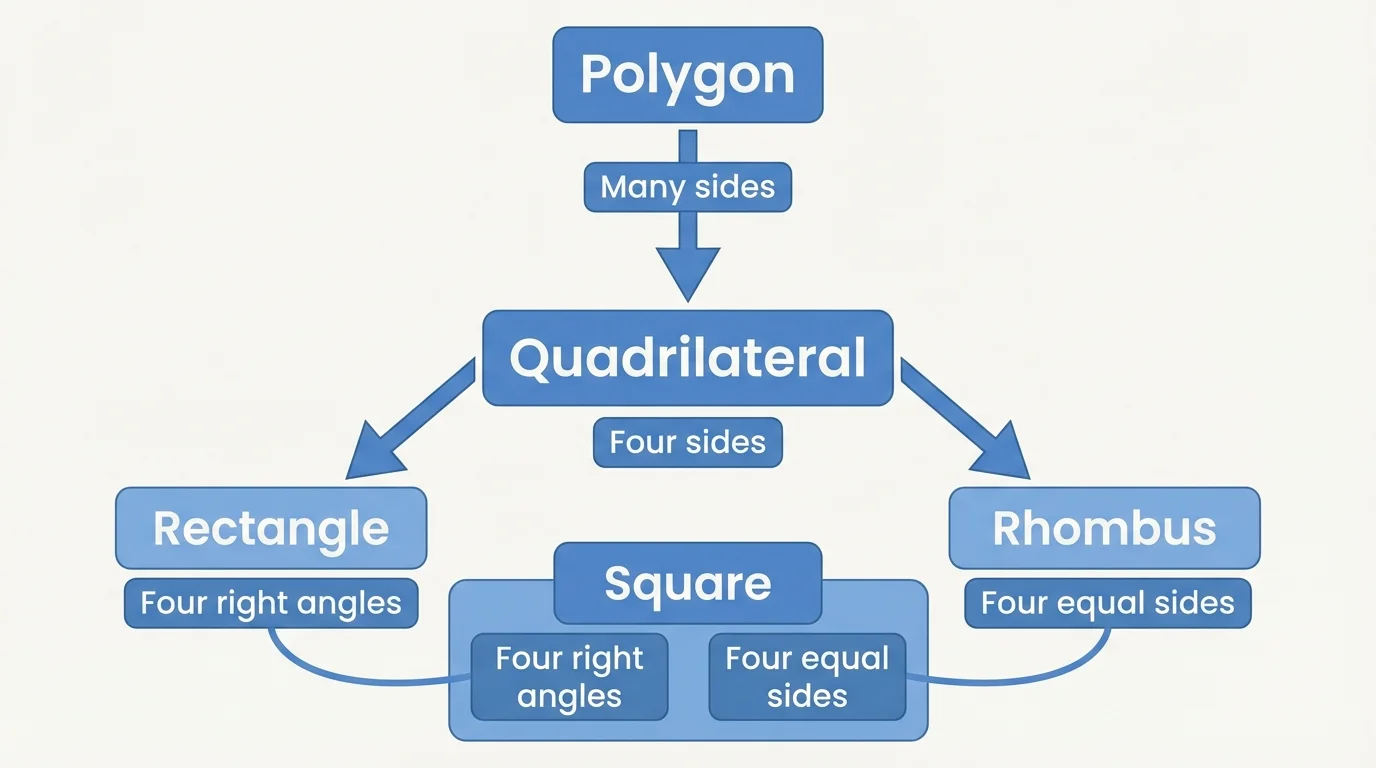
Geometry categories can be arranged like a family tree, as [Figure 1] shows. A polygon is a large category. Inside it is the subcategory of quadrilaterals. Inside quadrilaterals are groups like rectangles and rhombuses. Then inside both of those is the square category.
This means every square is automatically a quadrilateral and also automatically a polygon. It also means every rectangle is a quadrilateral and a polygon. The farther down you go into a subcategory, the more specific the rules become. But the earlier rules do not disappear. They still apply.
Think about it step by step. If a figure is a quadrilateral, then it has four sides. So every rectangle has four sides, because a rectangle is a quadrilateral. Every square also has four sides, because a square is a rectangle and a quadrilateral.
Now add another property. Every rectangle has four right angles. Since every square is a rectangle, every square has four right angles too. This means a square also has a property of a larger category. The square did not lose the rectangle property. It kept it.
We can write this chain of ideas in words:
If all rectangles have four right angles, and all squares are rectangles, then all squares have four right angles.
We can also reason this way with other properties. If all quadrilaterals have four sides, and all rectangles are quadrilaterals, then all rectangles have four sides. If all rectangles are quadrilaterals, and all squares are rectangles, then all squares are quadrilaterals.
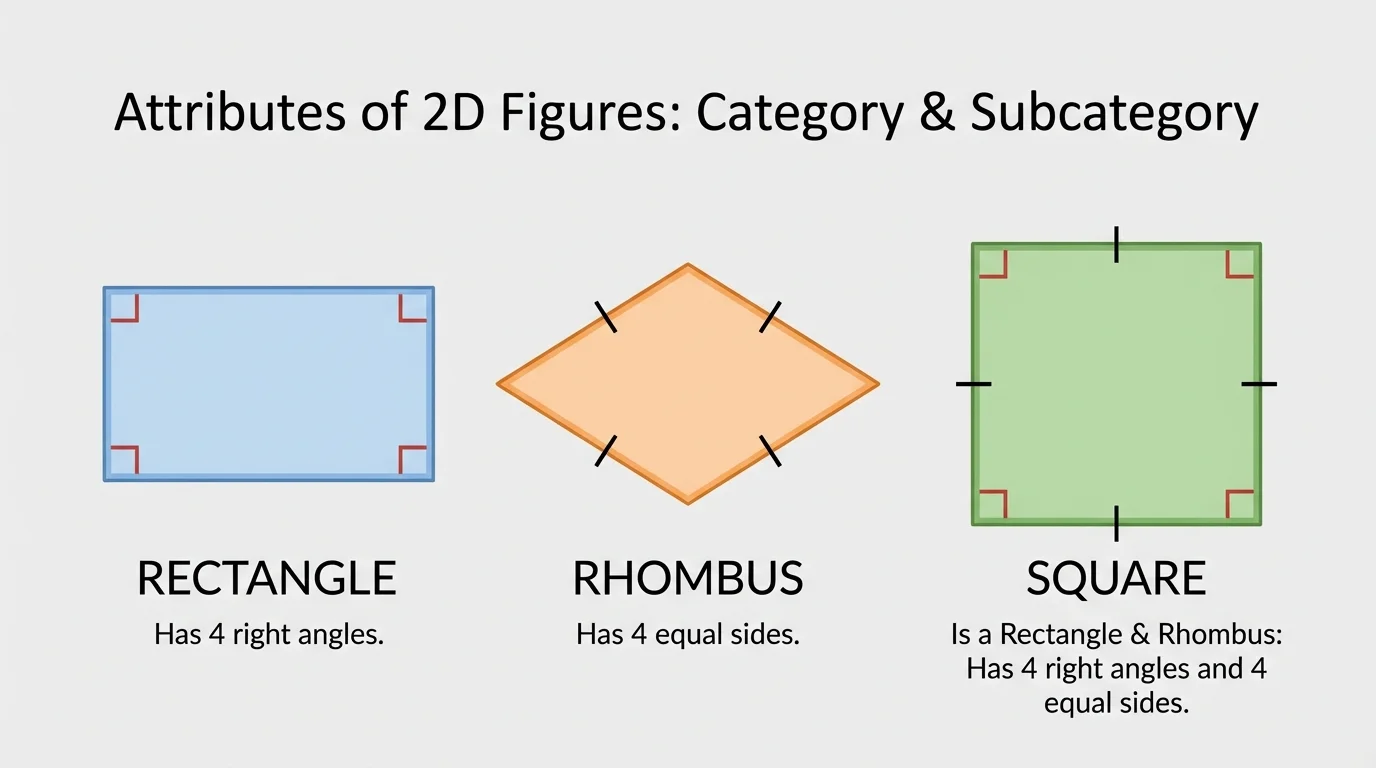
A square is especially interesting because it belongs to more than one subcategory at the same time, as [Figure 2] illustrates. A square is a rectangle because it has four right angles. A square is also a rhombus because it has four equal sides.
That means a square inherits properties from both categories. From rectangles, squares inherit four right angles and two pairs of parallel sides. From rhombuses, squares inherit four equal sides and two pairs of parallel sides. So a square combines both sets of properties.
This helps explain why geometry definitions can feel different from everyday language. In everyday speech, people may think of a rectangle as a shape that is longer than it is tall. But in geometry, the definition is based only on properties. If a shape has four right angles, it is a rectangle, even if all four sides are equal.
Here are some true statements:
Here are some statements that are not true:
The reason these are not true is that the larger category includes shapes that do not meet the extra rules of the smaller category. For example, a quadrilateral only needs four sides. It does not need four right angles. So some quadrilaterals are not rectangles.
How inherited properties work
When one category is inside another category, every figure in the smaller category must satisfy all the properties of the larger one. The smaller category may also add more rules. Those extra rules make the group smaller and more specific.
As we saw earlier in [Figure 1], categories stack on top of each other. That is why learning the definitions carefully matters so much. If you know the definitions, you can tell which properties must always be true.
Let's use the idea of categories and subcategories to solve some geometry questions.
Worked example 1
A shape is a square. Does it have four right angles? Explain.
Step 1: Identify a category the square belongs to.
A square is a rectangle.
Step 2: Recall a property of rectangles.
All rectangles have four right angles.
Step 3: Apply the property to the subcategory.
Because squares are rectangles, squares also have four right angles.
The answer is yes. Every square has four right angles.
This example shows a common pattern in geometry reasoning: identify the larger category, name a property of that category, and then apply it to the smaller category.
Worked example 2
A figure is a rectangle. Can you say for sure that it has four sides?
Step 1: Place the figure in a larger category.
Every rectangle is a quadrilateral.
Step 2: Use the quadrilateral definition.
Every quadrilateral has exactly four sides.
Step 3: State the conclusion.
Since a rectangle is a quadrilateral, it must have four sides.
The answer is yes. Every rectangle has four sides.
Notice that we did not need to measure the shape. The classification tells us the property.
Worked example 3
A shape has four sides. Is it definitely a rectangle?
Step 1: Identify what we know.
The shape is a quadrilateral because it has four sides.
Step 2: Ask whether that is enough for the rectangle definition.
A rectangle needs four right angles, not just four sides.
Step 3: Decide.
Knowing only that a shape has four sides is not enough to prove it is a rectangle.
The answer is no. It could be a rectangle, but it could also be another kind of quadrilateral.
This example is important because it reminds us that properties travel downward from larger groups to smaller groups, but not upward automatically. If every rectangle is a quadrilateral, that does not mean every quadrilateral is a rectangle.
Worked example 4
A figure is a square. Name two other categories it belongs to.
Step 1: Start with the square definition.
A square has four equal sides and four right angles.
Step 2: Match those properties to category definitions.
Because it has four right angles, it is a rectangle. Because it has four equal sides, it is a rhombus.
Step 3: Go to an even larger category.
Since rectangles and rhombuses are quadrilaterals, a square is also a quadrilateral.
Two possible answers are rectangle and rhombus. Another correct category is quadrilateral.
One common mistake is thinking that a shape can belong to only one category. But in geometry, one shape can belong to many categories at once. A square belongs to the square category, the rectangle category, the rhombus category, the quadrilateral category, and the polygon category.
Another common mistake is using everyday pictures instead of definitions. For example, if someone draws a long rectangle and a square side by side, students may think they must be different kinds of shapes. But geometry does not depend on what looks "usual." It depends on what is always true from the definition.
As shown earlier in [Figure 2], the square has both the rectangle property of four right angles and the rhombus property of four equal sides. That is why it fits into both groups.
A third mistake is mixing up "all" and "some." Here is the difference:
Those two statements are very different. The word all is strong. It means there are no exceptions.
| Statement | True or False | Why |
|---|---|---|
| All squares are rectangles. | True | Squares have four right angles, so they meet the rectangle definition. |
| All rectangles are squares. | False | A rectangle does not need four equal sides. |
| All rectangles are quadrilaterals. | True | Rectangles have four sides, so they are quadrilaterals. |
| All quadrilaterals are squares. | False | Most quadrilaterals do not have both four equal sides and four right angles. |
Table 1. True and false classification statements about quadrilaterals and their subcategories.
Many computer drawing programs and video games classify shapes by properties behind the scenes. Geometry rules help the software decide how shapes should be drawn, resized, or grouped.
You can test your thinking by asking, "What properties must this shape have because of its category?" That question helps you use logic instead of guessing.
Shape classification is not just for math class. It helps in design, building, and technology, as [Figure 3] shows with familiar objects. Floor tiles are often squares, which means they also have the properties of rectangles. Phone and tablet screens are usually rectangles, which means they are quadrilaterals with four right angles.
Architects and builders care about properties such as right angles and parallel sides because those properties help structures fit together correctly. If a window is a rectangle, workers know opposite sides are parallel and all four corners are right angles. If a tile is a square, they know it also has equal side lengths.
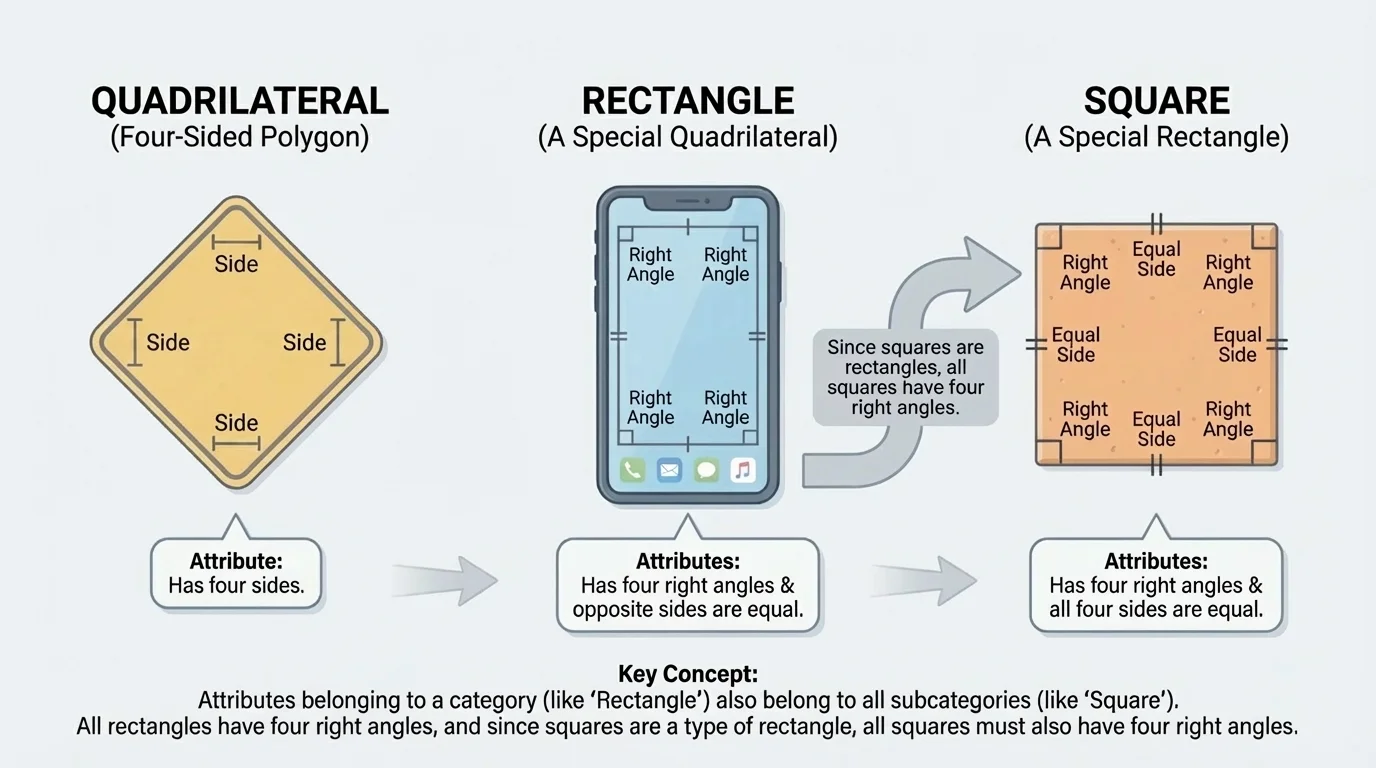
Sports also use these ideas. A basketball backboard is a rectangle. A chessboard is a square, so it is also a rectangle. The markings on courts and fields depend on correct shape properties. Knowing the category helps people know what measurements and angles are needed.
Later, when you study more geometry, you will keep using this kind of classification logic. The same idea appears again and again: if a figure belongs to a subcategory, then it keeps all the properties of the larger category. That is why definitions are so powerful.
When you look back at the examples from [Figure 1] and the everyday objects in [Figure 3], the big idea becomes clear. Geometry is not just about naming shapes. It is about understanding how their properties connect.
