What if you had \(3\) brownies and \(4\) friends wanted to share them equally? You cannot give each friend a whole brownie, but you can still share fairly. This is where fractions become powerful: a fraction is not just a piece of something. A fraction can also be the answer to a division problem.
When we write \(\dfrac{3}{4}\), we can read it as "three fourths," but we can also think of it as "\(3\) divided by \(4\)." That idea helps us solve many real-life sharing problems. It connects fractions, division, equal groups, and fair sharing all in one picture.
Fraction as division means that when the denominator is not \(0\), the fraction \(\dfrac{a}{b}\) is equal to the division problem \(a \div b\).
Numerator is the top number. It tells how many wholes or parts are being divided.
Denominator is the bottom number. It tells how many equal groups or equal shares are being made.
Mixed number is a number written with a whole number and a fraction, such as \(2\dfrac{1}{3}\).
A fraction can describe part of a whole, but it can also describe the result of dividing. The key relationship is
\[\frac{a}{b} = a \div b\]
This means \(\dfrac{3}{4} = 3 \div 4\), \(\dfrac{5}{2} = 5 \div 2\), and \(\dfrac{9}{10} = 9 \div 10\).
We can check this idea with multiplication. If \(\dfrac{3}{4}\) is the answer to \(3 \div 4\), then multiplying that answer by \(4\) should give back \(3\):
\[\frac{3}{4} \times 4 = 3\]
That works because division and multiplication are related. If \(a \div b = c\), then \(c \times b = a\).
This is especially useful in sharing problems. If \(3\) wholes are shared equally among \(4\) people, each person gets \(\dfrac{3}{4}\) of a whole. The total amount is \(3\), the number of equal shares is \(4\), and one share is \(\dfrac{3}{4}\).
In equal-sharing situations, the top and bottom numbers have clear jobs. The numerator tells how much is being shared. The denominator tells how many equal shares are made.
For example, in \(\dfrac{8}{3}\), the \(8\) means \(8\) wholes or units are being shared, and the \(3\) means the sharing is among \(3\) equal groups or \(3\) people.
This helps with meaning. If \(2\) pizzas are shared by \(8\) people, each share is \(\dfrac{2}{8}\), which is also \(\dfrac{1}{4}\). If \(8\) pizzas are shared by \(2\) people, each share is \(\dfrac{8}{2} = 4\). The same numbers give very different answers because the roles of the numerator and denominator are different.
You already know that division can mean equal sharing or equal grouping. In this lesson, we focus on equal sharing: one total amount is split into a certain number of equal shares.
Visual models make this idea much easier to understand. In [Figure 1], the whole amounts are split into equal parts, and one person's share takes one equal part from each whole. This shows why sharing \(3\) wholes among \(4\) people gives each person \(\dfrac{3}{4}\).
Think of \(3\) identical bars. Split each bar into \(4\) equal pieces. Now there are \(12\) fourth-size pieces in all. If \(4\) people share equally, each person gets \(3\) of those fourth-size pieces. So each person gets \(\dfrac{3}{4}\) of a bar.
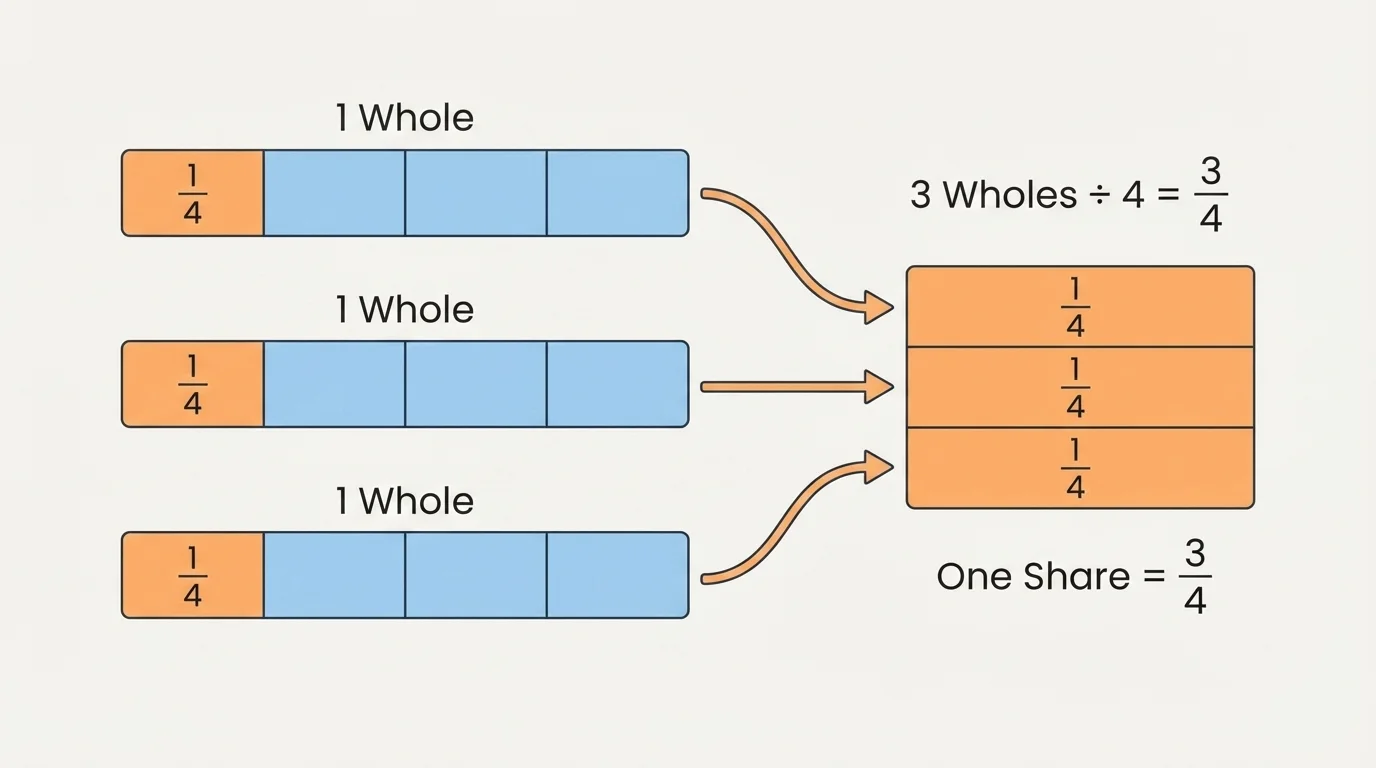
A model like this shows something important: the answer to a division problem does not always have to be a whole number. Sometimes the answer is a fraction because the wholes are cut into equal parts.
Models also help us see whether the answer should be less than \(1\) or greater than \(1\). If the number being shared is smaller than the number of shares, then each share is less than \(1\). That is what happens with \(3 \div 4 = \dfrac{3}{4}\).
How to read a sharing problem
Ask two questions: How much is being shared? and How many equal shares are there? Then write a division equation. The quotient is the size of one share. If needed, write the quotient as a fraction or a mixed number.
This classic example shows exactly how fractions and division connect.
Worked example
Three whole pies are shared equally among four people. How much pie does each person get?
Step 1: Write the division equation.
The amount shared is \(3\) pies, and the number of people is \(4\).
\(3 \div 4\)
Step 2: Write the quotient as a fraction.
\(3 \div 4 = \dfrac{3}{4}\)
Step 3: Explain the meaning.
Each person gets \(\dfrac{3}{4}\) of a pie.
Step 4: Check with multiplication.
\(\dfrac{3}{4} \times 4 = 3\)
The fair share is
\[\frac{3}{4}\]
Because \(3\) pies are being shared among more people than pies, each person gets less than \(1\) whole pie. The pieces from the three pies combine into a share of size \(\dfrac{3}{4}\).
Sometimes the amount being shared is larger than the number of people. Then each share can be greater than \(1\). [Figure 2] makes it easier to see why the answer here is more than \(2\) but less than \(3\).
If \(7\) sandwiches are shared equally among \(3\) friends, each friend gets \(7 \div 3\).
Worked example
Seven sandwiches are shared equally among three friends. How much does each friend get?
Step 1: Write the division problem.
\(7 \div 3\)
Step 2: Write the quotient as a fraction.
\(7 \div 3 = \dfrac{7}{3}\)
Step 3: Change the improper fraction to a mixed number.
Since \(3\) goes into \(7\) two whole times with \(1\) left over, \(\dfrac{7}{3} = 2\dfrac{1}{3}\).
Step 4: Check the answer.
\(2\dfrac{1}{3} \times 3 = 7\)
Each friend gets
\[2\frac{1}{3}\]
Another way to think about it is this: first give each friend \(2\) whole sandwiches. That uses \(6\) sandwiches. One sandwich remains, and that last sandwich is divided into \(3\) equal parts. So each friend gets \(2\) wholes and \(\dfrac{1}{3}\) more.
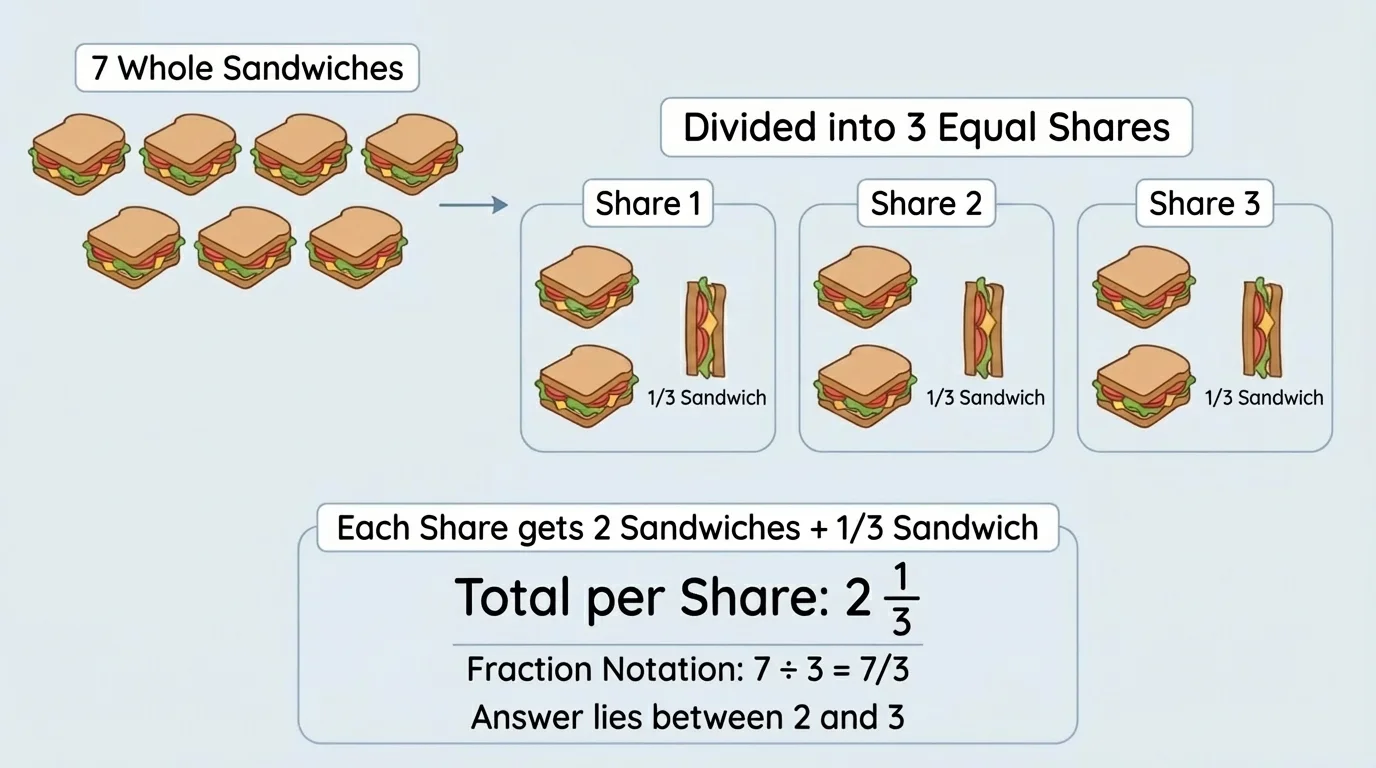
The fraction \(\dfrac{7}{3}\) is called an improper fraction because the numerator is greater than the denominator. That does not mean it is wrong. It simply means the value is greater than \(1\).
Now consider a real situation. In [Figure 3], a \(50\)-pound sack of rice is shared equally among \(9\) people. The size of one share is \(50 \div 9\). The model helps show both the equal-sharing idea and where the answer lands between two whole numbers.
Worked example
Nine people want to share a \(50\)-pound sack of rice equally by weight. How many pounds of rice should each person get? Between what two whole numbers does the answer lie?
Step 1: Write the division equation.
The total amount is \(50\) pounds and the number of equal shares is \(9\).
\(50 \div 9\)
Step 2: Write the quotient as a fraction.
\(50 \div 9 = \dfrac{50}{9}\)
Step 3: Change to a mixed number.
Since \(9 \times 5 = 45\), each person gets \(5\) whole pounds, with \(5\) pounds left over to share.
\(\dfrac{50}{9} = 5\dfrac{5}{9}\)
Step 4: Decide which whole numbers the answer is between.
Because \(5\dfrac{5}{9}\) is greater than \(5\) and less than \(6\), it lies between \(5\) and \(6\).
Each person gets
\[5\frac{5}{9} \textrm{ pounds}\]
The answer lies between
\[5 \textrm{ and } 6\]
We can compare nearby fractions to understand this. Since \(\dfrac{45}{9} = 5\) and \(\dfrac{54}{9} = 6\), the fraction \(\dfrac{50}{9}\) must be between \(5\) and \(6\).
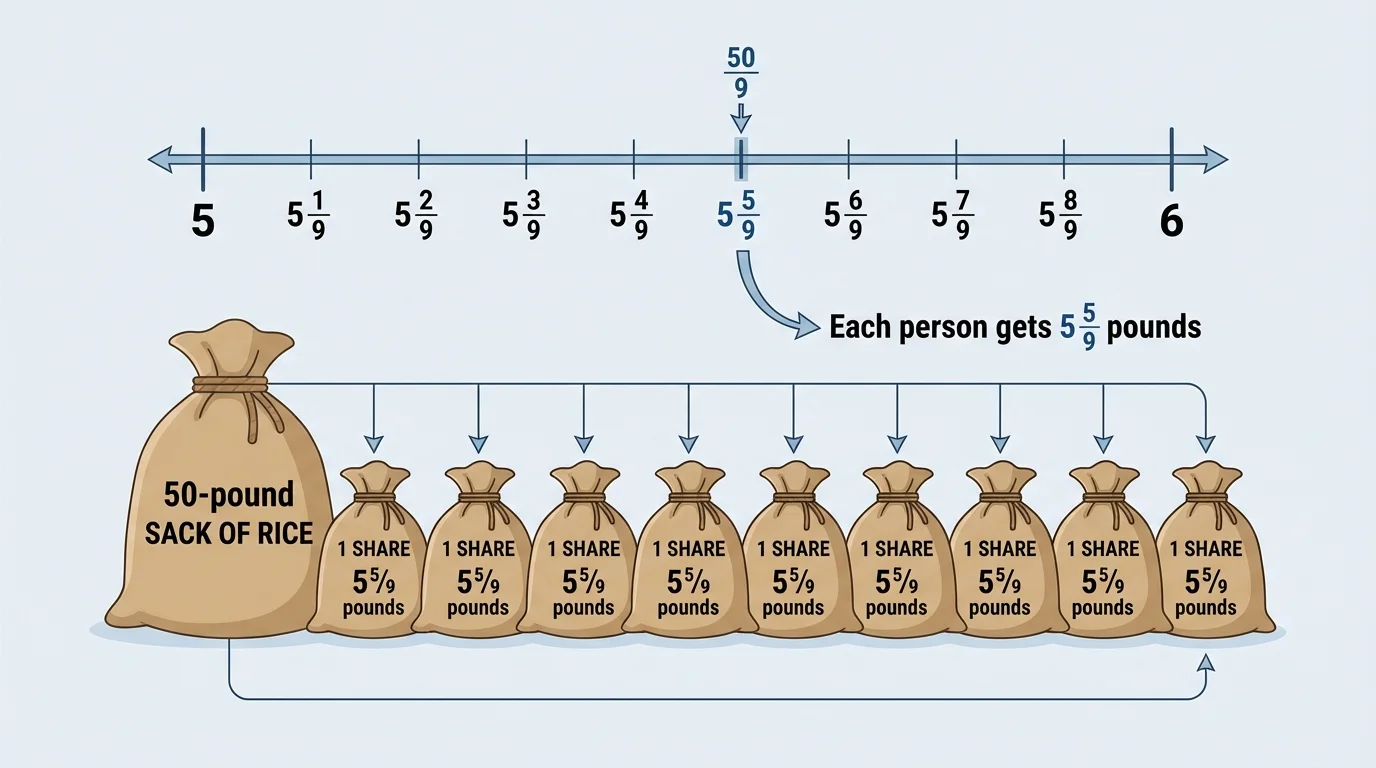
This kind of thinking is useful whenever you need to know whether an answer is reasonable. Later, when checking estimates, we can see that \(5\dfrac{5}{9}\) makes sense because it is only a little more than \(5\).
A division problem can give an answer that is less than \(1\), equal to \(1\), or greater than \(1\).
| Division problem | Fraction form | Value |
|---|---|---|
| \(3 \div 4\) | \(\dfrac{3}{4}\) | Less than \(1\) |
| \(5 \div 5\) | \(\dfrac{5}{5}\) | Equal to \(1\) |
| \(7 \div 3\) | \(\dfrac{7}{3}\) | Greater than \(1\) |
| \(50 \div 9\) | \(\dfrac{50}{9}\) | Greater than \(1\) |
Table 1. Examples showing how division answers can be less than, equal to, or greater than one.
When the numerator is smaller than the denominator, the fraction is less than \(1\). When the numerator equals the denominator, the fraction equals \(1\). When the numerator is larger than the denominator, the fraction is greater than \(1\), and it can often be written as a mixed number.
Recipes, sports statistics, and building projects often use answers that are fractions or mixed numbers because real-life sharing and measuring do not always come out to whole numbers.
Many word problems can be solved with the same simple plan. Read carefully, decide what is being shared, decide how many equal shares are needed, then write a division equation.
Here are some examples:
If \(4\) liters of juice are poured equally into \(5\) bottles, each bottle gets \(4 \div 5 = \dfrac{4}{5}\) liter.
If \(11\) meters of ribbon are cut equally into \(4\) pieces, each piece is \(11 \div 4 = \dfrac{11}{4} = 2\dfrac{3}{4}\) meters long.
If \(6\) pounds of trail mix are shared equally among \(8\) hikers, each hiker gets \(6 \div 8 = \dfrac{6}{8} = \dfrac{3}{4}\) pound.
Notice that the equation tells the story. The first number is the total amount. The second number is the number of equal shares.
Worked example
Twelve feet of rope are cut into five equal pieces. How long is each piece?
Step 1: Identify the total and the number of equal parts.
Total rope: \(12\) feet. Number of pieces: \(5\).
Step 2: Write the division equation.
\(12 \div 5\)
Step 3: Write the answer as a fraction and mixed number.
\(12 \div 5 = \dfrac{12}{5} = 2\dfrac{2}{5}\)
Step 4: State the answer with units.
Each piece is \(2\dfrac{2}{5}\) feet long.
The length of each piece is
\[2\frac{2}{5} \textrm{ feet}\]
One common mistake is reversing the numbers. If \(3\) pizzas are shared among \(4\) people, the correct expression is \(3 \div 4 = \dfrac{3}{4}\), not \(\dfrac{4}{3}\). The total amount goes on top, and the number of shares goes on the bottom.
Another mistake is thinking division always makes numbers smaller. Division by a number greater than \(1\) often makes the answer smaller, but in fraction form the result can still be greater than \(1\) if the amount being shared is large enough. For example, \(7 \div 3 = 2\dfrac{1}{3}\).
A third mistake is forgetting to ask whether the answer makes sense. If \(50\) pounds of rice are shared among \(9\) people, an answer of \(\dfrac{9}{50}\) pound per person would be far too small. Since \(50\) is much larger than \(9\), each share should be more than \(1\) pound.
Fractions as division appear in many everyday situations. When friends split food, when a coach divides playing time, when a gardener shares soil among planters, or when a builder cuts lumber into equal lengths, division can lead to fraction answers.
Suppose a class has \(5\) liters of paint for \(8\) mural panels. Each panel gets \(\dfrac{5}{8}\) liter. Suppose \(13\) miles of hiking trail are divided into \(6\) equal practice sections. Each section is \(\dfrac{13}{6} = 2\dfrac{1}{6}\) miles long.
These problems all use the same big idea: equal sharing leads to division, and division can be written as a fraction.
"A fraction is not only a part of a whole; it is also a division answer waiting to be understood."
Once you see a fraction as a division problem, many word problems become easier. You can move between a story, an equation, a model, and a final answer. That flexibility is what makes fractions so useful in mathematics.
