Sometimes the trickiest math ideas come from very ordinary moments: sharing food, pouring juice, or cutting ribbon. If you have only \(1/3\) of a sandwich left and you want to share that amount equally among \(4\) people, each person gets a very tiny piece. How tiny? That question leads directly to a powerful fraction idea: dividing a unit fraction by a whole number.
When we divide a unit fraction by a non-zero whole number, we are taking one small part of a whole and splitting it into even smaller equal parts. A unit fraction is a fraction with \(1\) in the numerator, such as \(1/2\), \(1/3\), \(1/5\), or \(1/10\).
For example, \((1/2) \div 3\) means: take \(1/2\) of something and share that half equally among \(3\) groups or \(3\) people. The answer must be smaller than \(1/2\), because we are breaking one piece into more pieces.
Unit fraction: a fraction with numerator \(1\), such as \(1/4\) or \(1/9\).
Quotient: the answer to a division problem.
Visual fraction model: a picture, strip, area model, or number line used to show fractions and fraction operations.
Division here does not mean "how many times does one number fit into another?" in the way you may use with whole numbers. Instead, it often means equal sharing. We start with a fraction and split it into a certain number of equal parts.
A non-zero whole number is a whole number greater than \(0\), such as \(1, 2, 3, 4\), or \(10\). We do not divide by \(0\), because division by \(0\) is not defined.
It is also important to notice what changes when we divide a unit fraction by a whole number. The pieces get smaller, not larger. So if you begin with \(1/6\) and divide it by \(2\), the result must be less than \(1/6\).
You already know that multiplying by a whole number can mean adding equal groups. Division is closely connected: it can mean splitting something into equal groups. That same idea works with fractions too.
This is why checking whether an answer makes sense matters. If someone says \((1/4) \div 2 = 2/4\), we can tell it is wrong right away, because \(2/4\) is larger than \(1/4\). Dividing a positive amount into equal parts should make each part smaller.
A story makes the meaning clearer. Suppose a granola bar is cut into \(3\) equal parts. Only \(1\) of those parts is left, so the leftover amount is \(1/3\) of the whole bar. Now \(4\) friends want to share that leftover \(1/3\) equally.
As shown in [Figure 1], the division expression for that situation is \((1/3) \div 4\). We are not dividing the whole bar by \(4\). We are dividing only the leftover \(1/3\) by \(4\). Each friend gets one of the \(4\) equal pieces made from that third.
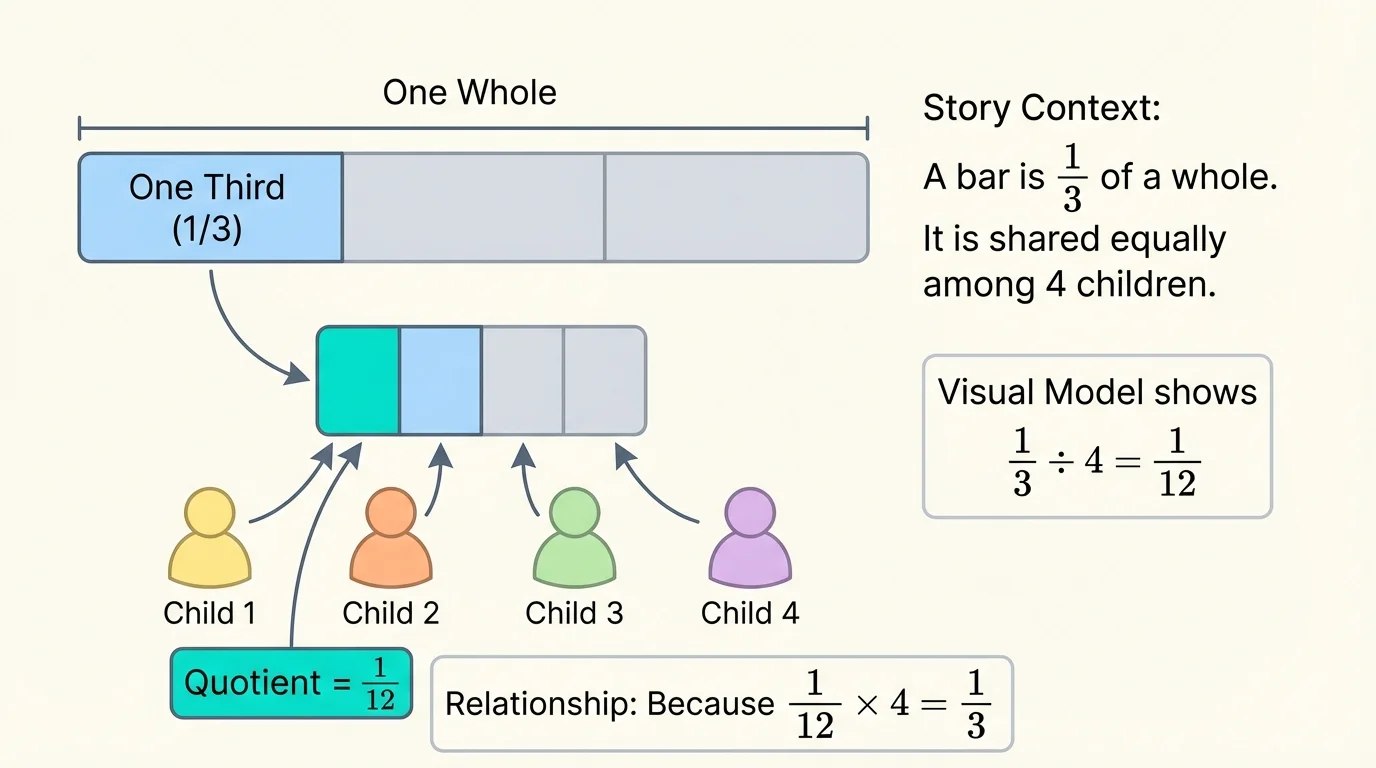
So what fraction of the whole bar does each friend get? Since one third is split into \(4\) equal parts, each part is \(1/12\) of the whole.
This makes sense because the whole bar can be thought of as cut into \(12\) equal pieces. One third of the bar is the same as \(4/12\). If that \(4/12\) is shared equally among \(4\) friends, each friend gets \(1/12\).
A visual fraction model helps us see why the answer to \((1/3) \div 4\) is \(1/12\). Start with one whole rectangle. First, divide the rectangle into \(3\) equal parts to show thirds.
As shown in [Figure 2], next, focus on one of those thirds. Now divide that one third into \(4\) equal smaller parts. Since each third is split into \(4\) pieces, the whole rectangle now has \(3 \times 4 = 12\) equal pieces.
Each small piece is one out of \(12\) equal pieces of the whole, so each one is \(1/12\). That means
\[(1/3) \div 4 = 1/12\]
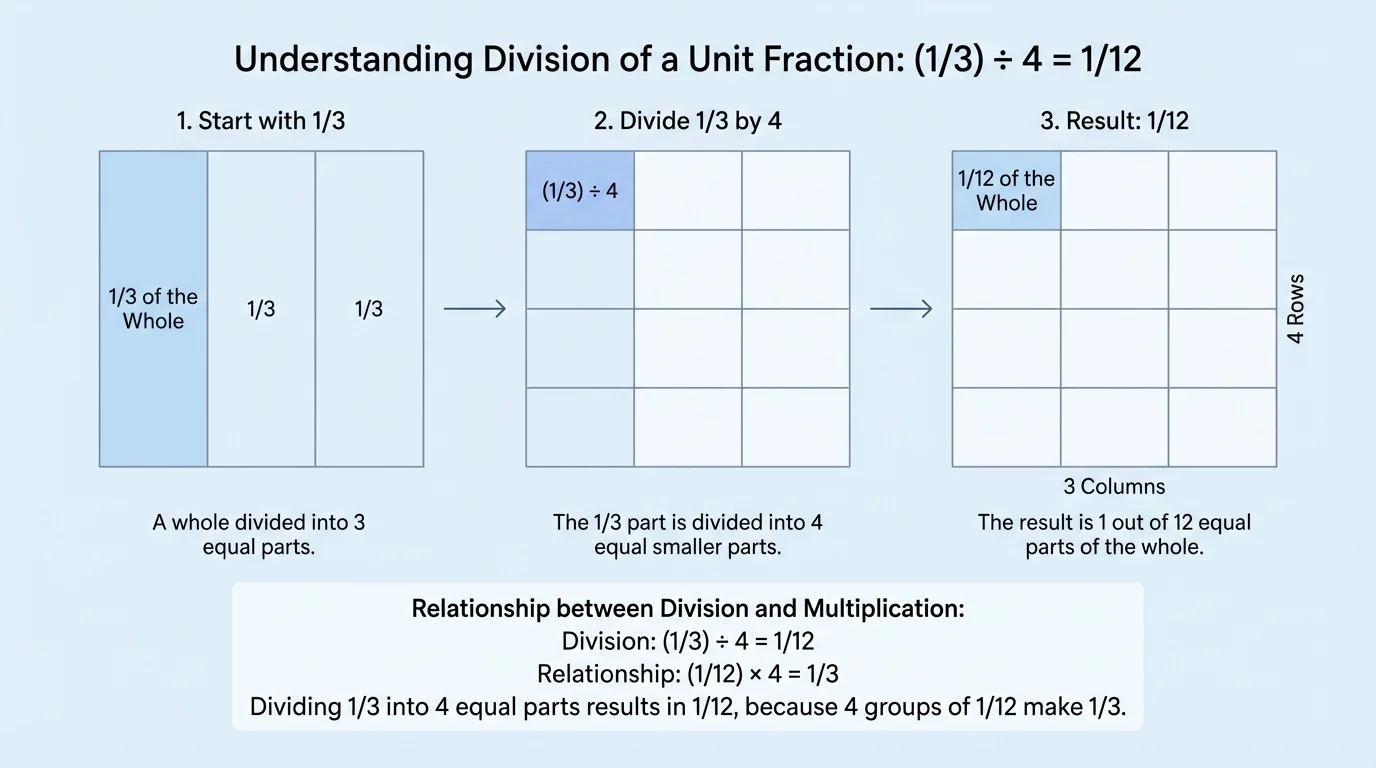
The model is powerful because it shows two ideas at once: the starting amount is \(1/3\), and the division by \(4\) means breaking that third into \(4\) equal pieces. Later, when you see a similar problem, you can picture the same kind of partitioning.
Notice something interesting. The denominator changes from \(3\) to \(12\). That happens because the original \(3\) equal parts are each split into \(4\) more equal parts, making \(3 \times 4 = 12\) equal parts in all.
How the denominator changes
For a unit fraction such as \(1/n\), dividing by a whole number \(k\) means splitting each fractional piece into \(k\) smaller equal pieces. That creates \(n \times k\) equal parts in the whole, so \((1/n) \div k = 1/(n \times k)\).
This rule is not magic. It comes directly from the picture. The whole is first split into \(n\) equal parts, and then each of those parts is split into \(k\) equal parts.
Division and multiplication are connected. If \((1/3) \div 4 = 1/12\), then multiplying the answer by \(4\) should return the starting amount.
As shown in [Figure 3], let us check:
\[(1/12) \times 4 = 4/12 = 1/3\]
Because \((1/12) \times 4 = 1/3\), we know that
\[(1/3) \div 4 = 1/12\]
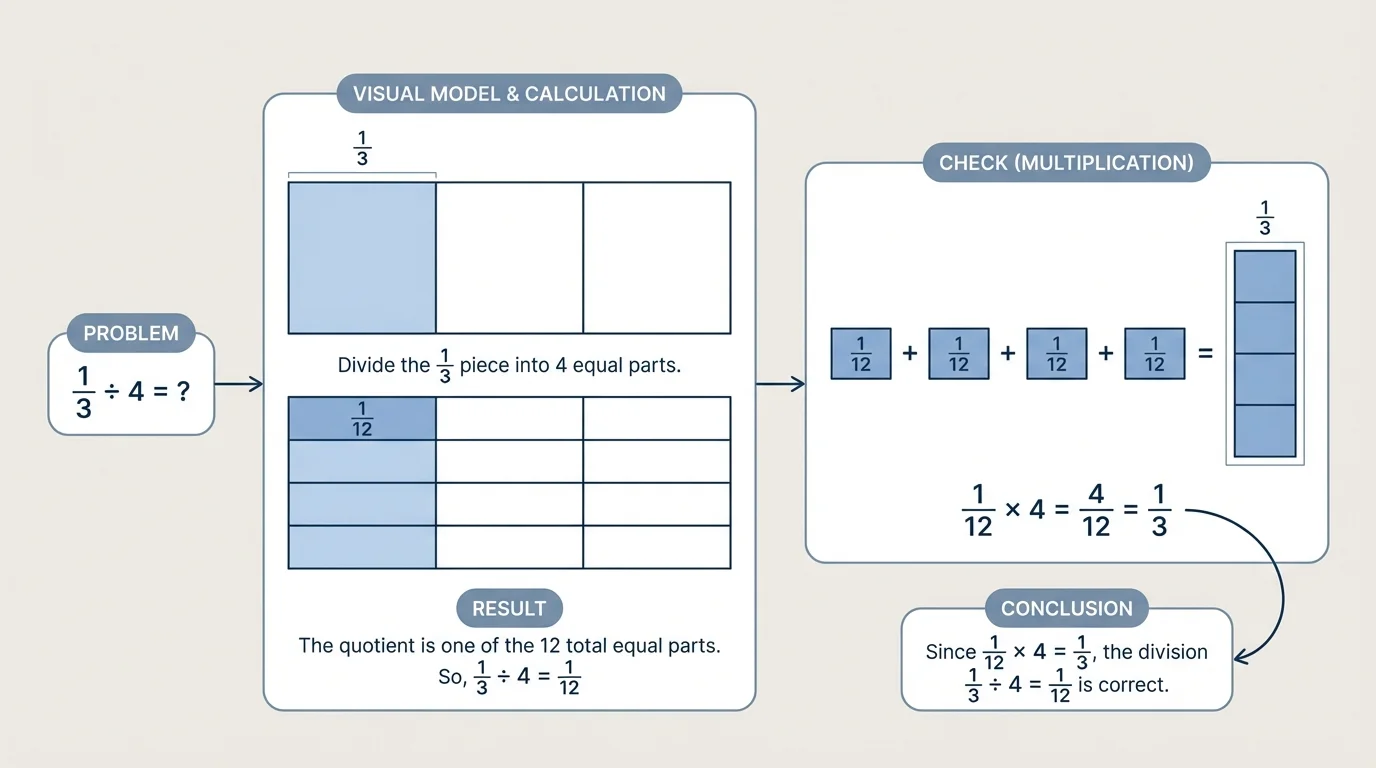
This multiplication check is very useful. It helps you prove that your quotient is correct instead of just guessing from a pattern.
Think of it this way: division asks, "What number times \(4\) gives \(1/3\)?" The answer is \(1/12\). That is the inverse relationship between division and multiplication.
Fractions often look smaller and harder to work with than whole numbers, but pictures can make them easier. In many cases, one well-drawn model tells the whole story of the operation.
Now let us solve several examples step by step.
Worked example 1
Find \((1/2) \div 3\).
Step 1: Interpret the division.
This means take \(1/2\) of a whole and share it equally among \(3\) groups.
Step 2: Think about the whole.
The whole is split into \(2\) equal parts first. Then the half is split into \(3\) equal parts. That makes \(2 \times 3 = 6\) equal parts in the whole.
Step 3: Write the quotient.
Each part is \(1/6\).
So, \[(1/2) \div 3 = 1/6\]
Check: \((1/6) \times 3 = 3/6 = 1/2\).
This example follows the same idea as the thirds example. For the same whole, a larger denominator means smaller pieces.
Worked example 2
Find \((1/5) \div 2\).
Step 1: Interpret the problem.
Take \(1/5\) of a whole and split it into \(2\) equal parts.
Step 2: Find how many equal parts are in the whole now.
The whole had \(5\) equal parts. Splitting each fifth into \(2\) smaller equal pieces gives \(5 \times 2 = 10\) equal parts.
Step 3: State the answer.
Each small part is \(1/10\).
So, \[(1/5) \div 2 = 1/10\]
Check: \((1/10) \times 2 = 2/10 = 1/5\).
The check confirms the answer and shows the multiplication-division relationship again.
Worked example 3
Find \((1/8) \div 4\).
Step 1: Start with the unit fraction.
The whole is split into \(8\) equal parts, and we take one of them.
Step 2: Divide that one eighth into \(4\) equal pieces.
Now the whole has \(8 \times 4 = 32\) equal parts.
Step 3: Write the quotient.
Each piece is \(1/32\).
So, \[(1/8) \div 4 = 1/32\]
Check: \((1/32) \times 4 = 4/32 = 1/8\).
Even though \(1/32\) seems tiny, it makes sense. Dividing an eighth into \(4\) pieces must give something smaller than an eighth.
Worked example 4
Find \((1/10) \div 5\).
Step 1: Multiply the denominator by the whole number divisor.
\(10 \times 5 = 50\).
Step 2: Write the new unit fraction.
The quotient is \(1/50\).
Step 3: Check with multiplication.
\((1/50) \times 5 = 5/50 = 1/10\).
So, \[(1/10) \div 5 = 1/50\]
By now, a pattern should be appearing clearly.
When you divide a unit fraction by a whole number, you can multiply the denominator by that whole number:
\[(1/n) \div k = 1/(n \times k)\]
Here, \(n\) is the original denominator, and \(k\) is the non-zero whole number you are dividing by.
For example:
The reason this works is the same one we saw in [Figure 2]: each original fraction part gets split into more equal pieces. More equal parts in the whole means smaller pieces.
You can also explain it using multiplication, as in [Figure 3]. If \((1/n) \div k = 1/(n \times k)\), then multiplying back by \(k\) gives
\[(1/(n \times k)) \times k = 1/n\]
That is exactly what division should do.
One common mistake is to divide the denominator instead of multiplying it. For example, someone might think \((1/6) \div 3 = 1/2\). But that cannot be true, because \(1/2\) is much larger than \(1/6\).
Another mistake is forgetting that division into equal parts makes the result smaller. If the original fraction is positive and you divide by a whole number greater than \(1\), the quotient must be less than the starting fraction.
A third mistake is mixing up the story. In \((1/3) \div 4\), you are not finding \(4\) groups of \(1/3\). You are sharing one third into \(4\) equal parts. The story in [Figure 1] helps keep that meaning clear.
| Problem | Incorrect idea | Why it is wrong | Correct answer |
|---|---|---|---|
| \((1/4) \div 2\) | \(2/4\) | The result became larger, but division into equal parts should make it smaller. | \(1/8\) |
| \((1/6) \div 3\) | \(1/2\) | The denominator should grow because the whole is split into more equal parts. | \(1/18\) |
| \((1/5) \div 4\) | \(4/5\) | This treats division like multiplication by the whole number. | \(1/20\) |
Table 1. Common errors and correct results when dividing a unit fraction by a whole number.
These problems appear in real life more often than you might think. If \(1/2\) cup of juice is poured equally into \(4\) tiny sample cups, each cup gets \((1/2) \div 4 = 1/8\) cup.
If \(1/3\) meter of ribbon is cut equally into \(3\) pieces for a craft project, each piece is \((1/3) \div 3 = 1/9\) meter.
If a hiker has \(1/4\) of a bag of trail mix left and shares it equally with \(2\) friends, each friend receives \((1/4) \div 2 = 1/8\) of the whole bag. These are all equal sharing situations.
Why this matters beyond one problem
Understanding unit fraction division builds strong number sense. It prepares you for later work with dividing any fraction by whole numbers and, eventually, more general fraction division by using patterns, models, and the link between multiplication and division.
Whenever you see a problem like \((1/9) \div 2\), you can think in three connected ways: a story of equal sharing, a picture that splits the whole into smaller equal parts, and a multiplication check that proves the answer.
