Which is bigger: a piece that is \(\dfrac{1}{2}\) of a pizza or a piece that is \(\dfrac{1}{5}\) of a pizza? Of course, \(\dfrac{1}{2}\) is bigger. But here is the surprising part: when you divide a whole number by a unit fraction, the answer often gets bigger, not smaller. That is because you are not asking for a smaller total. You are asking how many tiny pieces fit inside a larger amount.
Suppose you have \(4\) sandwiches, \(4\) liters of juice, or \(4\) yards of ribbon. If each serving or piece is only \(\dfrac{1}{5}\) of a whole, then many small pieces can be made. This lesson shows how to understand that idea, how to draw it, and how to use multiplication to prove your answer is correct.
Division does not always mean "share equally among people." Sometimes division means find how many groups. When we solve \(4 \div \dfrac{1}{5}\), we are asking, "How many groups of size \(\dfrac{1}{5}\) are in \(4\)?"
That kind of question appears in real life all the time. A recipe may use \(\dfrac{1}{4}\) cup of oil per batch. A sports drink may be poured into \(\dfrac{1}{2}\)-liter bottles. Fabric may be cut into \(\dfrac{1}{3}\)-yard pieces. In each case, we want to know how many fractional pieces fit into a whole-number amount.
You already know that a fraction names part of a whole. A whole number is a number such as \(0\), \(1\), \(2\), \(3\), or \(4\), with no fractional part. A fraction such as \(\dfrac{1}{5}\) tells us that one whole has been divided into \(5\) equal parts, and we are talking about \(1\) of those parts.
Earlier idea: Division can mean two different things: sharing into equal groups or finding how many groups of a certain size fit into an amount. In this lesson, we mostly use division to ask how many groups.
A fraction like \(\dfrac{1}{5}\), \(\dfrac{1}{3}\), or \(\dfrac{1}{8}\) is called a unit fraction because the numerator is \(1\). Unit fractions are the building blocks of other fractions.
Unit fraction means a fraction with numerator \(1\), such as \(\dfrac{1}{2}\), \(\dfrac{1}{4}\), or \(\dfrac{1}{10}\). It names one equal part of a whole.
Quotient is the answer to a division problem.
When you divide a whole number by a unit fraction, you are asking how many of those one-part pieces fit into the whole number.
Consider the expression \(4 \div \dfrac{1}{5}\). This does not mean cutting \(4\) into \(5\) equal groups. Instead, it means asking how many pieces of size \(\dfrac{1}{5}\) fit into \(4\) wholes.
One whole contains \(5\) pieces of size \(\dfrac{1}{5}\). So if you have \(4\) wholes, each whole gives \(5\) such pieces. Altogether, that is \(4 \times 5 = 20\) pieces.
How dividing a whole number by a unit fraction works
If one whole contains \(b\) pieces of size \(\dfrac{1}{b}\), then \(a\) wholes contain \(a \times b\) such pieces. So \(a \div \dfrac{1}{b}\) asks for the number of \(\dfrac{1}{b}\)-sized parts in \(a\), which is \(a \times b\).
This is why dividing by a small unit fraction gives a large answer. The smaller the piece, the more pieces fit into the same amount.
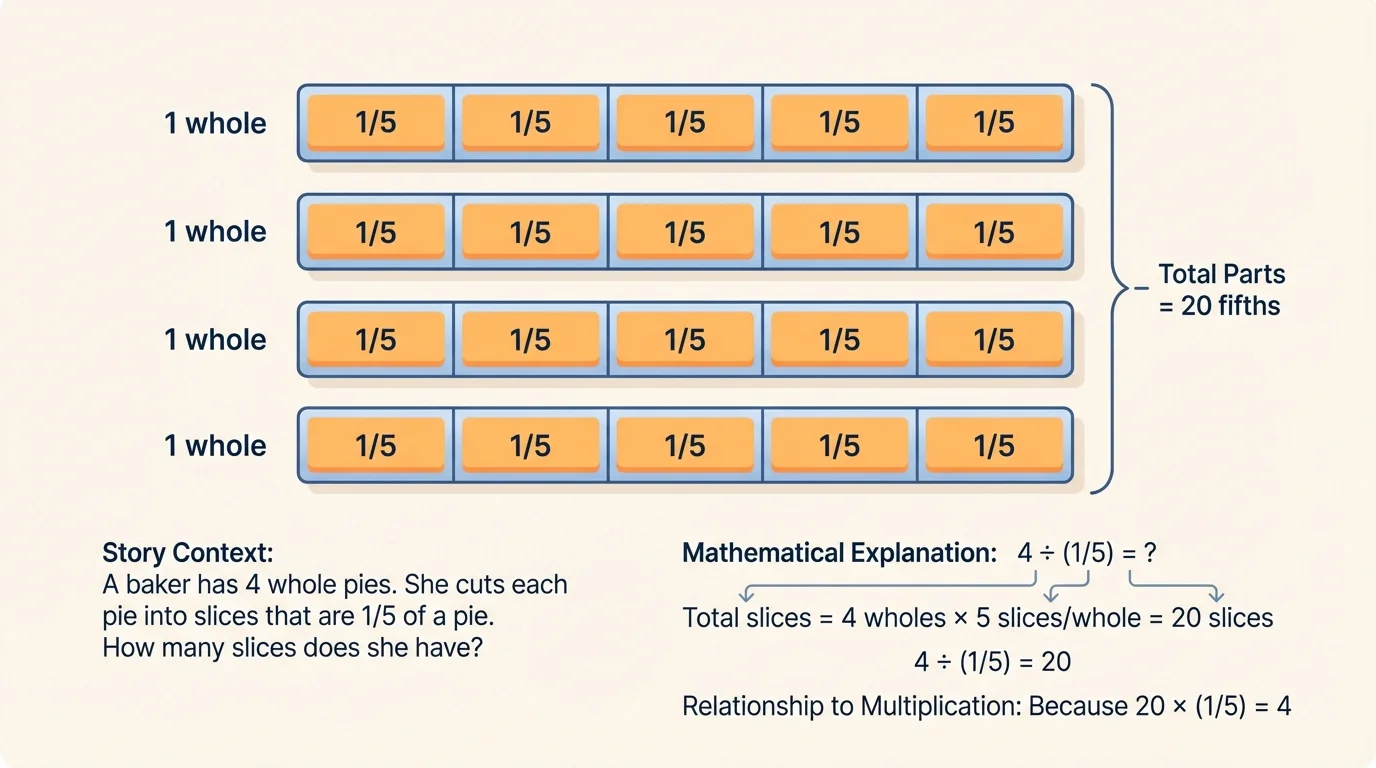
A visual fraction model helps make this idea clear. [Figure 1] shows \(4\) wholes. Each whole is divided into \(5\) equal parts, because each part is \(\dfrac{1}{5}\) of a whole. To solve the problem, we count all the fifths.
In each whole, there are \(5\) fifths. Since there are \(4\) wholes, the total number of fifths is \(5 + 5 + 5 + 5 = 20\). So the quotient is \(20\).
We can write the result as
\[4 \div \frac{1}{5} = 20\]
This visual model is powerful because it shows the meaning of the problem, not just the answer. We are counting how many \(\dfrac{1}{5}\)-sized parts are in \(4\) wholes.
Later, when you compare different unit fractions, the same picture idea still works. For example, as with the bars in [Figure 1], if the pieces were smaller than fifths, even more pieces would fit into \(4\).
Division and multiplication are connected. If \(4 \div \dfrac{1}{5} = 20\), then the related multiplication equation should be
\[20 \times \frac{1}{5} = 4\]
Why does this make sense? Because \(20\) groups of \(\dfrac{1}{5}\) make \(20\) fifths. Every \(5\) fifths make \(1\) whole, so \(20\) fifths make \(4\) wholes.
The multiplication-division relationship
If \(a \div b = c\), then \(c \times b = a\). For fraction division in this lesson, that means if you find how many unit fractions fit into a whole number, you can multiply your answer by the unit fraction to check that you get back to the starting amount.
This relationship is very useful because it gives you a second way to think about the problem. First, count how many pieces fit. Then check by multiplying the number of pieces by the size of each piece.
Now let us work through several examples carefully.
Example 1: Story context for \(4 \div \dfrac{1}{5}\)
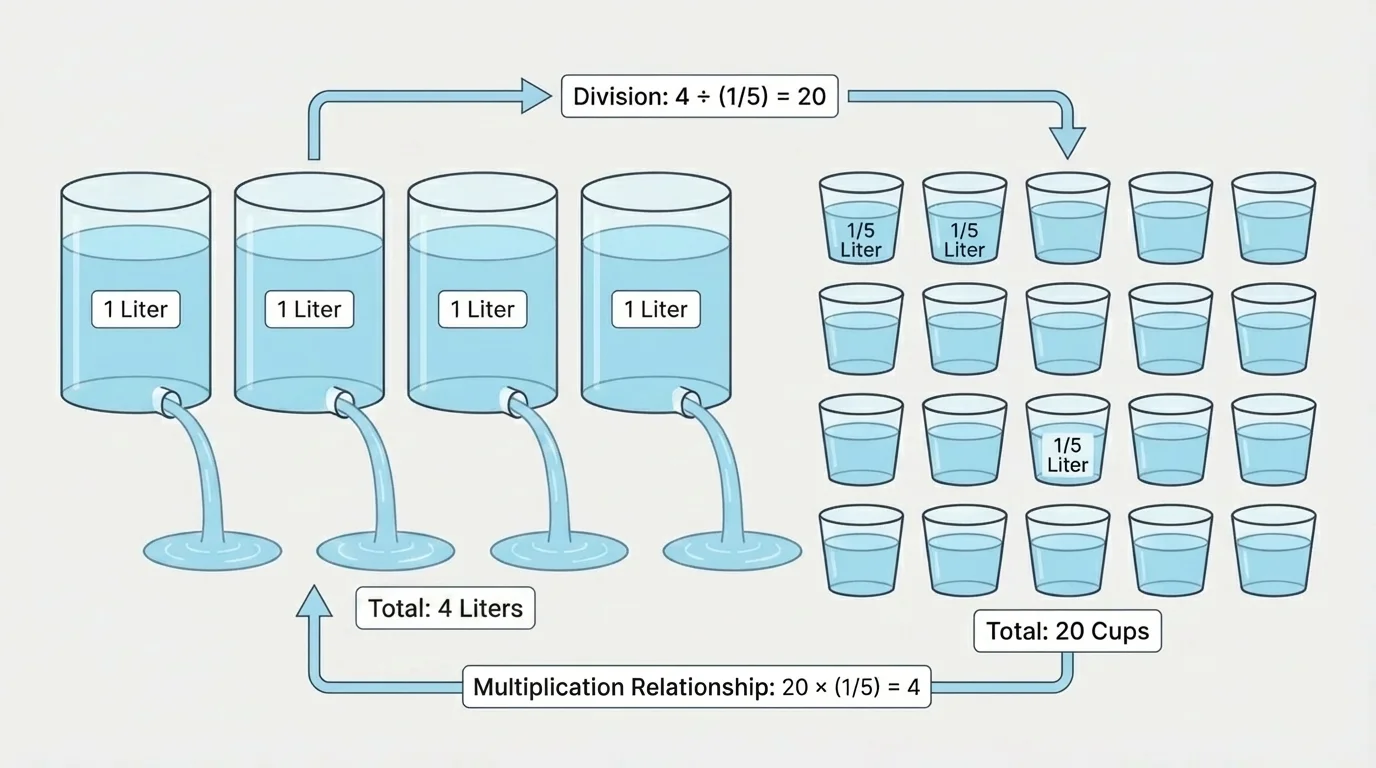
You have \(4\) liters of juice. Each small cup holds \(\dfrac{1}{5}\) liter. How many cups can you fill?
Step 1: Write the division expression.
The question asks how many \(\dfrac{1}{5}\)-liter cups fit into \(4\) liters, so we write \(4 \div \dfrac{1}{5}\).
Step 2: Think about one whole liter.
One liter contains \(5\) cups of size \(\dfrac{1}{5}\) liter.
Step 3: Extend to \(4\) liters.
Since \(1\) liter gives \(5\) cups, \(4\) liters give \(4 \times 5 = 20\) cups.
Step 4: Check using multiplication.
\(20 \times \dfrac{1}{5} = 4\), so the answer is correct.
The quotient is \(20\). You can fill 20 cups.
This kind of problem is really about measurement. We measure how many small containers fit into a larger amount.
Example 2: \(3 \div \dfrac{1}{2}\)
How many halves are in \(3\)?
Step 1: Think about one whole.
One whole contains \(2\) halves.
Step 2: Count across \(3\) wholes.
Three wholes contain \(3 \times 2 = 6\) halves.
Step 3: Check with multiplication.
\(6 \times \dfrac{1}{2} = 3\).
So \(\displaystyle 3 \div \dfrac{1}{2} = 6\).
Notice that the answer, \(6\), is greater than \(3\). That happens because halves are smaller than wholes, so more pieces fit.
Example 3: \(2 \div \dfrac{1}{4}\)
How many fourths are in \(2\)?
Step 1: Think about one whole.
One whole contains \(4\) fourths.
Step 2: Multiply by the number of wholes.
Two wholes contain \(2 \times 4 = 8\) fourths.
Step 3: Check.
\(8 \times \dfrac{1}{4} = 2\).
So \(\displaystyle 2 \div \dfrac{1}{4} = 8\).
Again, the quotient is larger than the starting whole number because fourths are even smaller pieces than halves.
Example 4: Ribbon problem
A ribbon is \(5\) meters long. Each bow uses \(\dfrac{1}{5}\) meter of ribbon. How many bows can be made?
Step 1: Write the expression.
\(5 \div \dfrac{1}{5}\)
Step 2: Count fifths in \(5\) wholes.
Each whole meter has \(5\) fifths, so \(5\) meters have \(5 \times 5 = 25\) fifths.
Step 3: Check.
\(25 \times \dfrac{1}{5} = 5\).
So \(\displaystyle 5 \div \dfrac{1}{5} = 25\). The ribbon makes 25 bows.
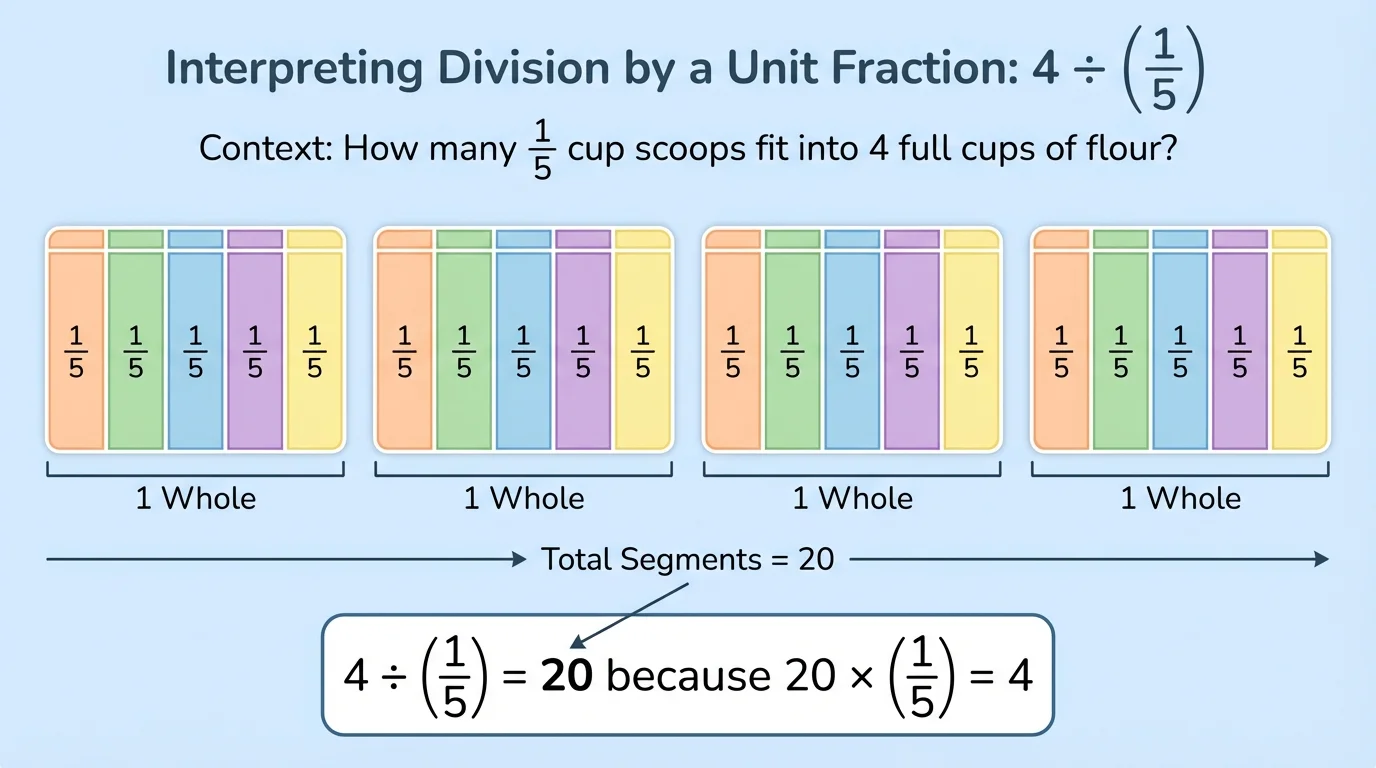
[Figure 2] helps reveal an important pattern: when the whole number stays the same and the unit fraction gets smaller, the quotient gets larger. Smaller pieces mean more pieces fit.
Look at these three expressions:
\[3 \div \frac{1}{2} = 6\]
\[3 \div \frac{1}{3} = 9\]
\[3 \div \frac{1}{4} = 12\]
Why do the answers keep getting bigger? Because \(\dfrac{1}{4}\) is smaller than \(\dfrac{1}{3}\), and \(\dfrac{1}{3}\) is smaller than \(\dfrac{1}{2}\). More fourths fit into \(3\) than thirds, and more thirds fit into \(3\) than halves.
You can also notice a simple pattern. For a whole number \(a\), dividing by \(\dfrac{1}{b}\) gives \(a \times b\). For instance:
\(6 \div \dfrac{1}{2} = 12\), because \(6\) wholes contain \(12\) halves.
\(6 \div \dfrac{1}{3} = 18\), because \(6\) wholes contain \(18\) thirds.
\(6 \div \dfrac{1}{6} = 36\), because \(6\) wholes contain \(36\) sixths.
This pattern matches the visual idea from [Figure 2]. As the pieces become smaller, the number of pieces increases.
Measurement problems are one of the clearest real-world uses of this topic. [Figure 3] shows a juice example in which each serving is \(\dfrac{1}{5}\) liter. We are not breaking the juice into \(5\) groups. We are counting how many cup-sized amounts fit into the total.
Cooking works the same way. If you have \(2\) cups of broth and each recipe batch needs \(\dfrac{1}{4}\) cup, then you can make \(2 \div \dfrac{1}{4} = 8\) batches. Sports drinks, fabric, rope, wood, and paint can all be measured this way.
Here are some common application types:
| Situation | Whole-number amount | Unit-fraction size | Question asked |
|---|---|---|---|
| Juice | \(4\) liters | \(\dfrac{1}{5}\) liter | How many cups? |
| Ribbon | \(5\) meters | \(\dfrac{1}{5}\) meter | How many bows? |
| Broth | \(2\) cups | \(\dfrac{1}{4}\) cup | How many batches? |
| Rope | \(3\) yards | \(\dfrac{1}{2}\) yard | How many pieces? |
Table 1. Real-world measurement situations modeled by dividing a whole number by a unit fraction.
In all of these examples, the key question is the same: how many pieces of a certain fractional size fit into the total amount?
Bakers and chefs often think this way without saying the math out loud. If a recipe uses a small scoop or cup again and again, they are really asking how many equal fractional portions fit into the total ingredient amount.
The same idea applies beyond liquids. Any time you measure repeated equal fractional parts in a larger whole-number amount, this kind of division appears.
One common mistake is to think division must always make numbers smaller. That is not true. When you divide by a unit fraction, the answer can be greater than the starting number because you are counting many small pieces.
Another mistake is mixing up these two different problems:
\(4 \div \dfrac{1}{5}\) means how many fifths are in \(4\).
\(\dfrac{1}{5} \div 4\) means one fifth is split into \(4\) equal parts.
These are not the same at all. In fact,
\[4 \div \frac{1}{5} = 20\]
but
\[\frac{1}{5} \div 4 = \frac{1}{20}\]
The order of the numbers matters in division.
Example 5: Comparing two division expressions
Compare \(4 \div \dfrac{1}{5}\) and \(\dfrac{1}{5} \div 4\).
Step 1: Interpret \(4 \div \dfrac{1}{5}\).
This asks how many fifths are in \(4\). The answer is \(20\).
Step 2: Interpret \(\dfrac{1}{5} \div 4\).
This asks what size each piece is if \(\dfrac{1}{5}\) is split into \(4\) equal parts.
Step 3: Find the second answer.
Each part is \(\dfrac{1}{20}\).
So the two expressions have very different meanings and different answers.
A final mistake is forgetting to check with multiplication. If your division answer is correct, multiplying the quotient by the divisor should return the original amount.
Let us return to the most important example:
\[4 \div \frac{1}{5} = 20\]
You can understand it in three connected ways:
Story: \(4\) liters of juice fill \(20\) cups of size \(\dfrac{1}{5}\) liter.
Visual: \(4\) wholes each split into \(5\) fifths make \(20\) fifths, as shown earlier in [Figure 1].
Multiplication check: \(20 \times \dfrac{1}{5} = 4\).
When all three ways agree, your understanding is strong.
"Division asks how many groups or what size group."
— A powerful way to think about division
For this topic, the "how many groups" meaning is especially important. We are counting how many unit fractions fit into a whole-number amount.
