A store advertises 20% off, a basketball player makes 75% of her shots, and a phone battery is at 58%. Percents appear everywhere, but they all mean the same basic idea: a number out of 100. Once you understand that, you can solve two very useful kinds of problems: finding a part of a whole, and working backward to find the whole from a part.
A percent is a rate per 100. The word percent literally means "for each hundred." So, 30% means 30 out of 100. In math, that can be written in several equivalent ways:
\[30\% = \frac{30}{100} = 0.30\]
This is why 30% of a quantity means \(\dfrac{30}{100}\) times the quantity. For example, 30% of 50 means:
\[\frac{30}{100} \times 50 = 0.30 \times 50 = 15\]
So, \(30\%\) of \(50\) is \(15\).
Percent means "out of 100." A percent can be written as a fraction with denominator 100, as a decimal, or as a rate comparing a part to a whole.
Whole is the total amount. Part is the portion of that total.
Percents are closely connected to fractions and decimals. Here are a few common conversions:
| Percent | Fraction | Decimal |
|---|---|---|
| \(10\%\) | \(\dfrac{10}{100} = \dfrac{1}{10}\) | \(0.10\) |
| \(25\%\) | \(\dfrac{25}{100} = \dfrac{1}{4}\) | \(0.25\) |
| \(50\%\) | \(\dfrac{50}{100} = \dfrac{1}{2}\) | \(0.50\) |
| \(75\%\) | \(\dfrac{75}{100} = \dfrac{3}{4}\) | \(0.75\) |
| \(100\%\) | \(\dfrac{100}{100} = 1\) | \(1.00\) |
Table 1. Common percent, fraction, and decimal equivalents.
Knowing these equivalent forms helps you choose a strategy. Sometimes a fraction is easiest. Sometimes a decimal is quicker. Either way, the meaning stays the same.
To find a percent of a quantity, multiply the whole quantity by the percent written as a fraction or decimal.
Here is the general idea:
\[p = r \times w\]
Here, \(p\) represents the part, \(r\) represents the percent written as a decimal or fraction, and \(w\) represents the whole.
If the percent is written as a whole number, first rewrite it as a fraction over 100 or as a decimal. For example, 20% becomes \(\dfrac{20}{100}\) or \(0.20\).
Worked example 1
Find \(30\%\) of \(80\).
Step 1: Write the percent as a fraction or decimal.
\(30\% = \dfrac{30}{100} = 0.30\)
Step 2: Multiply by the whole.
\(0.30 \times 80 = 24\)
Step 3: State the result.
So, \(30\%\) of \(80\) is \(24\).
You can also reason with easy percentages. Since 10% of 80 is 8, then 30% is three times that amount, so \(3 \times 8 = 24\).
This kind of mental reasoning is useful when the percent is a multiple of 10% or 5%.
Worked example 2
A class has \(24\) students. \(25\%\) of them bring lunch from home. How many students is that?
Step 1: Recognize a familiar percent.
\(25\% = \dfrac{1}{4}\)
Step 2: Find one fourth of the class.
\(\dfrac{1}{4} \times 24 = 6\)
Step 3: Write the answer with context.
So, \(25\%\) of \(24\) is \(6\).
So, \(6\) students bring lunch from home.
Some percent problems involve decimals in the answer. For example, 15% of 60 is \(0.15 \times 60 = 9\). This means 9 is 15% of 60.
To change a percent to a decimal, divide by 100. Moving the decimal point two places left gives the same result: \(42\% = 0.42\), \(7\% = 0.07\), and \(125\% = 1.25\).
If the percent is greater than 100%, the part is greater than the whole. For instance, 120% of 50 is \(1.20 \times 50 = 60\). That makes sense because 120% means more than the entire amount.
A double number line helps match percent values with actual amounts, as shown in [Figure 1]. One line shows percent from \(0\%\) to \(100\%\), and the other line shows the quantity from \(0\) to the whole. Matching points on the two lines helps you see equivalent ratios.
Suppose \(100\%\) matches \(40\). Then \(50\%\) matches half of \(40\), which is \(20\). And \(25\%\) matches half of \(20\), which is \(10\). This is ratio reasoning: if the percent is cut in half, the quantity is cut in half too.
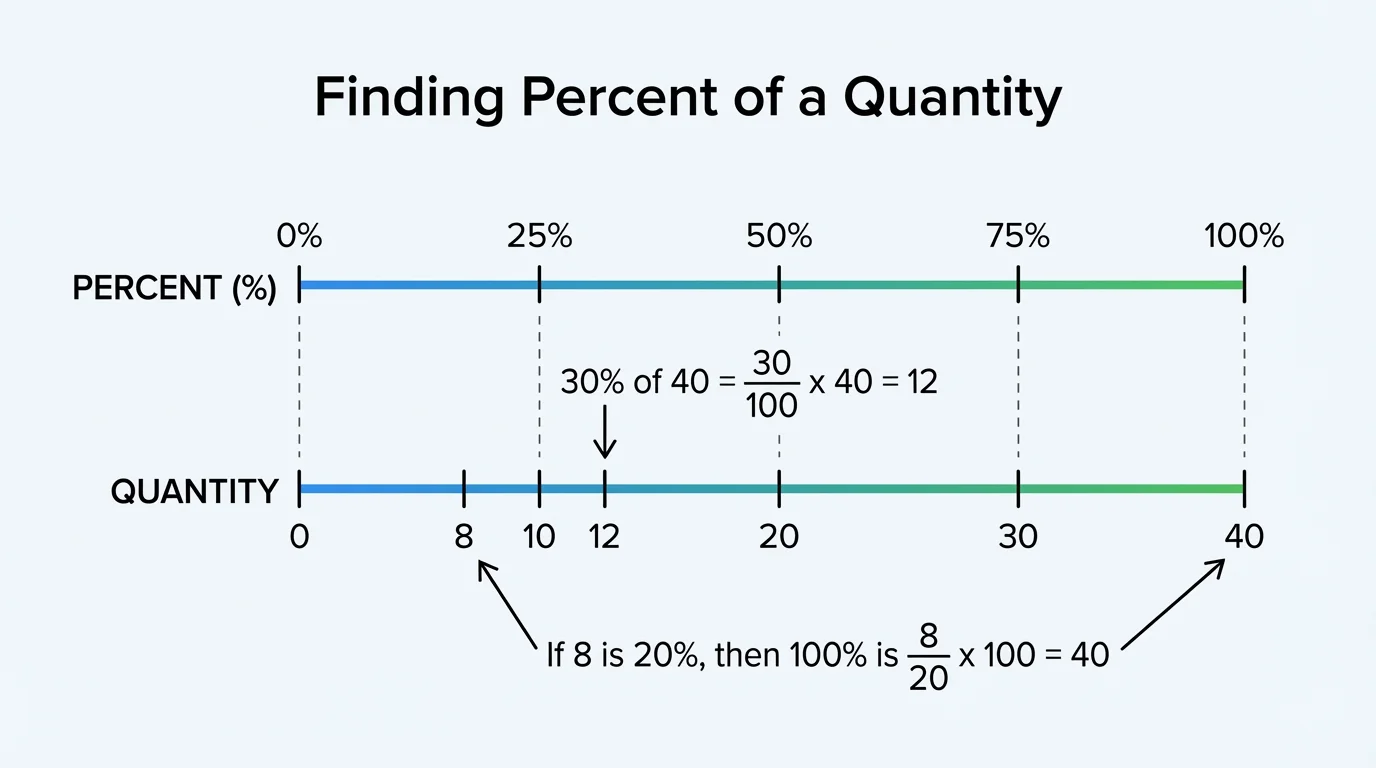
Another useful model is a tape diagram or a 100-grid. If the whole is split into 100 equal parts, then each small part represents 1%. Shading 30 boxes shows 30% of the whole.
These models are helpful because they show that percent problems are really ratio problems. For example, 30% of 50 is based on the ratio 30 to 100. If the whole changes, the percent ratio stays the same.
Later, when you work backward to find a whole, the same visual idea from [Figure 1] still helps. You can line up a known percent with a known amount and then scale up to 100%.
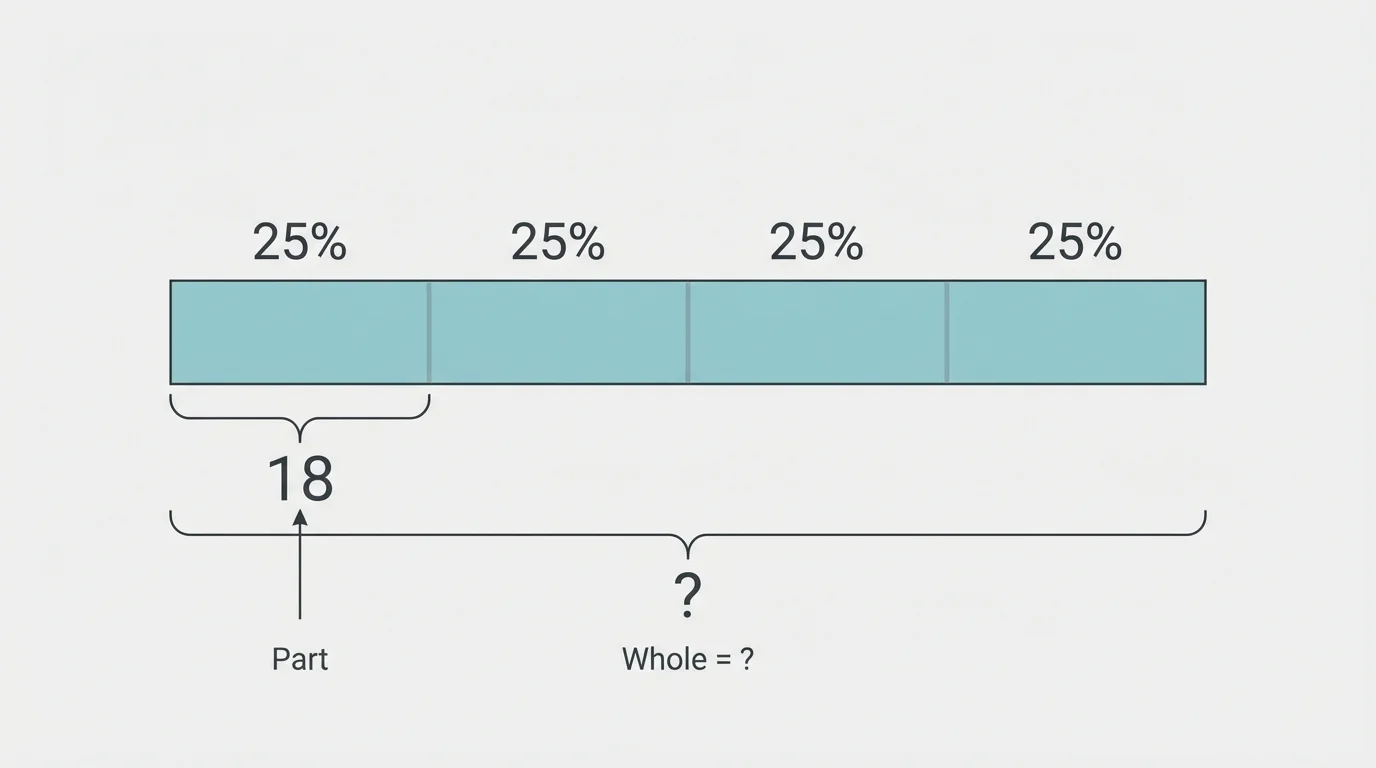
Sometimes you know the part and the percent, but not the whole. This is the reverse of finding a percent of a quantity. A tape diagram, like the one represented in [Figure 2], makes this easier because it shows a known piece of the total and asks for the full amount.
The key equation is:
\[p = r \times w\]
Here, \(p\) represents the part, \(r\) represents the percent written as a decimal or fraction, and \(w\) represents the whole.
If you know the part and the percent, solve for the whole by dividing the part by the decimal form of the percent:
\[w = \frac{p}{r}\]
For example, if \(18\) is \(25\%\) of a number, then:
\[w = \frac{18}{0.25} = 72\]
Worked example 3
\(12\) is \(40\%\) of what number?
Step 1: Write an equation.
Let the whole be \(w\). Then \(0.40w = 12\).
Step 2: Divide both sides by \(0.40\).
\(w = \dfrac{12}{0.40} = 30\)
Step 3: Check.
\(40\%\) of \(30\) is \(0.40 \times 30 = 12\), so the answer is correct.
The whole is \(30\).
You can also use ratio reasoning instead of an equation. If \(20\%\) of a number is \(8\), then \(10\%\) is half of \(8\), which is \(4\). Since \(100\%\) is ten times \(10\%\), the whole is \(40\).
Worked example 4
A jar contains some marbles. \(35\) marbles are \(70\%\) of the jar's full amount. How many marbles are in the full jar?
Step 1: Write the percent as a decimal.
\(70\% = 0.70\)
Step 2: Use the equation \(p = r \times w\).
\(35 = 0.70w\)
Step 3: Solve for \(w\).
\(w = \dfrac{35}{0.70} = 50\)
Step 4: Check the result.
\(70\%\) of \(50\) is \(35\), so the answer makes sense.
The jar holds \(50\) marbles.
As with the tape model in [Figure 2], if you know one equal part, you can often build up to the entire bar. For 25%, one part out of four equal parts is known, so multiplying by 4 gives the whole.
There is more than one good way to solve percent problems. The best strategy depends on the numbers.
If the percent is familiar, a fraction strategy can be fast. For example, 50% means \(\dfrac{1}{2}\), and 75% means \(\dfrac{3}{4}\). Finding 75% of 20 is easier if you think \(\dfrac{3}{4} \times 20 = 15\).
If the percent is not so friendly, a decimal strategy may be easier. To find 12% of 75, compute \(0.12 \times 75 = 9\).
An equation strategy is especially useful when the whole is unknown. If 27 is 45% of a number, write \(0.45w = 27\) and solve: \(\dfrac{27}{0.45} = 60\).
Sometimes a scale factor strategy works well. For example, if \(20\%\) of a quantity is \(8\), then \(10\%\) is \(4\), and \(100\%\) is \(40\). This uses repeated multiplication based on equivalent ratios.
Percent problems are proportional relationships. When the percent and the part change by the same scale factor, the relationship stays balanced. That is why tables of equivalent ratios, tape diagrams, double number lines, and equations all describe the same idea in different forms.
Here is a comparison of common strategies:
| Situation | Helpful strategy | Example idea |
|---|---|---|
| Known whole, familiar percent | Fraction reasoning | \(25\% = \dfrac{1}{4}\) |
| Known whole, less familiar percent | Decimal multiplication | \(18\% = 0.18\) |
| Known part and percent, unknown whole | Equation or division | \(0.30w = 21\) |
| Mental math with benchmark percents | Use \(10\%\), \(5\%\), \(50\%\) | Build from easy pieces |
Table 2. Different strategies for different types of percent problems.
Percents are useful because they compare amounts fairly, even when totals are different. That is why stores, schools, sports teams, and scientists all use them.
In shopping, a discount is often given as a percent. If a jacket costs $40 and is on sale for 20% off, the discount amount is \(0.20 \times 40 = 8\), so the sale price is $32. The percent tells how large the reduction is compared with the original price.
In school, test scores are often given as percents. If a student gets 18 correct out of 20 questions, the score is \(\dfrac{18}{20} = \dfrac{90}{100} = 90\%\). If another student scored 27 points and that is 90% of the test, then the whole test must be \(\dfrac{27}{0.90} = 30\) points.
Worked example 5
A soccer player made \(18\) penalty kicks, which was \(60\%\) of all penalty kicks attempted. How many penalty kicks did the player attempt?
Step 1: Identify the part and the percent.
The part is \(18\). The percent is \(60\% = 0.60\).
Step 2: Write the equation.
\(0.60a = 18\), where \(a\) is the number of attempts.
Step 3: Solve.
\(a = \dfrac{18}{0.60} = 30\)
Step 4: Check.
\(60\%\) of \(30\) is \(18\).
The player attempted \(30\) penalty kicks.
In science and news reports, percents help describe change or composition. If 45% of a town's 200 homes use solar panels, then \(0.45 \times 200 = 90\) homes use solar panels. If 90 homes represent 45% of all homes, then the total number of homes is \(\dfrac{90}{0.45} = 200\).
Professional sports statistics often use percentages to compare players fairly. A player who makes \(8\) out of \(10\) shots has \(80\%\), while another who makes \(16\) out of \(20\) shots also has \(80\%\), even though the totals are different.
These examples all rely on the same idea: percent compares a part to a whole using a scale of 100.
One common mistake is forgetting to convert the percent before calculating. For example, using 30 instead of \(0.30\) gives the wrong result. Since 30% means 30 out of 100, it must be written as \(0.30\) or \(\dfrac{30}{100}\) before multiplying.
Another mistake is mixing up the part and the whole. In the statement "12 is 40% of a number," the 12 is the part, not the whole. The unknown number is the whole.
A third mistake is dividing when you should multiply, or multiplying when you should divide. If the whole is known and you want the part, multiply by the percent. If the part and percent are known and you want the whole, divide by the decimal form of the percent.
Students also sometimes expect the answer to always be smaller. But if the percent is greater than 100%, the answer will be larger than the whole. For example, 150% of 20 is \(1.5 \times 20 = 30\).
Good mathematicians do not stop after getting an answer. They also check whether the answer is reasonable.
Estimation is a powerful check. If you need 19% of 50, you know the answer should be a little less than 20% of 50, which is 10. So an exact answer of 9.5 makes sense.
For reverse problems, compare the part to the percent. If 15 is 25% of a number, the whole must be bigger than 15 because 25% is only one fourth of the total. Computing \(\dfrac{15}{0.25} = 60\) confirms that.
You can also check by substitution. If you think 35 is the whole and 14 is 40% of it, test it: \(0.40 \times 35 = 14\). The equation works, so the answer is correct.
"Percent problems become easier when you always ask: What is the whole, what is the part, and what does the percent tell me about their relationship?"
Once you keep track of those three ideas, percent problems become much more organized. You are no longer guessing; you are using ratio reasoning to connect the numbers in a clear way.
