Suppose a factory makes exactly 1,248 pencils and packs them into boxes of 6. How many boxes can it fill? Situations like this appear in shopping, sports schedules, road trips, and computer data. Division is not just the opposite of multiplication—it is a powerful way to organize large amounts into equal groups. When numbers get bigger, mental math alone is often not enough. That is where the standard algorithm becomes useful.
Division tells how many equal groups can be made or how many objects are in each group. In a division problem, the number being divided is called the dividend, the number you divide by is the divisor, and the answer is the quotient. Sometimes there is an extra amount left over, called the remainder.
For example, in \(24 \div 6 = 4\), the dividend is \(24\), the divisor is \(6\), and the quotient is \(4\). If we divide \(26 \div 6\), the quotient is \(4\) with remainder \(2\), because \(6 \times 4 = 24\) and \(26 - 24 = 2\).
Dividend: the number being divided.
Divisor: the number you divide by.
Quotient: the result of a division problem.
Remainder: the amount left over when the divisor does not divide the dividend exactly.
When dividing larger numbers, we use place value. That means we look at hundreds, tens, and ones carefully. The standard algorithm keeps all those place values organized.
[Figure 1] The standard algorithm is a step-by-step method for division. It follows a repeating cycle: divide, multiply, subtract, bring down. These four actions repeat until there are no more digits to bring down.
Here is the basic idea. First, ask how many times the divisor can fit into the first digit or first few digits of the dividend. Write that number in the quotient. Next, multiply the quotient digit by the divisor. Then subtract. Finally, bring down the next digit and repeat.
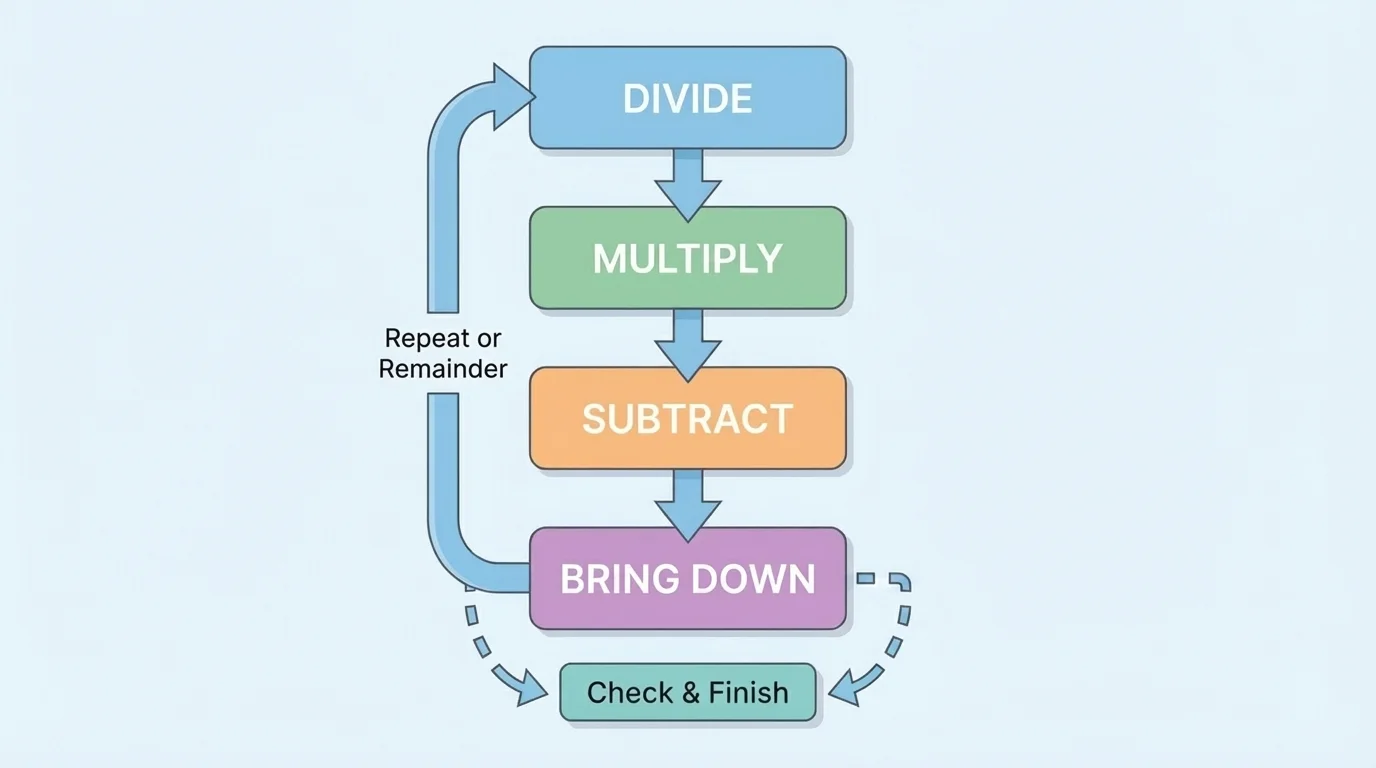
This process may seem complicated at first, but it is actually a pattern. Once you know the pattern, each new division problem becomes easier. It is a lot like following moves in a game: the same moves repeat, but the numbers change.
To divide fluently, you need strong multiplication facts. When you ask how many times a divisor fits into a number, you are really using multiplication in reverse.
You also need careful subtraction. A wrong subtraction step can make the rest of the problem incorrect, even if your division idea was right.
[Figure 2] Good division is not just about writing steps. It also uses estimation to choose quotient digits. Estimating helps you avoid trying too many possibilities.
Suppose you are dividing \(738 \div 3\). Look at the first digit: \(7\). Since \(3 \times 2 = 6\) and \(3 \times 3 = 9\), the divisor goes into \(7\) \(2\) times, not \(3\). So the first quotient digit is \(2\).
For a two-digit divisor, estimation matters even more. If you are dividing \(864 \div 24\), you can think of \(24\) as about \(20\). Since \(80 \div 20 \approx 4\), the first quotient digit will probably be close to \(3\) or \(4\). Estimation gives you a smart starting point.
Some calculators hide all the thinking, but mathematicians still estimate first. Estimation helps you notice quickly if a calculator answer is unreasonable.
Estimation does not replace exact division. It helps you choose each step more confidently.
The long-division layout has special places for the divisor, dividend, and quotient. Now use that structure to divide \(156 \div 3\).
Worked example
Find \(156 \div 3\).
Step 1: Set up the division.
Write \(3\) outside the division bar and \(156\) inside.
\[\begin{array}{r}3\overline{)156}\end{array}\]
Step 2: Divide the hundreds.
Ask: How many times does \(3\) go into \(1\)? It does not, so look at \(15\). How many times does \(3\) go into \(15\)? It goes \(5\) times.
Write \(5\) in the quotient above the tens place.
Step 3: Multiply and subtract.
Multiply: \(5 \times 3 = 15\).
Subtract: \(15 - 15 = 0\).
Step 4: Bring down the next digit.
Bring down the \(6\). Now divide \(6 \div 3 = 2\).
Step 5: Multiply and subtract again.
Multiply: \(2 \times 3 = 6\).
Subtract: \(6 - 6 = 0\).
The quotient is \(52\).
So, \(156 \div 3 = 52\).
One way to display the full work is:
\[\begin{array}{r} \phantom{00}52 \\ 3\overline{)156} \\ \underline{15} \\ \phantom{0}06 \\ \underline{\phantom{0}6} \\ \phantom{0}0 \end{array}\]
This example ends with no remainder. That means \(156\) is a multiple of \(3\). Notice how each quotient digit matches a place value in the dividend.
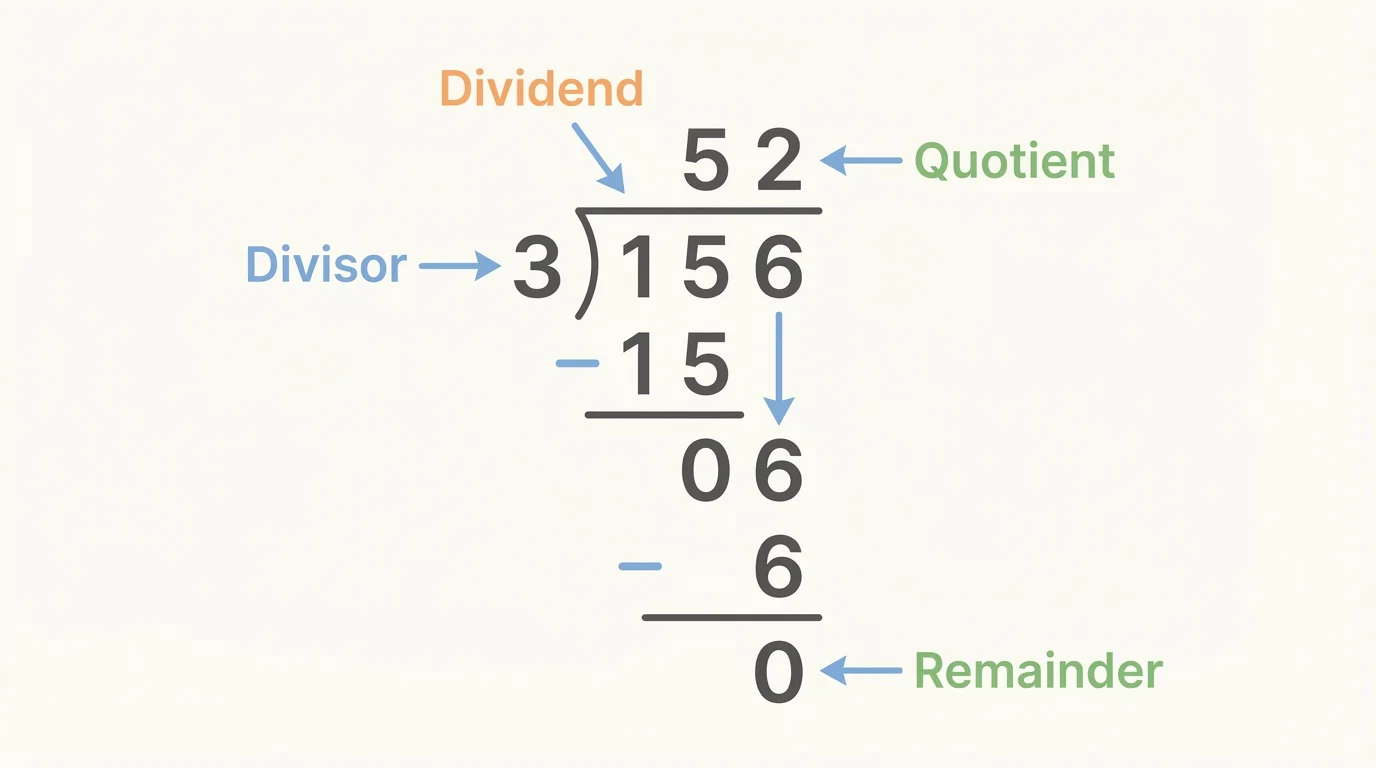
As you continue dividing larger numbers, the same cycle from [Figure 1] keeps repeating. The numbers change, but the structure stays the same.
Now divide \(2,437 \div 5\). This example has a remainder.
Worked example
Find \(2,437 \div 5\).
Step 1: Divide the first digit or digits.
Ask: How many times does \(5\) go into \(2\)? It does not, so look at \(24\).
\(5\) goes into \(24\) \(4\) times because \(5 \times 4 = 20\) and \(5 \times 5 = 25\) is too large.
Step 2: Write, multiply, and subtract.
Write \(4\) in the quotient.
Multiply: \(4 \times 5 = 20\).
Subtract: \(24 - 20 = 4\).
Step 3: Bring down the next digit.
Bring down \(3\), making \(43\).
Now divide: \(43 \div 5 = 8\) remainder \(3\), because \(5 \times 8 = 40\).
Step 4: Multiply and subtract again.
Multiply: \(8 \times 5 = 40\).
Subtract: \(43 - 40 = 3\).
Step 5: Bring down the last digit.
Bring down \(7\), making \(37\).
Now divide: \(37 \div 5 = 7\), because \(5 \times 7 = 35\).
Step 6: Finish the problem.
Subtract: \(37 - 35 = 2\).
There are no more digits to bring down, so \(2\) is the remainder.
The quotient is \(487\) remainder \(2\).
So, \(2,437 \div 5 = 487\) remainder \(2\).
The full work can be shown as:
\[\begin{array}{r} \phantom{0}487 \\ 5\overline{)2437} \\ \underline{20} \\ \phantom{0}43 \\ \underline{40} \\ \phantom{00}37 \\ \underline{\phantom{0}35} \\ \phantom{00}2 \end{array}\]
A remainder must always be less than the divisor. Here, the remainder is \(2\), and \(2 < 5\), so the answer makes sense.
Dividing by a two-digit number uses the same algorithm, but careful estimation becomes more important. Let us divide \(972 \div 18\).
Worked example
Find \(972 \div 18\).
Step 1: Estimate the first quotient digit.
Since \(18\) does not fit into \(9\), look at \(97\).
Estimate with nearby multiples: \(18 \times 5 = 90\) and \(18 \times 6 = 108\).
So the first quotient digit is \(5\).
Step 2: Multiply and subtract.
Multiply: \(5 \times 18 = 90\).
Subtract: \(97 - 90 = 7\).
Step 3: Bring down the next digit.
Bring down \(2\), making \(72\).
Step 4: Divide again.
Ask: How many times does \(18\) go into \(72\)? Since \(18 \times 4 = 72\), it goes exactly \(4\) times.
Step 5: Multiply and subtract.
Multiply: \(4 \times 18 = 72\).
Subtract: \(72 - 72 = 0\).
The quotient is \(54\).
So, \(972 \div 18 = 54\).
The vertical work is:
\[\begin{array}{r} \phantom{0}54 \\ 18\overline{)972} \\ \underline{90} \\ \phantom{0}72 \\ \underline{72} \\ \phantom{0}0 \end{array}\]
Even with a larger divisor, the pattern from [Figure 1] still guides every step: divide, multiply, subtract, bring down.
You can check a division answer by using multiplication. If there is no remainder, multiply the quotient by the divisor. If there is a remainder, multiply and then add the remainder.
For example, in \(156 \div 3 = 52\), check with \(52 \times 3 = 156\). The check works exactly.
For \(2,437 \div 5 = 487\) remainder \(2\), check with \(487 \times 5 = 2,435\), then add the remainder: \(2,435 + 2 = 2,437\). Since the result matches the dividend, the division is correct.
The division check
Every correct division problem follows this relationship:
\[\textrm{dividend} = (\textrm{divisor} \times \textrm{quotient}) + \textrm{remainder}\]
This is a powerful way to test your work and catch mistakes.
If your check does not match the dividend, go back and look for an error in multiplication, subtraction, or the quotient digits.
One common mistake is placing a quotient digit above the wrong place value. If you divide into tens, the quotient digit must go in the tens place. Place value matters all the way through the problem.
Another mistake is forgetting to bring down the next digit. After subtracting, always ask, "Are there more digits left in the dividend?" If there are, bring the next one down and continue.
Students also sometimes choose a quotient digit that is too large. For example, if you are dividing by \(18\), writing \(6\) when \(18 \times 6 = 108\) is too much for \(97\) creates trouble right away. Estimation helps prevent this.
A final common mistake is leaving a remainder that is larger than the divisor. That cannot happen in a finished answer. If the remainder is at least as large as the divisor, you must divide again.
Division appears in many real situations. A school has \(1,152\) notebooks to pack equally into \(9\) classrooms. The number in each classroom is found by \(1,152 \div 9 = 128\). The quotient tells how many notebooks go into each room.
A delivery company has \(2,880\) packages and loads \(24\) packages on each cart. The number of carts needed is \(2,880 \div 24 = 120\). This is grouping division: how many equal groups can be made?
A coach has \(365\) minutes of practice time to spread equally over \(7\) days. Since \(365 \div 7 = 52\textrm{ remainder }1\), that means \(52\) minutes each day with \(1\) minute left over. In real life, that leftover minute still matters.
Real-world application
A farmer packs \(1,248\) apples into crates holding \(6\) apples each.
Step 1: Write the problem as division.
\(1,248 \div 6\)
Step 2: Divide.
\(12 \div 6 = 2\), bring down \(4\), then \(4 \div 6 = 0\) tens, bring down \(8\), and \(48 \div 6 = 8\).
Step 3: State the result.
\(1,248 \div 6 = 208\)
The farmer fills 208 crates.
Notice that this real-world problem also includes a zero in the quotient. That is an important variation of the standard algorithm.
Sometimes the divisor does not fit into a certain place value, so you must write a zero in the quotient. This keeps the place values lined up correctly.
[Figure 3] Consider \(408 \div 4\). First, \(4\) goes into \(4\) exactly \(1\) time. Subtract and get \(0\). Bring down the \(0\). Now \(0 \div 4 = 0\), so you must write \(0\) in the quotient. Then bring down the \(8\), and \(8 \div 4 = 2\). The answer is \(102\).
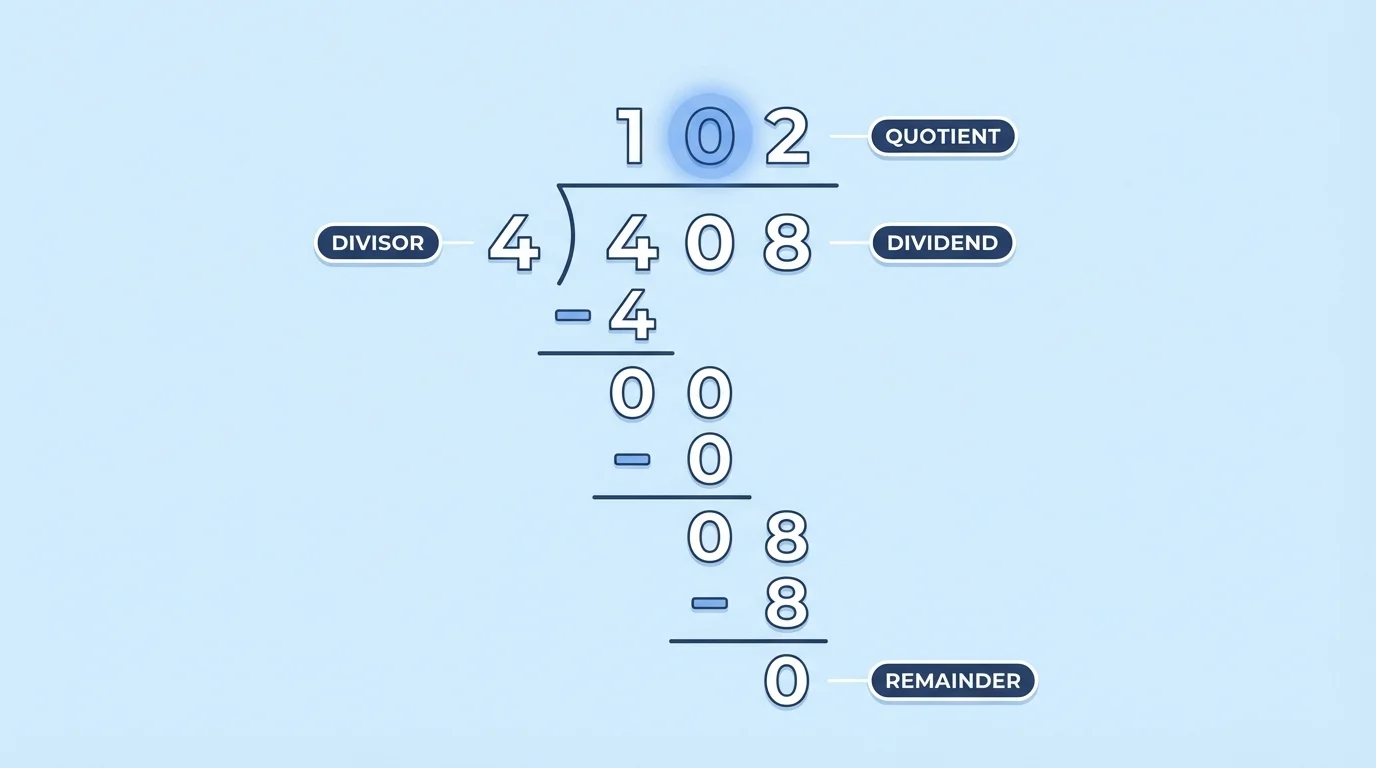
If you leave out that zero, you would get \(12\), which is far too small. Place value is the reason the zero matters.
This same idea appears in the apple-crate example. The zero in \(208\) shows there are zero tens of crates in that middle place. Later, when you check the answer, the diagram helps remind you why that placeholder zero is necessary.
Fluency means being accurate, efficient, and flexible. It does not mean rushing. A fluent student can divide correctly, choose sensible quotient digits, and check whether an answer is reasonable.
To become fluent, keep these habits: know multiplication facts well, estimate before writing quotient digits, line up place values carefully, subtract accurately, and always check whether the remainder makes sense.
Over time, the standard algorithm becomes faster because your brain starts recognizing patterns. For instance, if you know that \(18 \times 5 = 90\), then in a problem such as \(972 \div 18\), you quickly see how to begin. Fluency grows from understanding plus repeated correct use.
"Mathematics is not about memorizing steps only; it is about noticing patterns that make the steps make sense."
Division is one of those topics where pattern and meaning work together. The algorithm is useful because it matches how place value works in our number system.
