A race can be won by just a few hundredths of a second. A shopping bill can be off by a few cents. A recipe can fail if a measurement is not exact. Decimals may look small, but they matter in a big way. When you can compute with decimals quickly and accurately, you are using math the same way people do in science, business, sports, and everyday life.
Working fluently with decimals means more than getting an answer. It means understanding where the decimal point belongs, knowing why the steps work, and being able to check whether the answer makes sense. The standard algorithms for addition, subtraction, multiplication, and division are powerful because they organize place value in a clear, reliable way.
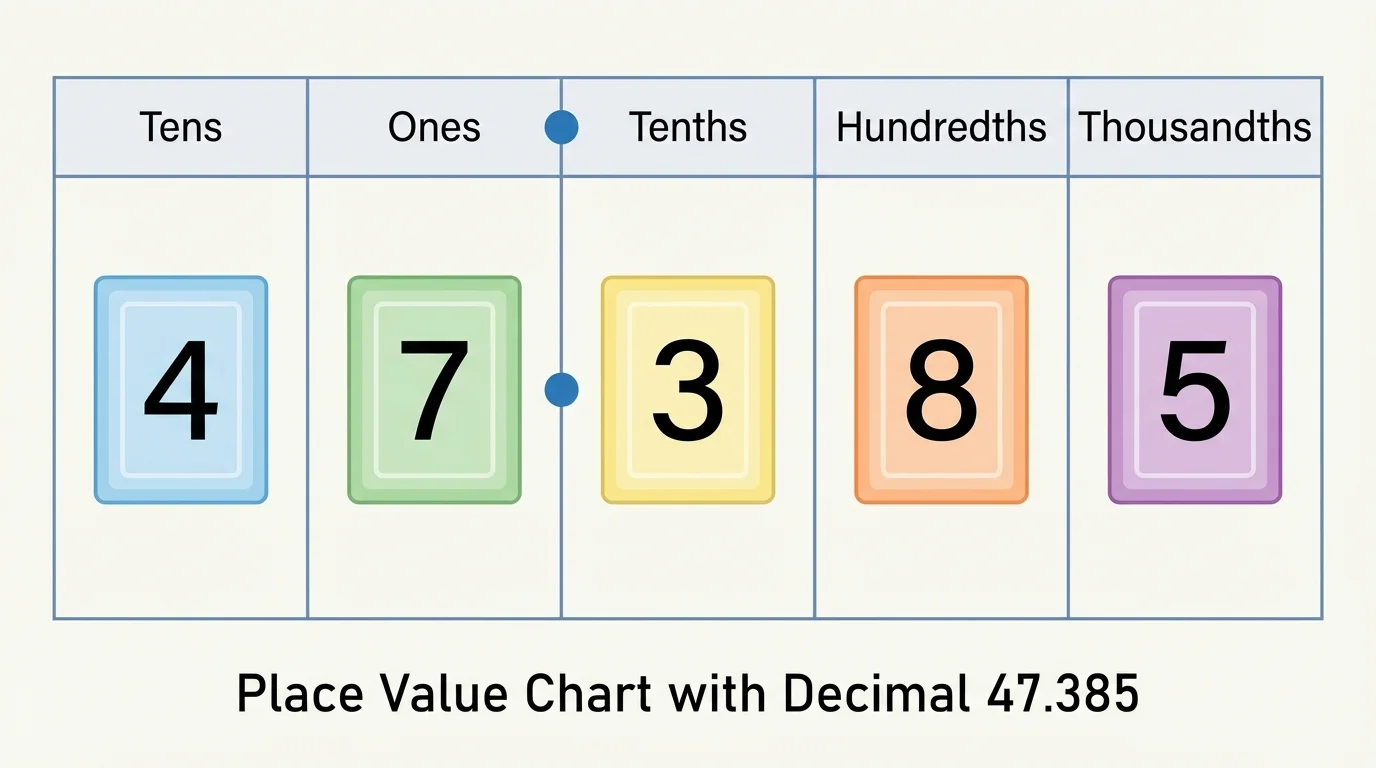
Every decimal number is built on place value. The value of a digit depends on its position. In the number \(47.385\), the \(4\) means \(4\) tens, the \(7\) means \(7\) ones, the \(3\) means \(3\) tenths, the \(8\) means \(8\) hundredths, and the \(5\) means \(5\) thousandths. This is why digits must line up correctly when you compute, as [Figure 1] shows.
You can also write decimals in expanded form. For example, \(47.385 = 40 + 7 + 0.3 + 0.08 + 0.005\). Expanded form reminds us that decimal operations are really operations on place values.
Whole-number algorithms still matter here. When you add, subtract, multiply, or divide decimals, you are using the same basic ideas as with whole numbers. The difference is that you must pay close attention to the decimal point and to the value of each place.
Zeros can be very helpful in decimal work. For example, \(6.4\), \(6.40\), and \(6.400\) all have the same value. Adding zeros to the right of a decimal does not change the number, but it can make the standard algorithm easier to use.
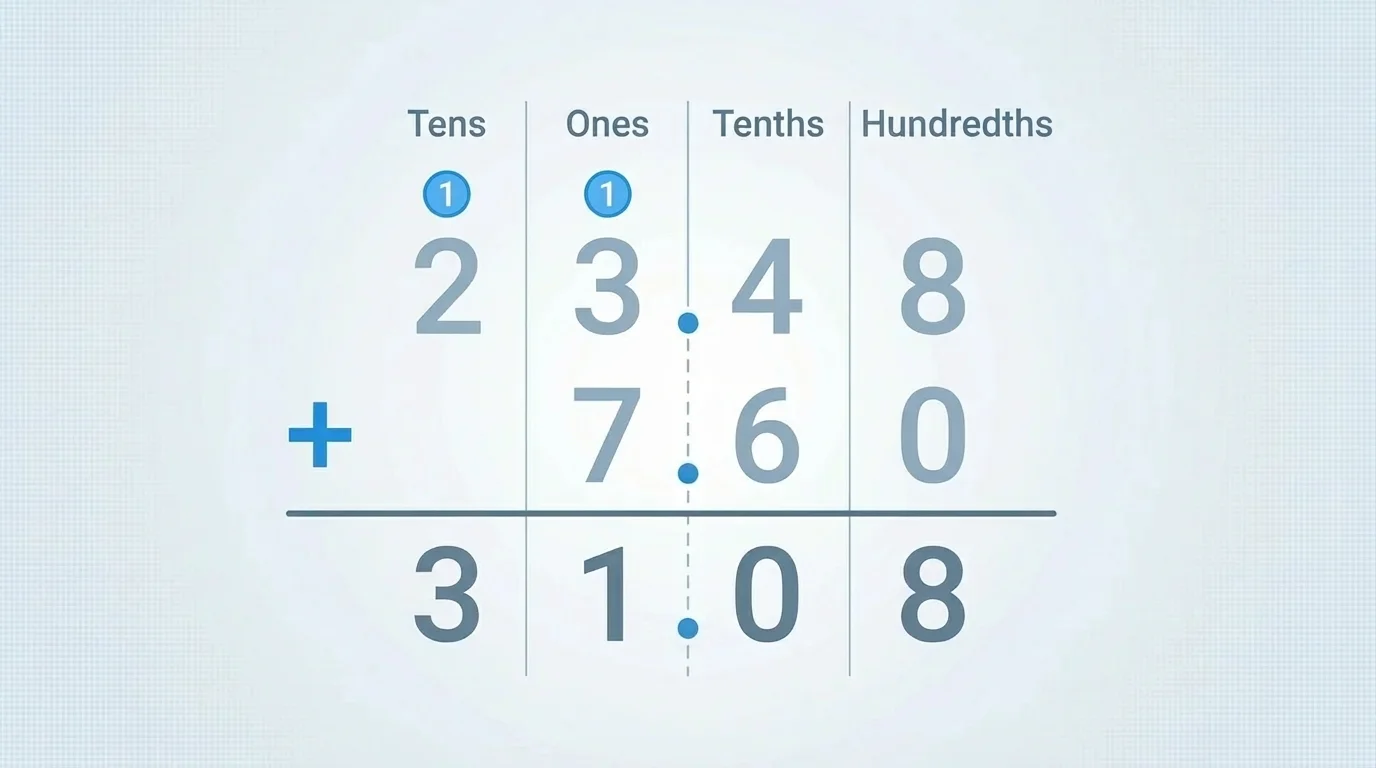
To add decimals, line up the decimal points first. This makes sure tenths are added to tenths, hundredths to hundredths, and so on, as [Figure 2] illustrates. Then add from right to left, regrouping when needed, just as you do with whole numbers.
If one number has fewer decimal places, you can add zeros to help line everything up. For example, \(8.7\) can be written as \(8.70\) if you are adding hundredths.
Solved Example 1
Find \(23.48 + 7.6\).
Step 1: Line up the decimal points.
Write \(7.6\) as \(7.60\).
\[\begin{array}{r} 23.48 \\ +\;7.60 \end{array}\]
Step 2: Add from right to left.
Hundredths: \(8 + 0 = 8\)
Tenths: \(4 + 6 = 10\), so write \(0\) tenths and regroup \(1\) one.
Ones: \(3 + 7 + 1 = 11\), so write \(1\) one and regroup \(1\) ten.
Tens: \(2 + 1 = 3\)
Step 3: Write the answer with the decimal point lined up.
\[\begin{array}{r} 23.48 \\ +\;7.60 \\ \hline 31.08 \end{array}\]
The sum is \(31.08\).
Notice that the decimal point in the answer stays in the same column. In decimal addition, the decimal point is not guessed. Its position is determined by the alignment of place values.
Estimation helps you check. Since \(23.48 \approx 23.5\) and \(7.6 \approx 7.5\), the sum should be about \(31\). The exact answer, \(31.08\), is reasonable.
Subtracting decimals also begins by lining up decimal points. Then subtract place by place from right to left. If needed, regroup from the next place value. Sometimes it helps to write extra zeros so both numbers have the same number of decimal places.
For example, to subtract \(12.5 - 3.78\), write \(12.5\) as \(12.50\). Now the hundredths places match, and the subtraction is easier to see.
Solved Example 2
Find \(12.5 - 3.78\).
Step 1: Line up the decimal points and add a zero.
\[\begin{array}{r} 12.50 \\ -\;3.78 \end{array}\]
Step 2: Subtract from right to left.
In the hundredths place, \(0 - 8\) is not possible, so regroup \(1\) tenth as \(10\) hundredths.
\(10 - 8 = 2\)
Now in the tenths place, after regrouping, \(4 - 7\) is not possible, so regroup \(1\) one as \(10\) tenths.
\(14 - 7 = 7\)
In the ones place, \(1 - 3\) is not possible, so regroup \(1\) ten as \(10\) ones.
\(11 - 3 = 8\)
Step 3: Complete the subtraction.
\[\begin{array}{r} 12.50 \\ -\;3.78 \\ \hline 8.72 \end{array}\]
The difference is \(8.72\).
A quick estimate gives \(12.5 - 3.8 \approx 8.7\), so \(8.72\) makes sense. Estimation is especially useful in subtraction because a missed regrouping can lead to an answer that is close-looking but wrong.
Standard algorithm is a step-by-step method for computing that is based on place value. In decimal operations, the standard algorithm helps keep tenths, hundredths, thousandths, and larger places organized correctly.
As with addition, writing zeros to the right can help, but you should only add zeros at the end of the decimal part. For example, \(4.2 = 4.20\), but \(4.2\) is not the same as \(4.02\).
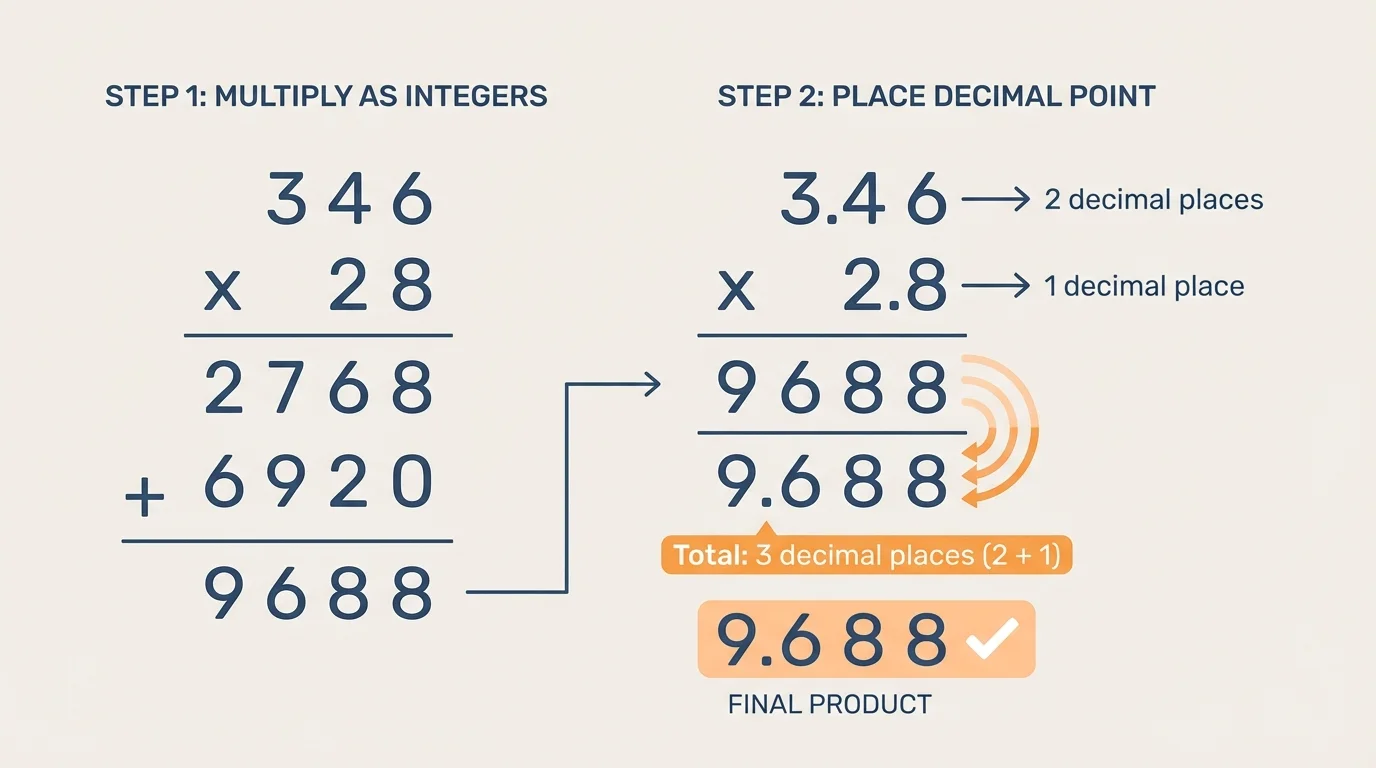
Decimal multiplication uses a very important idea: first multiply as if the numbers were whole numbers, then place the decimal point in the product. The number of decimal places in the final answer depends on the total number of decimal places in the factors, as [Figure 3] shows.
Suppose you multiply \(3.4 \times 2.7\). Ignore the decimal points at first and multiply \(34 \times 27\). Then count the decimal places in the factors: \(3.4\) has \(1\) decimal place and \(2.7\) has \(1\) decimal place, for a total of \(2\). So the product must have \(2\) decimal places.
Solved Example 3
Find \(3.46 \times 2.8\).
Step 1: Ignore the decimal points and multiply as whole numbers.
Compute \(346 \times 28\).
\[\begin{array}{r} 346 \\ \times\;28 \\ \hline 2768 \\ 6920 \\ \hline 9688 \end{array}\]
Step 2: Count decimal places in the factors.
\(3.46\) has \(2\) decimal places.
\(2.8\) has \(1\) decimal place.
Total decimal places: \(2 + 1 = 3\).
Step 3: Place the decimal point in the product.
The whole-number product is \(9688\). With \(3\) decimal places, the product is \(9.688\).
\[3.46 \times 2.8 = 9.688\]
The product is \(9.688\).
You can check by estimating. Since \(3.46 \approx 3.5\) and \(2.8 \approx 3\), the product should be about \(10.5\). The exact answer \(9.688\) is close, so it is reasonable.
This is one place where students often make mistakes: they multiply correctly but place the decimal in the wrong spot. Estimation can catch that. If someone said \(3.46 \times 2.8 = 96.88\), you would know immediately that the answer is too large.
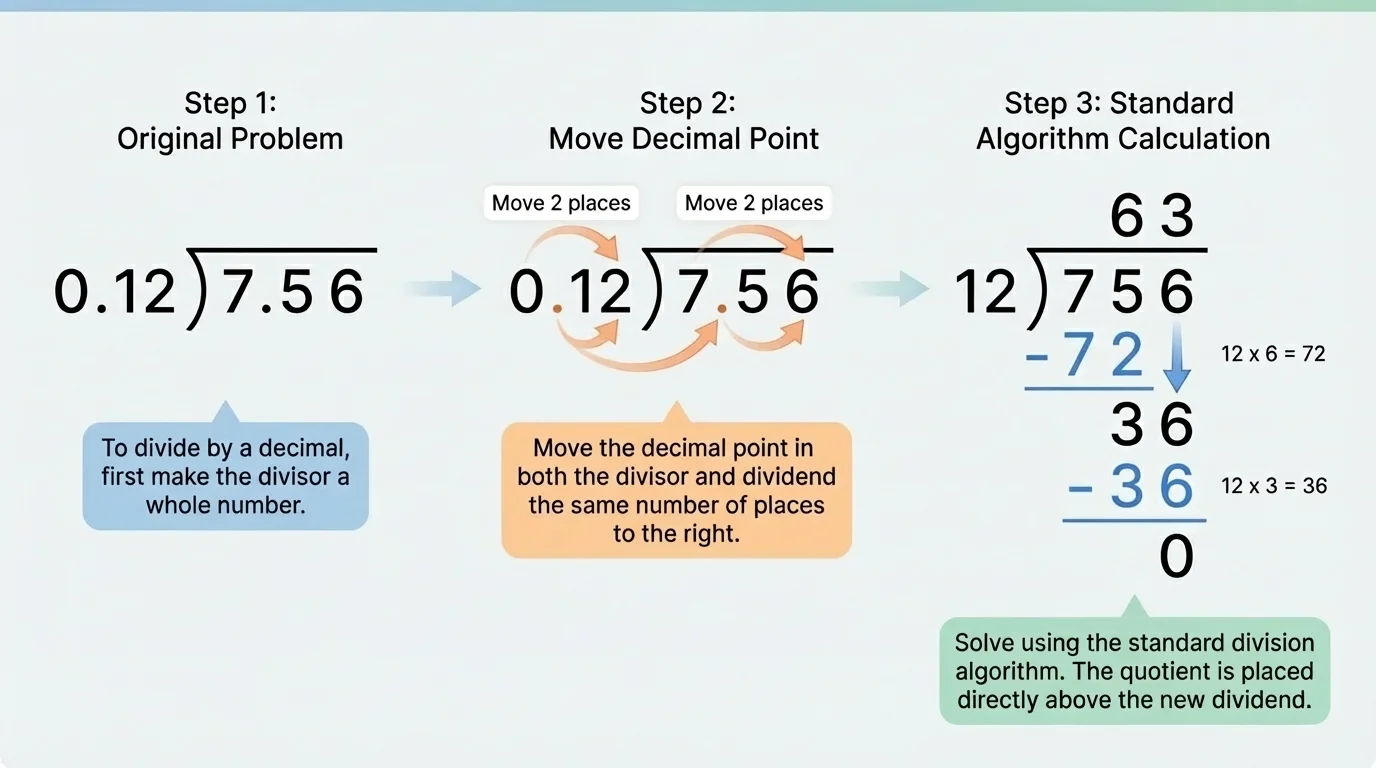
Quotient means the answer to a division problem. Dividing decimals can feel more challenging, but the standard process stays organized when you use place value carefully. A key idea is that dividing by a decimal is easier if you rewrite the problem so the divisor is a whole number, as [Figure 4] illustrates.
If the divisor is already a whole number, divide much like you would with whole numbers, placing the decimal point in the quotient directly above the decimal point in the dividend. If the divisor is a decimal, move the decimal point in both the divisor and the dividend the same number of places to the right. This does not change the value of the quotient.
Why moving both decimal points works
Multiplying both the dividend and the divisor by the same power of \(10\) creates an equivalent division problem. For example, \(4.2 \div 0.6\) becomes \(42 \div 6\) after both numbers are multiplied by \(10\). The quotient stays the same because you scaled both numbers equally.
For example, \(15.75 \div 3\) keeps the divisor as a whole number, so you can divide directly. But \(7.56 \div 0.12\) needs to be rewritten. Move both decimals two places right to get \(756 \div 12\).
Solved Example 4
Find \(7.56 \div 0.12\).
Step 1: Rewrite the division so the divisor is a whole number.
\(0.12\) has \(2\) decimal places, so move the decimal in both numbers \(2\) places to the right.
\(7.56 \div 0.12 = 756 \div 12\)
Step 2: Divide.
\(756 \div 12 = 63\)
Step 3: State the quotient.
\[7.56 \div 0.12 = 63\]
The quotient is \(63\).
Here is a second division example with a whole-number divisor. For \(18.24 \div 8\), divide normally. Since \(18 \div 8 = 2\) with remainder, place the decimal in the quotient above the decimal in \(18.24\), then continue dividing. The result is \(2.28\).
Later, when you check your work, multiply the quotient by the divisor. Equivalent division problems help make the algorithm easier without changing the answer.
Estimate means to find a close answer that helps you judge whether an exact answer is reasonable. Estimation is not a replacement for exact computation here. Instead, it acts like a safety check.
When adding and subtracting decimals, round to nearby whole numbers or tenths. For example, \(19.87 + 4.12\) is close to \(20 + 4 = 24\). The exact sum, \(23.99\), is therefore sensible.
When multiplying and dividing, think about size. If both factors are less than \(10\), the product should not suddenly jump to the hundreds unless one factor is very large. If you divide by a number less than \(1\), the quotient becomes larger than the dividend. For instance, \(6 \div 0.5 = 12\). That may seem surprising at first, but it makes sense because you are asking how many halves fit into \(6\).
Sprinters, swimmers, and race car drivers are often separated by only hundredths or thousandths. Accurate decimal computation is part of how officials record times and decide winners.
Inverse operations are operations that undo each other. Addition and subtraction are inverses, and multiplication and division are inverses. You can use this idea to check answers. If \(5.73 + 2.48 = 8.21\), then \(8.21 - 2.48\) should return \(5.73\). If \(4.5 \times 1.2 = 5.4\), then \(5.4 \div 1.2\) should return \(4.5\).
One common mistake is not lining up decimal points in addition or subtraction. For example, writing \(3.4 + 12.56\) without alignment can mix up tenths and ones. The correct setup is
\[\begin{array}{r} 3.40 \\ +\;12.56 \\ \hline 15.96 \end{array}\]
Another common mistake is forgetting to add zeros when subtracting. In \(9.2 - 4.78\), writing \(9.2\) as \(9.20\) makes the subtraction much clearer.
A third mistake happens in multiplication when students count decimal places incorrectly. For example, \(0.45 \times 0.2\) should be \(0.09\), not \(0.9\), because there are \(2 + 1 = 3\) decimal places in the factors, and the whole-number product \(45 \times 2 = 90\) becomes \(0.090\), which is \(0.09\).
In division, students sometimes move only one decimal point instead of both. In \(3.6 \div 0.4\), moving only the divisor would change the problem incorrectly. Move both one place right: \(36 \div 4 = 9\).
Decimal operations are everywhere. Money is one of the clearest examples. If you buy items costing $12.49, $3.75, and $8.60, you add decimals to find the total cost. If you pay with $30.00, you subtract to find the change.
Measurements also rely on decimals. A piece of wood might be \(1.25\) meters long, and another might be \(0.87\) meters long. To find the total, you add. To find how much longer one piece is than the other, you subtract.
Multiplication appears when one amount repeats. If apples cost $2.35 per kilogram and you buy \(3.4\) kilograms, multiply \(2.35 \times 3.4\) to find the cost. Division appears when you share or compare. If \(6.75\) liters of juice is poured equally into \(9\) bottles, divide \(6.75 \div 9\) to find liters per bottle.
Real-world solved example
A runner completes \(3\) laps. Each lap is \(0.75\) kilometer. How far does the runner travel?
Step 1: Identify the operation.
Equal groups mean multiplication: \(3 \times 0.75\).
Step 2: Multiply.
\(3 \times 75 = 225\), and since \(0.75\) has \(2\) decimal places, the product is \(2.25\).
\[3 \times 0.75 = 2.25\]
Step 3: State the answer with units.
The runner travels \(2.25\) kilometers.
Cooking is another great example. A recipe may need \(1.25\) cups of milk for one batch. For \(4\) batches, you multiply \(1.25 \times 4 = 5\) cups. If you have \(5\) cups total and use \(1.25\) cups per batch, then \(5 \div 1.25 = 4\) batches can be made.
| Operation | Main Idea | Important Detail |
|---|---|---|
| Add | Combine amounts | Line up decimal points |
| Subtract | Find the difference | Line up decimal points and regroup if needed |
| Multiply | Find equal groups or area | Multiply first, then place the decimal using total decimal places |
| Divide | Share or find how many groups | Make the divisor a whole number if necessary |
Table 1. The main idea and critical detail for each decimal operation.
When you understand the standard algorithm for each operation, decimals become much less mysterious. The key is always to let place value guide the steps. Whether you are adding money, subtracting distances, multiplying measurements, or dividing quantities, the decimal point is not just a dot. It tells the value of every digit around it.
