What do a winter forecast, a scuba diver, and a bank account have in common? All of them use numbers that go on both sides of zero. If the temperature is \(-4\), a diver is at \(-12\) meters, or your account changes by \(-\$15\), the negative sign is telling an important story. Numbers are not just about how much; they can also show direction, position, gain, loss, and opposites.
Until now, you may have used counting numbers like \(1, 2, 3\) and whole numbers like \(0, 1, 2, 3\). But real life includes situations where numbers below zero matter too. To describe these situations clearly, mathematicians use positive and negative numbers together.
Some quantities naturally come in opposite pairs. A number can show being above or below, gain or loss, forward or backward, or positive or negative. A positive number and a negative number can have the same distance from zero but opposite meanings. For example, \(5\) and \(-5\) are opposites.
If a city has a temperature of \(5\), that means \(5\) degrees above zero. If another city has a temperature of \(-5\), that means \(5\) degrees below zero. The numbers are related, but they do not mean the same thing. The sign matters.
Positive numbers are numbers greater than \(0\). Negative numbers are numbers less than \(0\). The set of negative numbers, \(0\), and positive numbers is called the set of integers.
In many real-world situations, using only positive numbers would be confusing. If a diver is \(20\) meters below sea level, writing just \(20\) would not tell whether the diver is above or below sea level. The negative sign makes the meaning clear.
When you see the integer \(0\), it does not always mean "nothing." Often, it means a starting point, a reference point, or a balance point. This is one of the most important ideas in this topic.
The meaning of \(0\) depends on the situation:
So \(0\) is not just "empty." It is the point that separates positive values from negative values.
You already know how to compare whole numbers on a number line: numbers farther to the right are greater. This same idea still works when negative numbers are included.
For example, \(3\) is greater than \(1\), and \(-1\) is greater than \(-4\). Even though both are negative, \(-1\) is farther to the right on the number line.
When reading signed numbers, always pay attention to the sign. The number \(-7\) is read as "negative seven." The number \(7\) may be read as "positive seven," although the positive sign is often not written.
A signed number tells two things at once: the sign tells the direction or type, and the number part tells the size. In \(-9\), the negative sign shows the direction or value type, and the \(9\) shows the amount.
Here are some examples of interpretation:
Comparing signed numbers can feel surprising at first. For example, \(-2\) is greater than \(-6\), because \(-2\) is closer to \(0\). Also, any positive number is greater than any negative number. And \(0\) is greater than every negative number but less than every positive number.
| Number | Position relative to \(0\) | Comparison idea |
|---|---|---|
| \(-5\) | \(5\) units below \(0\) | Less than \(0\) |
| \(0\) | At the reference point | Neither positive nor negative |
| \(4\) | \(4\) units above \(0\) | Greater than \(0\) |
Table 1. How signed numbers relate to zero on a number line.
A number line shows numbers in order on both sides of zero. Numbers to the right are greater, and numbers to the left are smaller. This picture helps us understand why signs matter.
On a horizontal number line, moving right usually means the positive direction, and moving left means the negative direction. The distance from \(0\) tells how far a number is from the reference point. For instance, \(4\) and \(-4\) are both \(4\) units away from \(0\), but in opposite directions.
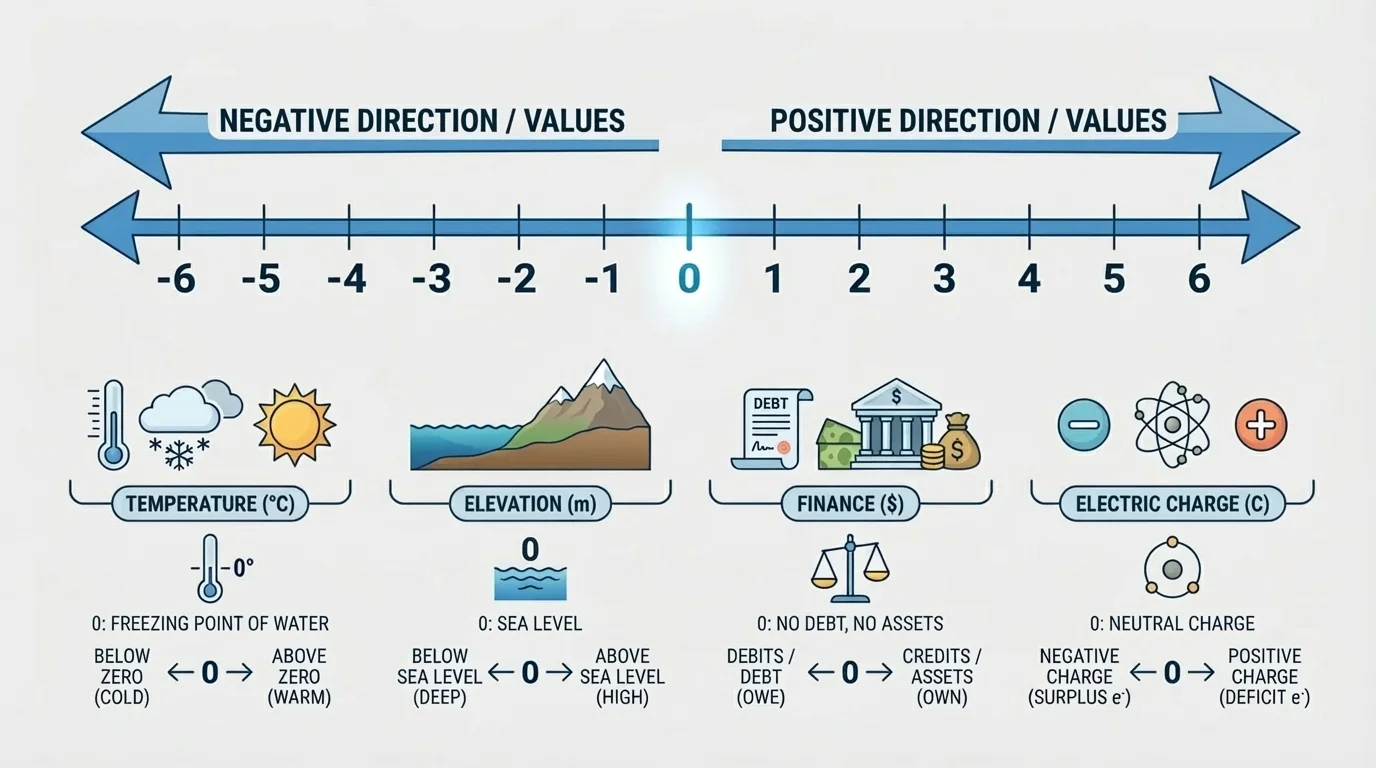
Opposites are especially important. The opposite of \(6\) is \(-6\). The opposite of \(-3\) is \(3\). The opposite of \(0\) is still \(0\), because \(0\) is exactly at the center.
Opposite values and equal distance from zero
Two numbers are opposites if they are the same distance from \(0\) on a number line but on opposite sides. Opposites have different signs unless the number is \(0\). This is why \(9\) and \(-9\) are opposites, but \(9\) and \(8\) are not.
You can also think about vertical number lines. [Figure 1] helps connect this idea to the horizontal number line. In some situations, "up" is positive and "down" is negative. This is useful for elevation, floors in a building, or depth underwater. The same math idea works even when the picture is vertical instead of horizontal.
Positive and negative numbers become most meaningful when they are connected to real situations. They help us describe the world accurately and efficiently, as [Figure 2] shows for temperature.
A temperature scale often uses \(0\) as an important reference point. Temperatures above \(0\) are positive, and temperatures below \(0\) are negative.
If the temperature in the morning is \(-3\) and later rises to \(4\), that means it started \(3\) degrees below zero and later reached \(4\) degrees above zero. The sign tells whether the temperature is above or below the reference point of \(0\).
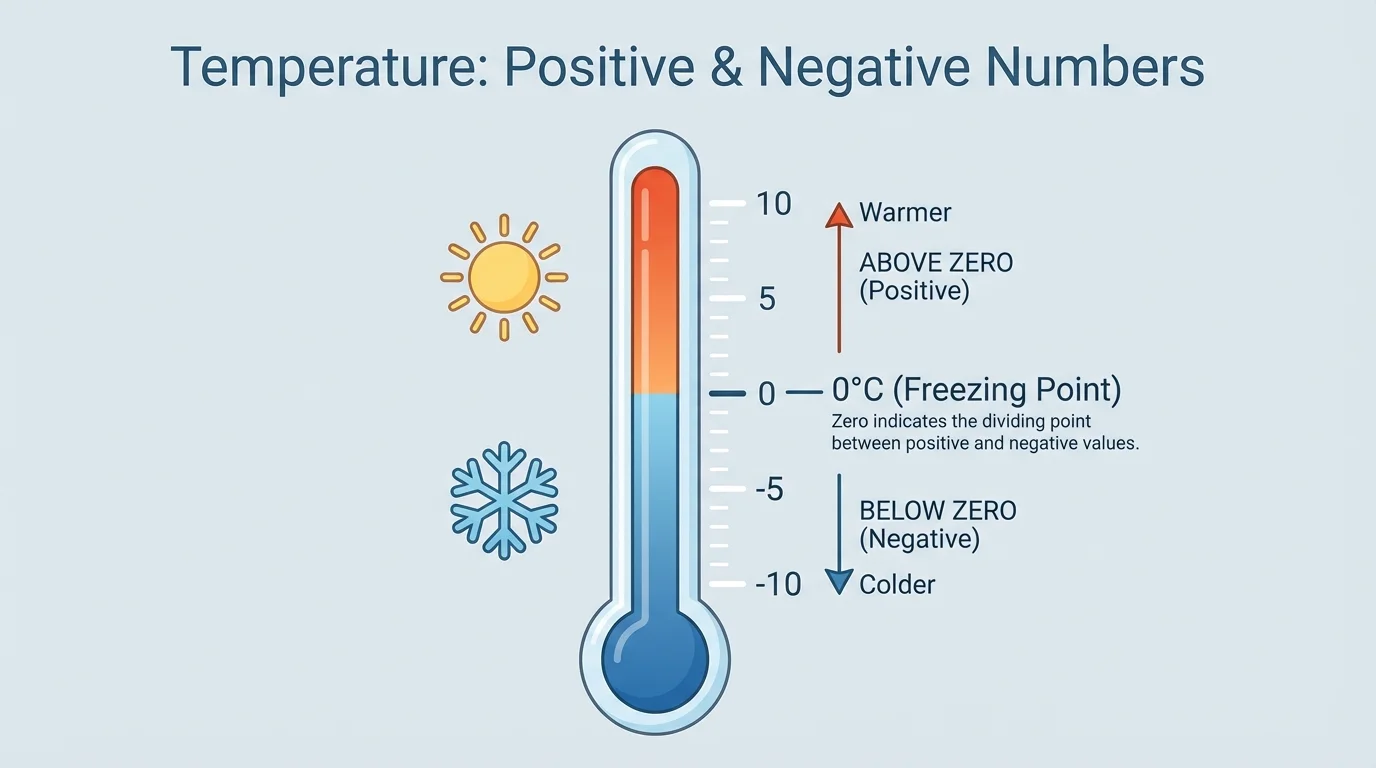
In this context, \(0\) does not mean there is no temperature. It means zero degrees on the scale being used.
Elevation measures height relative to sea level. [Figure 3] shows sea level as the reference point. Locations above sea level have positive elevation. Locations below sea level have negative elevation.
A mountain cabin at \(850\) meters has elevation \(+850\) meters. A place at \(-30\) meters is \(30\) meters below sea level. Sea level itself is \(0\) meters.
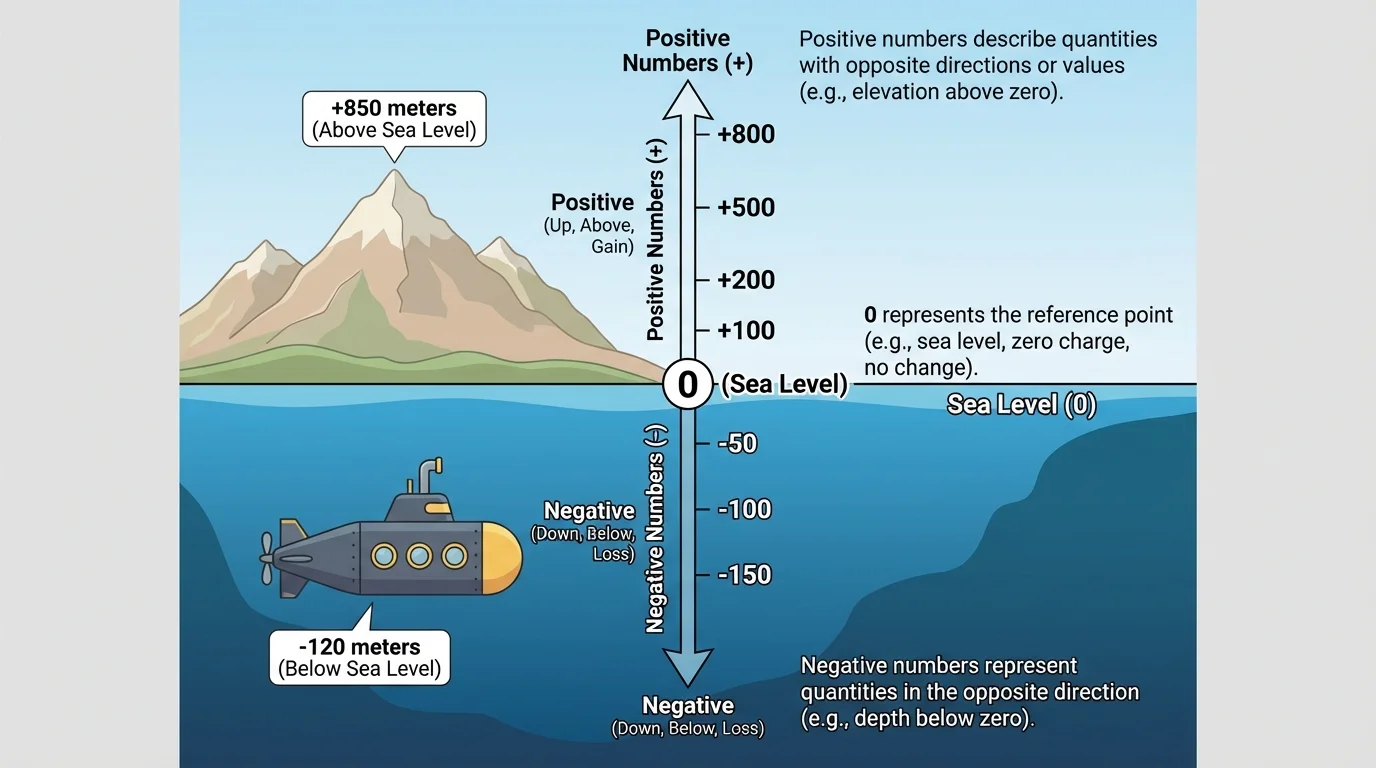
Here, \(0\) means sea level, not the absence of land or water. A location can still exist at \(0\) meters; it is simply at the reference height.
In money situations, a credit may be represented by a positive number because it increases a balance, while a debit may be represented by a negative number because it decreases a balance. [Figure 4] shows how these changes can be recorded in a simple ledger.
If your account changes by \(+\$20\), that means \(\$20\) was added. If your account changes by \(-\$15\), that means \(\$15\) was taken away. These signed numbers help track increases and decreases clearly.
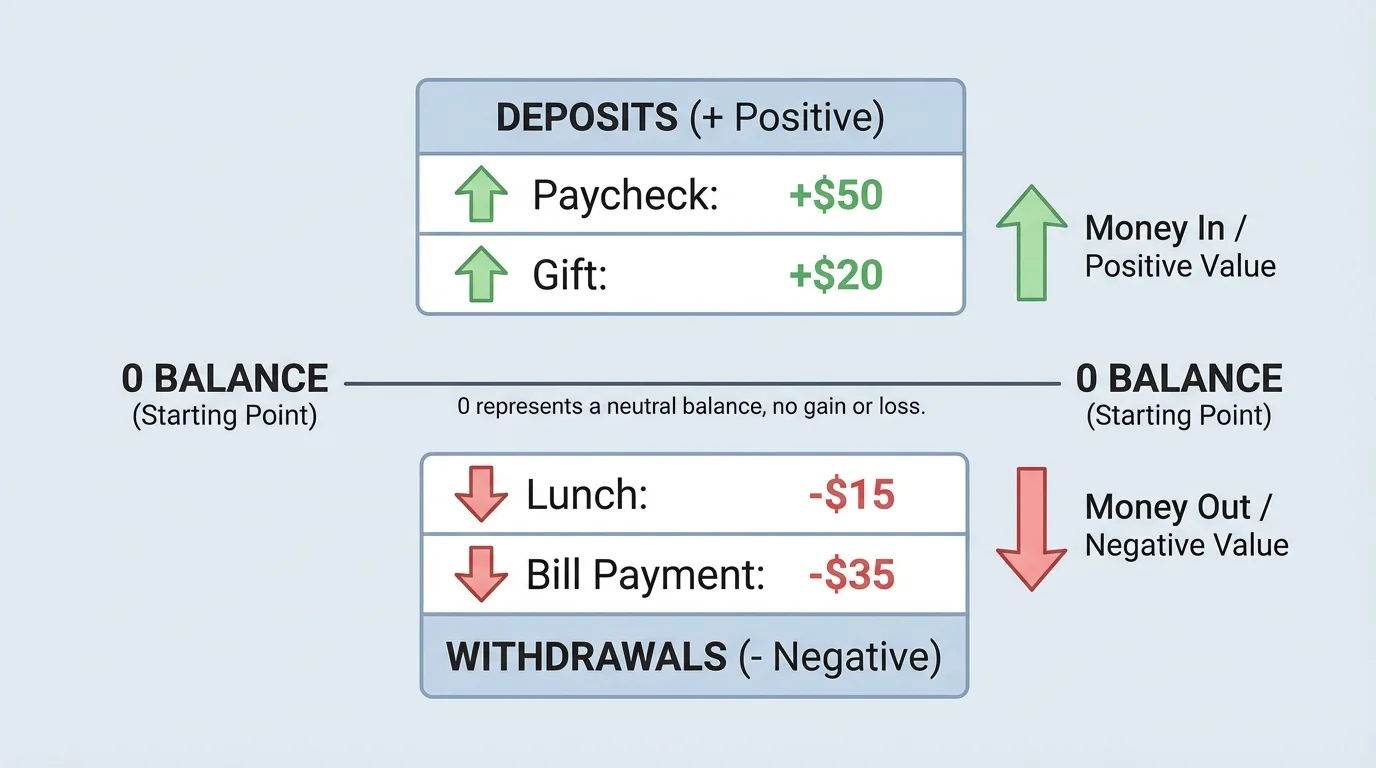
In this context, \(0\) can mean no change, or it can mean the account balance is exactly zero. Again, the meaning of \(0\) depends on the situation.
An electric charge can be positive or negative. This is another example of opposite values. A positive charge and a negative charge are different types of charge, not "good" and "bad" charges.
In this context, \(0\) means neutral charge. An object with a total charge of \(0\) is balanced, not positively charged and not negatively charged.
Lightning happens because electric charges build up and then move suddenly. The idea of positive and negative charge is not just a math idea; it helps scientists describe real events in nature.
The same pattern keeps appearing: positive and negative numbers describe opposites, and \(0\) is the reference point that separates them.
Now let's see how to represent and interpret these numbers carefully in context.
Worked example 1
A weather report says the overnight temperature is \(-7\) degrees and the afternoon temperature is \(5\) degrees. Explain what each number means and what \(0\) means in this situation.
Step 1: Interpret \(-7\).
The negative sign means the temperature is below zero, so \(-7\) means \(7\) degrees below \(0\).
Step 2: Interpret \(5\).
The positive value means the temperature is above zero, so \(5\) means \(5\) degrees above \(0\).
Step 3: Explain the meaning of \(0\).
Here, \(0\) means zero degrees on the thermometer scale. It is the reference point between temperatures above zero and below zero.
So \(-7\) is colder than \(5\), and \(0\) is the dividing point on the temperature scale.
Notice that the sign gives the direction from zero, while the number gives the amount.
Worked example 2
A submarine is at \(-120\) meters, and a boat is at \(0\) meters. What does each number mean?
Step 1: Interpret \(-120\).
The negative sign shows a position below sea level, so \(-120\) meters means \(120\) meters below sea level.
Step 2: Interpret \(0\).
The boat at \(0\) meters is at sea level.
Step 3: Compare the values.
Since \(-120\) is less than \(0\), the submarine is below the boat's level.
The number \(0\) is not "no location." It means the reference level of the sea.
The same number line idea helps here, even though the real situation is vertical instead of horizontal.
Worked example 3
A bank record shows \(+\$30\), \(-\$12\), and \(\$0\) as possible changes. Explain each one.
Step 1: Interpret \(+30\).
A positive change means an increase, so \(+30\) means \(\$30\) was added to the account.
Step 2: Interpret \(-12\).
A negative change means a decrease, so \(-12\) means \(\$12\) was removed from the account.
Step 3: Interpret \(0\).
A change of \(0\) means the balance did not increase or decrease.
In this context, the sign tells whether money moves in or out.
Money records make it easy to see why positive and negative numbers are useful for tracking gains and losses.
Worked example 4
Write a signed number for each situation: \(8\) meters above sea level, \(14\) degrees below zero, and a gain of \(\$6\).
Step 1: Above sea level.
Above the reference point is positive, so the number is \(+8\).
Step 2: Below zero.
Below the reference point is negative, so the number is \(-14\).
Step 3: Gain of money.
A gain is positive, so the number is \(+\$6\).
The signed numbers are \(+8\), \(-14\), and \(+\$6\).
One common mistake is ignoring the sign. The numbers \(4\) and \(-4\) are not the same. They have the same distance from \(0\), but opposite meanings.
Another mistake is thinking that \(0\) always means "nothing." In temperature, \(0\) is a temperature. In elevation, \(0\) is sea level. In electric charge, \(0\) is neutral. In a bank account change, \(0\) means no change.
Students also sometimes think the negative number with the greater digit is larger. But on a number line, \(-10\) is less than \(-2\). The farther left a number is, the smaller it is.
Reading signed numbers in context
To understand a signed number, ask two questions: What does the sign mean in this situation, and what does \(0\) represent? Once those are clear, the number becomes much easier to interpret correctly.
This same careful reading helps with temperatures on thermometers, heights on maps, and balances in money records. The thermometer in [Figure 2] and the elevation diagram in [Figure 3] both show that \(0\) is a reference point, not just an empty spot.
Positive and negative numbers are used in science, geography, sports statistics, and finance. Weather scientists report temperatures above and below zero. Geographers record elevations relative to sea level. Electric charge helps scientists describe atoms and electricity. Banks and businesses use positive and negative values to track money coming in and going out.
These numbers let us describe opposites clearly and accurately. Without negative numbers, many real-world measurements would be incomplete or confusing.
