What do a basement floor, a winter temperature, and money owed all have in common? They can all be described using numbers less than \(0\). Negative numbers may look strange at first, but they help us describe locations and amounts on the other side of zero. Once you understand how numbers sit on a number line, ideas like \(-3\), \(-(-3)\), and why \(0\) is special begin to make a lot of sense.
You already know positive integers like \(1\), \(2\), and \(10\). These are useful for counting objects. But some situations are not about counting things you have. Sometimes you need to describe being below a starting point, less than nothing in a certain context, or in the opposite direction. That is when negative numbers become useful.
For example, if the outside temperature is \(5\) degrees below zero, we write \(-5\). If a diver is \(8\) meters below sea level, that can be written as \(-8\). If a building has a basement level one floor below the ground floor, that can be labeled \(-1\). In each case, the negative sign helps show a position on one side of a reference point, and positive numbers describe positions on the other side.
On a number line, numbers increase as you move to the right and decrease as you move to the left. The number \(0\) sits in the middle between positive and negative numbers.
This idea of a reference point is very important. In this lesson, the main reference point is \(0\). We will use the number line to see how numbers with opposite signs are related.
A number line is a straight line on which each number corresponds to a point. As [Figure 1] shows, numbers with opposite signs lie on opposite sides of \(0\). Positive numbers such as \(1\), \(2\), and \(5\) are to the right of \(0\). Negative numbers such as \(-1\), \(-2\), and \(-5\) are to the left of \(0\).
The distance from \(0\) matters. The numbers \(4\) and \(-4\) are both \(4\) units away from \(0\), but they are on different sides. That is why they are called opposites. The sign tells the direction from \(0\): positive means right, and negative means left.
Here are some opposite pairs:
Notice that opposites do not have to be whole numbers. Fractions and decimals can also have opposites. Any rational number can be placed on the number line, and its opposite is the same distance from \(0\) on the other side.
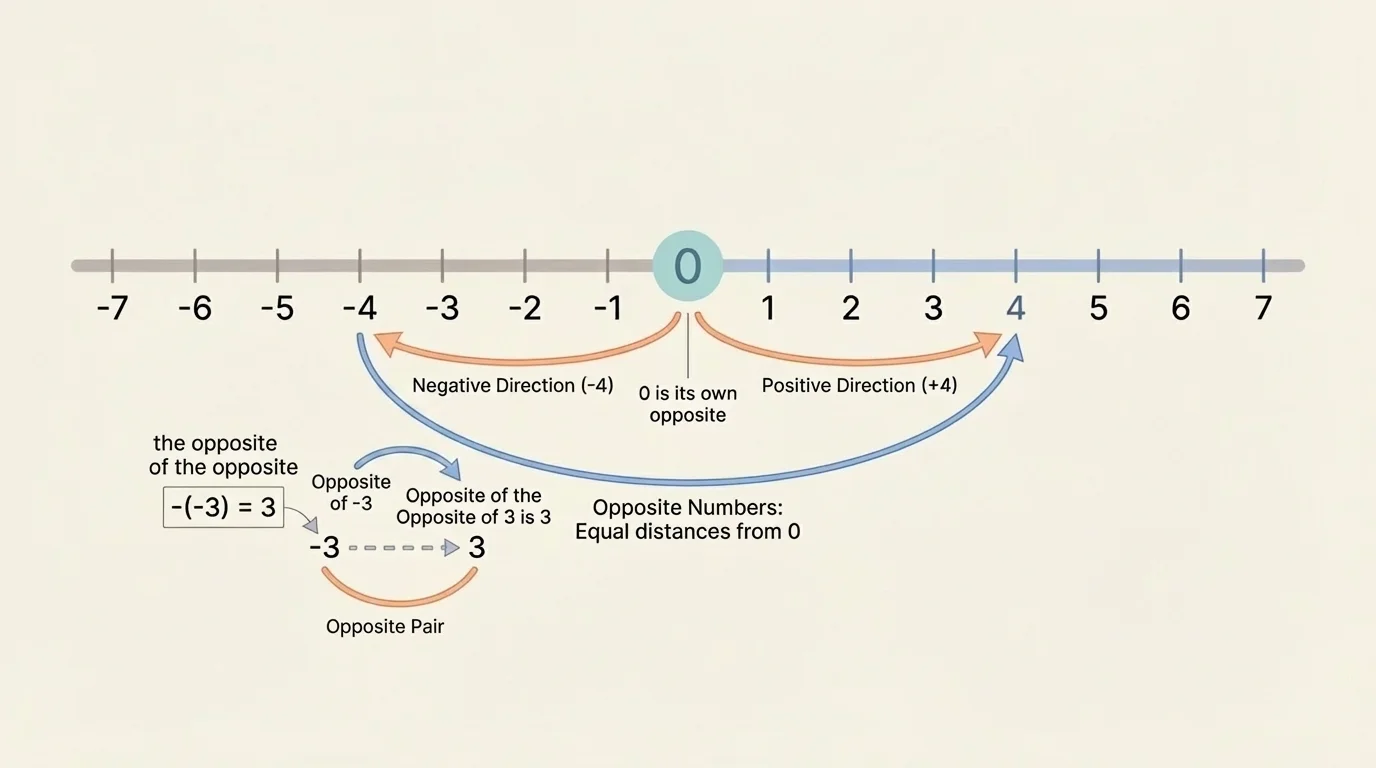
If one number is to the right of \(0\), its opposite is the same number of units to the left. This relationship stays true no matter how large or small the number is. Later, when you work with coordinate axes, the same idea helps you understand points with negative coordinates.
Opposite numbers are numbers that are the same distance from \(0\) on the number line but on opposite sides of \(0\).
Positive numbers are greater than \(0\), and negative numbers are less than \(0\).
Think of walking on a straight sidewalk. If you start at \(0\) and walk \(3\) steps to the right, you land on \(3\). If you instead walk \(3\) steps to the left, you land on \(-3\). The two locations are mirror images across \(0\).
An opposite is not just a number with a minus sign. It is a number that represents the same distance from \(0\) in the opposite direction. The opposite of \(6\) is \(-6\), and the opposite of \(-6\) is \(6\).
Another way to say this is that opposites "undo" each other in direction. If one number means moving right from \(0\), its opposite means moving left the same amount. If one number means above sea level, its opposite means below sea level by the same amount.
Here are several examples:
It helps to focus on two parts: the distance from \(0\) stays the same, but the side of \(0\) changes.
Same distance, opposite direction
Opposites are connected to location. If two numbers are opposites, they are equally far from \(0\) but in reverse directions. That is why opposite signs are meaningful: the sign does not just decorate the number; it tells which side of \(0\) the point lies on.
You can even talk about the opposite of a negative number. This is a key idea because students often think the minus sign always means "make it smaller." On the number line, the opposite of a negative number actually moves you to the positive side.
If you reverse direction once, you go to the opposite side. If you reverse direction again, you come back to where you started. As [Figure 2] illustrates, taking the opposite twice brings you back to the original number.
For example, start with \(3\). Its opposite is \(-3\). Now take the opposite of \(-3\). You get \(3\) again. In symbols, we write
\(-(-3) = 3\)
This works for any number. Here are more examples:
Why does this happen? The first opposite changes the side of \(0\). The second opposite changes the side again, returning to the original side. It is like turning around twice: after two reversals, you face the original direction.
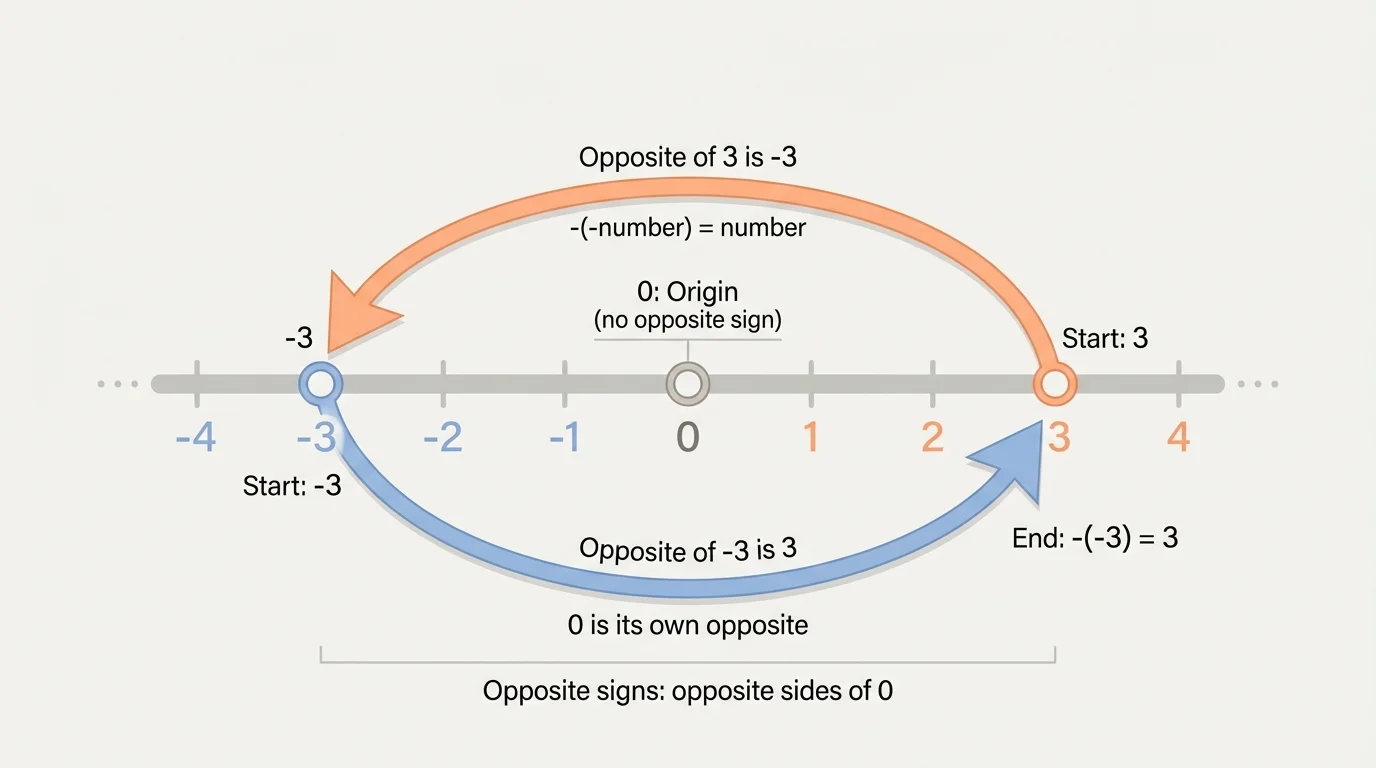
This idea is very important when reading expressions. The expression \(-4\) means a negative number. But the expression \(-(-4)\) means the opposite of \(-4\), which is \(4\). The outer negative sign is not simply another decoration; it tells you to find the opposite.
Later, when you study integers more deeply, this idea helps explain addition and subtraction with signed numbers. For now, the most important fact is this:
The opposite of the opposite of a number is the number itself.
The number zero is special. It is not positive, and it is not negative. It is the point that separates positive numbers from negative numbers on the number line.
To find the opposite of a number, you look for the number the same distance from \(0\) on the other side. But \(0\) is already exactly at \(0\). It is \(0\) units away from itself. There is no other number on the opposite side at the same distance. So the opposite of \(0\) is \(0\).
We can write this as
\(-0 = 0\)
This makes sense on the number line. There is no left or right movement when you stay at \(0\). So changing direction does not change the location.
Zero took a long time to be accepted in mathematics. Today it seems ordinary, but it is one of the most powerful ideas in all of math because it works as a starting point, a separator, and a number with unique properties.
That is why \(0\) is called its own opposite. It is the only number with this property.
Once you understand opposites, you can interpret many number line situations more clearly. Numbers farther to the right are greater. Numbers farther to the left are less. So \(-2\) is greater than \(-5\) because \(-2\) is to the right of \(-5\).
Opposites help you compare positions. For example, \(4\) and \(-4\) are equally far from \(0\), but \(4\) is greater because it is to the right. The pair tells you something about symmetry around \(0\), not that the two numbers are equal.
This same idea works for fractions and decimals. The numbers \(1.2\) and \(-1.2\) are opposites. The numbers \(\dfrac{5}{6}\) and \(-\dfrac{5}{6}\) are opposites. Rational numbers are not limited to whole numbers, and all of them can be shown as points on the number line.
| Number | Opposite | Location Compared to \(0\) |
|---|---|---|
| \(5\) | \(-5\) | Right of \(0\) |
| \(-3\) | \(3\) | Left of \(0\) |
| \(0\) | \(0\) | At \(0\) |
| \(2.7\) | \(-2.7\) | Right of \(0\) |
| \(-\dfrac{1}{4}\) | \(\dfrac{1}{4}\) | Left of \(0\) |
Table 1. Examples of numbers, their opposites, and their locations relative to \(0\).
As you saw earlier in [Figure 1], opposite numbers form mirror pairs around \(0\). This mirror idea is a powerful way to picture signed numbers quickly.
Let's work through several examples step by step.
Worked example 1
Find the opposite of \(7\), \(-11\), and \(0\).
Step 1: Remember the meaning of opposite.
An opposite is the same distance from \(0\) on the other side of \(0\).
Step 2: Find each opposite.
The opposite of \(7\) is \(-7\).
The opposite of \(-11\) is \(11\).
The opposite of \(0\) is \(0\).
The answers are \(-7\), \(11\), and \(0\).
Notice how the sign changes for nonzero numbers, but \(0\) stays the same.
Worked example 2
Evaluate \(-(-9)\).
Step 1: Read the expression carefully.
The expression asks for the opposite of \(-9\).
Step 2: Find the opposite.
The opposite of \(-9\) is \(9\).
So, \(-(-9) = 9\)
This illustrates the idea that the opposite of the opposite of a number is the number itself. A double reversal returns to the original number.
Worked example 3
A submarine is at \(-120\) meters relative to sea level. What location is the opposite of that position?
Step 1: Interpret the number.
The submarine is \(120\) meters below sea level, so its location is \(-120\).
Step 2: Find the opposite location.
The opposite must be the same distance from sea level on the other side, so it is \(120\).
Step 3: State the meaning.
\(120\) means \(120\) meters above sea level.
The opposite location is \(120\) meters relative to sea level.
In real situations, opposite numbers often describe positions above and below a reference line.
Worked example 4
Which number is the opposite of the opposite of \(-\dfrac{3}{5}\)?
Step 1: Find the first opposite.
The opposite of \(-\dfrac{3}{5}\) is \(\dfrac{3}{5}\).
Step 2: Find the opposite again.
The opposite of \(\dfrac{3}{5}\) is \(-\dfrac{3}{5}\).
So the opposite of the opposite of \(-\dfrac{3}{5}\) is \(-\dfrac{3}{5}\).
This example shows that the rule works for fractions too, not just whole numbers.
[Figure 3] Signed numbers are useful whenever a situation has a central reference point. Positive and negative numbers describe positions on opposite sides of the same starting level.
Elevation and sea level: If a hilltop is \(200\) meters above sea level, it can be written as \(200\). If a trench is \(200\) meters below sea level, it can be written as \(-200\). These two numbers are opposites because they are the same distance from sea level in opposite directions.
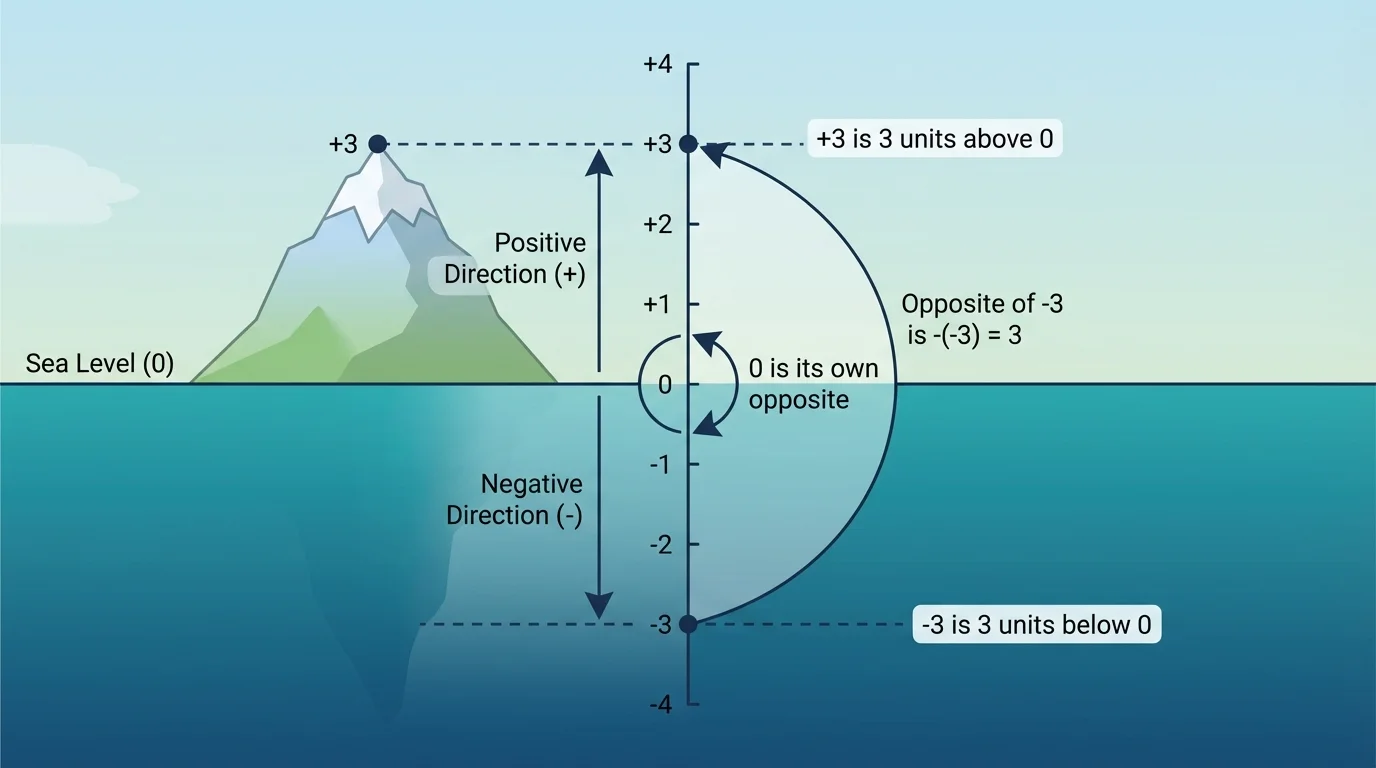
Temperature: A temperature of \(6\) degrees above zero is \(6\), and \(6\) degrees below zero is \(-6\). If the weather changes from \(-6\) to its opposite, it becomes \(6\).
Money: If a person has \(\$15\) in a bank account, that can be thought of as \(15\). If the person owes \(\$15\), that can be represented as \(-15\). The numbers describe opposite financial situations.
Floors in a building: The ground floor can be treated as \(0\). Floors above it might be \(1\), \(2\), and \(3\), while basement levels might be \(-1\) and \(-2\). The first floor above ground and the first floor below ground are opposites if the building uses ground level as \(0\).
Coordinates: On a coordinate plane, negative numbers help locate points left of the vertical axis or below the horizontal axis. The same number line ideas you have learned here are the basis for understanding negative coordinates later.
When you look back at the movement idea in [Figure 2], it becomes easier to understand why changing direction twice returns to the same location. Real-world models and number lines support the same rule.
One common mistake is thinking that "opposite" means "negative." That is not always true. The opposite of \(8\) is \(-8\), but the opposite of \(-8\) is \(8\). Opposite means switch sides of \(0\), not "always put a minus sign in front."
Another mistake is forgetting that \(0\) is special. Some students think the opposite of \(0\) should be something else, but there is no other number the same distance from \(0\) on the opposite side. So the opposite of \(0\) is still \(0\).
A third mistake is reading \(-(-4)\) as a negative number because it starts with a minus sign. But the expression means "the opposite of \(-4\)," which is \(4\).
"Same distance from \(0\), opposite side of \(0\)."
— A useful rule for recognizing opposites
If you keep this rule in mind, many sign problems become much easier. Opposites are about location, symmetry, and direction on the number line.
