On a winter day, a temperature of \(-3^\circ \textrm{C}\) can feel freezing, but it is still warmer than \(-7^\circ \textrm{C}\). That may seem strange at first because \(7\) is bigger than \(3\). The key idea is that when numbers are negative, the one closer to \(0\) is actually greater. Learning how to compare rational numbers helps us understand weather reports, heights above and below sea level, bank account balances, and many other real-life situations.
We use order whenever we decide which number is greater, less, or equal to another number. In everyday life, order helps answer questions like: Which city is colder? Which elevator is lower? Which player lost more points? Which account has more debt?
Order is not just about listing numbers from smallest to largest. It is also about writing clear mathematical statements and explaining what they mean. For example, the statement \(-3 > -7\) means that \(-3\) is greater than \(-7\). In a temperature context, that means \(-3^\circ \textrm{C}\) is warmer than \(-7^\circ \textrm{C}\).
You already know that numbers can be compared using symbols. \(5 > 2\) means \(5\) is greater than \(2\), and \(1 < 4\) means \(1\) is less than \(4\). Now the same ideas extend to negative numbers and all rational numbers.
When rational numbers appear in real-world contexts, the meaning of "greater" depends on the situation but still follows the same number order. A greater temperature is warmer. A greater elevation is higher. A greater bank balance means more money or less debt.
A rational number is any number that can be written as a fraction of two integers, as long as the denominator is not \(0\). Integers such as \(-5\), \(0\), and \(8\) are rational numbers. Fractions such as \(\dfrac{3}{4}\) and \(-\dfrac{7}{2}\), and decimals such as \(1.5\) and \(-0.25\), are also rational numbers.
Comparison symbols help show order.
\(>\) means greater than.
\(<\) means less than.
\(=\) means equal to.
Here are some examples of reading comparison statements:
\(4 > -2\) is read as "\(4\) is greater than \(-2\)."
\(-8 < -1\) is read as "\(-8\) is less than \(-1\)."
\(\dfrac{1}{2} = 0.5\) is read as "\(\dfrac{1}{2}\) equals \(0.5\)."
The symbols point toward the smaller number. In \(-8 < -1\), the opening of the symbol faces \(-1\), which is greater, and the pointed end faces \(-8\), which is smaller.
A number line makes order easy to see, as [Figure 1] shows. Numbers farther to the right are greater, and numbers farther to the left are less. This rule works for positive numbers, negative numbers, fractions, and decimals.
On a number line, \(-7\) is to the left of \(-3\), so \(-7 < -3\). Also, \(-3\) is to the right of \(-7\), so \(-3 > -7\). Even though \(7\) is greater than \(3\), the negative sign changes the order.
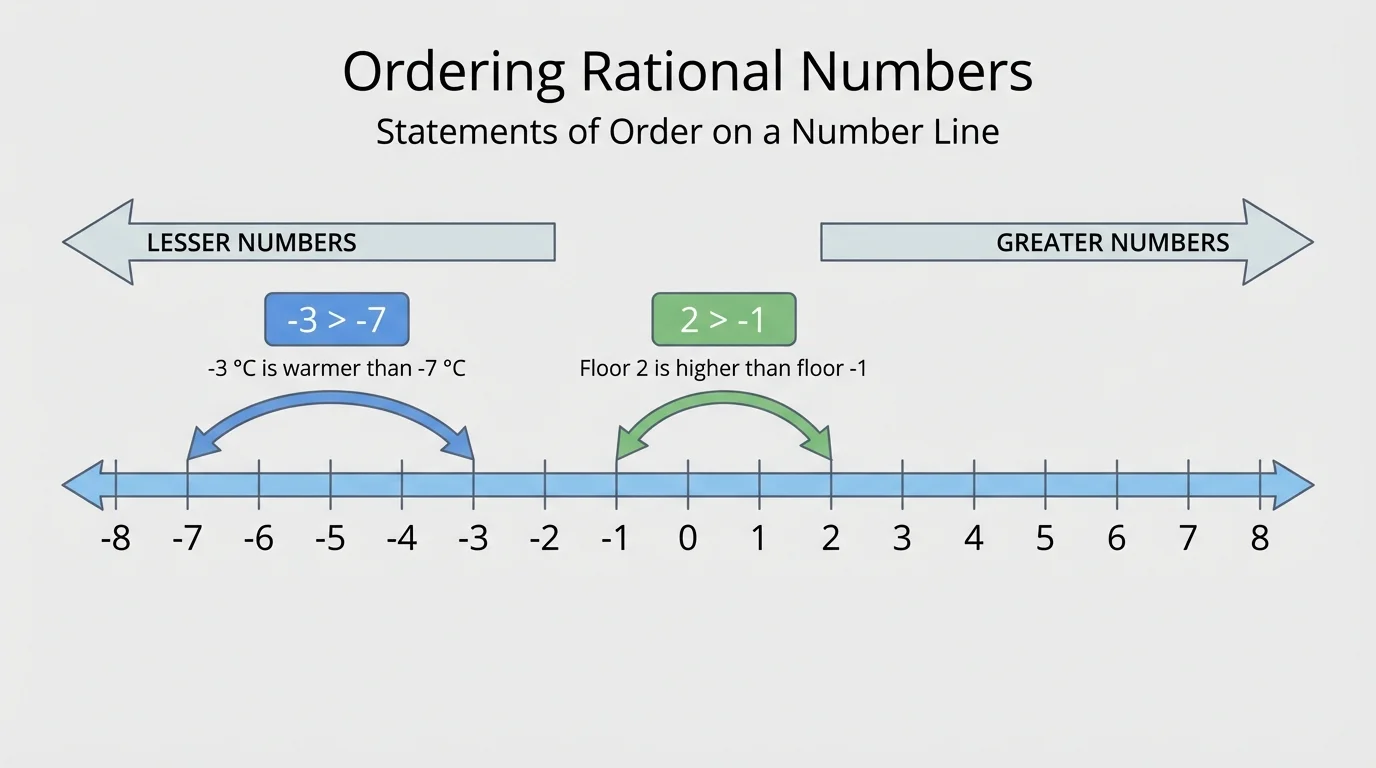
Zero is an important point on the number line. Positive numbers are to the right of \(0\), and negative numbers are to the left of \(0\). Any positive number is greater than any negative number. For example, \(2 > -5\), \(0.1 > -8\), and \(\dfrac{1}{3} > -\dfrac{1}{3}\).
When two negative numbers are compared, the one closer to \(0\) is greater. For example, \(-2 > -6\) because \(-2\) is to the right of \(-6\). This idea is one of the most important parts of ordering rational numbers.
Think right to left. On a number line, moving right means numbers get greater. Moving left means numbers get smaller. This is true no matter how the numbers are written.
Later, when you compare decimals such as \(-1.2\) and \(-1.8\), the same rule still works. Since \(-1.2\) is closer to \(0\), it is greater, so \(-1.2 > -1.8\).
To write an order statement, first decide which quantity is greater. Then use the correct comparison symbol. After that, explain the meaning in words.
Suppose a submarine is at \(-120\) meters and another is at \(-300\) meters. Since \(-120\) is greater than \(-300\), we write \(-120 > -300\). In words, the submarine at \(-120\) meters is higher than the one at \(-300\) meters.
Suppose one basketball team has a point differential of \(-4\) and another has \(-9\). Since \(-4 > -9\), the team with \(-4\) has the better point differential because it is closer to \(0\).
Weather maps often use negative temperatures in winter, and scientists regularly compare values above and below \(0\). A small change around \(0\) can make a big difference, such as whether water freezes or melts.
When you explain an order statement, use words from the context. For temperature, use words like warmer or colder. For elevation, use higher or lower. For money, use more money or more debt.
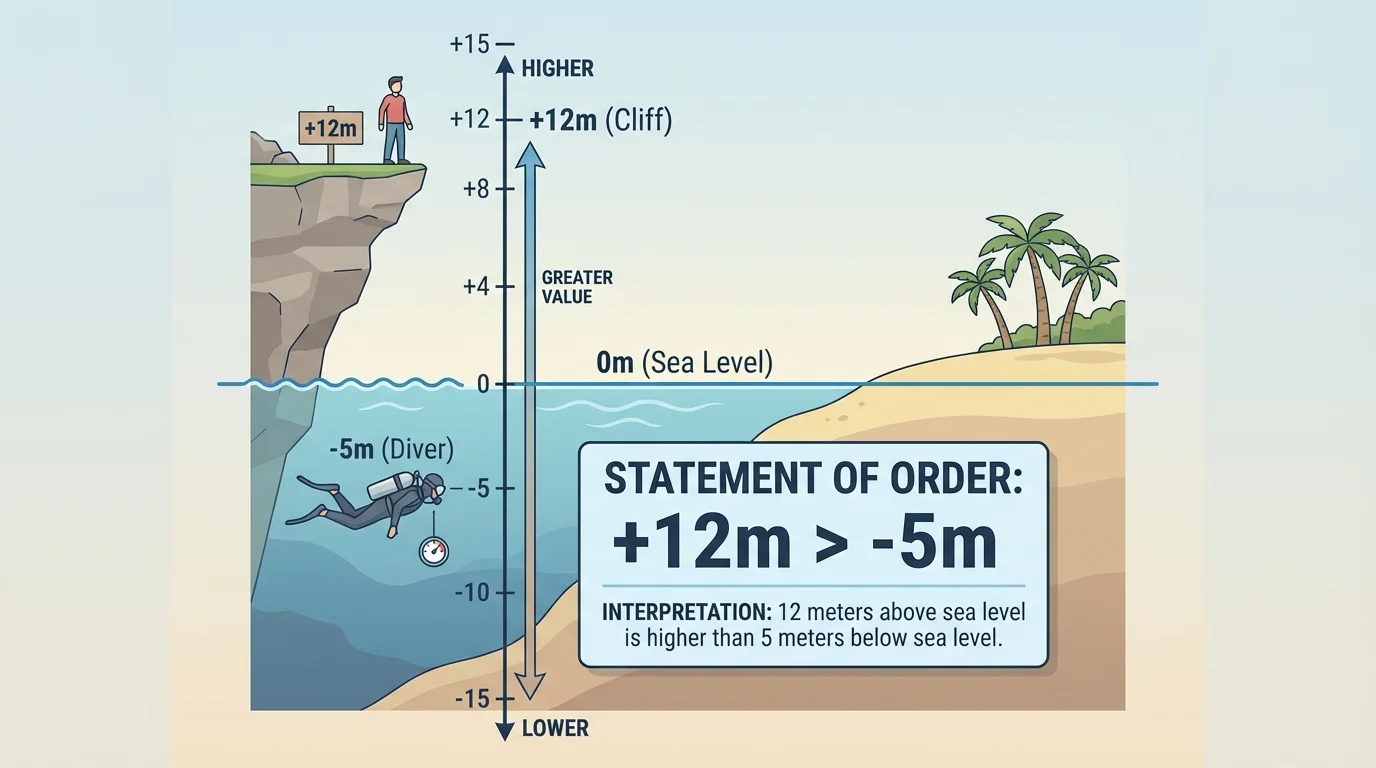
Rational numbers are used to describe many situations in the real world, and [Figure 2] illustrates one of the most common: elevation compared with sea level. Positive values can mean above a reference point, and negative values can mean below it.
For example, if a cliff is \(12\) meters above sea level and a diver is \(-5\) meters below sea level, then \(12 > -5\). This means the cliff is higher than the diver's position.
Temperatures also use rational numbers. If one morning is \(-2^\circ \textrm{C}\) and the next morning is \(4^\circ \textrm{C}\), then \(4 > -2\). The second morning is warmer.
Money can be described with positive and negative values too. A balance of \(\$15\) means money in an account, while a balance of \(-\$8\) means debt. Since \(\$15 > -\$8\), the account with \(\$15\) has a greater balance.
Sports statistics can include negative values. A golfer with a score of \(-6\) is doing better than a golfer at \(-2\), but mathematically \(-2 > -6\). This shows why context matters. The number order is still correct, but in golf a lower score is better.
| Context | Numbers | Order Statement | Meaning |
|---|---|---|---|
| Temperature | \(-3^\circ \textrm{C}\), \(-7^\circ \textrm{C}\) | \(-3 > -7\) | \(-3^\circ \textrm{C}\) is warmer |
| Elevation | \(25 \textrm{ m}\), \(-10 \textrm{ m}\) | \(25 > -10\) | \(25 \textrm{ m}\) is higher |
| Bank balance | \(-12\), \(5\) | \(5 > -12\) | \(\$5\) is the greater balance |
| Diving depth | \(-4 \textrm{ m}\), \(-11 \textrm{ m}\) | \(-4 > -11\) | \(-4 \textrm{ m}\) is closer to the surface |
Table 1. Examples of rational numbers ordered in different real-world contexts.
As with the elevation picture in [Figure 2], the reference point matters. Sea level is \(0\). Above sea level is positive, and below sea level is negative. Once the reference point is clear, writing comparison statements becomes much easier.
Absolute value is the distance from \(0\) on a number line, as [Figure 3] shows. Distance is always nonnegative, so absolute value is never negative.
Absolute value of a number is its distance from \(0\) on the number line.
For example, \(|4| = 4\) and \(|-4| = 4\).
Absolute value tells how far a number is from \(0\), but it does not tell whether the number is greater or less. For example, \(-4 < 4\), but \(|-4| = |4|\).
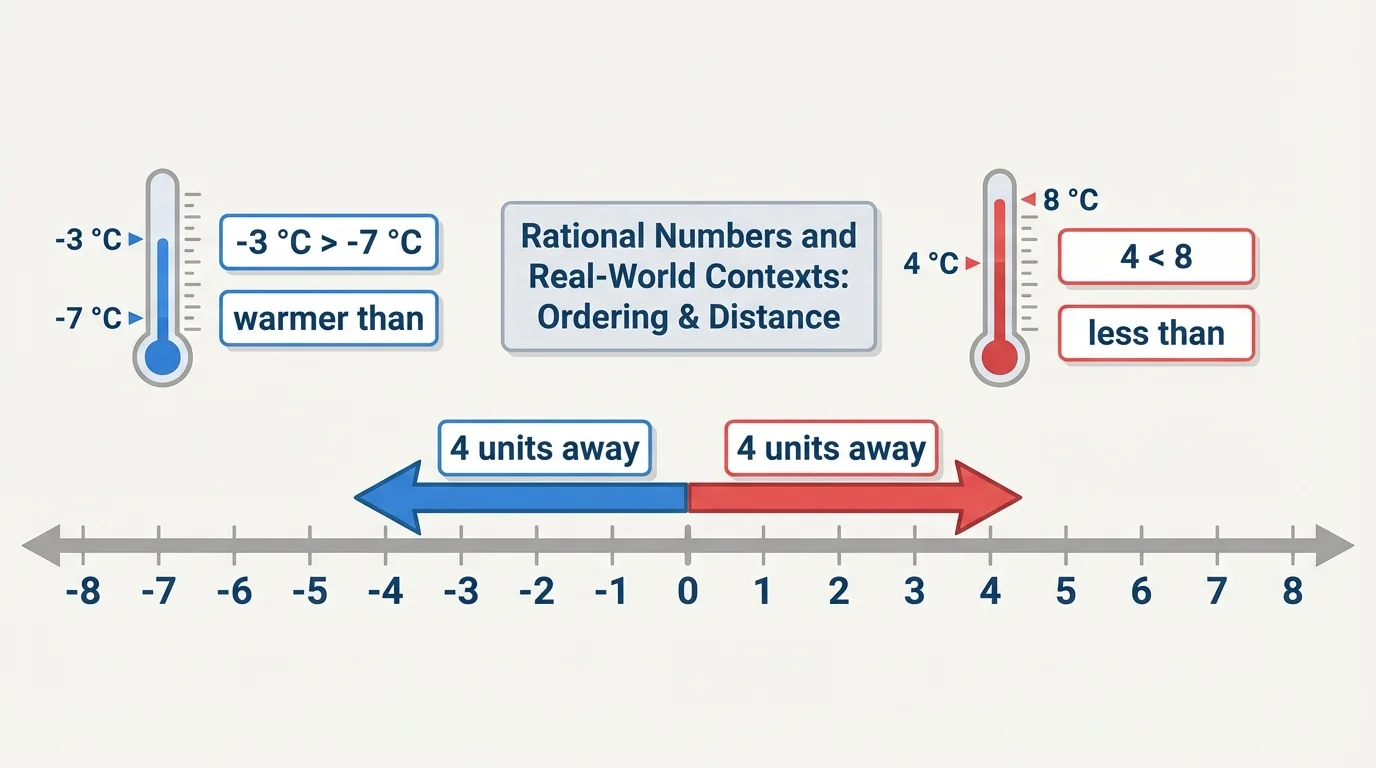
This idea matters in real life. A temperature of \(-6^\circ \textrm{C}\) and a temperature of \(6^\circ \textrm{C}\) are both \(6\) degrees away from \(0^\circ \textrm{C}\), so their absolute values are equal. But \(6^\circ \textrm{C}\) is still greater than \(-6^\circ \textrm{C}\).
Absolute value is especially helpful when talking about distance or how far away a value is from a starting point. For order, however, you still compare where the numbers are on the number line.
Let's work through several examples step by step.
Example 1
Write and explain a comparison for temperatures of \(-3^\circ \textrm{C}\) and \(-7^\circ \textrm{C}\).
Step 1: Decide which number is greater.
On the number line, \(-3\) is to the right of \(-7\), so \(-3 > -7\).
Step 2: Write the statement with units.
\(-3^\circ \textrm{C} > -7^\circ \textrm{C}\)
Step 3: Explain it in words.
\(-3^\circ \textrm{C}\) is warmer than \(-7^\circ \textrm{C}\).
The correct comparison statement is \(-3^\circ \textrm{C} > -7^\circ \textrm{C}\).
This example shows how mathematical order connects directly to the meaning of a real situation.
Example 2
A fish is at \(-8\) meters and a turtle is at \(-3\) meters relative to sea level. Compare their positions.
Step 1: Compare the numbers.
\(-3\) is to the right of \(-8\), so \(-3 > -8\).
Step 2: Interpret the result.
The turtle at \(-3\) meters is higher than the fish at \(-8\) meters.
The order statement is \(-3 > -8\).
Notice that both positions are below sea level, but the one closer to \(0\) is higher.
Example 3
Compare \(-\dfrac{1}{2}\) and \(\dfrac{1}{4}\).
Step 1: Identify positive and negative numbers.
\(-\dfrac{1}{2}\) is negative, and \(\dfrac{1}{4}\) is positive.
Step 2: Use the rule for positives and negatives.
Any positive number is greater than any negative number.
Step 3: Write the comparison.
\(\dfrac{1}{4} > -\dfrac{1}{2}\)
The positive fraction is greater.
This is true even though the denominators are different. The sign matters first.
Example 4
A bank account has balances of \(-\$18\) and \(-\$5\) on two different days. Which balance is greater?
Step 1: Compare the integers.
Since \(-5\) is closer to \(0\) than \(-18\), \(-5 > -18\).
Step 2: Explain the context.
A balance of \(-\$5\) is greater because it represents less debt than \(-\$18\).
The correct statement is \(-5 > -18\).
Bank balance examples help show that a greater number does not always mean a positive amount; it can also mean a smaller loss.
One common mistake is thinking that because \(8 > 2\), then \(-8 > -2\). This is not true. On the number line, \(-8\) is farther left, so \(-8 < -2\).
Another mistake is confusing order with absolute value. It is true that \(|-9| = 9\), but that does not mean \(-9 > -3\). In fact, \(-9 < -3\) because \(-9\) is farther left on the number line.
A third mistake is ignoring the context. In golf, a lower score may be better, but mathematically \(-2 > -6\). Always separate the mathematical order from what the situation describes as better or worse.
Order answers "Which number is greater?" Absolute value answers "How far is the number from \(0\)?" These are different questions.
The number line in [Figure 1] helps prevent many of these mistakes because it shows the actual positions of the numbers.
Rational numbers do not have to be whole numbers. They can be decimals and fractions too. The same order rules still apply.
To compare decimals, line up place values if needed. For example, compare \(-1.2\) and \(-1.25\). Write \(-1.2\) as \(-1.20\). Since \(-1.20\) is to the right of \(-1.25\), we have \(-1.2 > -1.25\).
To compare fractions, it can help to use common denominators or convert to decimals. For example, compare \(-\dfrac{3}{4}\) and \(-\dfrac{2}{3}\). Using decimals, \(-\dfrac{3}{4} = -0.75\) and \(-\dfrac{2}{3} \approx -0.67\). Since \(-0.67\) is greater than \(-0.75\), we get \(-\dfrac{2}{3} > -\dfrac{3}{4}\).
If the numbers are on opposite sides of \(0\), the positive number is always greater. For example, \(0.6 > -0.6\), and \(\dfrac{5}{8} > -\dfrac{5}{8}\).
Mathematics is not only about symbols. You should also be able to explain what a statement means in clear words. Suppose you read \(-12 < -4\). In a temperature context, this means \(-12^\circ \textrm{C}\) is colder than \(-4^\circ \textrm{C}\). In an elevation context, it means \(-12\) meters is lower than \(-4\) meters.
Suppose you read \(3.5 > -2.1\). In a profit-and-loss context, this could mean a gain of \(3.5\) units is greater than a loss of \(2.1\) units. The explanation must match the situation.
The distance picture in [Figure 3] is useful here too. It reminds us that being the same distance from \(0\) does not mean two numbers are equal. For instance, \(|-5| = |5|\), but \(-5 < 5\).
When writing your own explanations, include three parts: the numbers, the comparison symbol, and the meaning in context. For example, \(-2 > -9\) because \(-2\) is warmer than \(-9\) on a thermometer, or because \(-2\) meters is higher than \(-9\) meters under water.
"A number's place on the number line tells its order."
This simple idea works for integers, fractions, and decimals, and it helps make sense of many real-world quantities.
