Have you ever noticed something surprising about winter temperatures? A day at \(-2^\circ\textrm{C}\) is actually warmer than a day at \(-5^\circ\textrm{C}\), even though the number \(5\) looks bigger than \(2\). This happens because negative numbers follow a special order, and a number line helps us see that order clearly. When mathematicians write an inequality such as \(-3 > -7\), they are really making a statement about where those numbers are placed.
Understanding inequalities on a number line is one of the most important ideas in the study of rational numbers. It helps you compare temperatures, money owed, elevations below sea level, and many other real-world quantities. Once you can picture numbers on a line, inequality symbols stop feeling like random marks and start making sense.
A number line is a straight line where numbers are placed in order. On a standard horizontal number line, the values increase from left to right. That means every number to the right is greater, and every number to the left is less, as [Figure 1] shows.
This simple left-to-right rule is the key idea behind comparing numbers. If one number is to the right of another, then the first number is greater. If it is to the left, then it is less. If two points land in the same place, the numbers are equal.
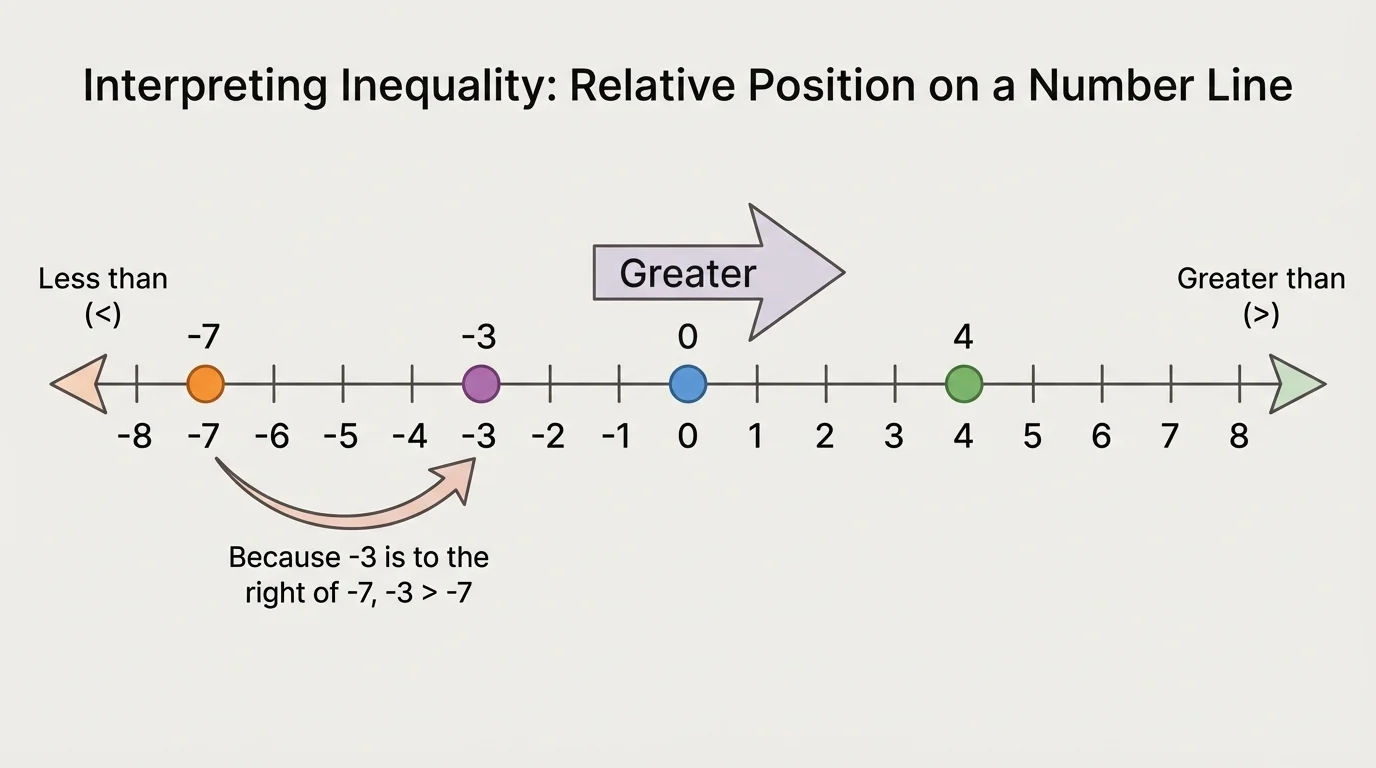
Inequality is a comparison between two numbers or expressions that shows one is greater than, less than, greater than or equal to, or less than or equal to the other. The symbols \(>\) and \(<\) are used most often when comparing positions on a number line.
Suppose you compare \(4\) and \(1\). Since \(4\) is to the right of \(1\) on the number line, we write \(4 > 1\). If we reverse the comparison, then \(1 < 4\), because \(1\) is to the left of \(4\).
Zero is an important landmark on the number line. Positive numbers are to the right of \(0\), and negative numbers are to the left of \(0\). This means any positive number is greater than \(0\), and any negative number is less than \(0\).
The symbol \(>\) means greater than. The symbol \(<\) means less than. You can read \(6 > 2\) as "\(6\) is greater than \(2\)" or "\(6\) is to the right of \(2\) on the number line." You can read \(-4 < 3\) as "\(-4\) is less than \(3\)" or "\(-4\) is to the left of \(3\)."
Notice that inequality symbols describe order. They do not tell you how far apart the numbers are. For example, \(5 > 4\) and \(5 > -100\) are both true, but the distances between the numbers are very different.
From earlier work, you already know how to count left and right on a number line. Moving one unit to the right increases a number by \(1\). Moving one unit to the left decreases a number by \(1\).
Equal numbers are written with the symbol \(=\). For example, \(2 = 2\). On a number line, equal numbers are located at exactly the same point.
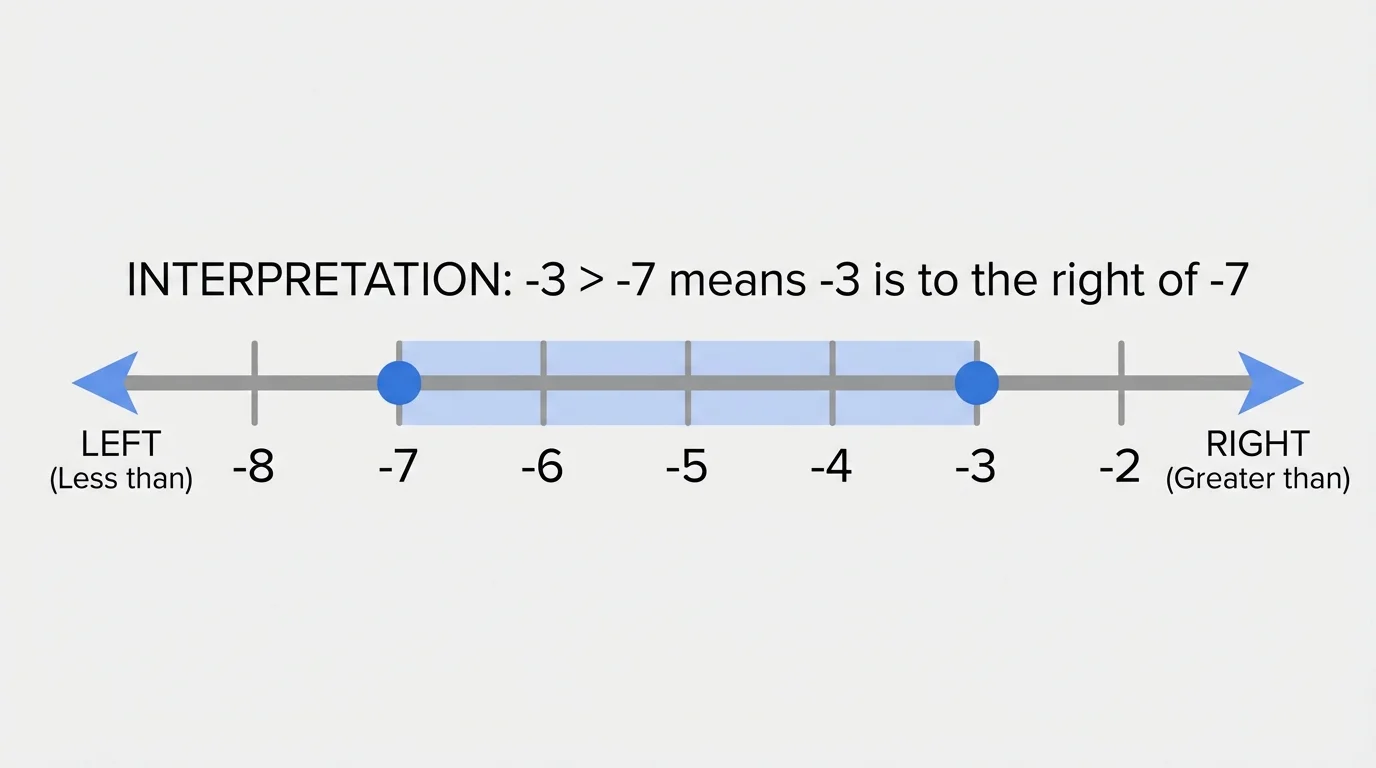
Negative numbers often confuse students because the digits can make the comparison look backward. [Figure 2] The number line picture clears this up. Even though \(7\) is greater than \(3\), the number \(-7\) is to the left of \(-3\), so \(-7\) is less.
That is why the statement \(-3 > -7\) is true. On a left-to-right number line, \(-3\) is located to the right of \(-7\). A good way to think about it is this: among negative numbers, the one closer to zero is greater.
For example, compare \(-2\) and \(-9\). Since \(-2\) is to the right of \(-9\), we write \(-2 > -9\). Compare \(-12\) and \(-5\). Since \(-12\) is farther left, we write \(-12 < -5\).
A powerful idea for negative numbers
When you compare two negative numbers, do not focus only on the digits. Instead, picture where they are on the number line. The negative number farther to the right is greater. The negative number farther to the left is less.
This idea also works when comparing a negative number and a positive number. Any positive number is always to the right of any negative number. So \(2 > -3\), \(0.5 > -1\), and \(-4 < 6\).
Inequalities are not only for whole numbers. They also work for fractions and decimals because these are also rational numbers that can be placed on a number line. For example, \(1.2\) is to the right of \(0.8\), so \(1.2 > 0.8\).
Negative decimals and fractions follow the same rule. Compare \(-0.5\) and \(-1.2\). Since \(-0.5\) is closer to zero and lies to the right of \(-1.2\), we write \(-0.5 > -1.2\).
Compare \(-\dfrac{1}{4}\) and \(\dfrac{1}{2}\). The fraction \(-\dfrac{1}{4}\) lies to the left of \(0\), while \(\dfrac{1}{2}\) lies to the right of \(0\). Therefore, \(-\dfrac{1}{4} < \dfrac{1}{2}\).
Decimals and fractions can name the same point on a number line. For example, \(0.5\), \(\dfrac{1}{2}\), and \(\dfrac{5}{10}\) all represent the same location.
When comparing fractions, it helps to think about benchmark numbers such as \(0\), \(\dfrac{1}{2}\), and \(1\), or to rewrite fractions in a common form. But no matter which method you use, the number line meaning stays the same: right means greater, and left means less.
Worked examples help show exactly how to translate an inequality into a position statement and back again.
Example 1: Interpret \(-3 > -7\)
Step 1: Locate both numbers on a number line.
Both numbers are negative, so both lie to the left of \(0\). The point \(-7\) is farther left, and the point \(-3\) is closer to \(0\).
Step 2: Decide which point is to the right.
The number \(-3\) is to the right of \(-7\).
Step 3: Write the interpretation.
Since numbers farther right are greater, \(-3 > -7\).
This means \(-3\) is located to the right of \(-7\) on a number line oriented from left to right.
The same interpretation works in reverse. If you know the positions on the number line, you can write the inequality. If you know the inequality, you can describe the positions.
Example 2: Compare \(2.4\) and \(-1.1\)
Step 1: Identify the signs.
\(2.4\) is positive, and \(-1.1\) is negative.
Step 2: Use the number line rule.
Any positive number is to the right of any negative number.
Step 3: Write the inequality.
\(2.4 > -1.1\).
This means \(2.4\) is to the right of \(-1.1\) on the number line.
Notice that you did not need to line up digits or subtract. The sign alone already told you which number is farther right.
Example 3: Compare \(-\dfrac{3}{4}\) and \(-\dfrac{1}{2}\)
Step 1: Think about their decimal values or locations.
\(-\dfrac{3}{4} = -0.75\) and \(-\dfrac{1}{2} = -0.5\).
Step 2: Compare the locations.
\(-0.75\) is to the left of \(-0.5\).
Step 3: Write the inequality.
\(-\dfrac{3}{4} < -\dfrac{1}{2}\).
This means \(-\dfrac{3}{4}\) is to the left of \(-\dfrac{1}{2}\).
Fractions and decimals follow exactly the same rules as integers because every rational number has a place on the number line.
Example 4: Put these numbers in order from least to greatest: \(-2, 1.5, 0, -\dfrac{1}{2}\)
Step 1: Identify numbers left of \(0\), at \(0\), and right of \(0\).
\(-2\) and \(-\dfrac{1}{2}\) are left of \(0\), \(0\) stays in the middle, and \(1.5\) is right of \(0\).
Step 2: Order the negative numbers.
\(-2\) is farther left than \(-\dfrac{1}{2}\), so \(-2 < -\dfrac{1}{2}\).
Step 3: Write the full order.
\[-2 < -\frac{1}{2} < 0 < 1.5\]
This order matches the left-to-right positions on the number line.
There is another important idea connected to number lines: [Figure 3] opposites and absolute value. Opposite numbers are the same distance from \(0\) but on opposite sides. For example, \(5\) and \(-5\) are opposites.
The absolute value of a number is its distance from \(0\) on the number line. Distance is never negative. So the absolute value of \(5\) is \(5\), and the absolute value of \(-5\) is also \(5\).
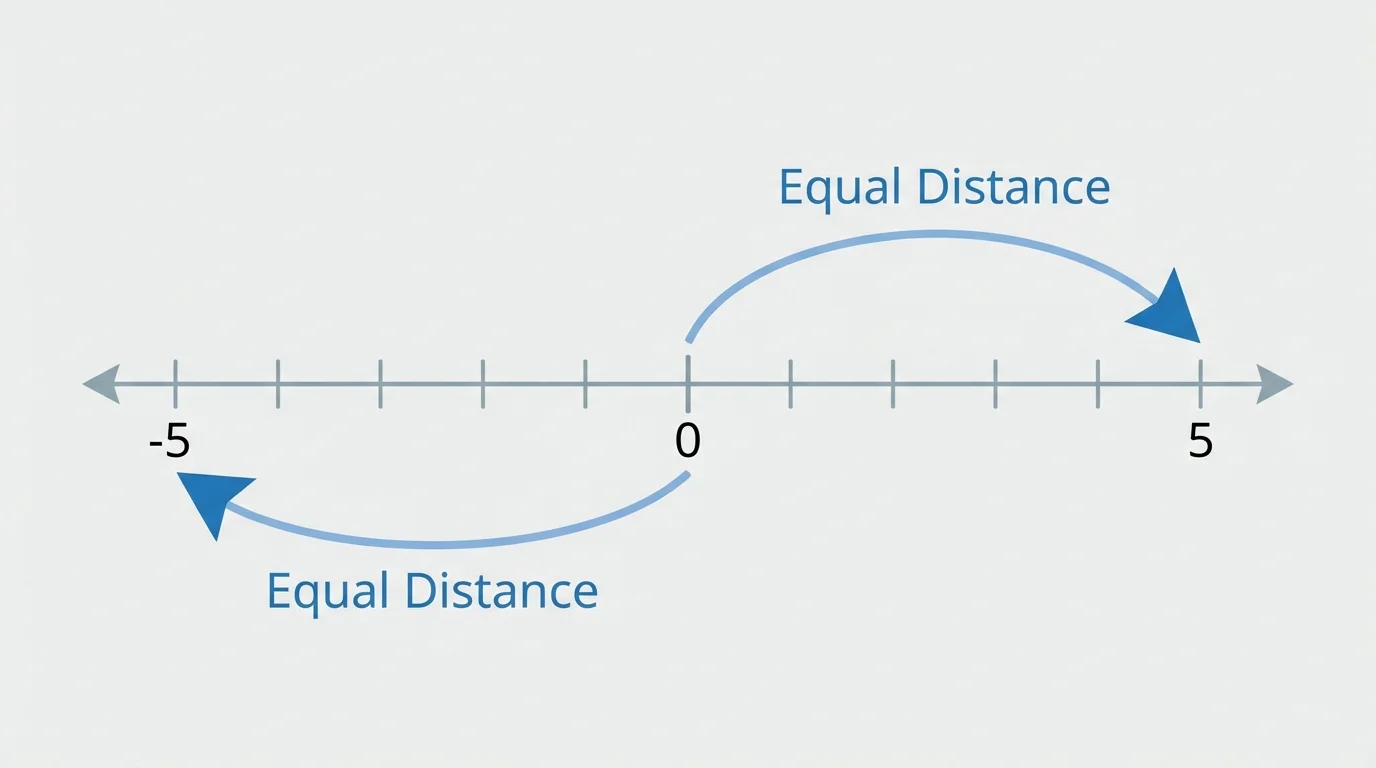
Absolute value is the distance of a number from \(0\) on a number line. For any number \(a\), the absolute value is written as \(|a|\).
Here are some examples:
\(|3| = 3\)
\(|-3| = 3\)
\(|0| = 0\)
It is very important not to confuse greater value with greater absolute value. For example, \(-8\) has a greater absolute value than \(-2\) because \(|-8| = 8\) and \(|-2| = 2\). But on the number line, \(-8 < -2\), because \(-8\) is farther left. The picture of opposites and distance helps separate these two ideas: order is about left and right, while absolute value is about distance from zero.
When you need to compare several numbers, imagine placing all of them on one number line. Then read from left to right. That is the order from least to greatest.
For example, consider \(-1.5, \dfrac{1}{4}, -2, 0, 1\). The leftmost number is \(-2\), then \(-1.5\), then \(0\), then \(\dfrac{1}{4}\), then \(1\). So the order is
\[-2 < -1.5 < 0 < \frac{1}{4} < 1\]
This method works even when the numbers are written in different forms, such as fractions, decimals, and integers. What matters is their locations, not the form they are written in.
| Comparison | Reason on the number line | True statement |
|---|---|---|
| \(-4\) and \(-1\) | \(-4\) is left of \(-1\) | \(-4 < -1\) |
| \(0\) and \(-3\) | \(0\) is right of \(-3\) | \(0 > -3\) |
| \(\dfrac{3}{5}\) and \(0.4\) | \(\dfrac{3}{5} = 0.6\), which is right of \(0.4\) | \(\dfrac{3}{5} > 0.4\) |
| \(-0.2\) and \(-0.8\) | \(-0.2\) is right of \(-0.8\) | \(-0.2 > -0.8\) |
Table 1. Examples of comparing rational numbers by their positions on a number line.
Inequalities on a number line are not just classroom ideas. They appear in many real situations where values can be above or below a reference point.
Temperature: If one city is at \(-6^\circ\textrm{C}\) and another is at \(-2^\circ\textrm{C}\), then \(-2 > -6\). The second city is warmer because \(-2\) is to the right of \(-6\) on the number line.
Elevation: A diver at \(-12\) meters is deeper than a diver at \(-4\) meters. Since \(-12 < -4\), the diver at \(-12\) is at a lower elevation.
Money: If one bank account has a balance of \(-\$5\) and another has a balance of \(-\$20\), the account with a balance of \(-\$5\) is greater because it represents less debt. In number form, \(-5 > -20\).
Sports and games: Some games track scores above and below zero. A team at \(-1\) is doing better than a team at \(-4\), because \(-1 > -4\).
Why this matters in daily life
Many real measurements use a reference point such as zero degrees, sea level, or zero dollars owed. Inequalities help compare positions relative to that reference point. The number line gives a picture that makes the comparison meaningful.
Whenever you see a quantity above or below a reference point, you can think of it as a location on a number line. Then the inequality tells you which quantity is greater, smaller, higher, lower, warmer, colder, deeper, or closer to zero.
One common mistake is thinking that \(-7\) must be greater than \(-3\) because \(7 > 3\). That would only make sense if the numbers were positive. On the number line, \(-7\) is farther left, so \(-7 < -3\).
Another mistake is confusing absolute value with order. For example, \(|-9| = 9\), which is greater than \(|-2| = 2\). But this does not mean \(-9 > -2\). In fact, \(-9 < -2\).
A third mistake is forgetting that the number line is oriented from left to right. If the line is drawn in the standard way, right means greater. This idea is the foundation of every comparison you make.
"Greater means farther to the right; less means farther to the left."
That short rule can guide you through almost every inequality problem in this topic.
