A surprising statement can actually be true: \(-50 < -30\), but at the same time \(|-50| > |-30|\). How can one number be less and yet have a greater absolute value? The answer is that these two comparisons are talking about different ideas. One compares where numbers are on the number line. The other compares how far they are from \(0\). Learning to tell those apart is an important part of working with negative numbers.
Negative numbers appear in real life more often than many students expect. A temperature of \(-8\) degrees is colder than \(-3\) degrees. A balance of \(-\$40\) means you owe more money than a balance of \(-\$15\). In a game, a score change of \(-12\) means losing \(12\) points. To understand these situations, you need to know whether you are comparing order or comparing distance from zero.
When we compare numbers by order, we ask, "Which number is greater or less?" When we compare by absolute value, we ask, "Which number is farther from \(0\)?" These are not always the same question.
On a number line, numbers increase as you move to the right and decrease as you move to the left. Negative numbers are to the left of \(0\), positive numbers are to the right of \(0\), and \(0\) is in the middle.
That simple picture of the number line helps explain almost everything in this topic. If two numbers are both negative, the one farther left is the smaller number. But the one farther from \(0\) has the greater absolute value.
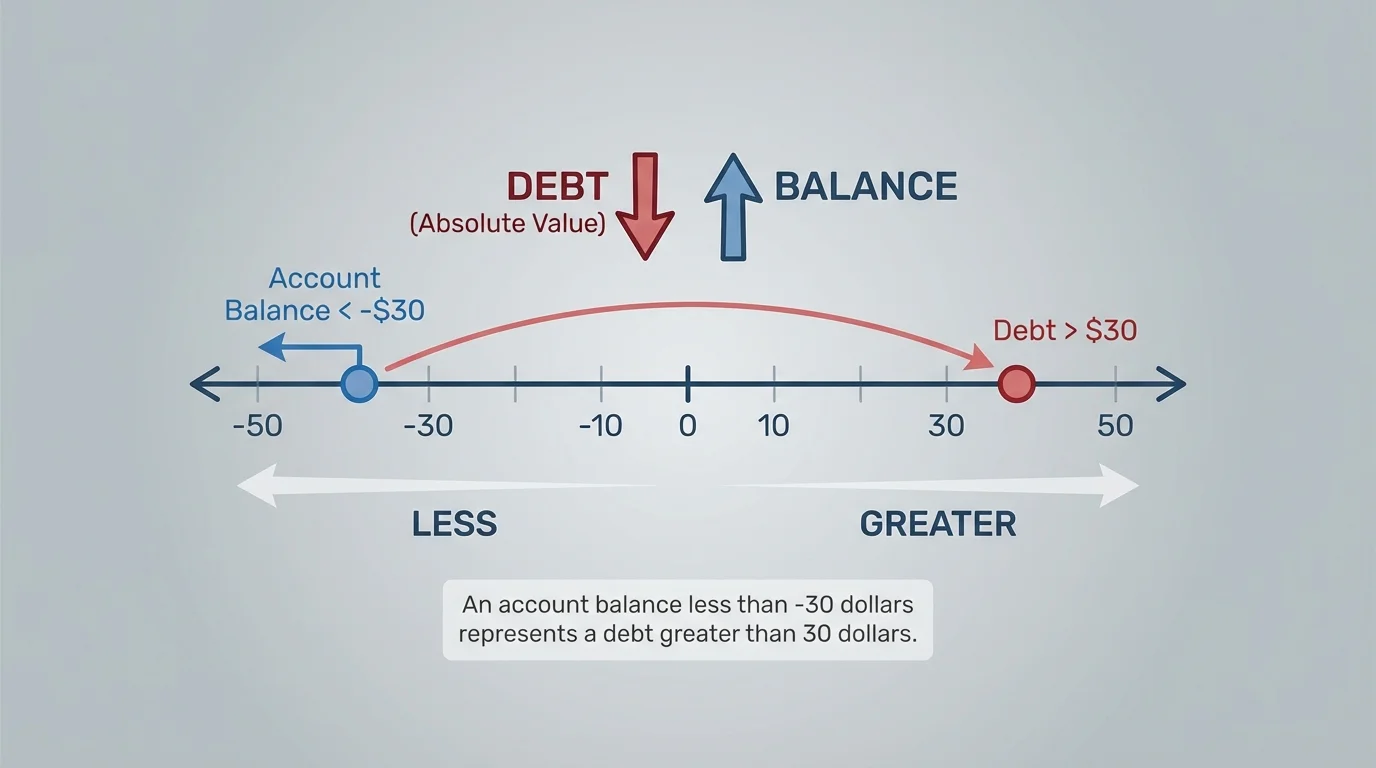
A rational number is any number that can be written as a fraction, including integers, fractions, and decimals that end or repeat. As [Figure 1] shows, every rational number has a position on the number line. The farther right a number is, the greater it is. The farther left it is, the less it is.
For example, \(-30\) is to the right of \(-50\). That means \(-30\) is greater than \(-50\), and we write \(-50 < -30\). Even though \(50\) is greater than \(30\), the negative signs change the order because both numbers are on the left side of \(0\).
Here are some important order comparisons:
Notice that when one number is negative and the other is positive, the positive number is always greater. Also, \(0\) is greater than any negative number and less than any positive number.
Absolute value tells how far a number is from \(0\) on the number line. Distance does not depend on direction, so absolute value is never negative.
Absolute value is the distance from \(0\) on the number line.
We write the absolute value of \(a\) as \(|a|\).
Examples: \(|5| = 5\), \(|-5| = 5\), and \(|0| = 0\).
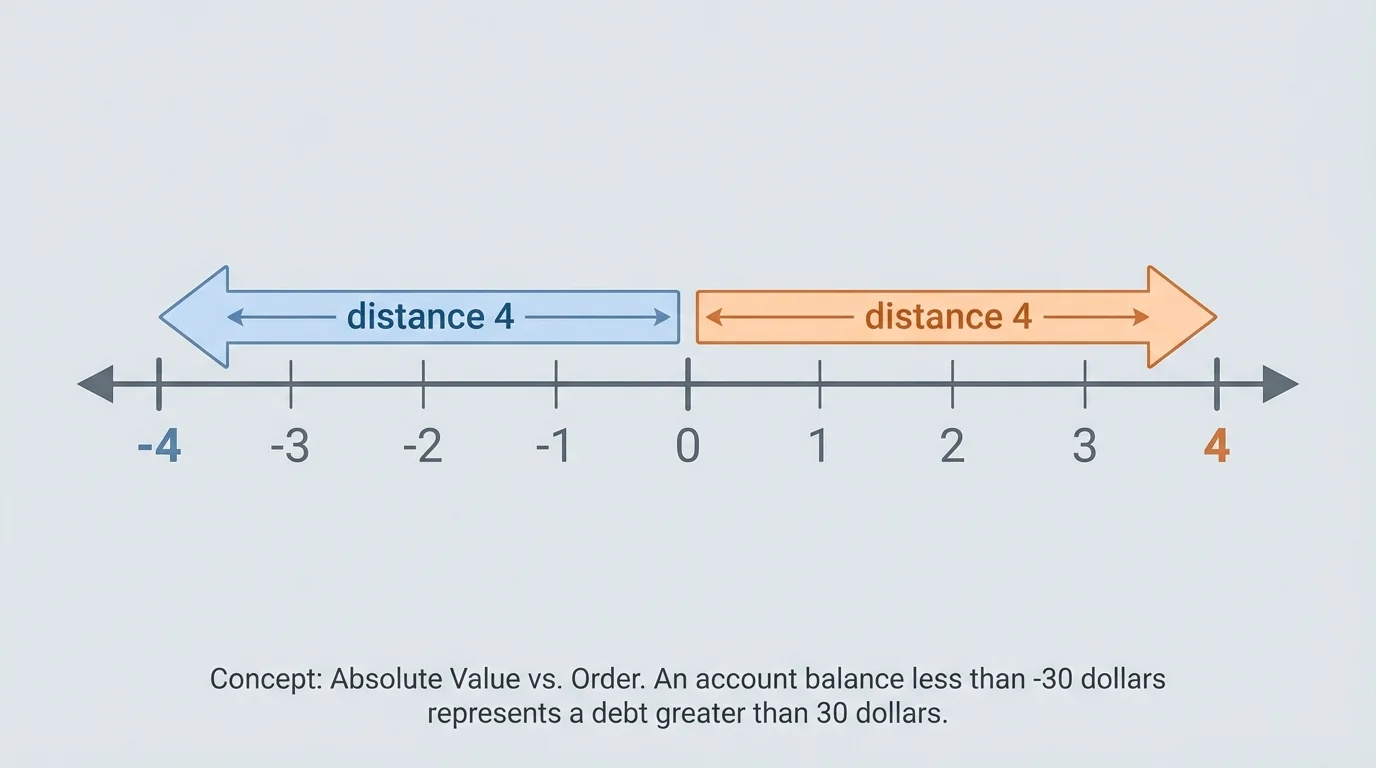
If a number is \(4\) units to the right of \(0\), its absolute value is \(4\). If a number is \(4\) units to the left of \(0\), its absolute value is also \(4\). So \(|4| = 4\) and \(|-4| = 4\).
As [Figure 2] shows, a negative number can have a large absolute value because it may be far from \(0\). The sign tells direction. The absolute value tells distance.
Here are more examples of absolute value:
The absolute value does not tell whether a number is positive or negative. It only tells how far the number is from \(0\).
This is the heart of the topic. An order statement and an absolute value statement may look similar, but they answer different questions.
Compare the numbers \(-30\) and \(-50\).
As numbers on the number line, \(-50\) is less than \(-30\), so
\[-50 < -30\]
But their absolute values are \(|-50| = 50\) and \(|-30| = 30\). Since \(50 > 30\), we have
\[|-50| > |-30|\]
Both statements are true because the first compares order and the second compares distance from zero.
Order versus absolute value
To compare by order, think about left and right on the number line. To compare by absolute value, think about distance from \(0\). A number can be smaller in order but have a larger absolute value if it is farther left from \(0\).
For negative numbers, this often feels backward at first. Among negative numbers, the one with the greater absolute value is actually the smaller number. For example, \(|-9| = 9\) is greater than \(|-4| = 4\), but \(-9 < -4\).
This is why the statement "an account balance less than \(-\$30\) represents a debt greater than \(\$30\)" is correct. A balance less than \(-\$30\) might be \(-\$40\), \(-\$75\), or \(-\$120\). Each of those numbers is smaller than \(-\$30\) in order, but each represents owing more than \(\$30\).
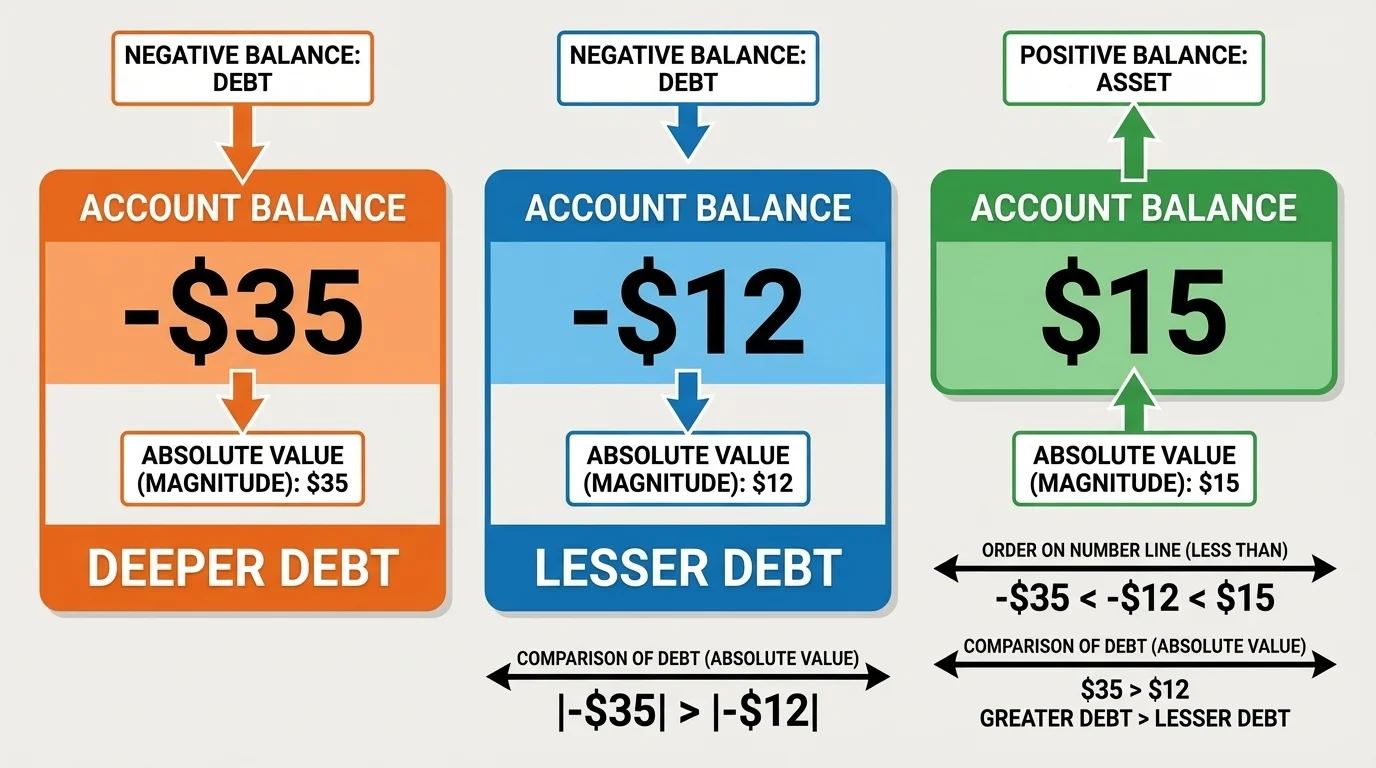
Money gives one of the clearest examples. In a bank account, a negative balance means debt. A balance of \(-\$35\) means you owe \(\$35\). A balance of \(-\$12\) means you owe \(\$12\). Since \(-35 < -12\), the balance of \(-\$35\) is less. But since \(|-35| = 35\) and \(|-12| = 12\), the debt of \(\$35\) is greater.
As [Figure 3] shows, temperatures work the same way. A temperature of \(-10\) degrees is less than \(-4\) degrees because it is colder. But the absolute value of \(-10\) is greater than the absolute value of \(-4\). That means \(-10\) is farther from \(0\).
Elevation also uses negative numbers. If sea level is \(0\), then an elevation of \(-200\) meters is below sea level. An elevation of \(-50\) meters is also below sea level. Since \(-200 < -50\), the first location is lower. Since \(|-200| = 200\) and \(|-50| = 50\), the first location is farther from sea level.
Sports can use this idea too. If a team's point change is \(-6\), it lost \(6\) points compared with an earlier score. If another team's point change is \(-14\), that is a bigger loss. In order, \(-14 < -6\). In absolute value, \(|-14| > |-6|\).
Scuba divers, mountain climbers, meteorologists, and bankers all use positive and negative numbers, but they do not always mean the same thing. The sign gives direction or type, while the absolute value often tells size.
Later, when you look back at account balances like the ones in [Figure 3], it becomes easier to see why a "smaller" negative balance can mean a "bigger" debt.
Worked examples help make the difference clear. Pay close attention to whether each question asks about order or absolute value.
Worked example 1
Which number is greater: \(-18\) or \(-11\)? Then compare their absolute values.
Step 1: Compare the numbers by order.
On the number line, \(-11\) is to the right of \(-18\), so \(-11\) is greater.
\[-18 < -11\]
Step 2: Find the absolute values.
\(|-18| = 18\) and \(|-11| = 11\).
Step 3: Compare the absolute values.
Since \(18 > 11\), we have
\[|-18| > |-11|\]
So \(-11\) is the greater number, but \(-18\) has the greater absolute value.
This example shows the main pattern for negative numbers: farther left means smaller in order, but farther from \(0\) means greater in absolute value.
Worked example 2
An account balance is less than \(-\$30\). What does that tell you about the debt?
Step 1: Interpret the order statement.
"Less than \(-\$30\)" means the balance might be \(-\$31\), \(-\$45\), or any number to the left of \(-\$30\) on the number line.
Step 2: Translate negative balance into debt.
A balance of \(-\$31\) means a debt of \(\$31\). A balance of \(-\$45\) means a debt of \(\$45\).
Step 3: State the conclusion.
If the balance is less than \(-\$30\), then the debt is greater than \(\$30\).
This is because balances more negative than \(-\$30\) are farther from \(0\) than \(-\$30\).
Money examples are useful because students often hear the words "less than" and think "smaller amount." For debt, though, a lower balance can mean a greater amount owed.
Worked example 3
Compare \(-\dfrac{5}{2}\) and \(-1.8\) by order and by absolute value.
Step 1: Rewrite if helpful.
\(-\dfrac{5}{2} = -2.5\).
Step 2: Compare by order.
Since \(-2.5\) is to the left of \(-1.8\),
\[-\frac{5}{2} < -1.8\]
Step 3: Compare absolute values.
\(\left|-\dfrac{5}{2}\right| = \dfrac{5}{2} = 2.5\) and \(|-1.8| = 1.8\).
So
\[\left|-\frac{5}{2}\right| > |-1.8|\]
The smaller number in order has the greater absolute value.
Fractions and decimals follow the same rules as integers. The meanings of order and absolute value do not change.
Worked example 4
A city has a temperature of \(-7\) degrees, and another city has a temperature of \(5\) degrees. Which is greater? Which has the greater absolute value?
Step 1: Compare by order.
Any positive number is greater than any negative number, so
\(5 > -7\)
Step 2: Find absolute values.
\(|5| = 5\) and \(|-7| = 7\).
Step 3: Compare absolute values.
Since \(7 > 5\),
\[|-7| > |5|\]
The temperature \(5\) degrees is greater, but \(-7\) degrees is farther from \(0\).
Notice how this example is different from comparing two negative numbers. Here one number is positive and one is negative, so the greater number is easy to identify, but the greater absolute value still depends on distance from \(0\).
One common mistake is to think that a greater absolute value means a greater number. That is not always true. For example, \(|-20| = 20\) and \(|3| = 3\), so \(|-20| > |3|\), but \(-20 < 3\).
Another mistake is to forget that absolute value cannot be negative. For example, \(|-8| = 8\), not \(-8\).
A third mistake is mixing up the meaning of a negative quantity in context. A negative balance means debt, a negative elevation means below sea level, and a negative temperature means below zero. In all of these, the sign gives direction or status, while the absolute value gives the size.
"The sign tells where; the absolute value tells how far."
That sentence is short, but it is powerful. It helps separate two ideas that students often blend together.
The table below shows several pairs of numbers and compares both order and absolute value.
| Numbers | Order comparison | Absolute values | Absolute value comparison |
|---|---|---|---|
| \(-9\) and \(-4\) | \(-9 < -4\) | \(|-9| = 9\), \(|-4| = 4\) | \(|-9| > |-4|\) |
| \(-2\) and \(6\) | \(-2 < 6\) | \(|-2| = 2\), \(|6| = 6\) | \(|-2| < |6|\) |
| \(-15\) and \(-21\) | \(-15 > -21\) | \(|-15| = 15\), \(|-21| = 21\) | \(|-15| < |-21|\) |
| \(\dfrac{3}{4}\) and \(-\dfrac{3}{4}\) | \(\dfrac{3}{4} > -\dfrac{3}{4}\) | \(\left|\dfrac{3}{4}\right| = \dfrac{3}{4}\), \(\left|-\dfrac{3}{4}\right| = \dfrac{3}{4}\) | equal |
Table 1. Examples showing that order comparisons and absolute value comparisons can give different results.
The last row is especially interesting. Opposite numbers such as \(\dfrac{3}{4}\) and \(-\dfrac{3}{4}\) are equally far from \(0\), so they have the same absolute value.
Earlier, the number line in [Figure 1] showed that order depends on left and right position. The absolute value diagram in [Figure 2] showed that absolute value depends on distance from \(0\). Putting those together gives a complete picture.
If you compare two positive numbers, the greater number usually also has the greater absolute value. For example, \(8 > 3\) and \(|8| > |3|\). But if you compare two negative numbers, the smaller number has the greater absolute value. For example, \(-12 < -5\) but \(|-12| > |-5|\).
When a question includes a context, read carefully. Ask yourself whether the situation is about being greater or less, or about being farther from \(0\). That small difference changes the meaning of the comparison.
