Two numbers can have different values and still be the same distance from zero. For example, -5 and 5 are on opposite sides of zero, but each is 5 units away. That idea is one of the most useful meanings of absolute value. It helps us describe distance on a number line and the size of quantities in real life, even when those quantities are negative.
Absolute value is especially important when working with rational numbers, which include integers, fractions, and decimals. A number may be negative because of direction, loss, debt, or temperature below zero, but its absolute value tells the amount or size without the sign.
Absolute value is the distance of a number from 0 on the number line.
The absolute value of a number \(a\) is written as \(|a|\).
Because distance is never negative, absolute value is always 0 or positive.
If a number is positive, its absolute value is the same as the number. For example, \(|7| = 7\). The number 7 is already 7 units from 0.
If a number is negative, its absolute value is the positive distance from zero. For example, \(|-7| = 7\). Even though -7 is left of zero, it is still 7 units from 0.
Zero is a special case. Since 0 is neither to the left nor to the right of itself, its distance from zero is 0. So \(|0| = 0\).
On a number line, numbers to the right are greater, and numbers to the left are less. Negative numbers are less than 0, and positive numbers are greater than 0.
The bars in absolute value notation do not mean subtraction. They mean "the distance from zero." That is why \(|-3|\) is not -3. It is 3.
A number line makes absolute value easy to see. [Figure 1] shows that absolute value is about how many units a point is from 0, not which side of 0 it is on. Numbers on opposite sides of zero can have the same absolute value if they are the same distance away.
For example, -4 is 4 units left of 0, and 4 is 4 units right of 0. So both have an absolute value of 4:
\[|-4| = 4 \qquad |4| = 4\]
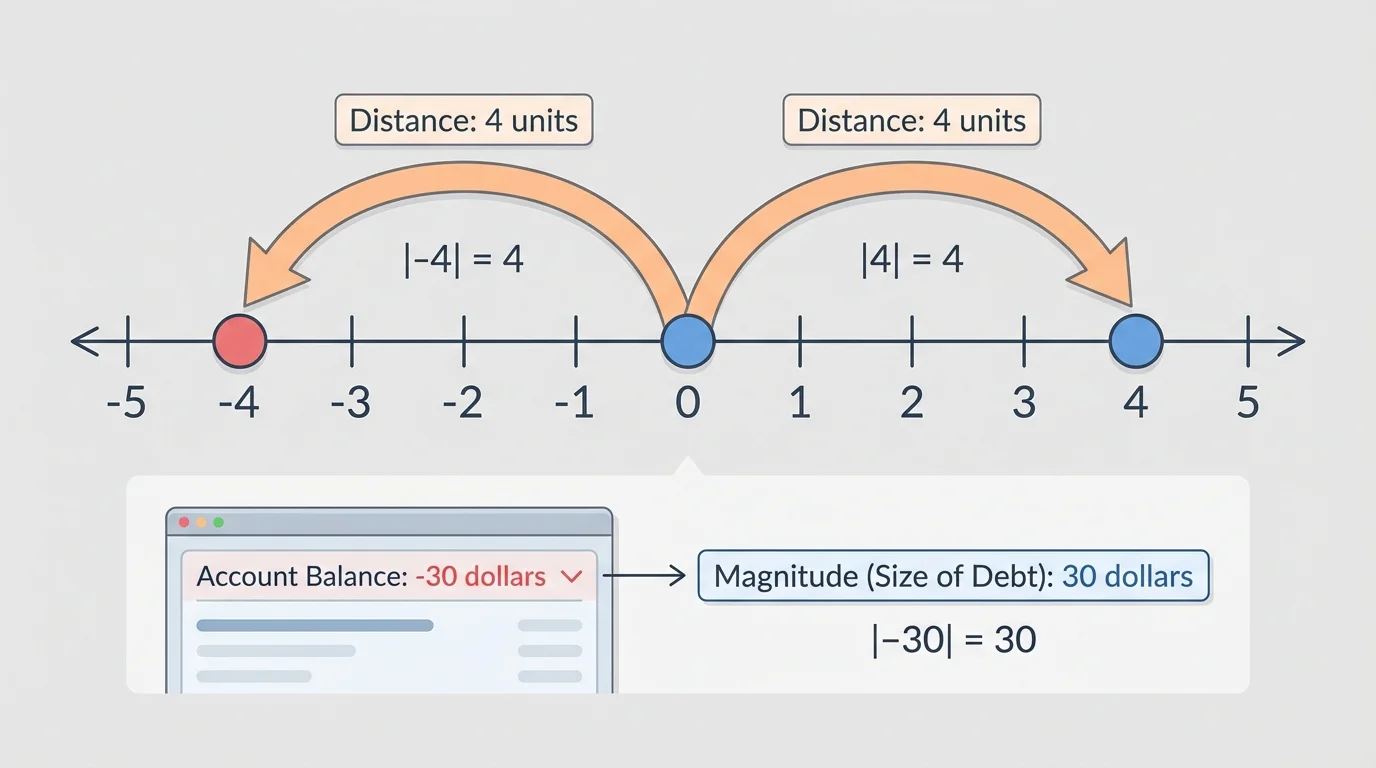
Numbers like -4 and 4 are called opposites. Opposites are the same distance from 0 but on different sides of 0. That is why opposites always have the same absolute value, except for 0, which is its own opposite.
Here are some examples:
Notice something important: the numbers -9 and 9 are not equal, but their absolute values are equal. In fact, -9 < 9, yet \(|-9| = |9|\). This idea becomes very useful when comparing size rather than direction or sign.
Absolute value works for every rational number, not just whole numbers. [Figure 2] illustrates that fractions and decimals can also be placed on a number line, and their absolute values are still their distances from 0.
For a decimal, think about distance exactly the same way. The number -2.5 is 2.5 units from zero, so \(|-2.5| = 2.5\). The number 1.2 is 1.2 units from zero, so \(|1.2| = 1.2\).
For a fraction, the idea is also the same. The number \(-\dfrac{3}{4}\) is \(\dfrac{3}{4}\) units from zero, so \(\left|-\dfrac{3}{4}\right| = \dfrac{3}{4}\). The number \(\dfrac{5}{6}\) is \(\dfrac{5}{6}\) units from zero, so \(\left|\dfrac{5}{6}\right| = \dfrac{5}{6}\).
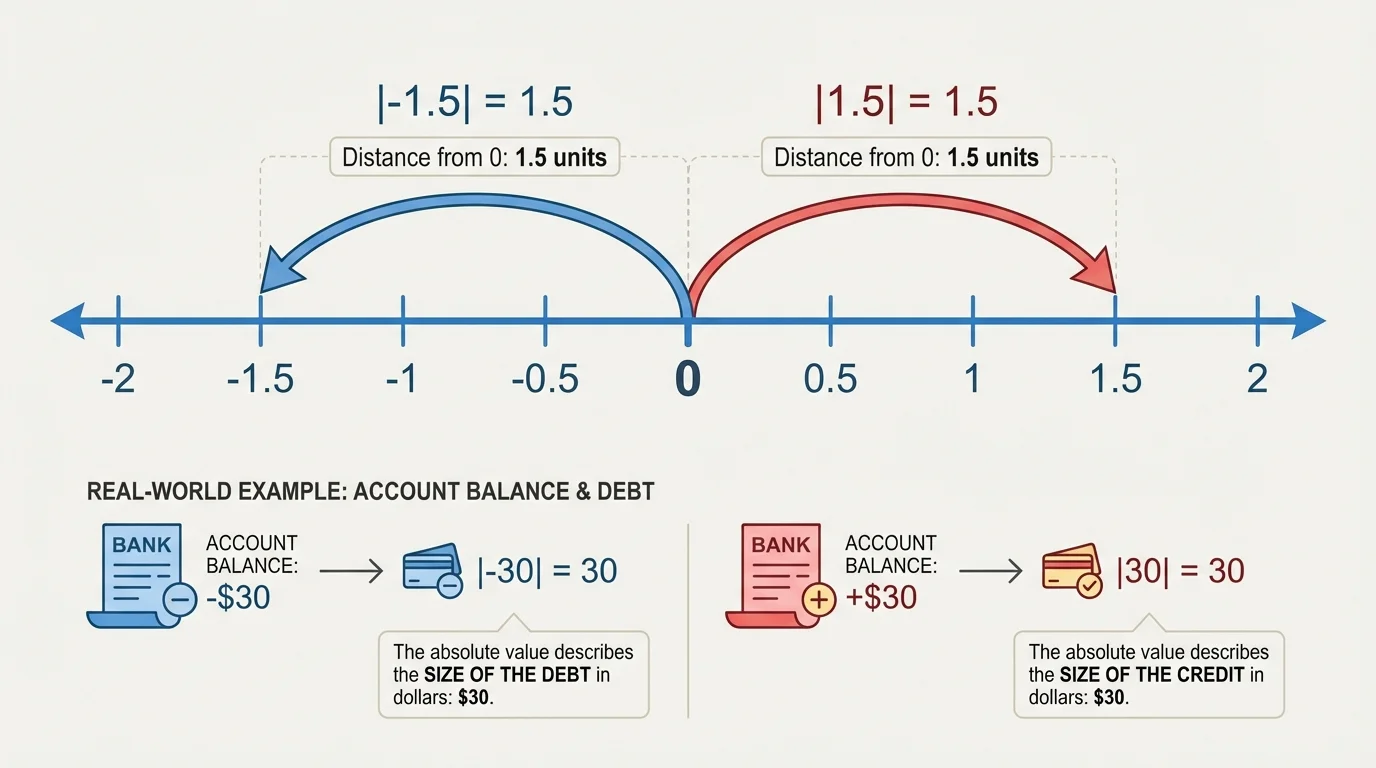
This means the sign tells the side of zero, while the absolute value tells the distance from zero. A negative sign does not by itself indicate a greater or lesser magnitude. It only tells direction relative to zero.
| Number | Absolute value | Meaning |
|---|---|---|
| \(-6\) | \(6\) | \(6\) units from zero on the left |
| \(6\) | \(6\) | \(6\) units from zero on the right |
| \(-2.3\) | \(2.3\) | \(2.3\) units from zero on the left |
| \(\dfrac{4}{5}\) | \(\dfrac{4}{5}\) | \(\dfrac{4}{5}\) unit from zero on the right |
| \(-\dfrac{4}{5}\) | \(\dfrac{4}{5}\) | \(\dfrac{4}{5}\) unit from zero on the left |
Table 1. Examples of rational numbers and their absolute values.
Worked examples help show exactly how to think about absolute value. In each one, focus on the distance from zero.
Worked Example 1
Find \(|-12|\).
Step 1: Identify the number on the number line.
The number is \(-12\), which is 12 units to the left of 0.
Step 2: Use the meaning of absolute value.
Absolute value is distance from 0, so the distance is 12.
Step 3: Write the answer.
\(|-12| = 12\)
The absolute value of \(-12\) is 12.
The answer is positive because distance is never negative.
Worked Example 2
Find \(\left|-\dfrac{7}{8}\right|\).
Step 1: Recognize the rational number.
The number \(-\dfrac{7}{8}\) is a fraction to the left of 0.
Step 2: Think about its distance from zero.
Its distance from 0 is \(\dfrac{7}{8}\) units.
Step 3: Write the absolute value.
\[\left|-\frac{7}{8}\right| = \frac{7}{8}\]
The absolute value keeps the size of the fraction but removes the negative sign.
This is true for any negative fraction: its absolute value is the matching positive fraction.
Worked Example 3
Compare \(-3.4\) and \(2.1\), then compare their absolute values.
Step 1: Compare the numbers themselves.
On the number line, \(-3.4\) is left of \(2.1\), so \(-3.4 < 2.1\).
Step 2: Find each absolute value.
\(|-3.4| = 3.4\) and \(|2.1| = 2.1\).
Step 3: Compare the absolute values.
Since \(3.4 > 2.1\), we have:
\[|-3.4| > |2.1|\]
Even though \(-3.4\) is less than \(2.1\), its distance from zero is greater.
This example shows an important idea: comparing numbers and comparing absolute values are not the same thing.
Worked Example 4
An account balance is -30 dollars. Write an absolute value equation to describe the size of the debt.
Step 1: Identify what the negative sign means.
The balance is negative, so the account owes money rather than having money.
Step 2: Find the magnitude of the debt.
The size of the debt is 30 dollars.
Step 3: Write the absolute value equation.
\(|-30| = 30\)
This equation says the balance has a magnitude of 30, so the amount of the debt is 30 dollars.
[Figure 3] Absolute value helps describe the amount owed without focusing on the negative sign.
In real situations, absolute value often means magnitude, or size. It shows that a quantity may be negative because of direction, loss, or being below a reference point, but the absolute value tells how large that quantity is.
Think about money. A bank balance of -30 dollars means a debt of 30 dollars. The negative sign tells that the balance is below zero. The absolute value tells the size of the debt:
\(|-30| = 30\)
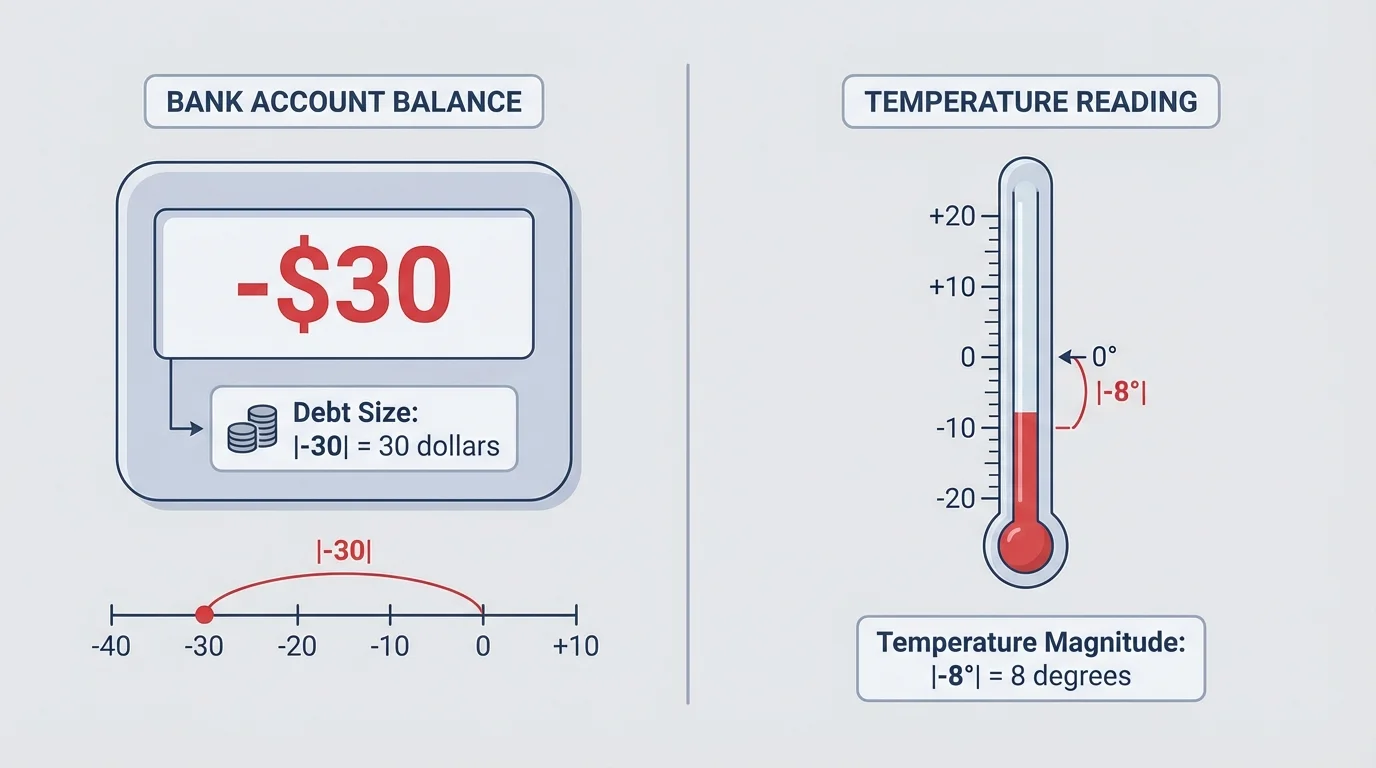
Temperature is another good example. If the temperature is \(-8\) degrees, the negative sign means it is below 0 degrees. The absolute value \(|-8| = 8\) tells the temperature is 8 degrees away from zero.
Elevation can be described this way too. A scuba diver at \(-12.5\) meters is 12.5 meters below sea level. The absolute value \(|-12.5| = 12.5\) tells how far below sea level the diver is.
In sports or games, a score change of \(-6\) points means losing 6 points. The absolute value tells the amount of change: \(|-6| = 6\).
Movement can also be described with absolute value. If a robot moves \(-4\) meters, that may mean 4 meters backward. Its absolute value, \(|-4| = 4\), tells the distance moved.
Temperatures, bank balances, and elevations all use negative numbers, but for different reasons. Absolute value gives one simple way to talk about the size of each quantity without changing what the negative sign means in the situation.
When you look back at the number line idea from [Figure 1], these real-world examples make even more sense. A negative quantity is still some distance from zero, and that distance is its absolute value.
One common mistake is thinking that a negative number has a negative absolute value. That cannot happen. Since absolute value means distance, and distance cannot be negative, the result of an absolute value is always 0 or a positive number.
Another mistake is confusing a number with its absolute value. For example:
These are not the same thing. The first tells position relative to zero. The second tells distance from zero.
A useful pattern is this:
You also need to be careful when comparing values. For example, \(-10 < -2\), but \(|-10| = 10\) and \(|-2| = 2\), so \(|-10| > |-2|\). The more negative number is farther from zero.
Comparing numbers versus comparing distances
When you compare two numbers, you ask which one is farther right on the number line. When you compare two absolute values, you ask which one is farther from zero. Those are different questions, so the answers may be different.
This is why the decimal example from [Figure 2] matters. A number like \(-1.5\) is less than \(0.5\), but its absolute value \(1.5\) is greater than \(0.5\).
Absolute value can also help us think about the distance between two numbers on a number line. If one point is at \(-2\) and another is at \(3\), the points are 5 units apart. You can see this by counting from \(-2\) to 0, which is 2 units, and then from 0 to 3, which is 3 more units.
The total distance is \(2 + 3 = 5\). This matches the difference between the two numbers:
\[|3 - (-2)| = |5| = 5\]
For another example, the distance between \(-1.2\) and \(2.7\) can be found as follows:
\[|2.7 - (-1.2)| = |3.9| = 3.9\]
This idea builds on the meaning of absolute value as distance. Whether you measure from a number to zero or between two numbers, absolute value keeps track of how far apart points are.
Whenever you see absolute value bars, ask one question: How far is this number from zero? If you can answer that, you can find the absolute value.
If the number is positive, keep it. If the number is negative, change it to its positive distance. If the number is zero, the absolute value is zero. This works for integers, decimals, and fractions.
Absolute value is useful because it lets us describe amount clearly. A debt, a drop in temperature, or a position below sea level can all be negative, but the absolute value tells how large the quantity is. That is why \(|-30| = 30\) tells the size of a debt of 30 dollars, and why \(|-8| = 8\) tells how far a temperature is below zero.
