One small number written high above another can completely change the value of an expression. For example, the difference between \(3 \cdot 4\) and \(3^4\) is huge: \(3 \cdot 4 = 12\), but \(3^4 = 81\). That tiny raised number is powerful. Learning how exponents work helps you write long repeated products in a short, neat way and evaluate expressions accurately.
Exponents are part of algebra because they help us describe patterns and write expressions efficiently. Even when no variable is involved, numerical expressions with exponents prepare you for algebraic expressions later. When you understand exponents well, you can read expressions more clearly, avoid common mistakes, and solve problems faster.
A numerical expression is a math phrase made of numbers and operations, such as \(8 + 2 \cdot 5\) or \(4^3 - 7\). It does not have an equals sign. When a number is multiplied by itself again and again, writing every factor can become long and hard to read. For example, \(6 \cdot 6 \cdot 6 \cdot 6\) can be written much more simply as \(6^4\).
This raised number tells how many times the base is used as a factor. Instead of writing a repeated product over and over, exponent notation gives a shorter form. That makes expressions easier to read, compare, and evaluate.
Repeated multiplication means multiplying equal factors. For example, \(4 \cdot 4 \cdot 4\) uses the factor \(4\) three times.
Exponents do not mean repeated addition. The expression \(5^3\) does not mean \(5 + 5 + 5\). It means \(5 \cdot 5 \cdot 5\). This difference matters because repeated multiplication grows much faster than repeated addition.
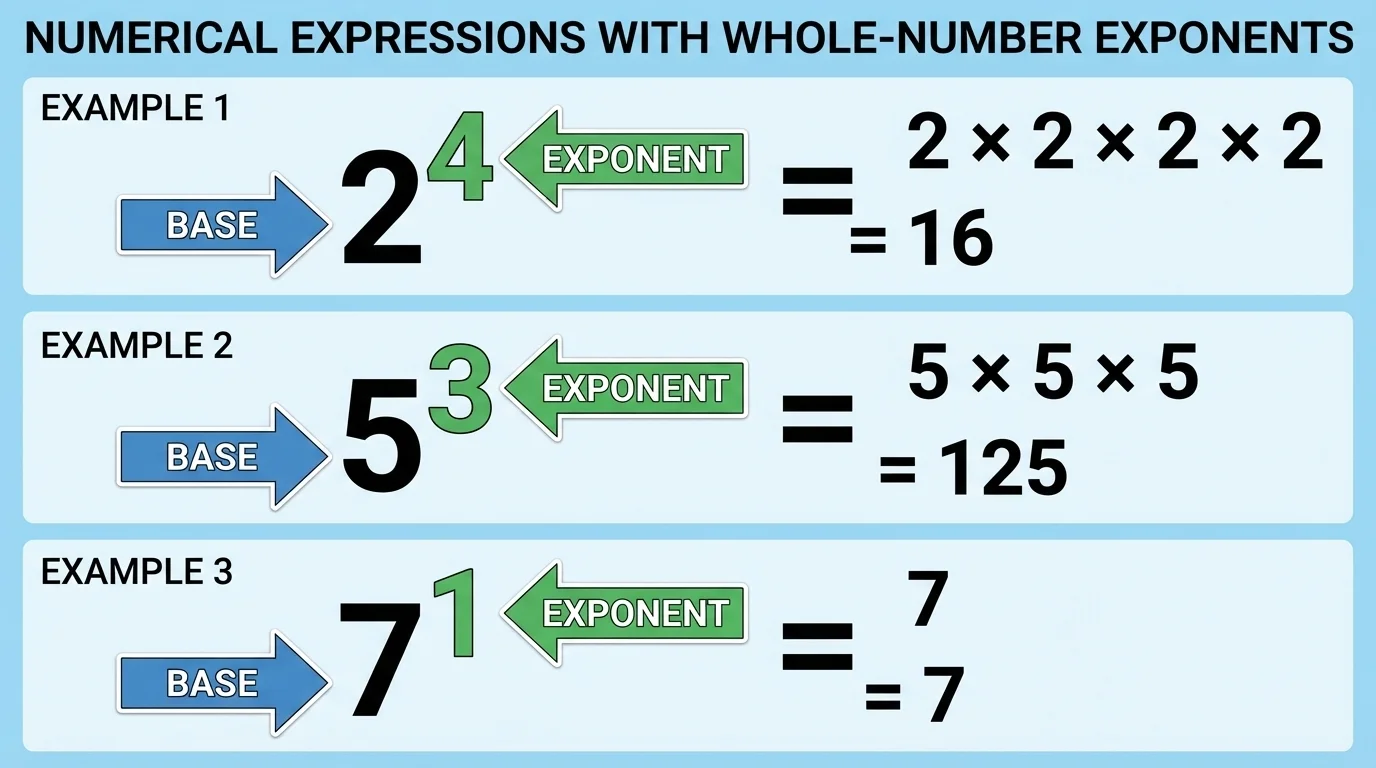
In an expression with a exponent, the two most important parts are the base and the exponent. As [Figure 1] shows, in \(2^4\), the base is \(2\) and the exponent is \(4\). The base is the factor being multiplied repeatedly, and the exponent tells how many times to use that factor.
Here are some examples: in \(5^3\), the base is \(5\) and the exponent is \(3\). In \(10^2\), the base is \(10\) and the exponent is \(2\). In \(7^1\), the base is \(7\) and the exponent is \(1\).
Base: the number being used as a repeated factor.
Exponent: the small raised number that tells how many times the base is multiplied by itself.
Power: another name for an expression with a base and an exponent, such as \(3^4\).
A whole-number exponent is an exponent like \(0\), \(1\), \(2\), \(3\), or any larger counting number. In this lesson, all exponents are whole numbers.
Some special whole-number exponents are especially important. If the exponent is \(1\), then the value stays the same: \(9^1 = 9\). If the exponent is \(2\), the number is multiplied by itself twice: \(9^2 = 9 \cdot 9 = 81\). If the exponent is \(3\), the number is multiplied by itself three times: \(9^3 = 9 \cdot 9 \cdot 9 = 729\).
Another very important case is exponent \(0\). For any nonzero number, \(a^0 = 1\). For example, \(4^0 = 1\) and \(12^0 = 1\). This may seem surprising at first, but it follows the pattern of dividing by the base each time the exponent goes down by \(1\): \(4^3 = 64\), \(4^2 = 16\), \(4^1 = 4\), and then \(4^0 = 1\).
The expression \(0^3\) means \(0 \cdot 0 \cdot 0\), so its value is \(0\). But \(0^0\) is not something you need to evaluate in this grade-level topic. Most of the time, you will work with positive whole-number bases and whole-number exponents.
To write repeated multiplication using exponents, identify the factor that repeats and count how many times it appears. Then write that factor as the base and the number of factors as the exponent.
For example, \(3 \cdot 3 \cdot 3 \cdot 3 \cdot 3\) becomes \(3^5\). The factor \(3\) appears \(5\) times, so the exponent is \(5\). The expression \(8 \cdot 8\) becomes \(8^2\), and \(11\) by itself can be written as \(11^1\).
You can also go in the other direction. If you see \(6^4\), you should be able to write it as \(6 \cdot 6 \cdot 6 \cdot 6\). If you see \(2^5\), you should think of \(2 \cdot 2 \cdot 2 \cdot 2 \cdot 2\).
The word square is often used for an exponent of \(2\), and the word cube is often used for an exponent of \(3\). So \(5^2\) is read as "five squared," and \(4^3\) is read as "four cubed."
These words connect to geometry. A square with side length \(5\) has area \(5^2 = 25\) square units, and a cube with side length \(4\) has volume \(4^3 = 64\) cubic units. Exponents are not just shorthand; they also connect to real measurements.
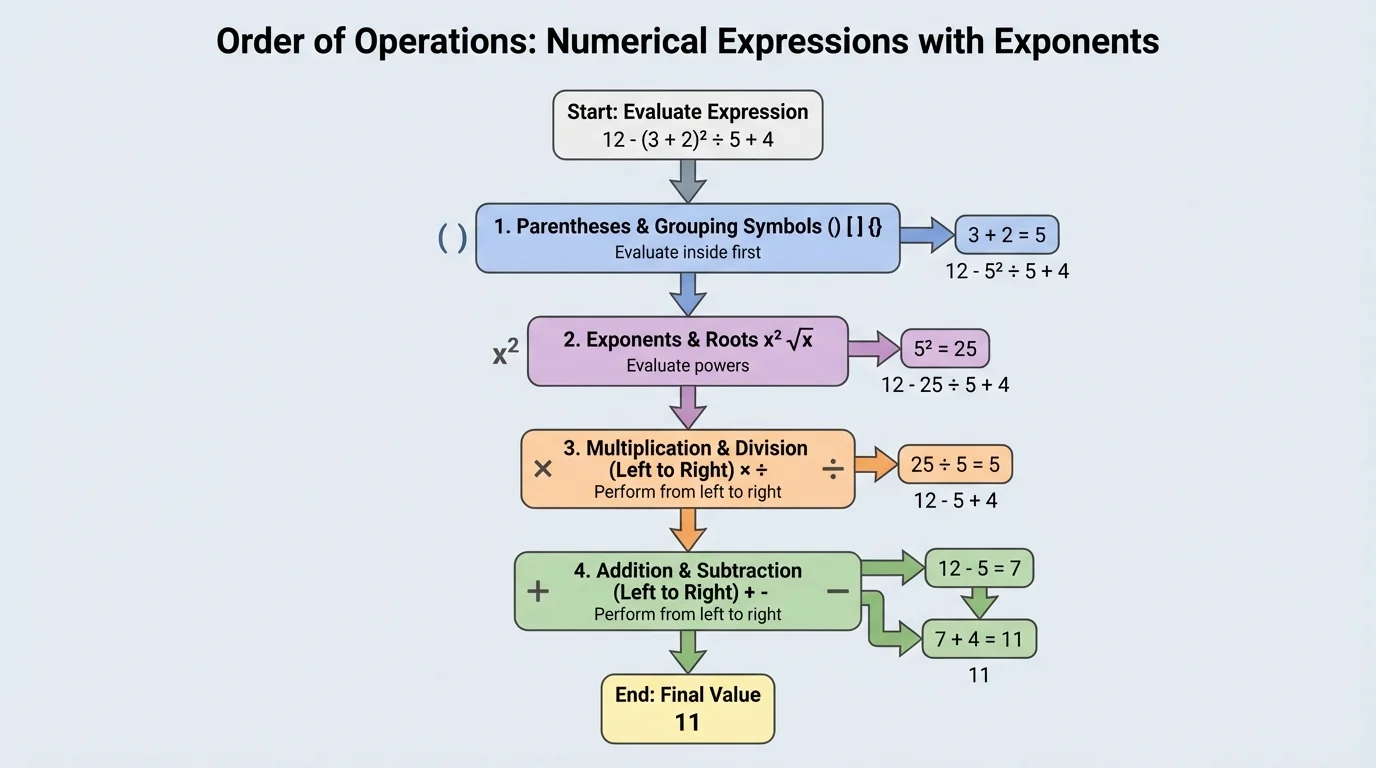
To evaluate an expression means to find its value. When exponents appear in a numerical expression, you must follow the correct order of operations. As [Figure 2] illustrates, exponents are evaluated before multiplication, division, addition, and subtraction, unless parentheses change the grouping.
For example, in \(2 + 3^2\), evaluate the exponent first: \(3^2 = 9\). Then add: \(2 + 9 = 11\). If you added first and got \(5^2\), that would be a different expression and the wrong result.
Order of operations with exponents
When evaluating expressions, work in this general order: parentheses first, exponents next, multiplication and division from left to right, and then addition and subtraction from left to right. Exponents do not simply mean "multiply everything nearby." They apply only to the base unless parentheses show a larger group.
Consider \(4 + 2 \cdot 3^2\). First find \(3^2 = 9\). Then multiply: \(2 \cdot 9 = 18\). Finally add: \(4 + 18 = 22\). The correct value is \(22\).
Parentheses can change the value of an expression. Compare \((2 + 3)^2\) and \(2 + 3^2\). In \((2 + 3)^2\), add inside the parentheses first: \(2 + 3 = 5\), and then square: \(5^2 = 25\). In \(2 + 3^2\), evaluate the exponent first: \(3^2 = 9\), then add \(2\), giving \(11\). The expressions look similar, but their values are different.
As you continue working with expressions, this order helps you decide what to do first, especially when several operations appear together.
One common mistake is confusing multiplication with exponent notation. The expression \(4^3\) does not mean \(4 \cdot 3\). It means \(4 \cdot 4 \cdot 4\). So \(4^3 = 64\), while \(4 \cdot 3 = 12\). These are completely different calculations.
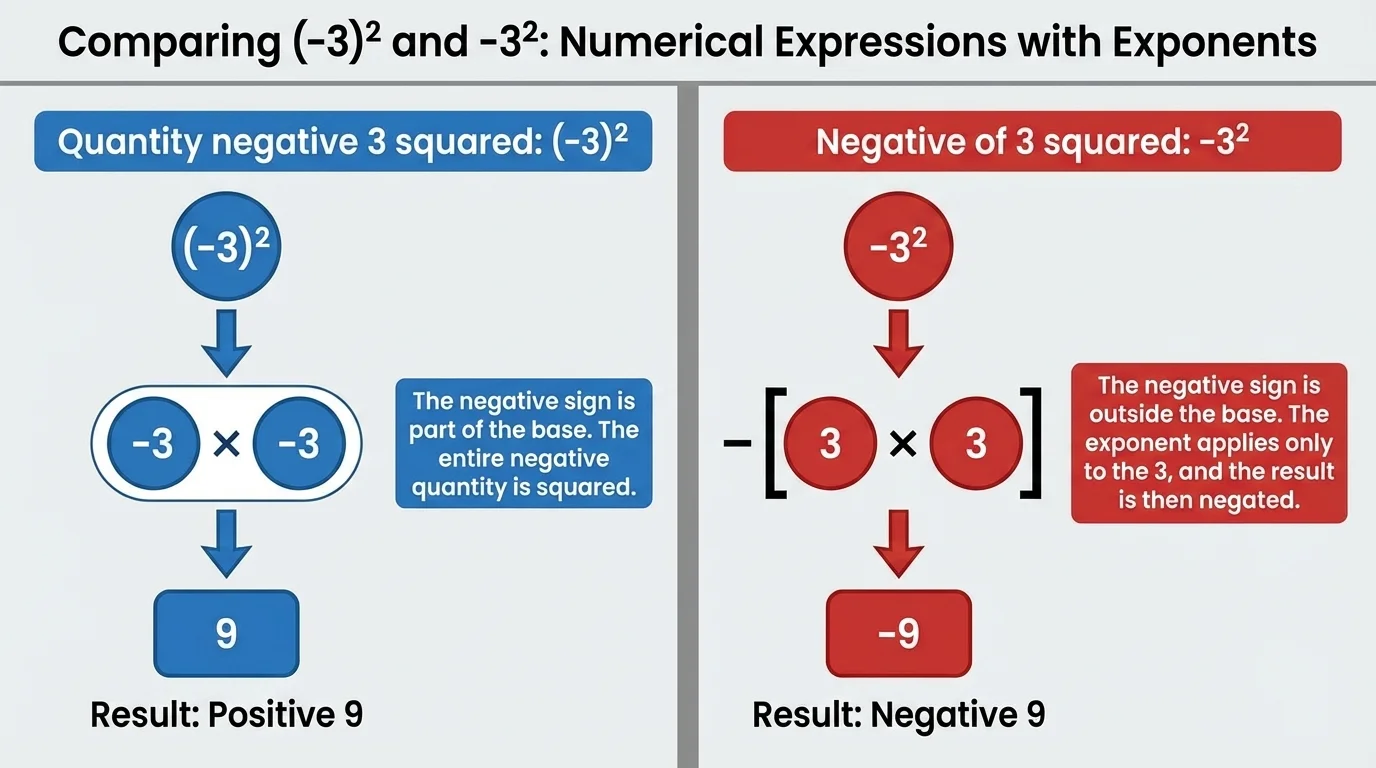
Another important issue involves negative numbers. As [Figure 3] shows, parentheses can change the meaning. The expression \((-3)^2\) means \((-3) \cdot (-3) = 9\). But \(-3^2\) means the exponent applies only to \(3\), so first compute \(3^2 = 9\), then apply the negative sign: \(-9\).
This is why grouping symbols matter. If the negative sign is part of the base, use parentheses. Without parentheses, the exponent belongs only to the number immediately below it.
Here are more special cases: \(1^n = 1\) for any whole-number exponent \(n\), because multiplying \(1\) by itself always gives \(1\). Also, \(10^2 = 100\), \(10^3 = 1{,}000\), and \(10^4 = 10{,}000\), which shows how powers of \(10\) create place-value patterns.
| Expression | Meaning | Value |
|---|---|---|
| \(5^2\) | \(5 \cdot 5\) | \(25\) |
| \(2^4\) | \(2 \cdot 2 \cdot 2 \cdot 2\) | \(16\) |
| \(7^1\) | \(7\) | \(7\) |
| \(9^0\) | nonzero base with exponent \(0\) | \(1\) |
| \((-3)^2\) | \((-3) \cdot (-3)\) | \(9\) |
| \(-3^2\) | negative of \(3^2\) | \(-9\) |
Table 1. Examples of numerical expressions with whole-number exponents and their values.
That last comparison is worth remembering. Later, when you evaluate more complicated expressions, the same idea helps you keep track of what the exponent actually applies to.
Worked examples are one of the best ways to build confidence. Notice how each solution follows a clear order and shows the meaning of the exponent.
Worked example 1
Write \(6 \cdot 6 \cdot 6 \cdot 6\) using an exponent, then evaluate it.
Step 1: Identify the repeated factor.
The factor \(6\) repeats.
Step 2: Count how many times it appears.
The factor \(6\) appears \(4\) times, so the expression is \(6^4\).
Step 3: Evaluate the power.
\(6^4 = 6 \cdot 6 \cdot 6 \cdot 6 = 36 \cdot 36 = 1{,}296\).
The expression in exponent form is \(6^4\), and its value is \(1{,}296\).
This example shows how exponent notation compresses a long repeated product into a short expression.
Worked example 2
Evaluate \(7 + 2^3 \cdot 4\).
Step 1: Evaluate the exponent first.
\(2^3 = 8\).
Step 2: Multiply.
Now the expression is \(7 + 8 \cdot 4\), so \(8 \cdot 4 = 32\).
Step 3: Add.
\(7 + 32 = 39\).
The value of the expression is \(39\).
Notice that adding \(7 + 2\) first would have been incorrect because exponents and multiplication come before addition.
Worked example 3
Evaluate \((3 + 1)^2 - 5\).
Step 1: Work inside the parentheses.
\(3 + 1 = 4\).
Step 2: Evaluate the exponent.
Now the expression is \(4^2 - 5\), and \(4^2 = 16\).
Step 3: Subtract.
\(16 - 5 = 11\).
The value of the expression is \(11\).
Parentheses changed the order here. Without them, the calculation would not be the same.
Worked example 4
Compare \((-2)^4\) and \(-2^4\).
Step 1: Evaluate \((-2)^4\).
\((-2)^4 = (-2) \cdot (-2) \cdot (-2) \cdot (-2) = 16\).
Step 2: Evaluate \(-2^4\).
First compute \(2^4 = 16\), then apply the negative sign: \(-16\).
Step 3: Compare the results.
\((-2)^4 = 16\), but \(-2^4 = -16\).
The expressions look similar, but they are not equal.
That difference is exactly why careful use of parentheses matters in exponential expressions.
Exponents appear in many real situations. Area and volume are common examples. If a square garden has side length \(9\) meters, its area is \(9^2 = 81\) square meters. If a cube-shaped box has side length \(3\) centimeters, its volume is \(3^3 = 27\) cubic centimeters.
Exponents also describe fast-growing patterns. Suppose one video game challenge doubles the number of points at each stage. Starting with \(5\) points and doubling three times gives \(5 \cdot 2^3 = 5 \cdot 8 = 40\) points. The exponent tells how many times the doubling happens.
Why exponent notation matters in patterns
Many patterns involve the same factor repeating again and again. Exponents provide a compact way to write those patterns. Instead of listing each multiplication step, exponent notation shows the structure of the pattern immediately.
Tournaments can also be described with powers of \(2\). In a single-elimination tournament, each round halves the number of players, so an \(8\)-player tournament involves \(2^3 = 8\). Technology, science, and engineering often use this kind of repeated multiplication.
Powers of \(10\) are especially useful in our number system. A thousand is \(10^3\), and ten thousand is \(10^4\). Place value itself is built on powers of \(10\). That means exponents connect directly to how we write and understand large numbers.
Sometimes you can tell whether an answer makes sense before finishing every step. For example, \(3^4\) should be bigger than \(3^3\) because it has one more factor of \(3\). Since \(3^3 = 27\), multiplying by another \(3\) gives \(81\). Reasoning like this helps you check your work.
You can also compare expressions with the same base or the same exponent. If the base stays the same, the larger exponent usually gives the larger value for positive bases greater than \(1\). For instance, \(2^5 = 32\) is greater than \(2^3 = 8\). If the exponent stays the same, the larger positive base gives the larger value, so \(6^2 = 36\) is greater than \(4^2 = 16\).
"A tiny symbol can change the whole value of an expression."
Checking for reasonableness also helps with order of operations. If someone says \(2 + 4^2 = 36\), you can test it quickly. Since \(4^2 = 16\), the expression should be \(2 + 16 = 18\), not \(36\). The wrong answer likely came from adding first and then squaring.
As you become more comfortable with exponents, you will read expressions more accurately, evaluate them more efficiently, and understand how repeated multiplication connects to algebra, geometry, and patterns in the world around you.
