What do movie tickets, a soccer score, and the number of songs in a playlist have in common? They can all be described with math before you even know the exact numbers. That is one of the big ideas of algebra: a letter can stand for a number, so you can write a rule or a relationship in a short, powerful way. Instead of listing every possible answer, you can use an expression such as \(5 - y\) or \(3n\) to describe many situations at once.
In arithmetic, you often work with known numbers such as \(7 + 4\) or \(18 \div 3\). In algebra, you also use letters. A variable is a letter or symbol that stands for a number. The number may change, or it may be unknown for the moment. For example, in \(x + 6\), the letter \(x\) stands for a number. If \(x = 2\), then the expression becomes \(2 + 6\). If \(x = 10\), then it becomes \(10 + 6\).
An expression is a math phrase made of numbers, variables, and operation symbols. Expressions do not have an equals sign. For example, \(4m\), \(12 - p\), and \(\dfrac{r}{5}\) are all expressions. They describe calculations.
Variable means a letter that stands for a number.
Expression means a combination of numbers, variables, and operations that represents a value.
Operation means an action in math, such as addition, subtraction, multiplication, or division.
Using letters helps mathematicians describe patterns and situations quickly. If one notebook costs $3, then the cost of \(n\) notebooks is \(3n\). You do not need to know the exact number of notebooks yet. The expression works for \(1\) notebook, \(5\) notebooks, or \(20\) notebooks.
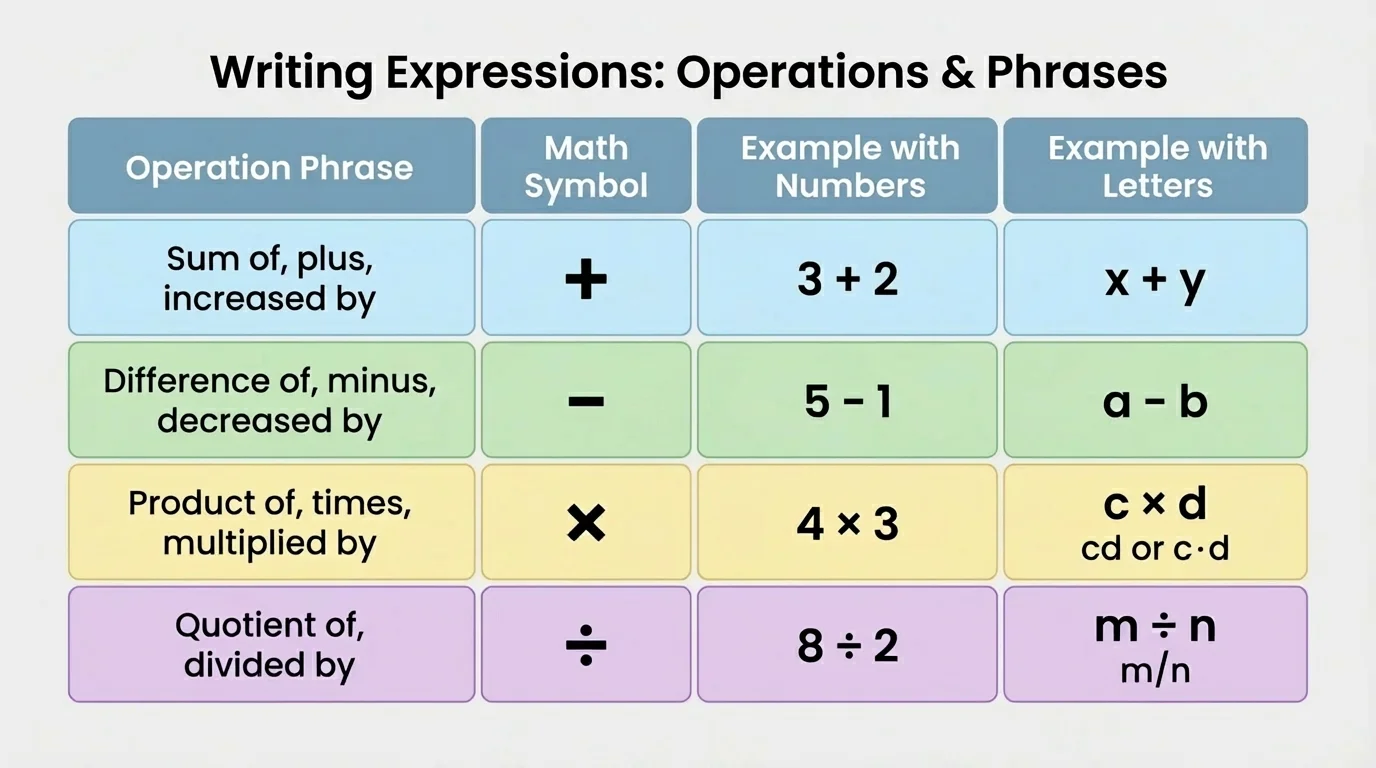
When you turn words into math, clue words help you choose the correct operation. As [Figure 1] shows, many common phrases match directly to one of the four basic operations. Learning these phrases makes it much easier to write expressions correctly.
Addition words include sum, plus, more than, increased by, and added to. Subtraction words include difference, minus, less than, decreased by, and subtracted from. Multiplication words include product, times, of, and phrases like twice or three times. Division words include quotient, divided by, per, and shared equally.
Here are some common examples:
| Word phrase | Expression |
|---|---|
| the sum of \(a\) and \(9\) | \(a + 9\) |
| \(7\) more than \(x\) | \(x + 7\) |
| the difference of \(m\) and \(4\) | \(m - 4\) |
| the product of \(6\) and \(y\) | \(6y\) |
| the quotient of \(z\) and \(3\) | \(\dfrac{z}{3}\) |
Table 1. Common verbal phrases and their matching algebraic expressions.
Notice that multiplication is often written without a multiplication sign. For example, \(6 \times y\) is usually written as \(6y\). This shorter form is standard in algebra.
From arithmetic, you already know the four basic operations. Algebra keeps those same operations, but now a letter can take the place of one or more numbers.
Some phrases are especially important because they can be tricky. The phrase the sum of \(x\) and \(5\) means \(x + 5\). The phrase the product of \(4\) and \(n\) means \(4n\). These are straightforward because the order does not change the value for addition and multiplication. But subtraction and division need more attention.
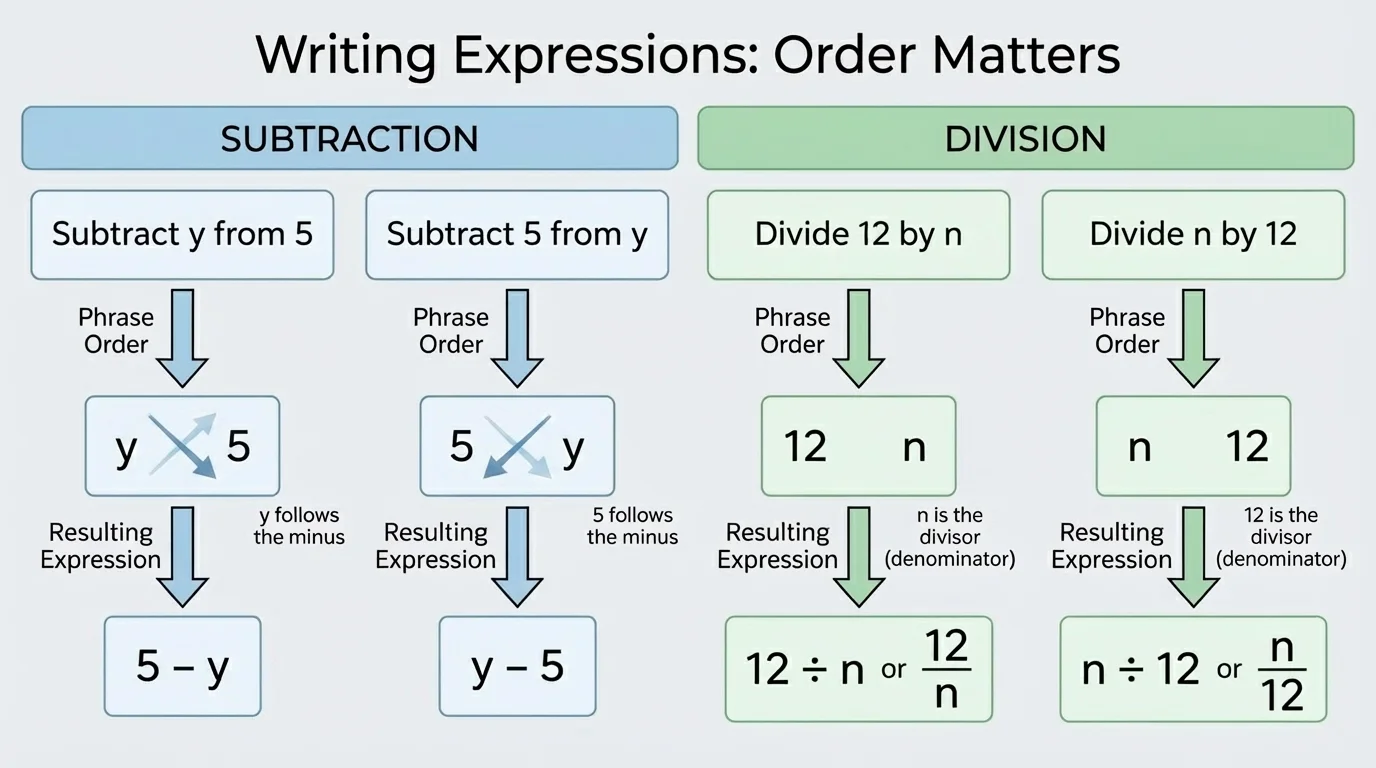
Subtraction and division are not like addition and multiplication. With subtraction and division, changing the order changes the value. That is why phrases must be read carefully, as [Figure 2] illustrates.
Look at these two subtraction phrases:
Subtract \(y\) from \(5\) means start with \(5\), then take away \(y\). The expression is \(5 - y\).
Subtract \(5\) from \(y\) means start with \(y\), then take away \(5\). The expression is \(y - 5\).
Those two expressions are different. In one, \(5\) comes first. In the other, \(y\) comes first. The word from tells you to reverse the order you hear.
The same idea appears in division. Divide \(12\) by \(n\) is \(\dfrac{12}{n}\). But divide \(n\) by \(12\) is \(\dfrac{n}{12}\). These are not the same expression.
Another phrase that often causes mistakes is less than. For example, \(3\) less than \(x\) means \(x - 3\), not \(3 - x\). The phrase tells you that \(3\) is being taken away from \(x\).
Why order matters
Addition and multiplication are commutative, which means \(a + b = b + a\) and \(ab = ba\). But subtraction and division are not commutative. In general, \(a - b \ne b - a\) and \(\dfrac{a}{b} \ne \dfrac{b}{a}\). That is why verbal phrases involving subtraction and division must be read very carefully.
When you are unsure, ask yourself, "What number do I start with?" In subtract \(y\) from \(5\), you start with \(5\). In \(8\) divided by \(k\), you start with \(8\). This simple question helps prevent many mistakes.
Now let's turn more word phrases into algebraic expressions. Start by finding the operation. Then decide the correct order. Finally, write the expression using a variable where needed.
Worked example 1
Write an expression for the sum of \(9\) and \(x\).
Step 1: Identify the operation.
The phrase sum of means addition.
Step 2: Write the numbers and variable in the expression.
\(9 + x\)
The expression is \(9 + x\).
That example is simple because addition does not depend on order. You could also write \(x + 9\), and it would have the same value.
Worked example 2
Write an expression for subtract \(t\) from \(14\).
Step 1: Identify the operation.
The word subtract means subtraction.
Step 2: Notice the word from.
The phrase says to subtract \(t\) from \(14\), so \(14\) comes first.
Step 3: Write the expression.
\(14 - t\)
The expression is \(14 - t\).
Here, writing \(t - 14\) would change the meaning, so the order is very important.
Worked example 3
Write an expression for the product of \(6\) and \(p\).
Step 1: Identify the operation.
The word product means multiplication.
Step 2: Write the multiplication expression.
\(6 \times p\)
Step 3: Use standard algebra form.
In algebra, \(6 \times p\) is usually written as \(6p\).
The expression is \(6p\).
You will often see special multiplication phrases. For example, twice \(n\) means \(2n\), and three times \(a\) means \(3a\).
Worked example 4
Write an expression for the quotient of \(m\) and \(8\).
Step 1: Identify the operation.
The word quotient means division.
Step 2: Write the expression in the given order.
\(m \div 8\)
Step 3: Use fraction form.
\(\dfrac{m}{8}\)
The expression is \(\dfrac{m}{8}\).
A coefficient is the number multiplied by a variable. In \(6p\), the coefficient is \(6\). In \(2x\), the coefficient is \(2\).
Writing expressions is one skill, and reading them is another. If you can read an expression clearly, you are more likely to understand what it means.
For example, \(x + 4\) can be read as \(x\) plus \(4\) or the sum of \(x\) and \(4\). The expression \(12 - y\) can be read as \(12\) minus \(y\) or the difference of \(12\) and \(y\).
Expressions with multiplication can be read in several correct ways too. The expression \(5n\) can be read as \(5\) times \(n\) or the product of \(5\) and \(n\). The expression \(\dfrac{a}{3}\) can be read as \(a\) divided by \(3\) or the quotient of \(a\) and \(3\).
Sometimes grouping symbols change the meaning. The expression \(2(x + 3)\) means multiply \(2\) by the entire quantity \(x + 3\). This is different from \(2x + 3\). In the first expression, the addition happens inside the parentheses before multiplication by \(2\). In the second expression, only \(x\) is multiplied by \(2\), and then \(3\) is added.
Mathematicians use expressions as a kind of shorthand. A short expression such as \(2n + 1\) can describe every odd number when \(n\) is a whole number.
This is why careful reading matters. Small changes in the way an expression is written can create a completely different calculation.
To evaluate an expression means to find its value when the variable is replaced by a number. You substitute the given value for the variable and then compute.
Suppose the expression is \(4x + 1\) and \(x = 3\). Replace \(x\) with \(3\):
\(4x + 1 = 4(3) + 1 = 12 + 1 = 13\)
So the value of the expression is \(13\).
Worked example 5
Evaluate \(5 - y\) when \(y = 2\).
Step 1: Substitute the value.
Replace \(y\) with \(2\): \(5 - y = 5 - 2\).
Step 2: Calculate.
\(5 - 2 = 3\)
The value of the expression is \(3\).
Now compare that with evaluating \(y - 5\) when \(y = 2\). You get \(2 - 5 = -3\). This shows again why order matters, just as we saw earlier in [Figure 2].
Worked example 6
Evaluate \(\dfrac{n}{4}\) when \(n = 20\).
Step 1: Substitute the value.
\(\dfrac{n}{4} = \dfrac{20}{4}\)
Step 2: Divide.
\(\dfrac{20}{4} = 5\)
The value of the expression is \(5\).
Always substitute carefully. Put the number where the variable is, then follow the order of operations if needed.
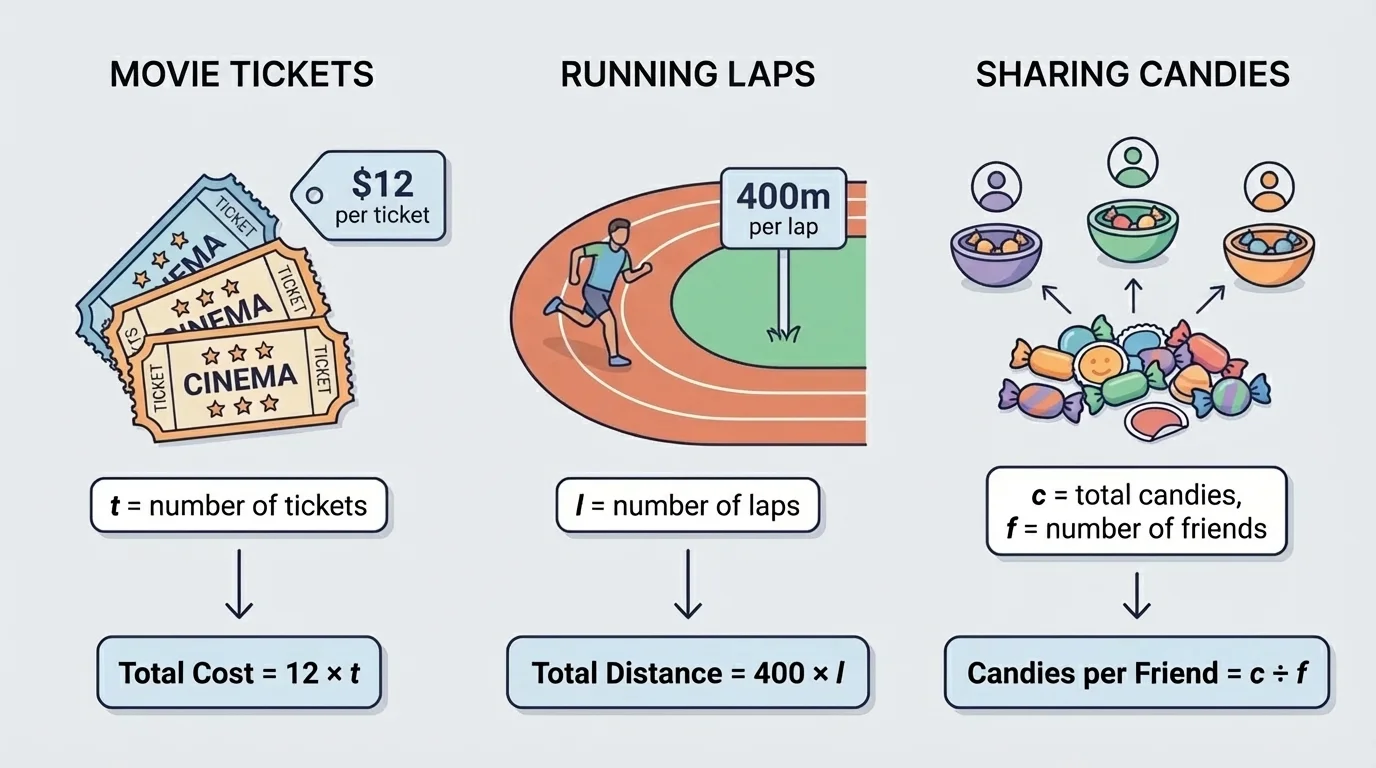
Expressions are not just school math. They describe real situations all the time, as [Figure 3] illustrates with prices, repeated actions, and equal sharing. They let you write a rule once and use it over and over.
If one movie ticket costs $8, then the cost of \(t\) tickets is \(8t\). If a runner completes \(l\) laps around a track and each lap is \(400\) meters, the total distance is \(400l\) meters. If \(24\) stickers are shared equally among \(s\) students, each student gets \(\dfrac{24}{s}\) stickers.
Expressions also help with planning. Suppose you save $5 each week. After \(w\) weeks, you have saved \(5w\) dollars. If you already had $12 to start, your total savings would be \(5w + 12\). One expression can describe your savings after any number of weeks.
Sports give another example. If a basketball player scores \(2\) points for each regular basket and makes \(b\) baskets, that part of the score is \(2b\). If the player also makes \(f\) free throws worth \(1\) point each, the total score is \(2b + f\).
Patterns in numbers can also be written with expressions. The perimeter of a square with side length \(s\) is \(4s\). The perimeter changes when \(s\) changes, but the expression stays the same.
Later, when you solve equations, these same expressions will help you describe unknown quantities and relationships. The simple phrase-to-expression skill you are learning now is a foundation for much more advanced algebra.
One common mistake is reversing subtraction. For example, \(6\) less than \(x\) means \(x - 6\), not \(6 - x\). Another common mistake is reversing division. \(18\) divided by \(n\) is \(\dfrac{18}{n}\), not \(\dfrac{n}{18}\).
Another mistake is confusing an expression with an equation. The expression \(3x + 2\) does not have an equals sign. An equation would look like \(3x + 2 = 11\). In this lesson, the focus is on writing expressions that record operations.
Students also sometimes forget that multiplication can be written without the \(\times\) symbol. The expression \(4r\) means \(4 \times r\). Writing \(4 + r\) instead would completely change the meaning.
If a phrase contains more than one operation, read it in parts. For example, \(3\) more than twice \(n\) means start with twice \(n\), which is \(2n\), and then add \(3\). The expression is \(2n + 3\).
"Algebra is a language for describing patterns and relationships."
That idea is exactly why expressions matter. They are short, clear ways to record what is happening with numbers, even when some numbers are still unknown.
