Here is a surprising idea: sometimes a number smaller than 1 can be divided by another number smaller than 1, and the answer can still make perfect sense in real life. If you have \(\dfrac{2}{3}\) of a cup of yogurt and each serving is \(\dfrac{3}{4}\) of a cup, the question is not strange at all. You are asking, "How many servings of size \(\dfrac{3}{4}\) fit into \(\dfrac{2}{3}\)?" That is exactly what fraction division helps us answer.
Division with fractions is about more than rules. It helps us find quotients in sharing problems, measuring problems, and geometry problems. You can use pictures, equations, and reasoning to understand what the answer means. Once the meaning is clear, the calculation becomes much easier.
When we divide fractions, we are usually answering one of two kinds of questions. The first is How many groups? The second is How much in each group? These are the same two meanings of division you already know from whole numbers.
Division of fractions means finding a missing number in a multiplication relationship. If \(x\) is the missing number, then \(\dfrac{a}{b} \div \dfrac{c}{d} = x\) means \(\dfrac{c}{d} \cdot x = \dfrac{a}{b}\).
Measurement division asks how many groups of a given size fit into an amount.
Partitive division asks how much is in each group when an amount is shared equally.
For example, \(\dfrac{2}{3} \div \dfrac{3}{4}\) asks: how many groups of size \(\dfrac{3}{4}\) are in \(\dfrac{2}{3}\)? The answer will be less than 1 because \(\dfrac{2}{3}\) is less than \(\dfrac{3}{4}\).
Another example is \(\dfrac{1}{2} \div 3\). This asks: if \(\dfrac{1}{2}\) of something is shared equally among 3 people, how much does each person get? This is a partitive division question.
It is helpful to keep both meanings in mind because word problems can sound different even when they both use division.
Measurement division: "How many '\(\dfrac{3}{4}\)'-cup servings are in '\(\dfrac{2}{3}\)' cup?" This is '\(\dfrac{2}{3} \div \dfrac{3}{4}\)'.
Partitive division: "How much chocolate will each person get if '3' people share '\(\dfrac{1}{2}\)' lb equally?" This is '\(\dfrac{1}{2} \div 3\)'.
Even area problems can involve fraction division. If a rectangle has area '\(\dfrac{1}{2}\)' square mile and length '\(\dfrac{3}{4}\)' mile, then its width is area divided by length:
\(\textrm{width} = \dfrac{1}{2} \div \dfrac{3}{4}\)
So fraction division appears in measurement, sharing, and geometry.
You already know that multiplication and division are related. Since \(12 \div 3 = 4\), it is also true that \(3 \cdot 4 = 12\). The same idea works with fractions.
That connection is the key to understanding why fraction division works. Instead of memorizing a rule first, we can ask what number makes a multiplication sentence true.
A visual fraction model helps you see the size of the fractions being compared, and [Figure 1] illustrates this by showing '\(\dfrac{2}{3}\)' of a whole and comparing it to groups of size '\(\dfrac{3}{4}\)'. A model is especially useful when the answer is not a whole number of groups.
One common strategy is to divide the whole into a number of equal parts that both fractions can use. For \(\dfrac{2}{3}\) and \(\dfrac{3}{4}\), a convenient common partition is twelfths because \(12\) is a common multiple of 3 and 4. Then \(\dfrac{2}{3} = \dfrac{8}{12}\) and \(\dfrac{3}{4} = \dfrac{9}{12}\).
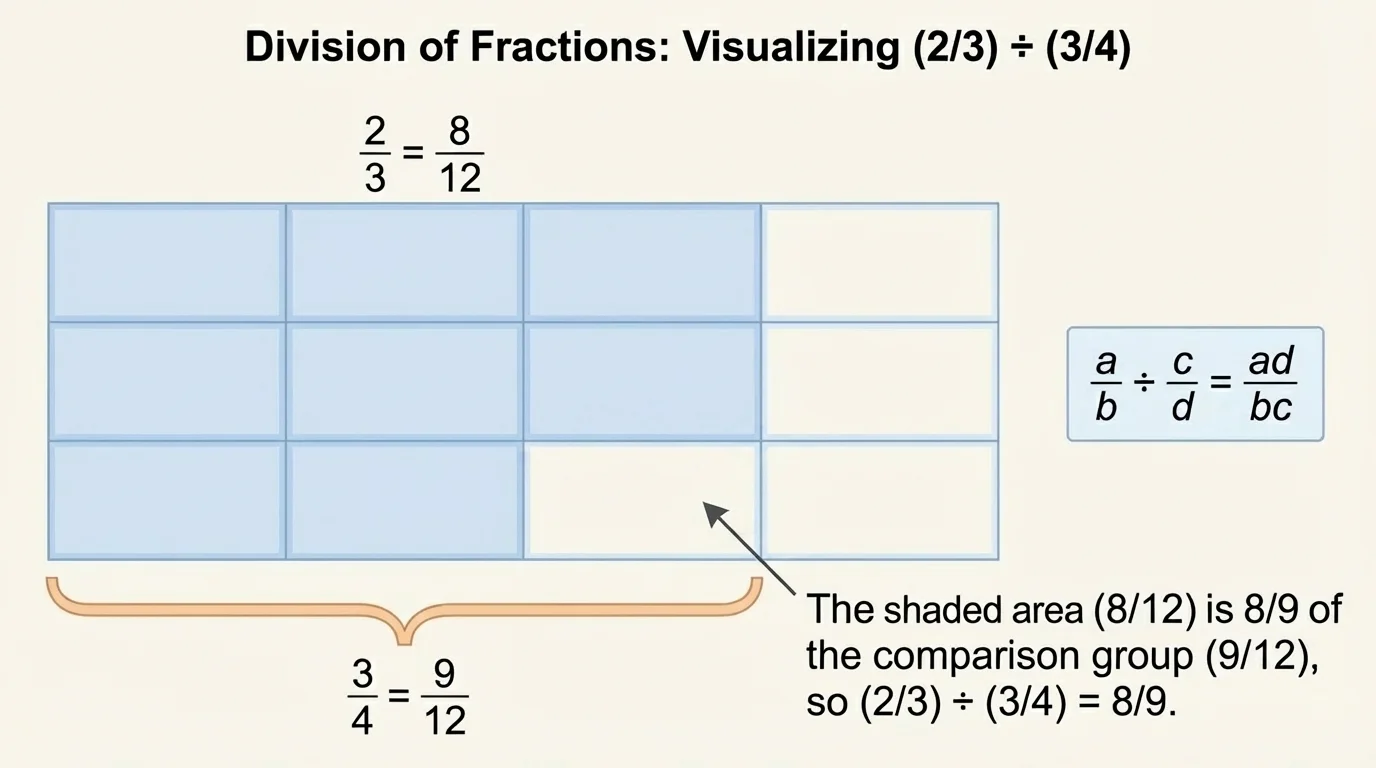
Now the question becomes: how many groups of size \(\dfrac{9}{12}\) fit into \(\dfrac{8}{12}\)? Since \(\dfrac{8}{12}\) is less than \(\dfrac{9}{12}\), the answer is less than 1 group. In fact, it is \(\dfrac{8}{9}\) of a group.
This is a powerful idea: division does not always count whole groups. Sometimes it tells what fraction of a group fits.
The inverse relationship between multiplication and division is the best way to explain fraction division. If '\(\dfrac{2}{3} \div \dfrac{3}{4} = x\)', then '\(\dfrac{3}{4} \cdot x = \dfrac{2}{3}\)'.
Why multiplication helps
To divide by a fraction, you can ask: "What number multiplied by the divisor gives the dividend?" So instead of only doing a procedure, you are solving a missing-factor problem.
Let us test '\(x = \dfrac{8}{9}\)'. Multiply:
\[\frac{3}{4} \cdot \frac{8}{9} = \frac{24}{36} = \frac{2}{3}\]
Because '\(\dfrac{3}{4}\)' of '\(\dfrac{8}{9}\)' is '\(\dfrac{2}{3}\)', it follows that '\(\dfrac{2}{3} \div \dfrac{3}{4} = \dfrac{8}{9}\)'. This matches the picture from [Figure 1], where '\(\dfrac{2}{3}\)' is '\(\dfrac{8}{9}\)' of a '\(\dfrac{3}{4}\)'-sized group.
Create a story: a container holds '\(\dfrac{2}{3}\)' cup of yogurt, and one full serving is '\(\dfrac{3}{4}\)' cup. How many servings are in the container? That situation models '\(\dfrac{2}{3} \div \dfrac{3}{4}\)'.
Worked example 1
Find '\(\dfrac{2}{3} \div \dfrac{3}{4}\)'.
Step 1: Rewrite each fraction with a common denominator.
'\(\dfrac{2}{3} = \dfrac{8}{12}\)' and '\(\dfrac{3}{4} = \dfrac{9}{12}\)'.
Step 2: Interpret the division.
Ask how many groups of size '\(\dfrac{9}{12}\)' fit into '\(\dfrac{8}{12}\)'.
Step 3: Compare the sizes.
Since '\(\dfrac{8}{12}\)' is '\(\dfrac{8}{9}\)' of '\(\dfrac{9}{12}\)', the quotient is '\(\dfrac{8}{9}\)'.
Step 4: Check with multiplication.
'\(\dfrac{3}{4} \cdot \dfrac{8}{9} = \dfrac{24}{36} = \dfrac{2}{3}\)'.
\[\frac{2}{3} \div \frac{3}{4} = \frac{8}{9}\]
This answer makes sense because the amount '\(\dfrac{2}{3}\)' is a little smaller than one full '\(\dfrac{3}{4}\)'-size serving, so the result should be a little less than '1'.
Now consider a sharing problem. Three people split '\(\dfrac{1}{2}\)' pound of chocolate equally. Each person gets the total amount divided by the number of people.
Worked example 2
Find how much each person gets when '\(3\)' people share '\(\dfrac{1}{2}\)' lb equally.
Step 1: Write the division expression.
'\(\dfrac{1}{2} \div 3\)'
Step 2: Rewrite the whole number as a fraction.
'\(3 = \dfrac{3}{1}\)'
Step 3: Divide.
'\(\dfrac{1}{2} \div \dfrac{3}{1} = \dfrac{1}{2} \cdot \dfrac{1}{3} = \dfrac{1}{6}\)'
Step 4: Check with multiplication.
'\(3 \cdot \dfrac{1}{6} = \dfrac{3}{6} = \dfrac{1}{2}\)'
\[\frac{1}{2} \div 3 = \frac{1}{6}\]
Each person gets '\(\dfrac{1}{6}\)' lb of chocolate.
This answer is reasonable. If half a pound is shared among three people, each share must be smaller than '\(\dfrac{1}{2}\)' pound.
This is a measurement question, and [Figure 2] shows the comparison by putting both amounts into twelfths. The model makes it clear that you are not asking for more yogurt; you are asking what fraction of a full '\(\dfrac{3}{4}\)'-cup serving is available.
The expression is '\(\dfrac{2}{3} \div \dfrac{3}{4}\)', the same one from the first example, but now the units are cups and servings.
Worked example 3
Find how many '\(\dfrac{3}{4}\)'-cup servings are in '\(\dfrac{2}{3}\)' cup.
Step 1: Write equivalent fractions.
'\(\dfrac{2}{3} = \dfrac{8}{12}\)' and '\(\dfrac{3}{4} = \dfrac{9}{12}\)'.
Step 2: Compare the amounts.
'\(\dfrac{8}{12}\)' is '\(\dfrac{8}{9}\)' of '\(\dfrac{9}{12}\)'.
Step 3: State the quotient.
'\(\dfrac{2}{3} \div \dfrac{3}{4} = \dfrac{8}{9}\)'
\[\frac{2}{3} \div \frac{3}{4} = \frac{8}{9}\]
There are '\(\dfrac{8}{9}\)' of a serving in '\(\dfrac{2}{3}\)' cup.
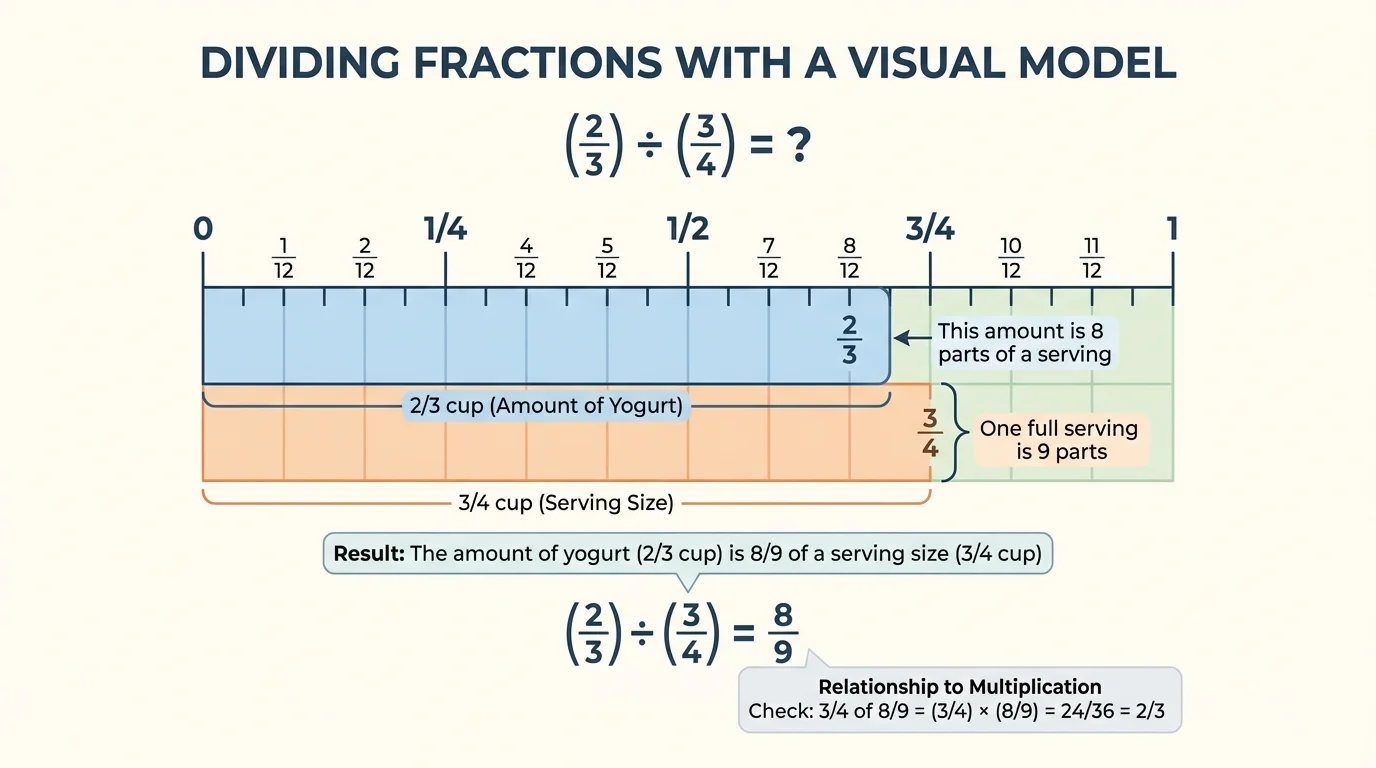
Notice how important the units are. The answer is not \(\dfrac{8}{9}\) cup. It is \(\dfrac{8}{9}\) of a serving. The picture in helps show that difference.
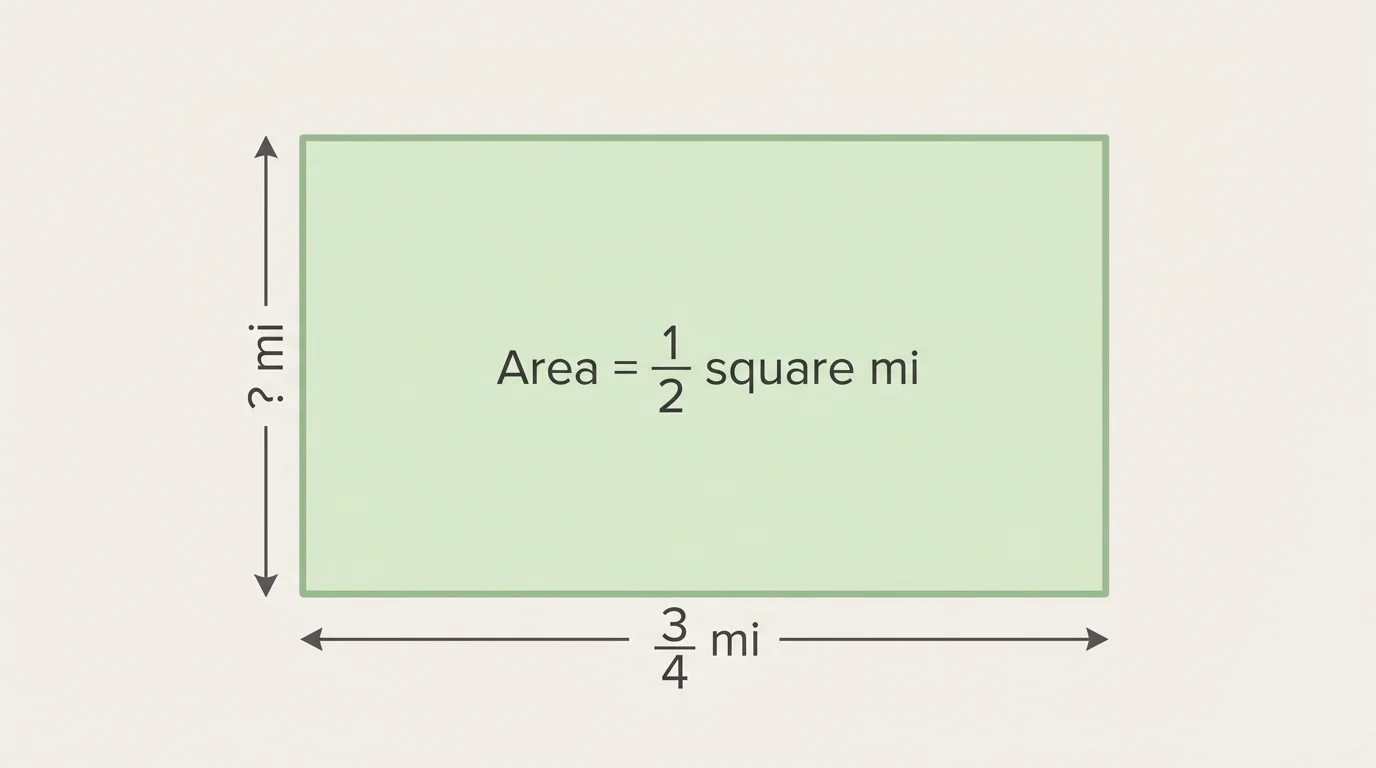
Area problems connect fraction division to geometry. A rectangle's area is found by multiplying length and width, so [Figure 3] represents the missing width as an unknown side when the area and length are known. That means division will help us find the missing side.
If the area is \(\dfrac{1}{2}\) square mile and the length is \(\dfrac{3}{4}\) mile, then the width is \(\dfrac{1}{2} \div \dfrac{3}{4}\).
\(\textrm{width} = \dfrac{1}{2} \div \dfrac{3}{4}\)
Worked example 4
Find the width of a rectangular strip of land with length '\(\dfrac{3}{4}\)' mi and area '\(\dfrac{1}{2}\)' square mi.
Step 1: Use the area relationship.
\(\textrm{Area} = \textrm{length} \cdot \textrm{width}\)
Step 2: Solve for width.
\(\textrm{Width} = \dfrac{1}{2} \div \dfrac{3}{4}\)
Step 3: Divide.
'\(\dfrac{1}{2} \div \dfrac{3}{4} = \dfrac{1}{2} \cdot \dfrac{4}{3} = \dfrac{4}{6} = \dfrac{2}{3}\)'
Step 4: Check.
'\(\dfrac{3}{4} \cdot \dfrac{2}{3} = \dfrac{6}{12} = \dfrac{1}{2}\)' square mi
\(\textrm{Width} = \dfrac{2}{3}\textrm{ mi}\)
This means the strip is '\(\dfrac{2}{3}\)' mile wide. The geometry picture in [Figure 3] shows why multiplying the length and width gives the area back.
After understanding the meaning, you can use a general rule to divide fractions efficiently:
\[\frac{a}{b} \div \frac{c}{d} = \frac{a}{b} \cdot \frac{d}{c} = \frac{ad}{bc}\]
This is often described as multiplying by the reciprocal. The reciprocal of \(\dfrac{c}{d}\) is \(\dfrac{d}{c}\) because
\[\frac{c}{d} \cdot \frac{d}{c} = 1\]
Why does this work? Suppose \(x = \dfrac{a}{b} \div \dfrac{c}{d}\). Then \(\dfrac{c}{d} \cdot x = \dfrac{a}{b}\). To isolate \(x\), multiply both sides by \(\dfrac{d}{c}\):
\(\dfrac{d}{c} \cdot \dfrac{c}{d} \cdot x = \dfrac{d}{c} \cdot \dfrac{a}{b}\), so \(1 \cdot x = \dfrac{ad}{bc}\). Therefore \(x = \dfrac{ad}{bc}\).
A fraction can be divided by another fraction even when the answer is greater than '1'. For example, '\(\dfrac{3}{4} \div \dfrac{1}{8} = 6\)' because six eighths fit into three fourths.
Whether the answer is less than '1' or greater than '1' depends on the sizes of the two fractions. Dividing by a very small fraction can produce a larger quotient because many small groups can fit into the amount.
One common mistake is to divide straight across, like '\(\dfrac{2}{3} \div \dfrac{3}{4} = \dfrac{2 \div 3}{3 \div 4}\)'. That is not a valid fraction division method.
Another mistake is forgetting what the answer means. In a serving problem, the quotient may mean a number of servings, not cups. In an area problem, the quotient may mean a length, not a square unit.
A smart habit is to estimate before solving. For example, '\(\dfrac{1}{2} \div \dfrac{3}{4}\)' should be less than '1' because '\(\dfrac{1}{2}\)' is smaller than '\(\dfrac{3}{4}\)'. The exact answer '\(\dfrac{2}{3}\)' matches that estimate.
It also helps to check by multiplication. If your answer to '\(\dfrac{a}{b} \div \dfrac{c}{d}\)' is '\(x\)', then verify that '\(\dfrac{c}{d} \cdot x = \dfrac{a}{b}\)'.
Fraction division appears in cooking when recipes are scaled, in construction when materials are cut, and in medicine when doses are measured from a limited amount. A baker might ask how many '\(\dfrac{3}{4}\)'-cup portions can be made from '\(\dfrac{2}{3}\)' cup of ingredient. A builder might use area and one side length to find the missing width of a floor section. A gardener might divide a half-pound packet of seeds equally into several small plots.
These situations may look different, but the mathematics is connected. You are always finding a missing factor or comparing one amount to the size of a group. That is why understanding the meaning of division matters just as much as learning the rule.
| Situation | Expression | Meaning of the quotient |
|---|---|---|
| Servings of yogurt | \(\dfrac{2}{3} \div \dfrac{3}{4}\) | How many servings fit into the amount |
| Sharing chocolate | \(\dfrac{1}{2} \div 3\) | How much each person gets |
| Finding land width | \(\dfrac{1}{2} \div \dfrac{3}{4}\) | The missing side length |
When you connect the equation, the picture, and the context, fraction division becomes much more logical. The rule is useful, but understanding why it works gives you confidence in every kind of problem.
