Basketball teams, recipes, video game scores, school votes, and even animal groups all involve a powerful math idea: comparison. If one team has \(12\) players and another has \(6\), you could subtract to find the difference. But what if you want to compare how many there are relative to each other? That is where ratios come in. Ratios help us describe how two quantities are connected.
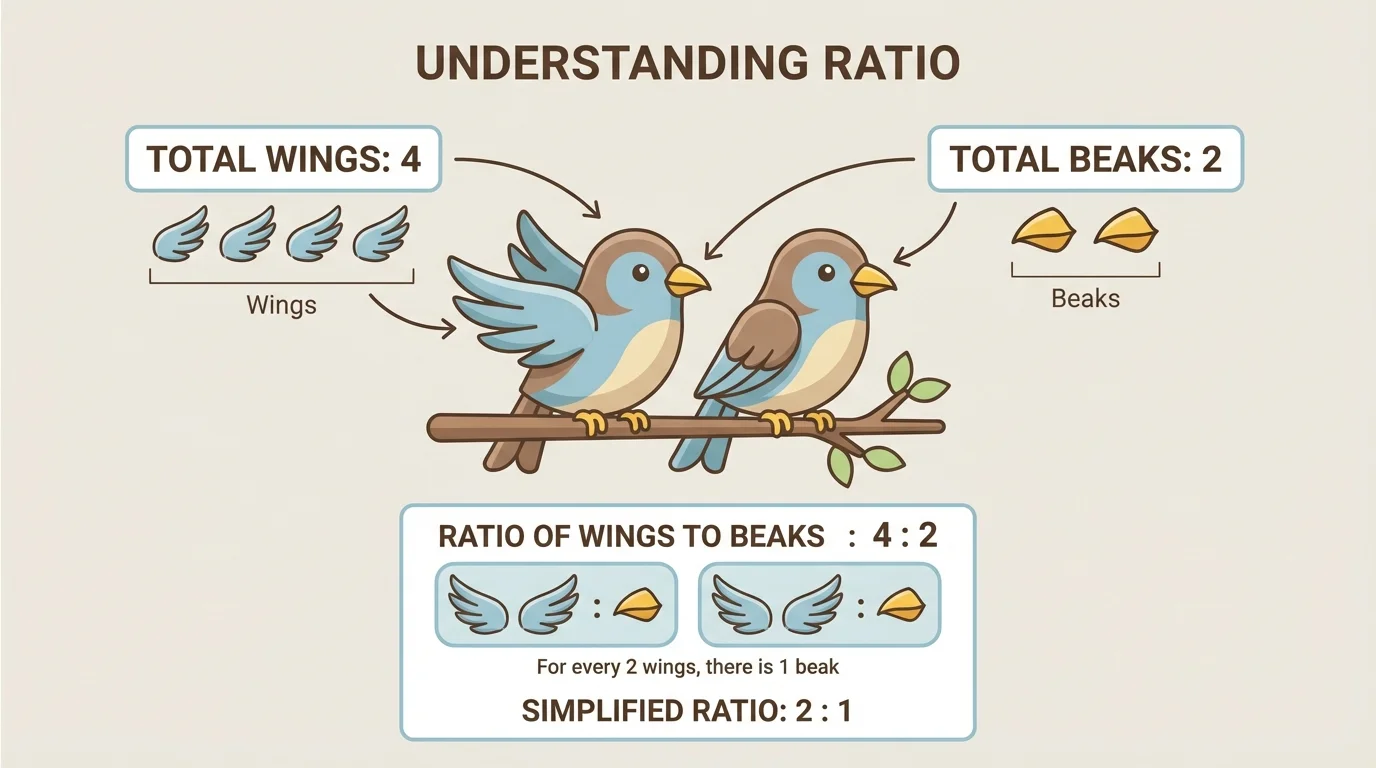
A ratio is a comparison of two quantities. It tells how much of one quantity there is compared with another quantity. For example, if the birds in an enclosure have a total of \(4\) wings and \(2\) beaks, the ratio of wings to beaks is \(4:2\). This comparison helps us describe the relationship between the two counts.
[Figure 1] We can also say that ratio in a simpler way. Since \(4:2\) and \(2:1\) describe the same relationship, we often say, "The ratio of wings to beaks is \(2:1\), because for every \(2\) wings there is \(1\) beak."
Ratio means a comparison of two quantities by division.
Ratio language uses words such as "for every" to describe the comparison in a sentence.
A ratio does not tell the total by itself. Instead, it tells how two amounts match up. If the ratio of red marbles to blue marbles is \(3:2\), that means for every \(3\) red marbles, there are \(2\) blue marbles.
Ratios are useful because they give more information than a simple count. Saying there are \(10\) red beads is helpful, but saying the ratio of red beads to blue beads is \(2:3\) tells how the colors compare.
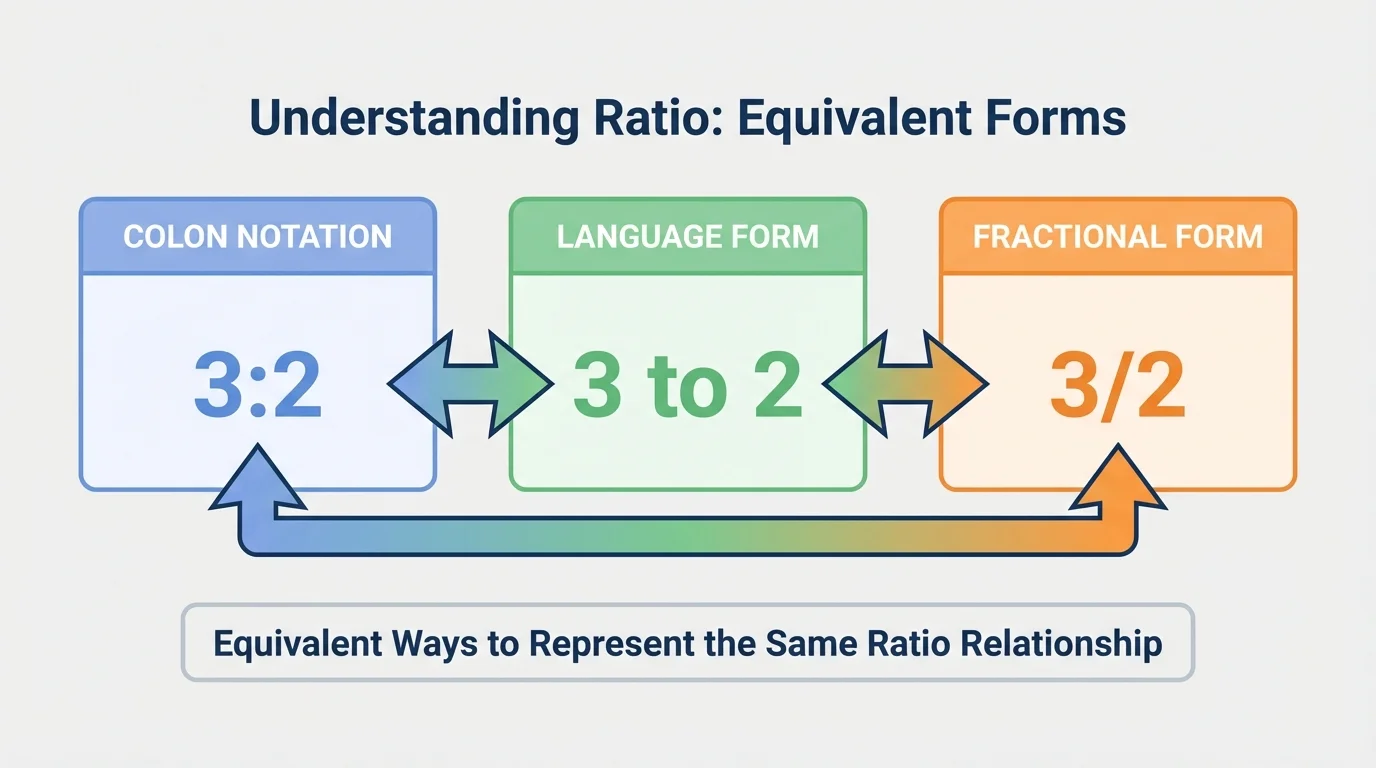
You can write the same ratio in several forms. The three most common forms are \(a:b\), "\(a\) to \(b\)," and \(\dfrac{a}{b}\). These forms all represent the same comparison when written in the same order.
For example, the ratio of apples to oranges can be written as \(3:5\), "\(3\) to \(5\)," or \(\dfrac{3}{5}\). [Figure 2] shows these three ways side by side so you can see they describe one relationship, not three different ones.
Order matters a lot. The ratio of cats to dogs might be \(2:7\), but the ratio of dogs to cats would be \(7:2\). Those are not the same. When you read or write a ratio, always check which quantity comes first.
Think of a ratio like directions. If someone says "go left, then right," changing the order changes everything. Ratios work the same way.
Because a ratio compares quantities by division, \(\dfrac{3}{5}\) in a ratio means "\(3\) compared with \(5\)." At this stage, it is most important to understand the comparison, not just the fraction form.
Ratio language turns numbers into clear meaning. A good ratio sentence often uses the words for every. For example, if the ratio of pencils to erasers is \(4:1\), you can say, "For every \(4\) pencils, there is \(1\) eraser."
You can also describe a ratio using a comparison sentence. If candidate A received \(20\) votes and candidate C received \(58\) votes, you might say, "For every vote candidate A received, candidate C received nearly \(3\) votes." That sentence describes a ratio relationship even though the numbers are not exactly \(1:3\).
How ratio language connects numbers and meaning
A ratio is not only a pair of numbers. It describes a pattern. If the ratio of blue tiles to yellow tiles is \(5:2\), that means every time you see \(5\) blue tiles, you should expect \(2\) yellow tiles in the same relationship. Ratio language helps you explain that pattern in words.
When using ratio language, say the quantities in the same order as the ratio. If the ratio is teachers to students, then your sentence should start with teachers, not students.
To find a ratio, first identify the two quantities being compared. Then count carefully. Finally, write the comparison in the correct order.
Suppose a table has \(6\) forks and \(4\) spoons. The ratio of forks to spoons is \(6:4\). You can say, "For every \(6\) forks, there are \(4\) spoons."
Suppose a jar has \(9\) green buttons and \(3\) red buttons. The ratio of green buttons to red buttons is \(9:3\), which can also be simplified to \(3:1\). That means for every \(3\) green buttons, there are \(1\) red button's worth in the comparison.
When you compare quantities, count the same kind of thing each time. If you compare apples to oranges, both quantities are counts of fruit. If you compare miles to hours, those are different units, but they still form a ratio because you are comparing two measurable quantities.
Always ask yourself, "Which quantity comes first?" The phrase "ratio of forks to spoons" means forks first, spoons second.
Some ratios look different but describe the same relationship. These are called equivalent ratios. For example, \(2:1\), \(4:2\), and \(6:3\) are all equivalent ratios.
You can make equivalent ratios by multiplying or dividing both parts of a ratio by the same nonzero number. If you divide \(6:3\) by \(3\), you get \(2:1\). If you multiply \(2:5\) by \(2\), you get \(4:10\).
Simplifying a ratio means writing it in an equivalent form using smaller whole numbers. This is similar to simplifying a fraction. The ratio \(8:12\) simplifies to \(2:3\) because both numbers can be divided by \(4\).
Many real-world mixtures are described with equivalent ratios. A sports drink recipe might say \(1:4\), but a larger batch could use \(2:8\) or \(3:12\). The taste stays the same because the relationship stays the same.
Equivalent ratios are important because they help us understand the same relationship at different sizes. As we saw earlier with the bird example in [Figure 1], \(4:2\) and \(2:1\) describe the same pattern.
Now let's work through some examples carefully.
Worked Example 1
A class has \(8\) girls and \(12\) boys. What is the ratio of girls to boys, and how can it be written in simplest form?
Step 1: Write the ratio in the order given.
The ratio of girls to boys is \(8:12\).
Step 2: Simplify by dividing both numbers by their greatest common factor.
Both \(8\) and \(12\) are divisible by \(4\).
\(8 \div 4 = 2\) and \(12 \div 4 = 3\)
Step 3: State the simplified ratio and describe it in words.
\(2:3\)
The simplified ratio is \(2:3\), so for every \(2\) girls, there are \(3\) boys.
This example shows why order matters. The ratio of boys to girls would be \(12:8\), or \(3:2\), which is different.
Worked Example 2
A zoo pen has \(10\) flamingos and \(5\) caretakers nearby. What is the ratio of flamingos to caretakers?
Step 1: Write the ratio in the correct order.
Flamingos to caretakers is \(10:5\).
Step 2: Simplify the ratio.
Divide both numbers by \(5\).
\(10 \div 5 = 2\) and \(5 \div 5 = 1\)
Step 3: Use ratio language.
\(2:1\)
The ratio is \(2:1\). For every \(2\) flamingos, there are \(1\) caretaker in the relationship.
Notice that the simplified ratio is easier to describe and understand than the larger numbers.
Worked Example 3
A recipe uses \(3\) cups of flour and \(2\) cups of sugar. Describe the ratio relationship.
Step 1: Identify the quantities and their order.
We are comparing flour to sugar, so the ratio is \(3:2\).
Step 2: Write the ratio in words.
"The ratio of flour to sugar is \(3:2\)."
Step 3: Use "for every" language.
For every \(3\) cups of flour, there are \(2\) cups of sugar.
Recipes are full of ratios. If a larger recipe keeps the same ratio, the food should taste the same.
Worked Example 4
A student says, "The ratio of red markers to total markers is \(4:10\), so the ratio of red markers to blue markers is also \(4:10\)." Is that correct if there are \(4\) red markers and \(6\) blue markers?
Step 1: Identify the two different comparisons.
Red to total is \(4:10\) because there are \(10\) markers altogether.
Red to blue is \(4:6\).
Step 2: Compare the ratios.
\(4:10\) and \(4:6\) are not the same because the second quantity is different.
Step 3: Give the correct conclusion.
The statement is not correct. The ratio of red markers to blue markers is \(4:6\), which simplifies to \(2:3\).
This example shows that you must know exactly which two quantities are being compared.
[Figure 3] Not all ratios compare the same kind of relationship. A part-to-part ratio compares one part of a group to another part of the group. A part-to-whole ratio compares one part of a group to the entire group. This difference can be seen in a class made up of girls and boys.
Suppose a class has \(6\) girls and \(4\) boys. Then the ratio of girls to boys is \(6:4\), which simplifies to \(3:2\). That is a part-to-part ratio. The total number of students is \(10\), so the ratio of girls to total students is \(6:10\), which simplifies to \(3:5\). That is a part-to-whole ratio.
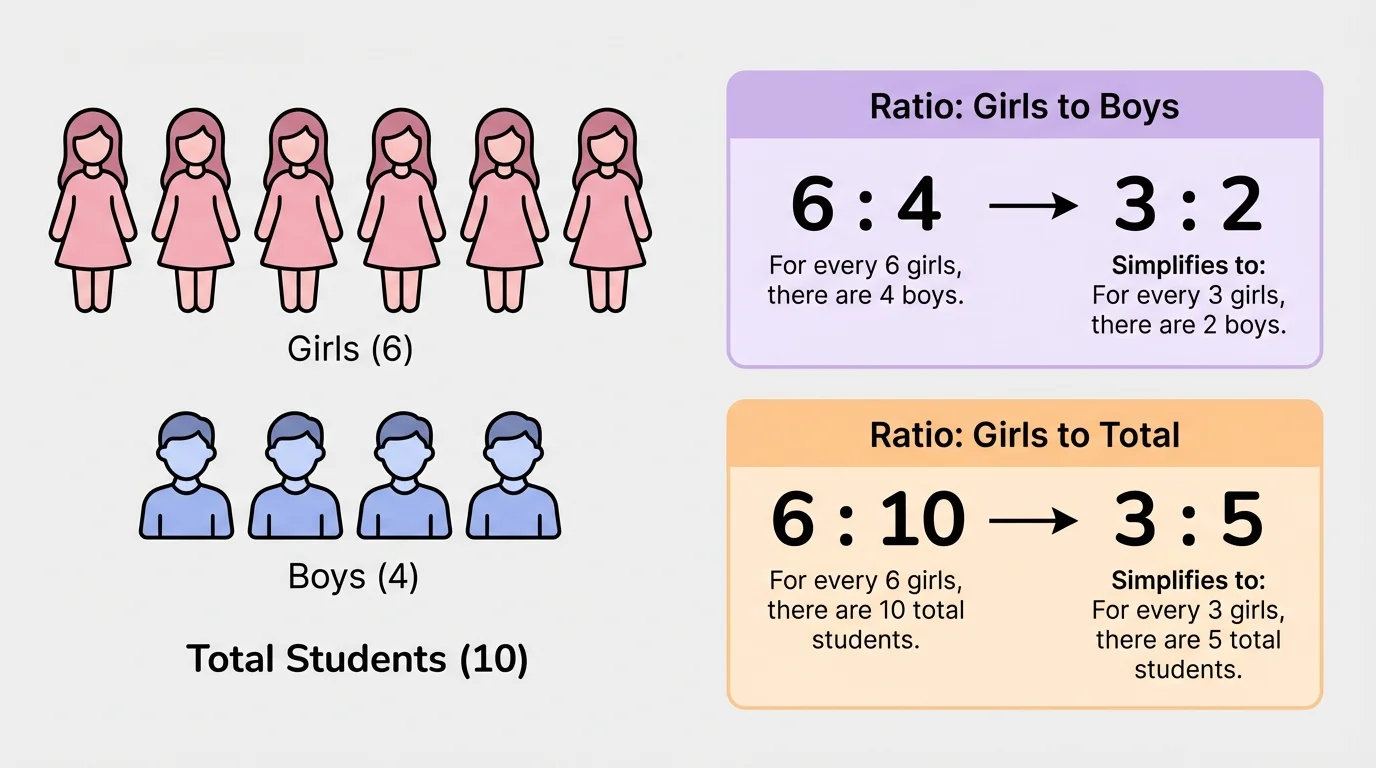
These two ratios answer different questions. One compares girls with boys. The other compares girls with everyone in the class. You can see why the second number changes when the comparison changes.
| Situation | Ratio | Type of Comparison |
|---|---|---|
| Girls to boys | \(6:4\) | Part-to-part |
| Girls to total students | \(6:10\) | Part-to-whole |
| Boys to total students | \(4:10\) | Part-to-whole |
Table 1. Different ratios that can be formed from the same class group.
Ratios appear in many everyday situations. In sports, a coach might compare wins to losses. In music, beats can be grouped in patterns. In recipes, ingredients are mixed in certain ratios. In art, shapes may be enlarged while keeping the same ratio so the picture looks right.
In a school election, if candidate B gets \(15\) votes and candidate D gets \(30\) votes, the ratio of B to D is \(15:30\), which simplifies to \(1:2\). You can say, "For every vote candidate B received, candidate D received \(2\) votes."
In science, a habitat study might compare the number of trees to the number of birds. In maps, a scale compares distance on the map to distance in real life. In all of these cases, a ratio describes a relationship between two quantities.
"A ratio tells more than how many. It tells how two amounts are connected."
Understanding ratios now prepares you for later topics like rates, unit rates, proportions, scale drawings, and percent. Ratios are the starting point for all of those ideas.
One common mistake is reversing the order. If the ratio of cats to dogs is \(5:2\), you cannot say the ratio of dogs to cats is \(5:2\). It would be \(2:5\).
Another mistake is comparing the wrong quantities. If a class has \(7\) girls and \(9\) boys, the ratio of girls to boys is \(7:9\), not \(7:16\). The ratio \(7:16\) would be girls to total students.
A third mistake is thinking a ratio is a difference. If one basket has \(8\) apples and another has \(4\), the difference is \(4\), but the ratio is \(8:4\), which simplifies to \(2:1\). Difference and ratio are not the same idea.
It is also important to use clear words. Saying "\(3:1\)" is fine, but saying "for every \(3\) orange fish, there is \(1\) blue fish" makes the meaning much easier to understand.
When you read a ratio, picture the two quantities side by side. That habit makes it easier to tell whether the comparison makes sense.
