A triangle may look simple, but it can hold a big mystery: if someone gives you three measurements, do they force exactly one triangle, or could there be several possibilities, or none at all? Builders, engineers, and computer designers face versions of this question all the time. A bridge support, a roof frame, or a digital model must meet precise specifications. Geometry gives us the tools to decide what is possible.
When you draw a shape freehand, you sketch it by eye. When you use a ruler and protractor, you measure carefully. When you use technology, a program can create and test the shape with even greater precision. In triangle construction, all three methods are useful, but they do not give the same accuracy.
Triangles are special because they are the simplest polygons, but they are also strong and stable. A quadrilateral can change shape without changing its side lengths, but a triangle is much more rigid. That is why triangles appear in trusses, towers, cranes, and structures and equipment such as bicycle frames and soccer goal supports.
In this topic, the word construction means drawing a geometric figure that exactly matches given conditions. Those conditions may include side lengths, angle measures, or both. The main goal is not just to draw a triangle, but to understand whether the information given is enough and whether it leads to one answer, many answers, or no answer.
There are three main ways to make geometric drawings, and the difference in precision matters, as [Figure 1] shows. A freehand sketch helps you think about the shape quickly. A ruler and protractor let you measure lengths and angles. Technology, such as dynamic geometry software, lets you construct a triangle and then test whether the conditions keep the shape fixed.
Freehand drawing is useful for planning. For example, if you hear "draw a triangle with angles about \(50^\circ\), \(60^\circ\), and \(70^\circ\)," a quick sketch helps you predict the shape before measuring.
Ruler and protractor drawing is more exact. A ruler measures side lengths, and a protractor measures angles. This method is often used when the conditions include side lengths such as \(5 \textrm{ cm}\) or angles such as \(35^\circ\).
Technology drawing uses software that can create points, segments, rays, circles, and measured angles. This is powerful because it lets you drag points and see whether the triangle stays the same or changes. If the triangle changes while still matching the conditions, then the conditions do not determine a unique triangle.
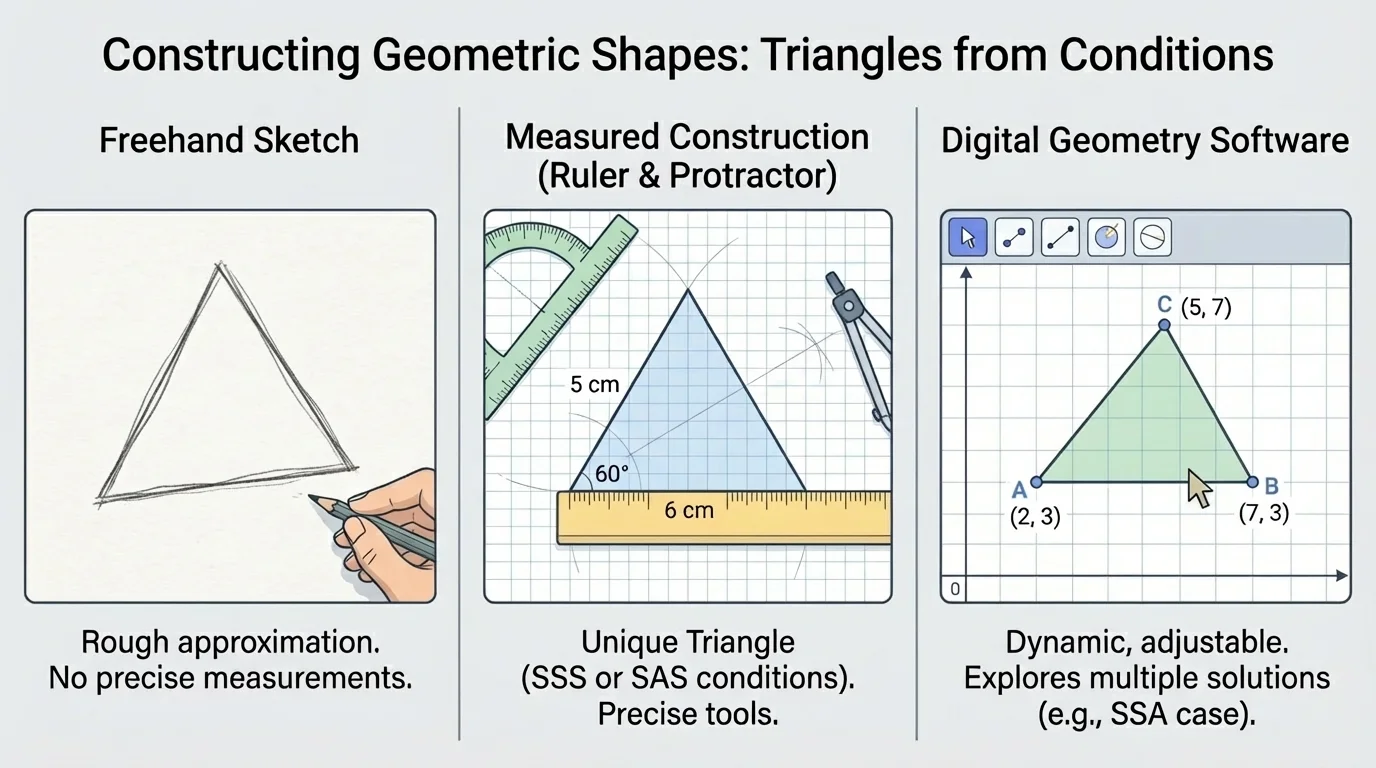
Each method has a purpose. Freehand is fast, ruler-and-protractor work is careful, and technology is excellent for testing ideas. In a geometry classroom, you should be able to use all three.
You already know that a triangle has three sides and three angles, and that angles are measured in degrees. You also know how to use a ruler to measure length and a protractor to measure an angle. Those skills are the foundation for every construction in this lesson.
Before constructing triangles, it helps to review a few facts that control what is possible.
Every triangle must follow some basic rules, as [Figure 2] illustrates. First, the sum of the three interior angles is always \(180^\circ\). Second, in any triangle, the longer side lies opposite the larger angle. Third, the lengths of the sides must work together so that any two side lengths add to more than the third side length.
Interior angles are the angles inside a polygon. In a triangle, the three interior angles always add to \(180^\circ\).
Included angle is the angle formed between two given sides.
Included side is the side between two given angles.
Unique triangle means exactly one triangle can be made from the given conditions.
The angle sum rule can be written as
\[m\angle A + m\angle B + m\angle C = 180^\circ\]
So if two angles are known, the third angle is fixed. For example, if \(m\angle A = 50^\circ\) and \(m\angle B = 60^\circ\), then the third angle is \(180^\circ - 50^\circ - 60^\circ = 70^\circ\).
The side-length rule is often called the triangle inequality. If the side lengths are \(a\), \(b\), and \(c\), then all three of these must be true:
\[a+b>c, \quad a+c>b, \quad b+c>a\]
If even one of these is false, no triangle can exist.
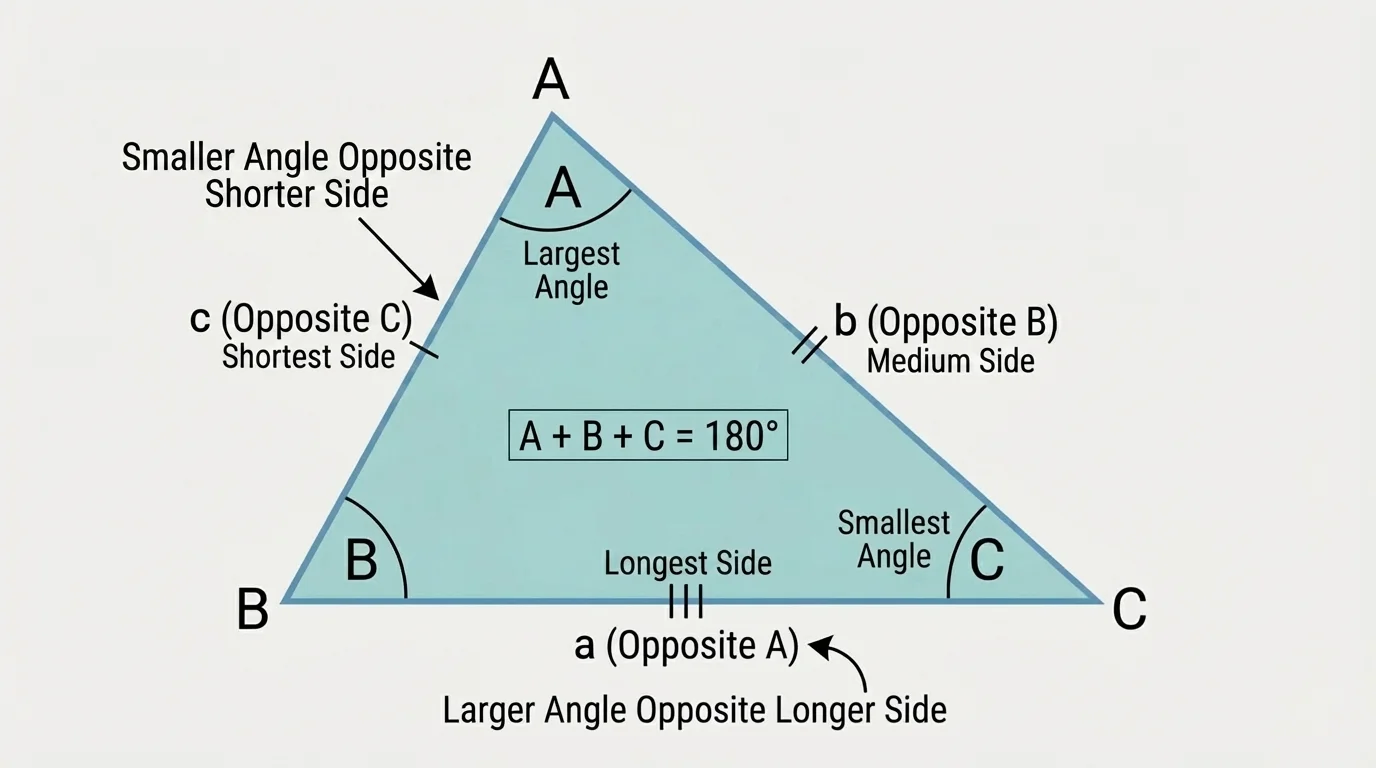
This diagram remains useful later. For example, if one angle is clearly the largest, then the side across from it must also be the longest, as we see again in [Figure 2]. That idea helps you check whether a drawing makes sense.
Some sets of information lock a triangle into one exact shape. Other sets are not enough, and some are impossible. This is one of the most important ideas in triangle construction.
Here is a comparison of common cases.
| Given conditions | What usually happens | Reason |
|---|---|---|
| Three side lengths | One triangle or no triangle | If the side lengths satisfy the triangle inequality, the shape is fixed. |
| Two sides and the included angle | One triangle | The angle between the two known sides fixes the opening. |
| Two angles and a side | One triangle | The third angle is determined by \(180^\circ\). |
| Three angles only | More than one triangle | The shape is fixed, but the size can change. |
| Two sides and a non-included angle | One, two, or no triangle | This is the ambiguous case. |
Table 1. Common triangle condition types and whether they determine one, many, or no triangles.
If you know only three angles, such as \(50^\circ\), \(60^\circ\), and \(70^\circ\), you can draw many triangles with that same shape but different sizes. One could have a base of \(4 \textrm{ cm}\), and another could have a base of \(10 \textrm{ cm}\). They are similar, not identical.
If you know three side lengths, such as \(4\), \(5\), and \(6\), then the triangle is fixed as long as the side lengths are possible. You can rotate or flip it, but it is still the same triangle size and shape.
Why three angles alone are not enough
Angles tell you the shape of a triangle, but not its size. If all three angles stay the same, you can enlarge or shrink the triangle and still keep the same angle measures. That is why three angles determine a family of similar triangles, not a unique triangle.
A side length is needed to set the scale. Once a side is included with angle information, the triangle usually becomes fixed.
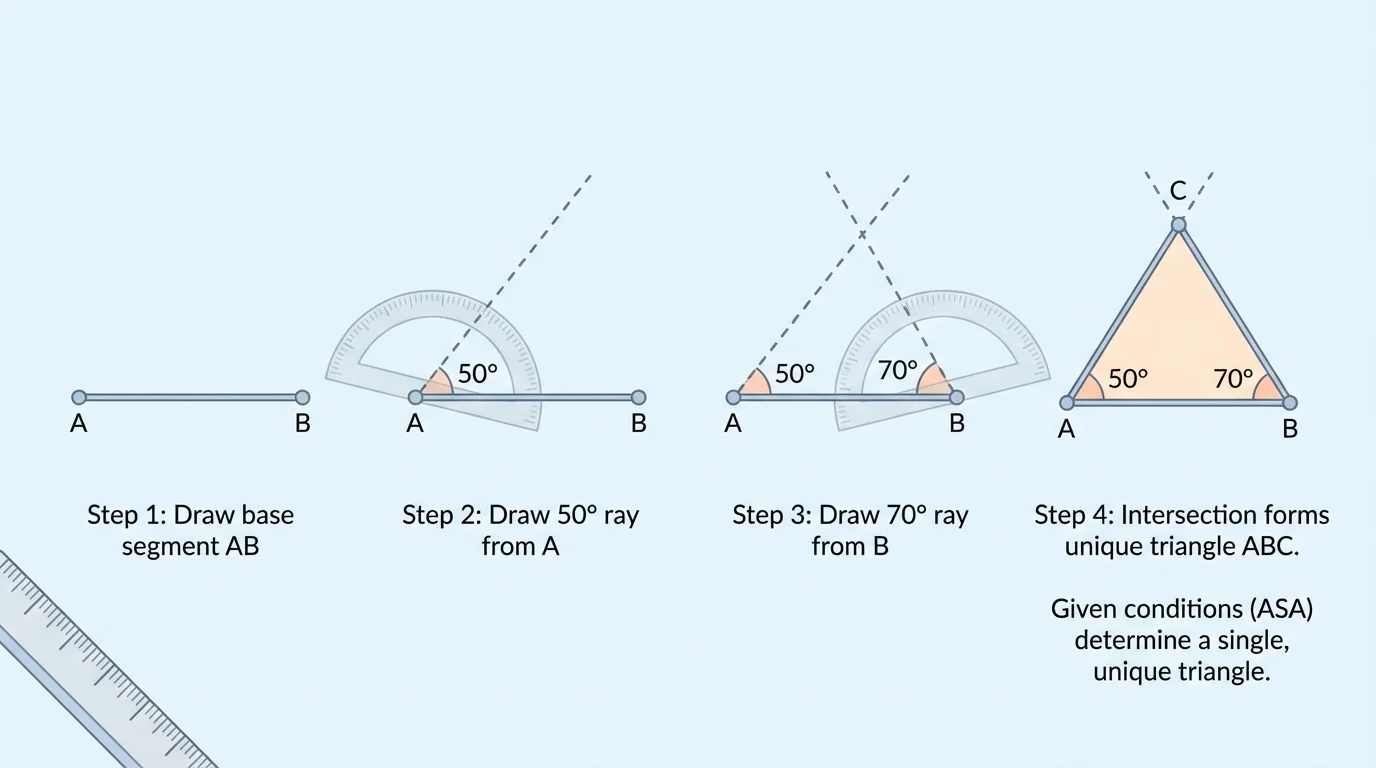
When a side and angle information are given, [Figure 3] illustrates the process of fixing a base and drawing measured rays. The key idea is that each measurement narrows the possibilities until only one point remains for the third vertex.
Suppose you are given one side and two angles. Draw the side first. Then place the protractor at one endpoint and draw a ray with the correct angle. Repeat at the other endpoint. Where the two rays meet is the third vertex.
Solved example 1: Construct a triangle with one side and two angles
Construct a triangle with side \(AB = 6 \textrm{ cm}\), \(m\angle A = 50^\circ\), and \(m\angle B = 70^\circ\).
Step 1: Draw the known side.
Use a ruler to draw segment \(AB\) with length \(6 \textrm{ cm}\).
Step 2: Draw the first angle.
Place the protractor at point \(A\). Draw a ray making an angle of \(50^\circ\) with segment \(AB\).
Step 3: Draw the second angle.
Place the protractor at point \(B\). Draw a ray making an angle of \(70^\circ\) with segment \(BA\).
Step 4: Mark the intersection.
The rays meet at point \(C\). Triangle \(ABC\) is the required triangle.
Step 5: Check the third angle.
\(m\angle C = 180^\circ - 50^\circ - 70^\circ = 60^\circ\).
This gives exactly one triangle.
This method works because the side length fixes the size, and the two angles fix the directions of the two rays. Their intersection can happen at only one point, as shown by the ray intersection pattern in [Figure 3].
Now consider two sides and the included angle. In this case, draw one known side. At one endpoint, use the protractor to make the given angle. Then measure the second known side along that ray. Connect the new point to the remaining endpoint.
Solved example 2: Construct a triangle with two sides and the included angle
Construct a triangle with \(AB = 7 \textrm{ cm}\), \(AC = 5 \textrm{ cm}\), and \(m\angle A = 40^\circ\).
Step 1: Draw segment \(AB\) with length \(7 \textrm{ cm}\).
Step 2: At point \(A\), draw a ray making an angle of \(40^\circ\) with \(AB\).
Step 3: Measure \(5 \textrm{ cm}\) from \(A\) along the ray and mark point \(C\).
Step 4: Connect \(C\) to \(B\).
The result is a triangle with the required conditions, and there is exactly one triangle.
The included angle matters. Since the angle is between the two known sides, it determines the opening precisely.
You can also construct from three side lengths. Draw one side first. Then use the other two lengths to locate the third vertex by measurement. With a ruler-and-protractor lesson, this is often explained using arcs or circles from each endpoint, even if the actual tool is physical or digital.
Solved example 3: Decide whether three side lengths make a triangle
Can side lengths \(3 \textrm{ cm}\), \(4 \textrm{ cm}\), and \(8 \textrm{ cm}\) form a triangle?
Step 1: Use the triangle inequality.
Check whether the sum of the two smaller sides is greater than the largest side.
Step 2: Calculate.
\(3 + 4 = 7\).
Step 3: Compare.
Since \(7 < 8\), the triangle inequality fails.
So there is no triangle.
Three side lengths are straightforward: they give one triangle if the triangle inequality works, and no triangle if it does not. Three angles are also clear: they give many similar triangles unless a side length is included. The most interesting case is when two sides and a non-included angle are given.
This case is sometimes called the ambiguous case, and one set of measurements can create two possible positions for the third vertex, as [Figure 4] shows. It can also produce one triangle or no triangle, depending on the lengths and angle.
Why does this happen? Suppose one side is fixed as a base. Another side length tells you that the third vertex must lie somewhere on a circle centered at one endpoint. But a non-included angle gives a ray from the other endpoint. That ray may hit the circle twice, once, or not at all.
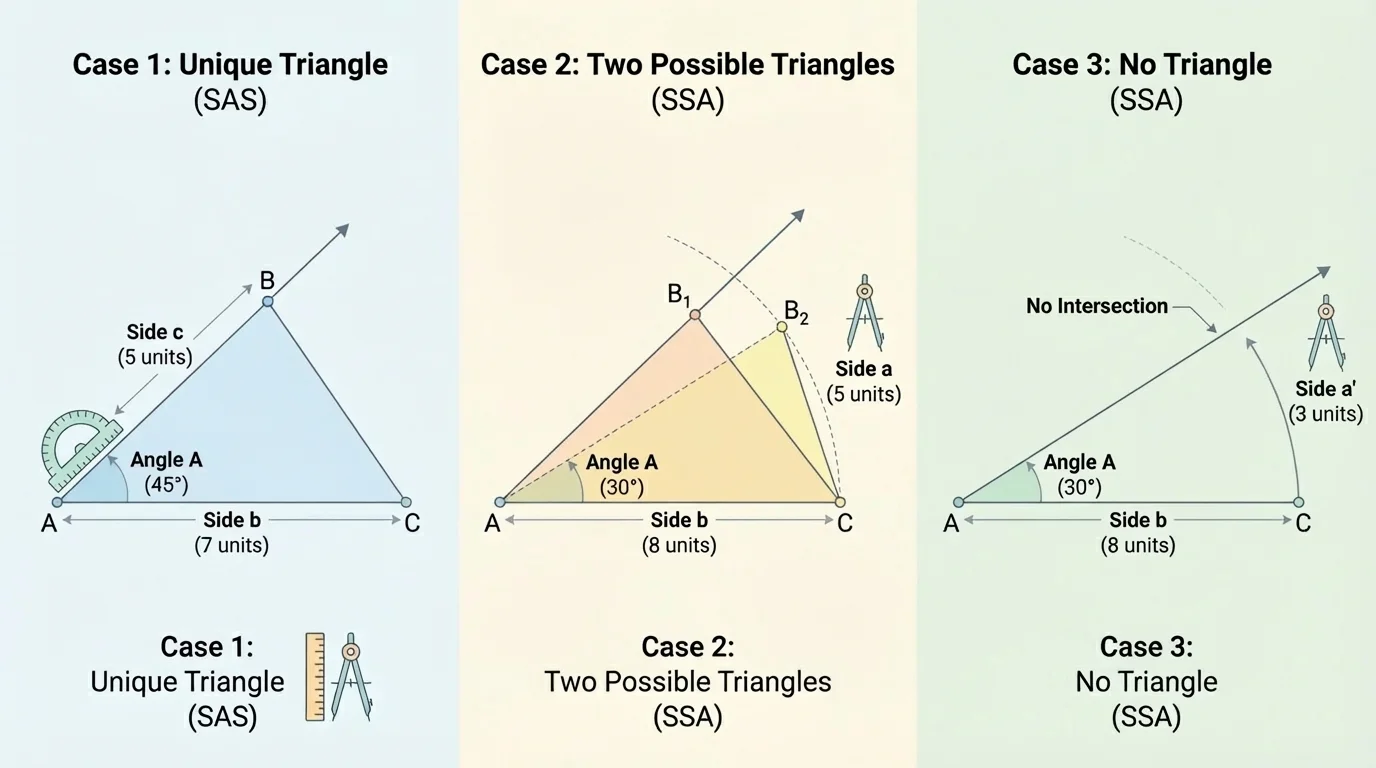
If the ray crosses the circle in two places, there are two different triangles. If it just touches once, there is one triangle. If it misses, there is no triangle. This is a strong example of why drawing and reasoning must work together.
Solved example 4: Analyze an ambiguous case
Suppose \(AB = 8 \textrm{ cm}\), \(BC = 6 \textrm{ cm}\), and \(m\angle A = 30^\circ\), where the known angle is not between the two known sides. How many triangles might be possible?
Step 1: Identify the type of information.
You know two sides and a non-included angle, so this is the ambiguous case.
Step 2: Think geometrically.
Draw \(AB = 8\). From point \(A\), draw a ray making \(30^\circ\). Point \(C\) must lie on that ray.
Step 3: Use the other side length.
Since \(BC = 6\), point \(C\) must also be exactly \(6 \textrm{ cm}\) from point \(B\). So \(C\) must lie on a circle centered at \(B\) with radius \(6\).
Step 4: Count intersections.
If the ray from \(A\) crosses the circle in two places, then there are two possible locations for \(C\), so there are two triangles.
For this kind of information, the answer can be two triangles, and in other measurements it could be one or none. The exact number depends on how the ray and circle meet.
Even without advanced formulas, you can reason from the picture. This is why the visual idea in [Figure 4] is so important. The same measurement type does not always lead to the same number of triangles.
Engineers often prefer triangles in structures because once the side lengths are fixed, the shape does not wobble. That rigidity is one reason triangle-based frames appear in bridges, roof supports, and towers.
Now compare these condition types carefully:
| Condition type | Unique? | More than one? | No triangle? |
|---|---|---|---|
| Three angles only | No | Yes | Only if the angles do not add to \(180^\circ\) |
| Two angles and a side | Yes | No | No, if angle sum is valid |
| Three sides | Yes | No | Yes, if triangle inequality fails |
| Two sides and included angle | Yes | No | No |
| Two sides and non-included angle | Sometimes | Sometimes | Sometimes |
Table 2. Whether common triangle conditions lead to one triangle, several triangles, or none.
Dynamic geometry software reveals fixed versus variable constructions very clearly, as [Figure 5] shows. You can create points, segments, circles, and measured angles, then drag one point to test whether the whole triangle changes.
For example, if you build a triangle from three angles only, you can often drag one side longer or shorter while keeping the same angles. The shape stays similar, but the size changes. That tells you the conditions do not determine a unique triangle.
If you build a triangle from three side lengths, dragging usually does not change the shape at all unless you break the conditions. The triangle is locked. That tells you the conditions determine a unique triangle.
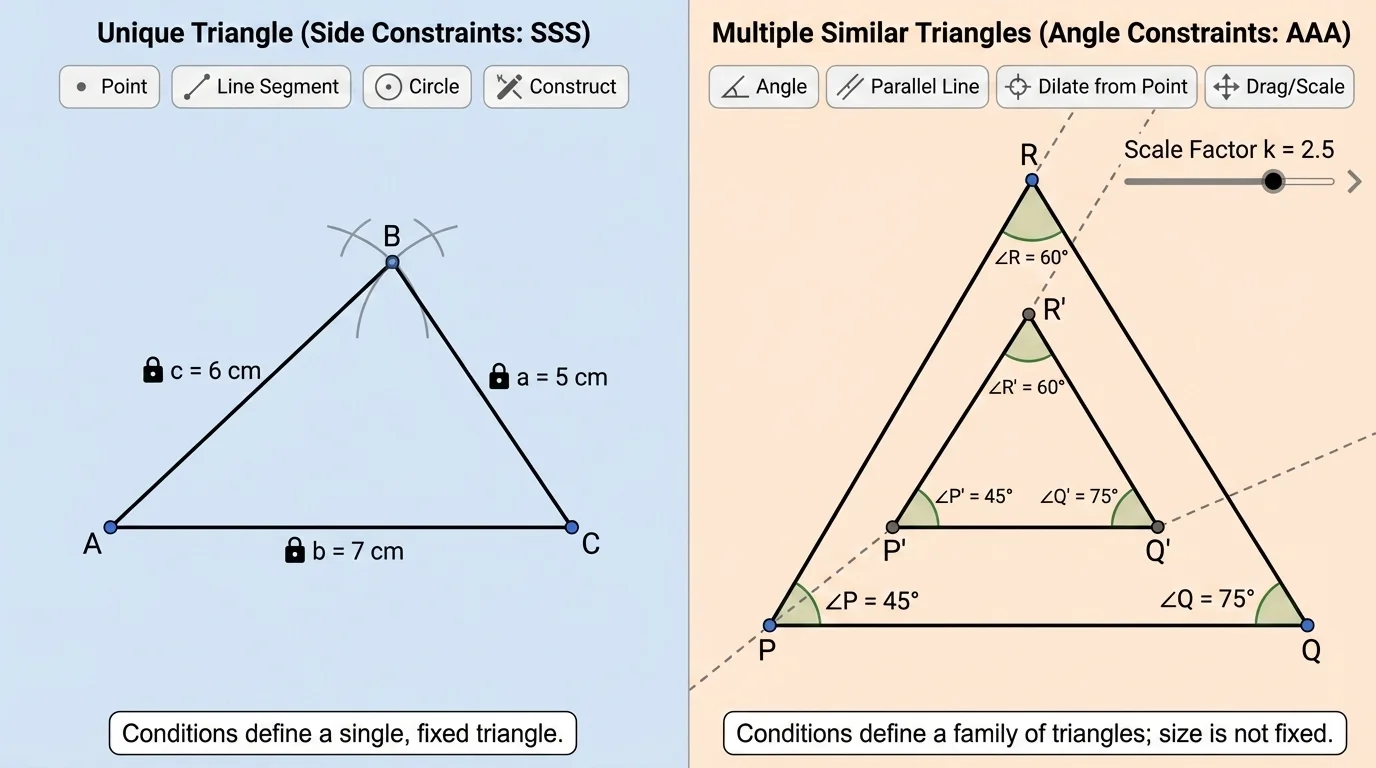
Technology is especially helpful for the ambiguous case. A ray and a circle can visibly intersect twice, once, or not at all. Seeing that happen on screen makes the idea much easier to understand. Later, when you use ruler-and-protractor methods on paper, you can connect them back to the same geometric relationships shown in [Figure 5].
Triangle construction is not just a classroom skill. Surveyors use triangles to measure land and distances that are hard to reach directly. Architects use triangular supports because they keep structures stable. Computer graphics programs use triangles to build 3D models because complex surfaces can be broken into many small triangular pieces.
Suppose a designer knows two support beams and the exact angle between them. That information creates one precise triangular frame. But if the designer knows two lengths and a different angle not between them, the design may be unclear until further information is added. Geometry prevents expensive mistakes.
In navigation and mapping, fixed conditions matter too. If landmarks determine a unique triangle, a location can be found accurately. If the conditions allow more than one triangle, another measurement is needed.
A common mistake is forgetting that triangle angles must total \(180^\circ\). If someone gives angles \(80^\circ\), \(70^\circ\), and \(40^\circ\), their sum is \(190^\circ\), so no triangle is possible.
Another mistake is ignoring the triangle inequality. Side lengths \(2\), \(5\), and \(9\) cannot make a triangle because \(2 + 5 = 7\), and \(7 < 9\).
Students also sometimes confuse an included angle with a non-included angle. That matters a lot. Two sides and the included angle give one triangle, but two sides and a non-included angle may give one, two, or no triangles.
When checking a construction, ask these questions:
If the answer to the last question is yes, the triangle is unique. If not, then the conditions allow more than one triangle.
"Good geometry is not just drawing the figure; it is knowing why the figure must look that way."
That idea is at the heart of constructions. A precise diagram is valuable, but the reasoning behind it is even more important. When you understand why a triangle is unique, variable, or impossible, you are doing real geometry.
