A single atom can help explain an important math idea: a hydrogen atom has no overall charge because its two particles are oppositely charged. One part has charge \(+1\), the other has charge \(-1\), and together they make \(0\). That same idea appears in money, temperatures, elevations, and scores. Math uses positive and negative numbers to describe these situations, and when opposite quantities combine, they cancel exactly.
An opposite quantity is a quantity with the same size but the reverse direction, sign, or effect. In math, numbers like \(+4\) and \(-4\) are opposites. They are the same distance from \(0\), but one is to the right of \(0\) and the other is to the left.
When two numbers are opposites, they add to zero:
\[4 + (-4) = 0\]
\(-7 + 7 = 0\)
The special name for a number and its opposite is additive inverse. The additive inverse of \(5\) is \(-5\). The additive inverse of \(-\dfrac{3}{4}\) is \(\dfrac{3}{4}\). The additive inverse of \(0\) is \(0\), because \(0 + 0 = 0\).
Opposite numbers are numbers that are the same distance from \(0\) on a number line but on opposite sides. When added together, they equal \(0\).
Additive inverse means the number that combines with another number to make \(0\).
This works not only for whole numbers but for all rational numbers, including fractions and decimals. For example, \(1.8\) and \(-1.8\) are opposites, and so are \(-\dfrac{5}{6}\) and \(\dfrac{5}{6}\).
It is important to notice that "opposite" does not just mean "different." The numbers \(3\) and \(-2\) are different, but they are not opposites, because their distances from \(0\) are not equal. Since they are not exact opposites, they do not combine to make \(0\): \(3 + (-2) = 1\).
A number line makes opposite quantities easier to see. As [Figure 1] shows, opposite numbers sit the same distance from \(0\) in opposite directions. If you start at \(0\) and move \(5\) units right, you land at \(+5\). If you start at \(0\) and move \(5\) units left, you land at \(-5\).
Now think about addition on the number line. If you begin at \(+5\) and add \(-5\), you move \(5\) units left and return to \(0\). If you begin at \(-5\) and add \(+5\), you move \(5\) units right and also return to \(0\).
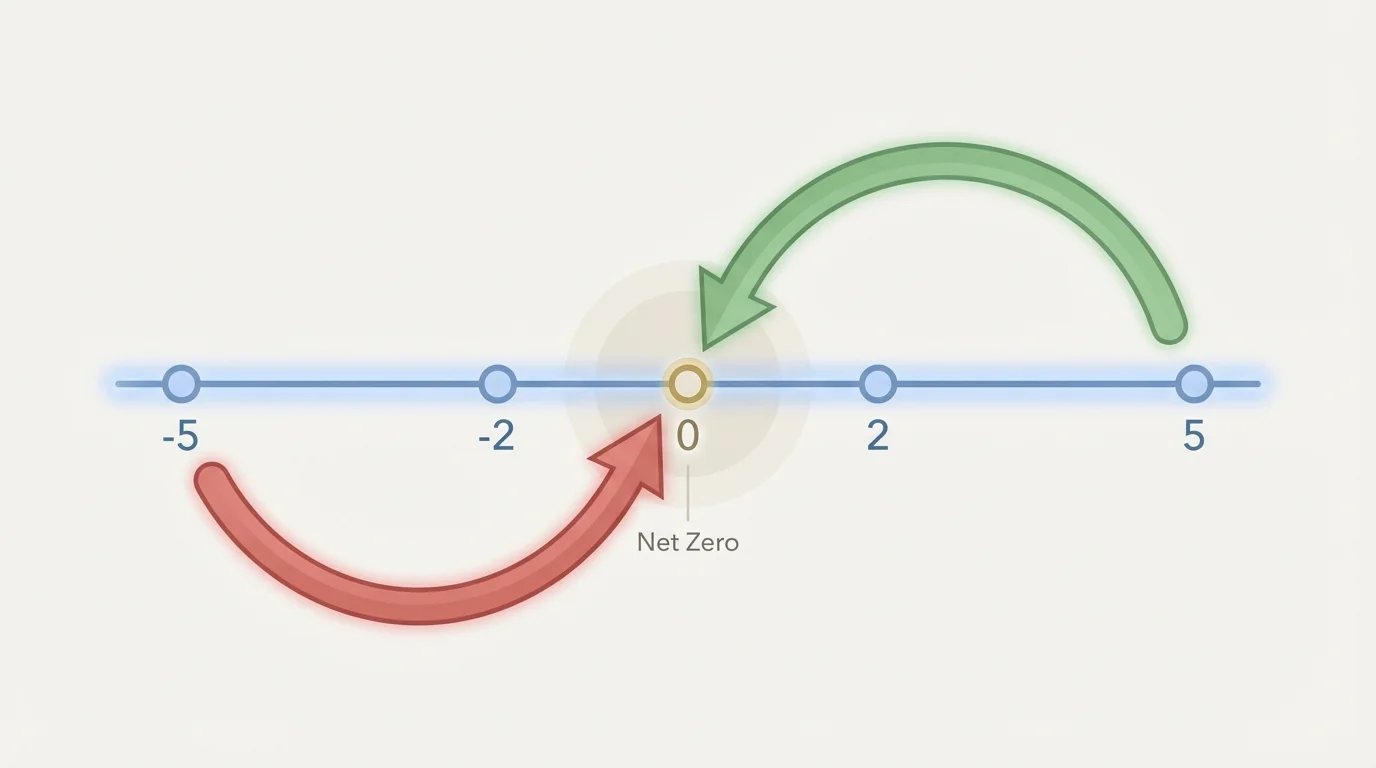
This is why opposite quantities are often described as canceling out. They balance each other. One undoes the effect of the other.
The same idea works on a vertical number line as well. Positive values can mean "up," and negative values can mean "down." If an elevator goes up \(8\) floors and then down \(8\) floors, its net change is \(0\). The upward and downward movements are opposites.
Zero as a balance point
Zero is not just a number between positive and negative values. It is also a balance point. When a positive quantity and an equal negative quantity combine, the total is exactly balanced at \(0\).
This balancing idea is one of the most useful meanings of zero in signed-number math. Later, when working with larger expressions, students often look for pairs like \(+a\) and \(-a\) because they combine to make \(0\).
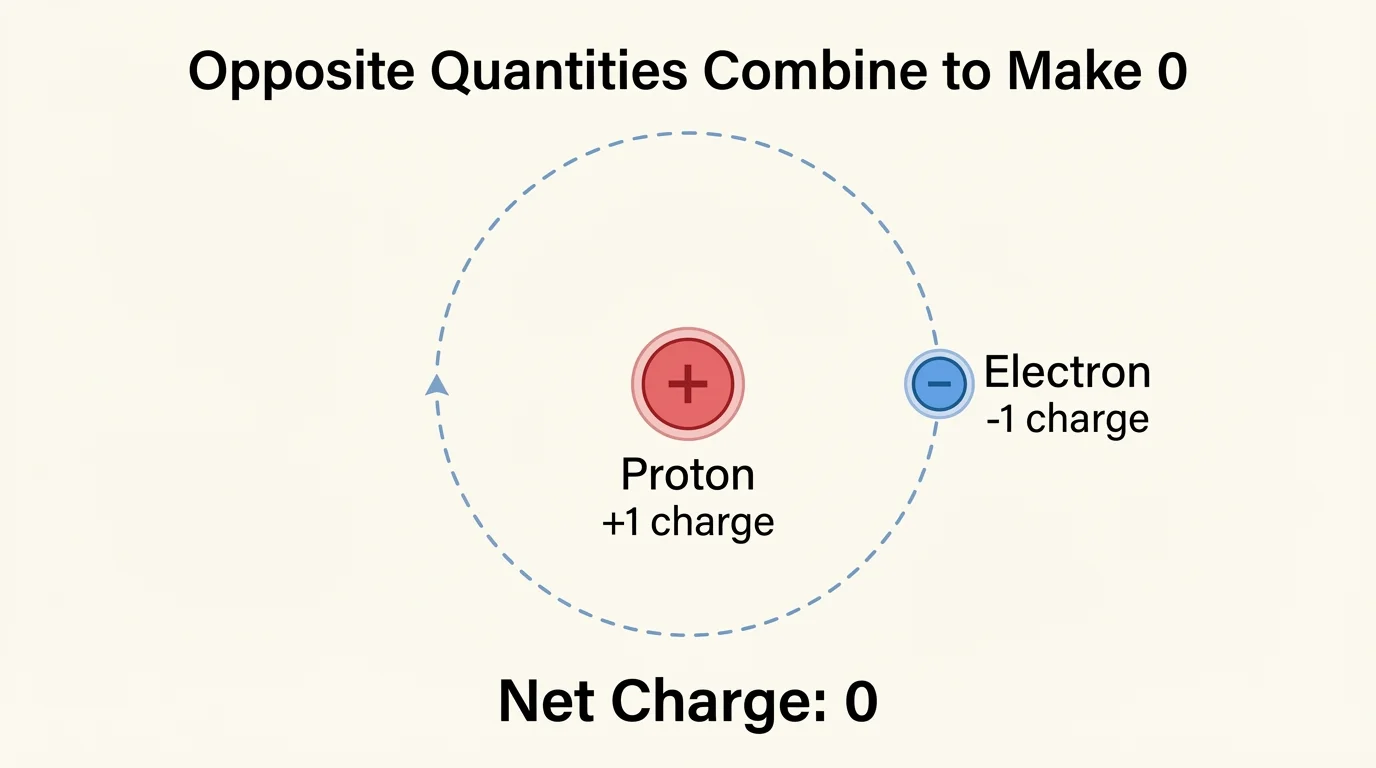
Many real situations use positive and negative numbers to describe opposite effects. In science, the hydrogen atom example is especially interesting. As [Figure 2] illustrates, a hydrogen atom contains one proton with charge \(+1\) and one electron with charge \(-1\). Because \(+1 + (-1) = 0\), the atom has overall charge \(0\).
Electric charge is a powerful example because the positive and negative values are not just labels. They represent truly opposite kinds of charge. When equal amounts of opposite charge are present, the total charge is zero.
Money is another familiar example. Suppose you deposit $20 into a bank account, which can be represented by \(+20\). Later, you withdraw $20, represented by \(-20\). The total change is \(+20 + (-20) = 0\). The account ends with no net change from those two transactions.
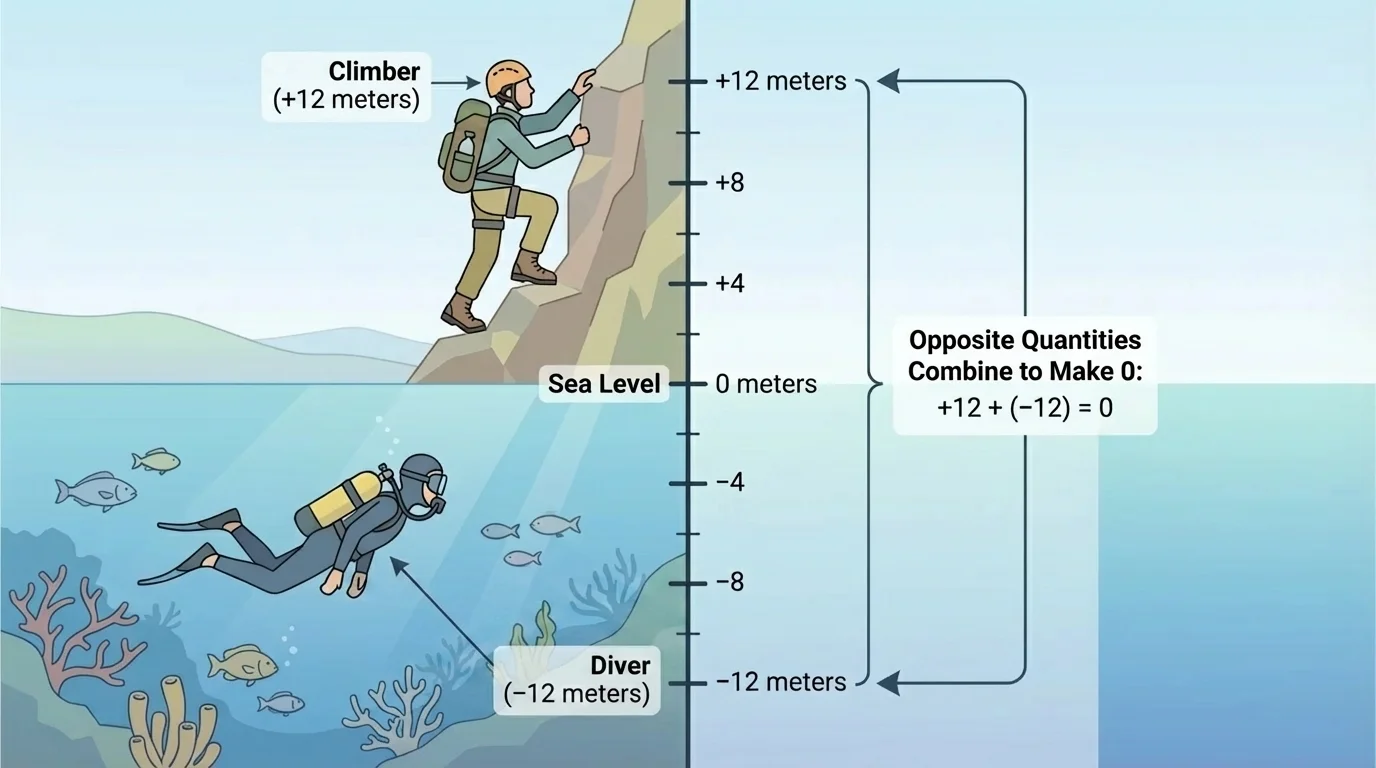
Elevation also uses opposite quantities. Sea level is often treated as \(0\). A diver \(12\) meters below sea level is at \(-12\) meters, while a climber \(12\) meters above sea level is at \(+12\) meters. These are opposite elevations, as [Figure 3] shows, because they are equally far from sea level in opposite directions.
If those positions are compared as signed quantities, then \(-12 + 12 = 0\). That does not mean the diver and climber are in the same place. It means their elevations are opposites relative to sea level.
Temperature changes can also cancel. If the temperature rises by \(6\) degrees and later falls by \(6\) degrees, the net change is \(0\). In symbols, \(+6 + (-6) = 0\).
In sports, a team might gain \(15\) yards on one play and lose \(15\) yards on the next. The total change in field position is \(+15 + (-15) = 0\). One play cancels the other.
In motion, walking \(9\) meters east and then \(9\) meters west leads to zero net change in position. If east is positive and west is negative, then \(+9 + (-9) = 0\).
Atoms, electric circuits, bank statements, and GPS coordinates all use the same signed-number idea: opposite effects can balance exactly to zero.
These examples show why negative numbers matter. They let us describe direction, loss, decrease, debt, or charge. Positive numbers describe the opposite ideas: gain, increase, credit, or opposite direction.
Now let's work through several examples carefully. In each one, the main question is whether the quantities are true opposites and what happens when they are added.
Example 1: Integer opposites
A submarine is \(18\) meters below sea level, represented by \(-18\). It rises \(18\) meters. What is the net change?
Step 1: Represent the movement with signed numbers.
The starting movement is \(-18\), and the rise is \(+18\).
Step 2: Add the opposite quantities.
\(-18 + 18 = 0\)
Step 3: Interpret the result.
The upward movement cancels the downward movement, so the net change is \(0\).
The two quantities are opposites because they have the same magnitude, \(18\), and opposite signs.
This example shows how changing direction can reverse an earlier movement exactly.
Example 2: Decimal opposites
A bank account changes by \(+2.5\) dollars and then by \(-2.5\) dollars. Find the total change.
Step 1: Identify the numbers.
The changes are \(+2.5\) and \(-2.5\).
Step 2: Add them.
\(2.5 + (-2.5) = 0\)
Step 3: State the meaning.
There is no net change in the account from these two transactions.
The decimal values are additive inverses, so they combine to make \(0\).
Decimals behave the same way as integers: if the values are equal in size and opposite in sign, they cancel.
Example 3: Fraction opposites
A hiker climbs \(\dfrac{3}{4}\) of a mile and later descends \(\dfrac{3}{4}\) of a mile. What is the net change in elevation?
Step 1: Write the signed quantities.
The climb is \(+\dfrac{3}{4}\), and the descent is \(-\dfrac{3}{4}\).
Step 2: Add the fractions.
\(\dfrac{3}{4} + \left(-\dfrac{3}{4}\right) = 0\)
Step 3: Interpret the answer.
The hiker ends with zero net elevation change from those two moves.
Fractions can also be opposites when they have the same absolute value and opposite signs.
Notice that the rule does not change with fractions. The sign tells the direction or effect, and the magnitude tells the size.
Example 4: Not opposites
A temperature rises \(4\) degrees and then falls \(3\) degrees. Do the changes combine to make \(0\)?
Step 1: Write the changes as signed numbers.
The changes are \(+4\) and \(-3\).
Step 2: Add the numbers.
\(4 + (-3) = 1\)
Step 3: Decide whether they are opposites.
They are not opposites because the sizes are not equal. One is \(4\), and the other is \(3\).
The net change is \(+1\), not \(0\).
This example is important because many mistakes happen when students notice one positive and one negative number and assume they must cancel. They only cancel when the magnitudes are equal.
A helpful idea here is absolute value. The absolute value of a number is its distance from \(0\). Opposite quantities have the same absolute value but different signs. For example, \(|-8| = 8\) and \(|8| = 8\), so \(-8\) and \(8\) are opposites.
If two numbers have different absolute values, they are not opposites. For instance, \(-10\) and \(6\) have different distances from \(0\), so they do not combine to make \(0\).
| Pair of quantities | Opposites? | Sum |
|---|---|---|
| \(+7\) and \(-7\) | Yes | \(0\) |
| \(-\dfrac{2}{3}\) and \(\dfrac{2}{3}\) | Yes | \(0\) |
| \(+1.2\) and \(-1.2\) | Yes | \(0\) |
| \(+5\) and \(-4\) | No | \(1\) |
| \(-9\) and \(+2\) | No | \(-7\) |
Table 1. Examples of pairs of signed numbers showing whether they are opposites and what their sum is.
Another common mistake is mixing up position with change. A diver at \(-12\) meters and a climber at \(+12\) meters have opposite positions relative to sea level, as shown earlier in [Figure 3]. But if one person moves \(+12\) meters and another stays still, that is not a pair of opposite changes. The context matters.
When adding signed numbers, the sign tells direction or effect, and the absolute value tells size. Zero happens only when opposite effects have exactly the same size.
Also remember that \(0\) is special. It is neither positive nor negative, but it is its own opposite in the sense that \(0 + 0 = 0\).
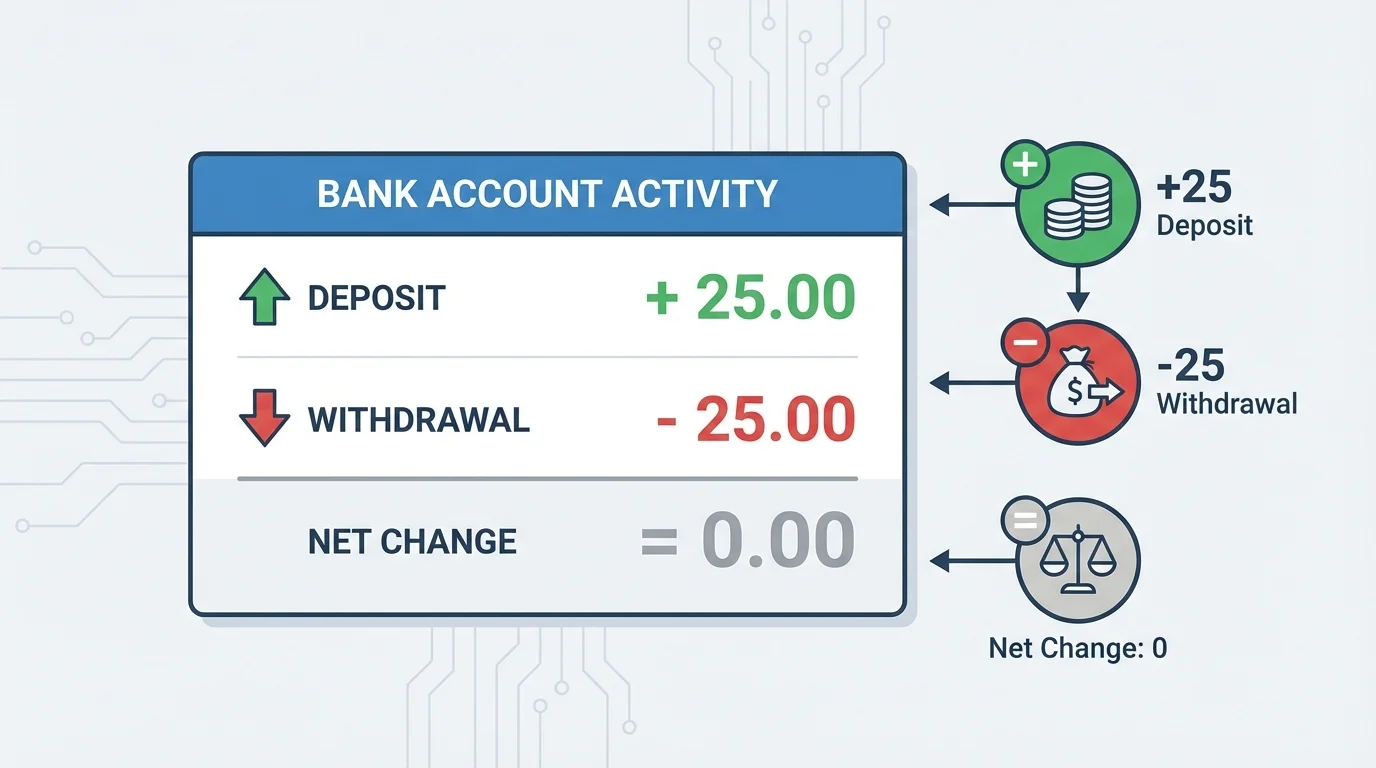
As [Figure 4] shows, tracking net change helps people understand what really happened after gains and losses are combined. A deposit of $25 and a withdrawal of $25 lead to a net change of \(0\). Bank statements, budgeting apps, and business records all depend on this idea.
Scientists also use opposite quantities constantly. In electricity, opposite charges can balance. In chemistry and physics, total charge matters because it affects how particles interact. The hydrogen example from [Figure 2] is one of the simplest cases of opposites combining to make zero.
Engineers and pilots use positive and negative values for position, altitude, and direction. Meteorologists use temperature changes. Oceanographers use depths below sea level. In all of these fields, signed numbers describe opposite conditions clearly and efficiently.
Even computer programs rely on this thinking. A game score might increase by \(+50\) points and decrease by \(-50\) points. A navigation app might track movement north as positive and south as negative. Signed numbers help computers calculate total change quickly.
Once you understand opposite quantities, you can see zero in a new way. Zero is not just "nothing." It can represent a perfect balance between two opposite effects.
