Here is a surprising fact: two expressions that look different can mean exactly the same thing. For rational numbers, subtraction can always be rewritten as addition. That means a problem like \(5 - (-2)\) is really an addition problem in disguise. This idea is powerful because once you understand addition of signed numbers, you also understand subtraction. It also helps explain something that seems different at first: why the distance between two numbers on a number line is connected to subtraction.
Before we begin, remember that rational numbers include integers, fractions, and decimals that can be written as fractions. So numbers like \(4\), \(-7\), \(\dfrac{3}{5}\), and \(-2.4\) are all rational numbers.
One of the most important ideas in this topic is the additive inverse. The additive inverse of a number is the number that adds to it to make \(0\). For example, the additive inverse of \(6\) is \(-6\), and the additive inverse of \(-\dfrac{2}{3}\) is \(\dfrac{2}{3}\).
Additive inverse means the opposite of a number. A number and its additive inverse always add to \(0\).
Absolute value means the distance of a number from \(0\) on the number line. It is written with bars, like \(|-4| = 4\).
Subtraction asks, "What happens when we subtract \(q\)?" In rational numbers, subtracting \(q\) has the same effect as adding the opposite of \(q\). This gives the rule
\[p - q = p + (-q)\]
This rule works for every pair of rational numbers \(p\) and \(q\). If \(q\) is positive, subtracting it means adding a negative. If \(q\) is negative, subtracting it means adding a positive. That is why subtracting a negative becomes adding a positive.
When adding integers, numbers with the same sign are added and keep their sign. Numbers with different signs are subtracted, and the result takes the sign of the number with the greater absolute value.
Let us look at both cases carefully. If you have \(8 - 3\), then you can rewrite it as \(8 + (-3)\). If you have \(8 - (-3)\), then you can rewrite it as \(8 + 3\). The subtraction sign does not change arbitrarily; it becomes addition because you are replacing the second number with its opposite.
A number line helps make this rule visible, and [Figure 1] shows how direction changes depending on whether you add a positive or a negative number. Start at the first number, then think of subtraction as addition of the opposite.
Suppose you want to find \(3 - 5\). Rewrite it as \(3 + (-5)\). On a horizontal number line, start at \(3\). Adding \(-5\) means moving \(5\) units left. You land at \(-2\).
Now suppose you want to find \(3 - (-5)\). Rewrite it as \(3 + 5\). Start at \(3\). Adding \(5\) means moving \(5\) units right. You land at \(8\).
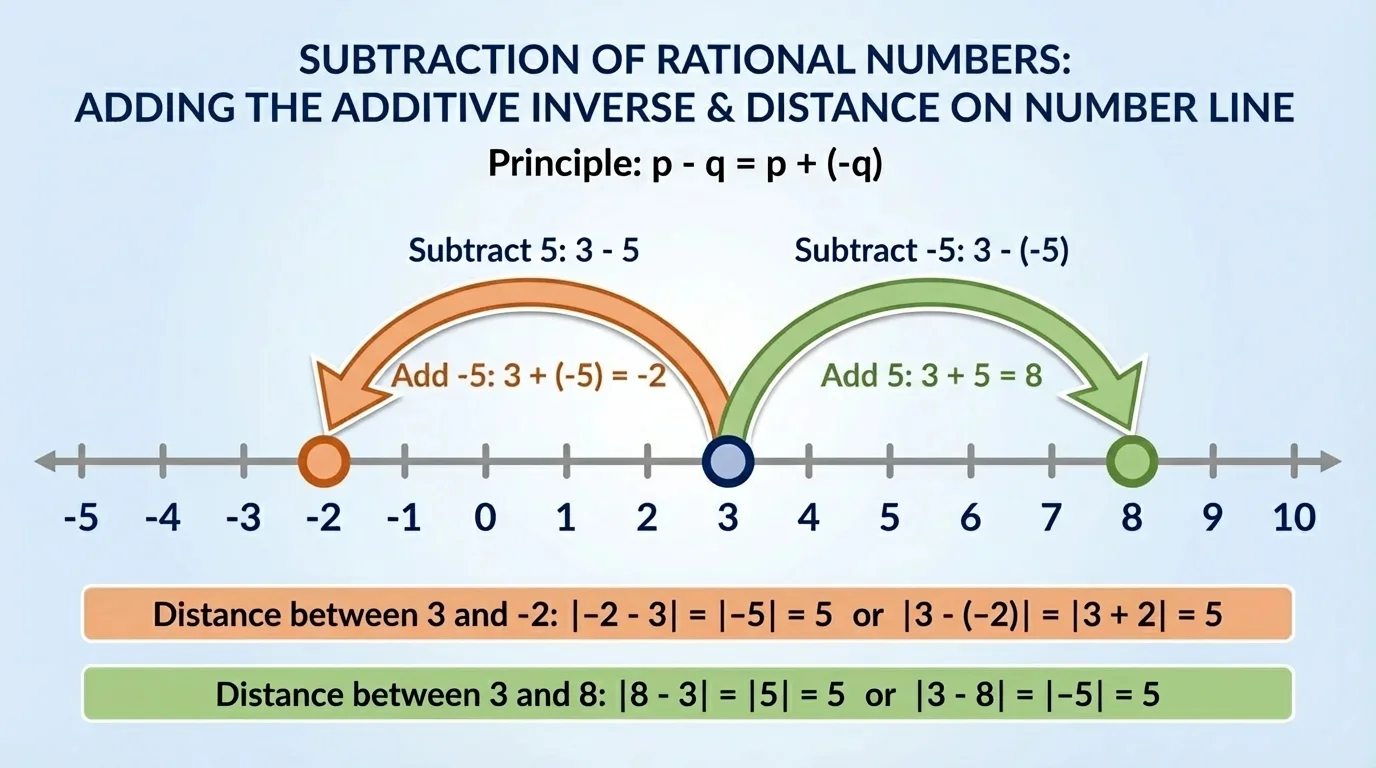
This is why signs matter so much. Subtracting a positive moves left because it becomes adding a negative. Subtracting a negative moves right because it becomes adding a positive. The number line does not just give an answer; it explains why the answer makes sense.
You can also use a vertical number line. On a vertical number line, positive movement goes up and negative movement goes down. The arithmetic stays the same; only the picture changes. This is useful in real situations like elevation or temperature, where up and down are more natural than left and right.
The starting point is always the first number. The second number tells you what opposite to add and therefore which direction to move.
Now let us work through several examples carefully.
Worked example 1
Find \(-4 - 7\).
Step 1: Rewrite subtraction as addition of the opposite.
\(-4 - 7 = -4 + (-7)\)
Step 2: Add the two negative numbers.
Starting at \(-4\) and adding \(-7\) means moving \(7\) more units left.
\(-4 + (-7) = -11\)
\[-4 - 7 = -11\]
Notice that subtracting a positive number made the result smaller. That fits the number line idea of moving left.
Worked example 2
Find \(-4 - (-7)\).
Step 1: Rewrite subtraction as addition of the opposite.
\(-4 - (-7) = -4 + 7\)
Step 2: Add numbers with different signs.
Compare absolute values: \(|-4| = 4\) and \(|7| = 7\). Since \(7\) has the greater absolute value, the answer is positive.
\(-4 + 7 = 3\)
\[-4 - (-7) = 3\]
This example shows the famous sign change: subtracting a negative is the same as adding a positive.
Worked example 3
Find \(\dfrac{2}{3} - \dfrac{5}{6}\).
Step 1: Rewrite as addition of the opposite.
\(\dfrac{2}{3} - \dfrac{5}{6} = \dfrac{2}{3} + \left(-\dfrac{5}{6}\right)\)
Step 2: Use a common denominator.
\(\dfrac{2}{3} = \dfrac{4}{6}\), so the expression becomes \(\dfrac{4}{6} + \left(-\dfrac{5}{6}\right)\).
Step 3: Add the numerators.
\(\dfrac{4}{6} + \left(-\dfrac{5}{6}\right) = -\dfrac{1}{6}\)
\[\frac{2}{3} - \frac{5}{6} = -\frac{1}{6}\]
The same rule works with fractions. Nothing about the idea changes; only the calculations look different.
Worked example 4
Find \(-\dfrac{3}{4} - \left(-\dfrac{1}{8}\right)\).
Step 1: Rewrite as addition.
\(-\dfrac{3}{4} - \left(-\dfrac{1}{8}\right) = -\dfrac{3}{4} + \dfrac{1}{8}\)
Step 2: Write equivalent fractions.
\(-\dfrac{3}{4} = -\dfrac{6}{8}\)
Step 3: Add.
\(-\dfrac{6}{8} + \dfrac{1}{8} = -\dfrac{5}{8}\)
\[-\frac{3}{4} - \left(-\frac{1}{8}\right) = -\frac{5}{8}\]
Even though the problem begins with subtraction, the easiest way to solve it is to turn it into addition right away.
The next big idea is distance. On a number line, distance tells how far apart two numbers are, and [Figure 2] illustrates that distance depends on the length between points, not on direction.
Distance between two rational numbers is the absolute value of their difference.
If the numbers are \(p\) and \(q\), then the distance between them is
\(|p-q|\)
You can also write it as \(|q-p|\). These are equal because distance is the same in either direction.
Why do we use absolute value? Because distance cannot be negative. If one subtraction gives a negative number, absolute value turns it into the nonnegative length between the points.
For example, the distance between \(2\) and \(7\) is \(|2-7| = |-5| = 5\). If you reverse the order, you get \(|7-2| = |5| = 5\). The distance stays \(5\).
This is different from ordinary subtraction. The subtraction results \(2-7\) and \(7-2\) are different, but the distances are the same after taking absolute value.
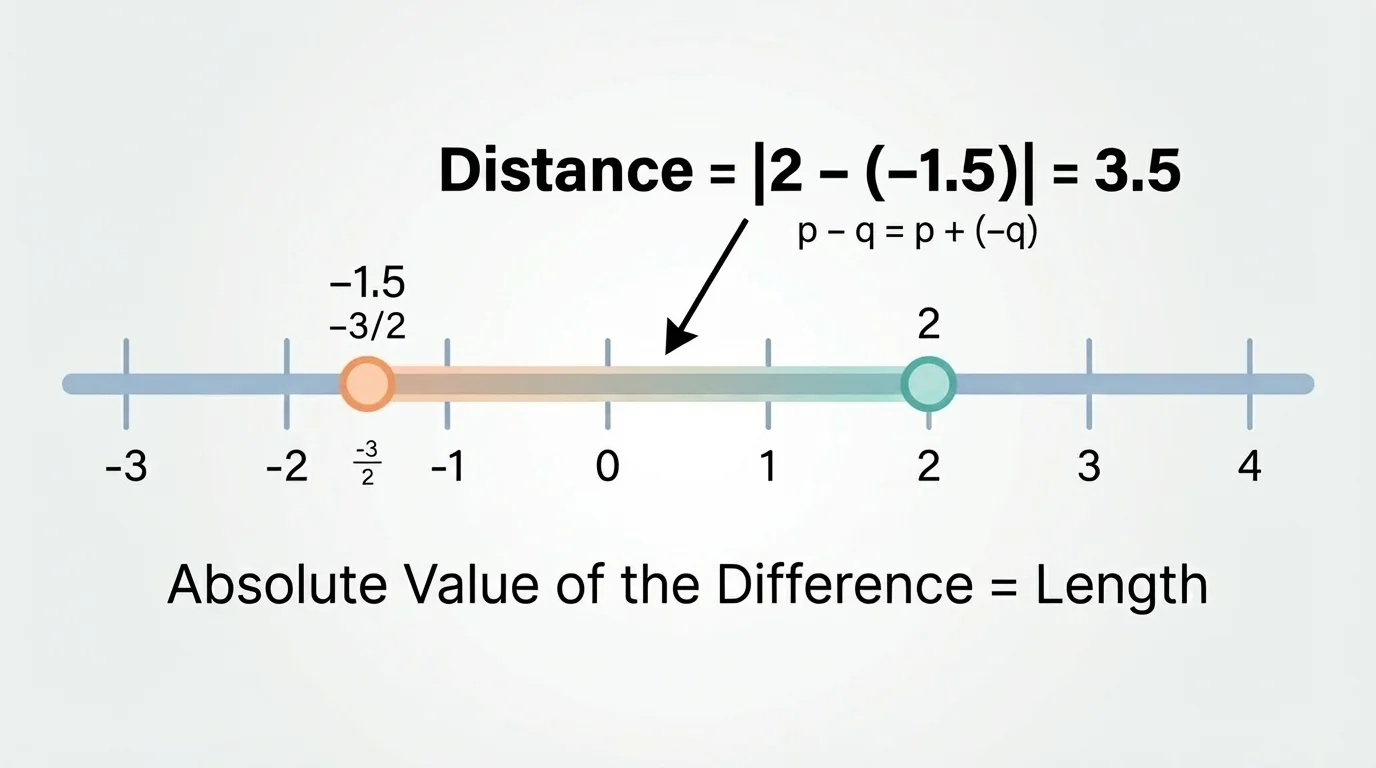
Think of subtraction as a directed change and distance as an undirected length. Subtraction can be positive or negative. Distance is always \(0\) or greater.
We can connect this idea to the earlier rule. Since \(p-q = p+(-q)\), finding the distance between \(p\) and \(q\) means first finding the difference and then taking its absolute value. The sign tells direction, but the absolute value tells the length.
Let us solve some distance problems.
Worked example 5
Find the distance between \(-3\) and \(5\).
Step 1: Write the distance formula.
Distance = \(|-3 - 5|\)
Step 2: Simplify inside the absolute value.
\(-3 - 5 = -8\)
Step 3: Take the absolute value.
\(|-8| = 8\)
Distance = \(8\)
The numbers are \(8\) units apart. You can also check with \(|5-(-3)| = |8| = 8\).
Worked example 6
Find the distance between \(\dfrac{1}{4}\) and \(-\dfrac{3}{4}\).
Step 1: Write the difference.
Distance = \(\left|\dfrac{1}{4} - \left(-\dfrac{3}{4}\right)\right|\)
Step 2: Rewrite subtraction of a negative as addition.
\(\dfrac{1}{4} - \left(-\dfrac{3}{4}\right) = \dfrac{1}{4} + \dfrac{3}{4} = 1\)
Step 3: Take the absolute value.
\(|1| = 1\)
Distance = \(1\)
This example connects both parts of the lesson: subtraction becomes addition of the opposite, and distance is the absolute value of the result.
Worked example 7
Find the distance between \(-\dfrac{3}{2}\) and \(2\).
Step 1: Write the absolute value of the difference.
Distance = \(\left|-\dfrac{3}{2} - 2\right|\)
Step 2: Rewrite \(2\) with denominator \(2\).
\(2 = \dfrac{4}{2}\)
Step 3: Subtract and take absolute value.
\(\left|-\dfrac{3}{2} - \dfrac{4}{2}\right| = \left|-\dfrac{7}{2}\right| = \dfrac{7}{2}\)
Distance = \(\dfrac{7}{2}\)
The highlighted segment matches this result: the points are \(\dfrac{7}{2}\) units apart.
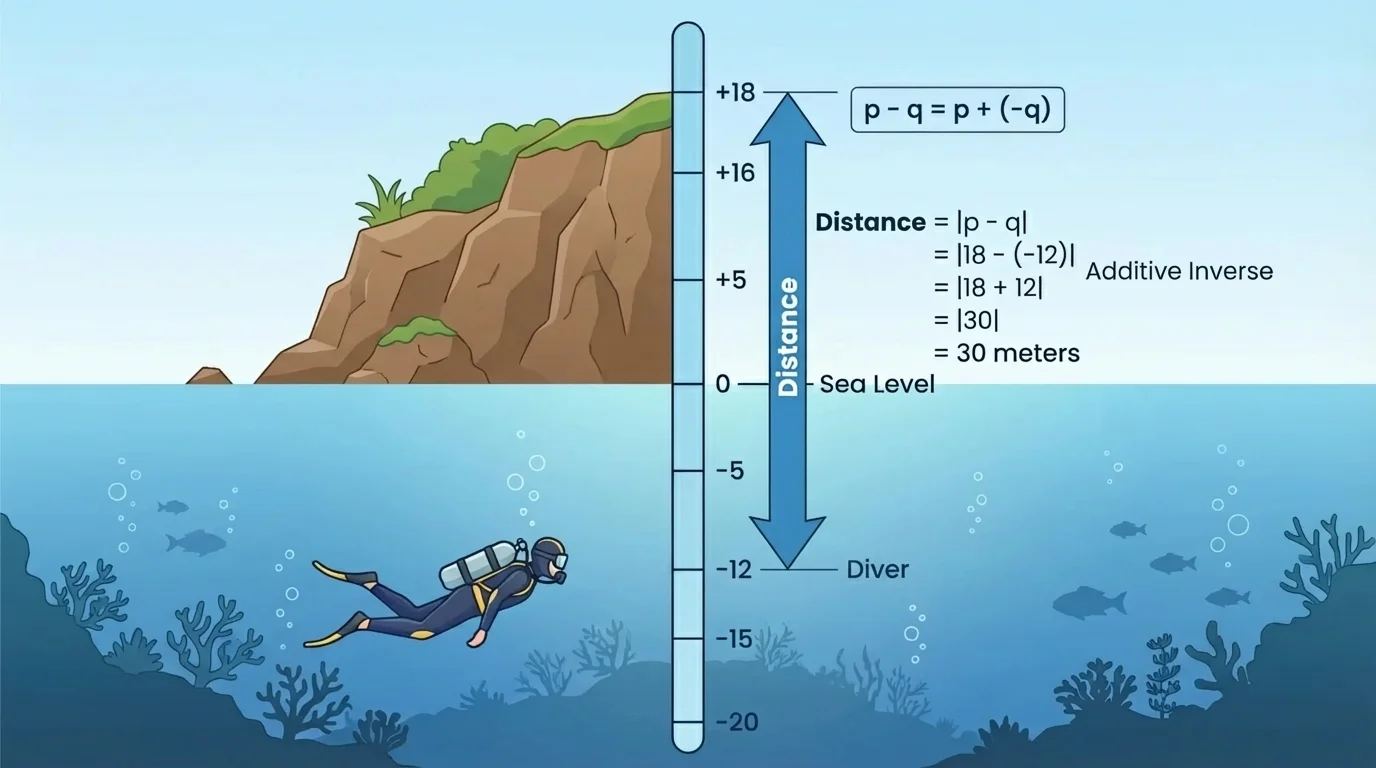
These ideas are not just number tricks. They help describe real changes and real distances. In many situations, positive and negative numbers are natural, and [Figure 3] shows one of the clearest examples with positions above and below a reference point.
Air temperature, elevation, electric charge, and profit or loss all use positive and negative values in real scientific and everyday settings. The same number rules work in all of them.
Temperature: Suppose the temperature is \(-2\,^{\circ}\textrm{C}\) in the morning and \(4\,^{\circ}\textrm{C}\) in the afternoon. The change is \(4 - (-2) = 6\). So the temperature rises by \(6\,^{\circ}\textrm{C}\). The distance between the two temperatures on a number line is also \(|4 - (-2)| = 6\).
Elevation: A diver is at \(-12 \textrm{ m}\) relative to sea level, and a cliff top is at \(18 \textrm{ m}\). The vertical distance between them is \(|18 - (-12)| = 30\,\textrm{m}\). This is exactly the kind of situation shown on a vertical number line.
Money: If your bank account changes from a debt of \(\$15\) to a balance of \(\$8\), the change is \(8 - (-15) = 23\). Your account increased by \(\$23\). The subtraction is really addition of the opposite: \(8 + 15 = 23\).
Sports: In golf, scores below par are negative and scores above par are positive. If one player is at \(-3\) and another is at \(+2\), the difference in their scores is \(|-3 - 2| = 5\). They are \(5\) strokes apart.
Travel on a subway line: If a station is represented by \(-4\) and another station by \(3\), then the distance along the line is \(|-4 - 3| = 7\) station units. The sign tells location relative to a central station, while the absolute value gives the actual separation.
Later, when you study coordinate planes, this same idea helps you find horizontal and vertical distances. The rule stays consistent: subtract to compare positions, then use absolute value when you need distance.
A very common error is forgetting to change subtraction into addition of the opposite. For example, some students see \(5 - (-2)\) and write \(5 + (-2)\). That is incorrect because the opposite of \(-2\) is \(+2\), not \(-2\). The correct rewrite is \(5 + 2\).
Another common error is treating distance as if it can be negative. If you find \(-6\) as a difference, that may be fine for subtraction, but it is not a final distance. Distance must be \(|-6| = 6\).
It also helps to keep subtraction and distance separate in your mind:
| Idea | Meaning | Can the answer be negative? |
|---|---|---|
| \(p-q\) | Difference or change from \(q\) to \(p\) | Yes |
| \(|p-q|\) | Distance between \(p\) and \(q\) | No |
Table 1. Comparison between difference and distance for rational numbers.
One more helpful check is to think about reasonableness. If you subtract a positive number, the result should usually move left on the number line. If you subtract a negative number, the result should move right. If your answer goes the wrong way, check your signs.
These two main ideas belong together. First, subtraction of rational numbers is really addition of the opposite:
\[p - q = p + (-q)\]
Second, distance between two rational numbers is the absolute value of their difference:
The distance between \(p\) and \(q\) is \(|p-q|\).
When you combine them, you get a very strong way to think about signed numbers. You can compare values, describe changes, and measure how far apart quantities are, whether you are working with temperature, elevation, game scores, or fractions on a number line.
