At first, one rule in math can feel completely backward: how can multiplying two negative numbers give a positive number? It seems strange until you realize that math is built like a carefully balanced system. If one rule changes for no reason, many other rules break. To keep multiplication consistent with patterns you already know, especially the distributive property, the product \((-1)(-1)\) must equal \(1\). Once that idea clicks, the rules for signed numbers stop feeling random and start feeling necessary.
You already know that multiplying whole numbers can mean repeated groups. For example, \(3 \cdot 4 = 12\) means \(3\) groups of \(4\). With fractions, multiplication also works as scaling. For instance, \(\dfrac{1}{2} \cdot 8 = 4\) means taking half of \(8\). But when negative numbers enter the picture, multiplication cannot be explained only as repeated addition. What does \((-3) \cdot (-4)\) mean if we think of it as "negative three groups" of "negative four"?
This is why mathematicians rely on the distributive property and other operation properties. These properties already work for whole numbers and fractions, so when we extend multiplication to rational numbers, the same structure must still hold. Math is not making up new rules here; it is preserving the old ones in a larger number system.
A rational number is any number that can be written as a fraction of integers, such as \(\dfrac{3}{4}\), \(-2\), \(0.5\), and \(-\dfrac{7}{3}\). Since negative fractions and negative decimals are rational numbers too, we need multiplication rules that work for all of them.
You already know that multiplying fractions means multiplying numerators and multiplying denominators. For example, \(\dfrac{2}{3} \cdot \dfrac{5}{4} = \dfrac{10}{12} = \dfrac{5}{6}\). The new idea is not a new fraction rule. The new idea is how signs behave when the factors are positive or negative.
Another important idea is the absolute value. The absolute value of a number is its distance from \(0\), so \(|-5|=5\) and \(|5|=5\). When multiplying signed numbers, it often helps to separate the problem into two parts: first decide the sign, then multiply the absolute values.
Three properties matter a lot here. First, the commutative property says order does not change the product: \(a \cdot b = b \cdot a\). Second, the associative property says grouping does not change the product: \((a \cdot b) \cdot c = a \cdot (b \cdot c)\). Third, the distributive property connects multiplication and addition:
\[a(b+c)=ab+ac\]
This property is the key to understanding negative times negative. It also explains why multiplication rules must stay consistent across integers, fractions, and decimals. If multiplication with negatives did not obey this property, many equations that work everywhere else would suddenly fail.
Distributive property means multiplying a number by a sum gives the same result as multiplying the number by each addend and then adding: \(a(b+c)=ab+ac\).
Signed numbers are numbers with either a positive sign or a negative sign.
For example, you already know that \(3(5+2)=3\cdot 5+3\cdot 2=15+6=21\). The same structure must still work if one or more numbers are negative. If it did not, algebra would become unreliable.
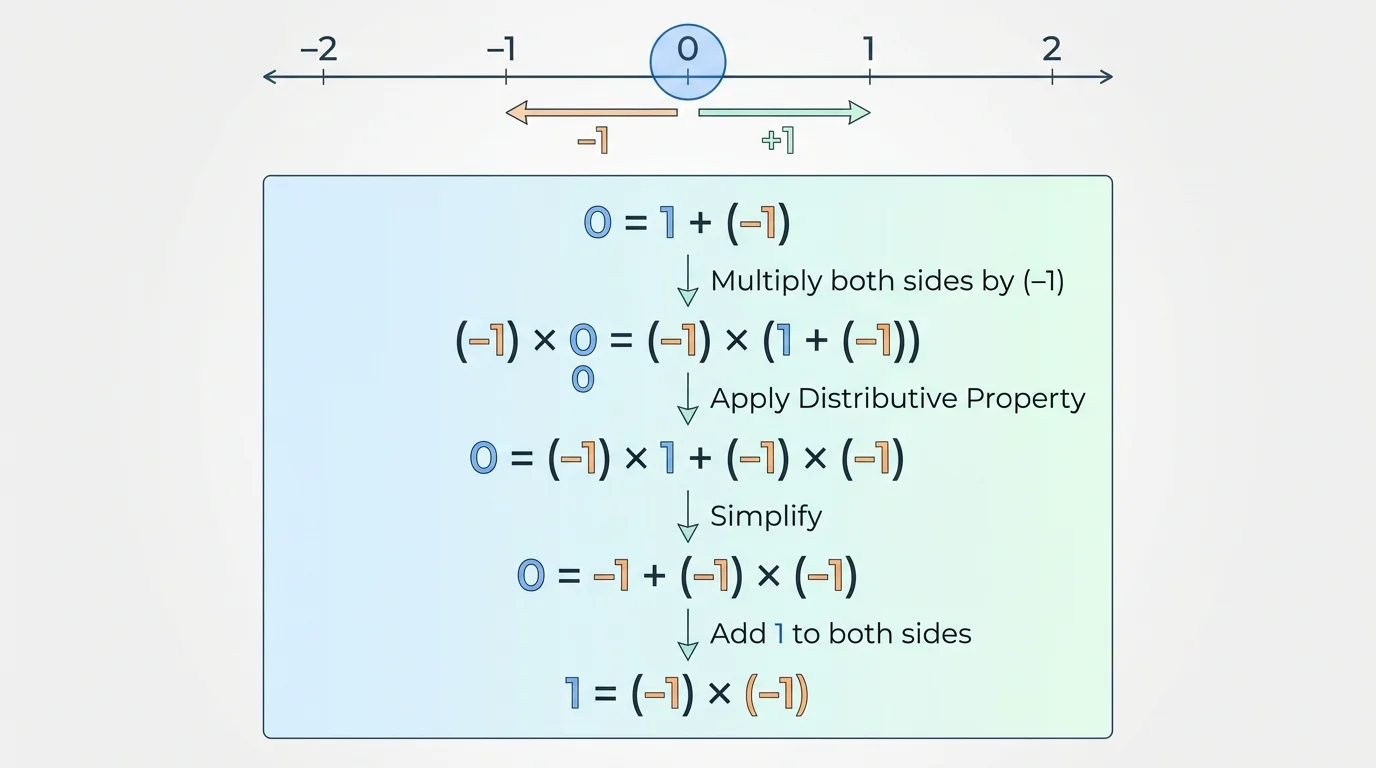
The most important fact in this lesson is that the distributive property forces the sign rule. As [Figure 1] illustrates through the equation built from zero, we start with a true statement: \(1+(-1)=0\). Now multiply both sides by \((-1)\).
Using the distributive property, we get
\[(-1)(1+(-1)) = (-1)(1)+(-1)(-1)\]
But the left side is \((-1)\cdot 0 = 0\). Also, \((-1)(1) = -1\). So the equation becomes
\[0 = -1 + (-1)(-1)\]
Now add \(1\) to both sides. Then
\[1 = (-1)(-1)\]
That is the reason two negative factors make a positive product. It is not a trick to memorize. It is the only result that keeps the distributive property true.
We can use the same thinking for other numbers. Since \((-1)(5)=-5\), multiplying by \((-1)\) changes the direction of a number. If a number is already negative, changing direction again makes it positive. That is why \((-1)(-5)=5\). Later, when you see products like \((-3)(-7)\), this same idea is still working underneath.
As we saw, the product has to be positive to keep arithmetic consistent. This is one of the best examples in mathematics of a rule that looks surprising at first but becomes logical once the structure is revealed.
Why the sign changes twice
Multiplying by a negative number can be thought of as reversing direction. One negative factor reverses once, so the product is negative. A second negative factor reverses again, so the product is positive. This idea matches the distributive-property proof and gives a helpful mental picture.
You can also notice a pattern in products with \(-2\): \((-2)(3)=-6\), \((-2)(2)=-4\), \((-2)(1)=-2\), \((-2)(0)=0\). Each time the second factor goes down by \(1\), the product goes up by \(2\). So the next values must be \((-2)(-1)=2\), \((-2)(-2)=4\), and so on. The pattern points to the same sign rule.
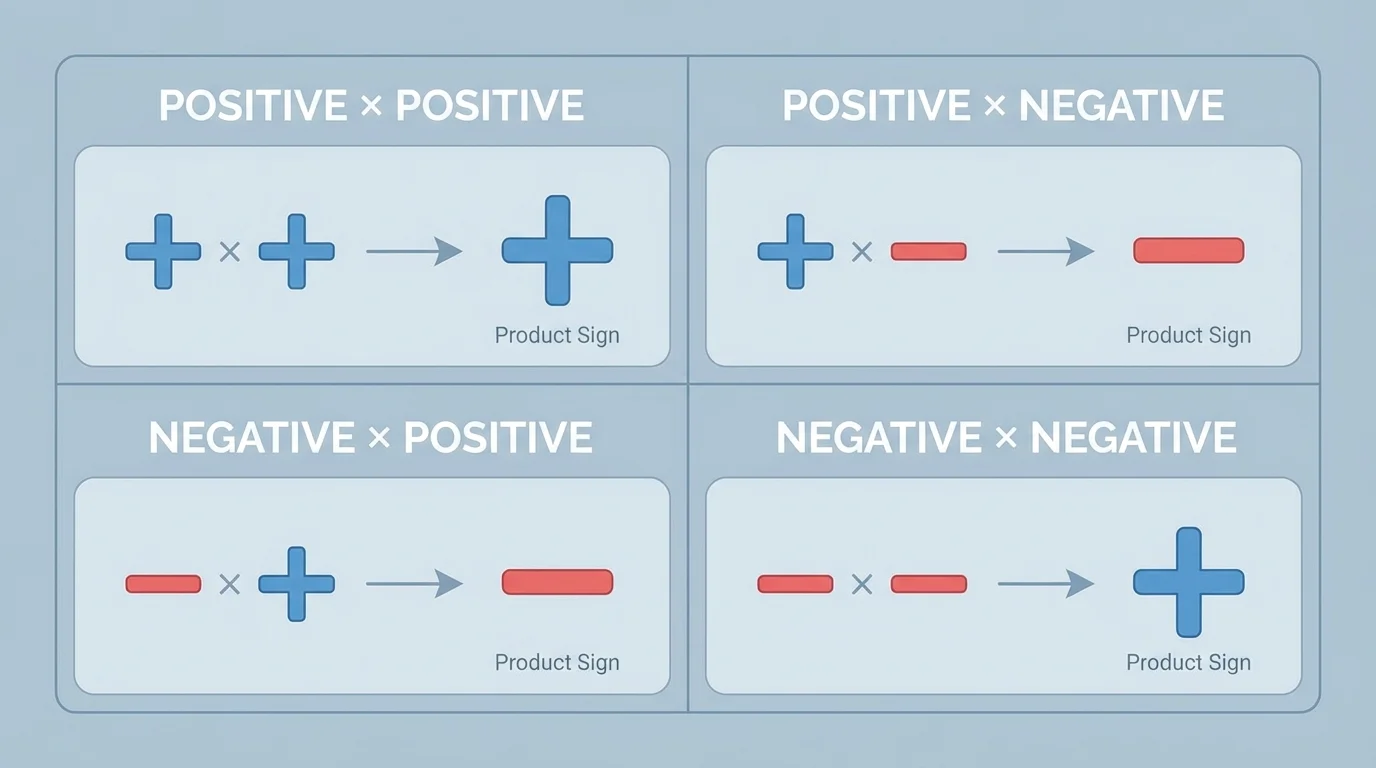
Once the logic is understood, the practical rules are straightforward. As [Figure 2] shows, the sign patterns are the same for all rational numbers: integers, fractions, and decimals.
If the signs are the same, the product is positive. If the signs are different, the product is negative.
Here are the four cases:
After deciding the sign, multiply the absolute values. For example, in \((-4)(6)\), the signs are different, so the product is negative. Then multiply \(|-4|\cdot |6| = 4\cdot 6 = 24\). So the result is \(-24\).
This sign rule is not limited to whole numbers. For instance, \((-\dfrac{2}{3})(-\dfrac{9}{5})\) is positive because the signs match. You still multiply the fraction parts exactly as usual.
A useful shortcut is this: same signs, positive; different signs, negative. That statement works whether the numbers are big or small, whole or fractional, in decimal or fraction form.
Later, when solving longer expressions, the visual pattern from [Figure 2] helps you quickly determine the sign before worrying about computation. This is especially useful when several negative numbers appear in the same problem.
For integers, multiply the absolute values and apply the sign rule. For fractions, multiply numerators and denominators, then apply the sign rule. For decimals, multiply as usual and then place the decimal point correctly, along with the correct sign.
Examples:
Notice that the sign rule never changes. Only the type of number changes.
Negative numbers were once viewed with suspicion in the history of mathematics because they seemed less "real" than counting numbers. Today they are essential in science, finance, coding, and engineering.
Zero is also important. Any rational number multiplied by \(0\) is \(0\): \(a\cdot 0 = 0\). Zero has no positive or negative sign in multiplication. This helps explain why the distributive proof started with a sum equal to zero.
Now let's solve several examples step by step.
Worked example 1
Find \((-7)(4)\).
Step 1: Determine the sign.
The factors have different signs, so the product is negative.
Step 2: Multiply the absolute values.
\(|-7|\cdot |4| = 7\cdot 4 = 28\).
Step 3: Combine the sign and the value.
\((-7)(4)=-28\)
The product is \(-28\).
This example shows the most common case: one positive factor and one negative factor give a negative result.
Worked example 2
Find \(\left(-\dfrac{3}{5}\right)\left(-\dfrac{10}{9}\right)\).
Step 1: Determine the sign.
Both factors are negative, so the product is positive.
Step 2: Multiply numerators and denominators.
\(\dfrac{3\cdot 10}{5\cdot 9} = \dfrac{30}{45}\).
Step 3: Simplify.
\(\dfrac{30}{45} = \dfrac{2}{3}\).
Step 4: State the answer.
\[\left(-\frac{3}{5}\right)\left(-\frac{10}{9}\right)=\frac{2}{3}\]
The product is \(\dfrac{2}{3}\).
Even though the numbers are fractions, the sign rule works exactly the same way as it does for integers.
Worked example 3
Find \((-1.5)(-0.4)\).
Step 1: Determine the sign.
The signs are the same, so the product is positive.
Step 2: Multiply the decimal parts.
Ignore the signs and decimal points for a moment: \(15\cdot 4 = 60\).
Step 3: Place the decimal point.
There are two decimal places total, one in \(1.5\) and one in \(0.4\), so the product is \(0.60\).
Step 4: Write the final answer.
\[(-1.5)(-0.4)=0.6\]
The product is \(0.6\).
Decimals can look harder, but the sign decision still comes first and stays simple.
Worked example 4
Use the distributive property to justify that \((-3)(-2)=6\).
Step 1: Start with a true equation.
\(2 + (-2) = 0\).
Step 2: Multiply both sides by \((-3)\).
\((-3)(2+(-2)) = (-3)(0)\).
Step 3: Distribute.
\((-3)(2) + (-3)(-2) = 0\).
Step 4: Substitute what you know.
\(-6 + (-3)(-2) = 0\).
Step 5: Solve.
Add \(6\) to both sides: \((-3)(-2)=6\).
\((-3)(-2)=6\)
This example connects the practical rule to the deeper reason behind it.
Products of rational numbers are not just symbols on paper. As [Figure 3] shows through everyday contexts, they can describe repeated gains, repeated losses, direction, and change in real situations. The sign tells whether the overall effect is positive or negative.
Suppose a bank account loses $8 each day for \(5\) days. The product is \(5\cdot (-8) = -40\). The negative result means an overall loss of $40.
Now think about reversing a loss. If your account is incorrectly reduced by $8 each day for \(5\) days, and the bank cancels those deductions by applying the opposite effect, then \((-5)(-8)=40\) can represent removing repeated losses, which creates a gain of $40.
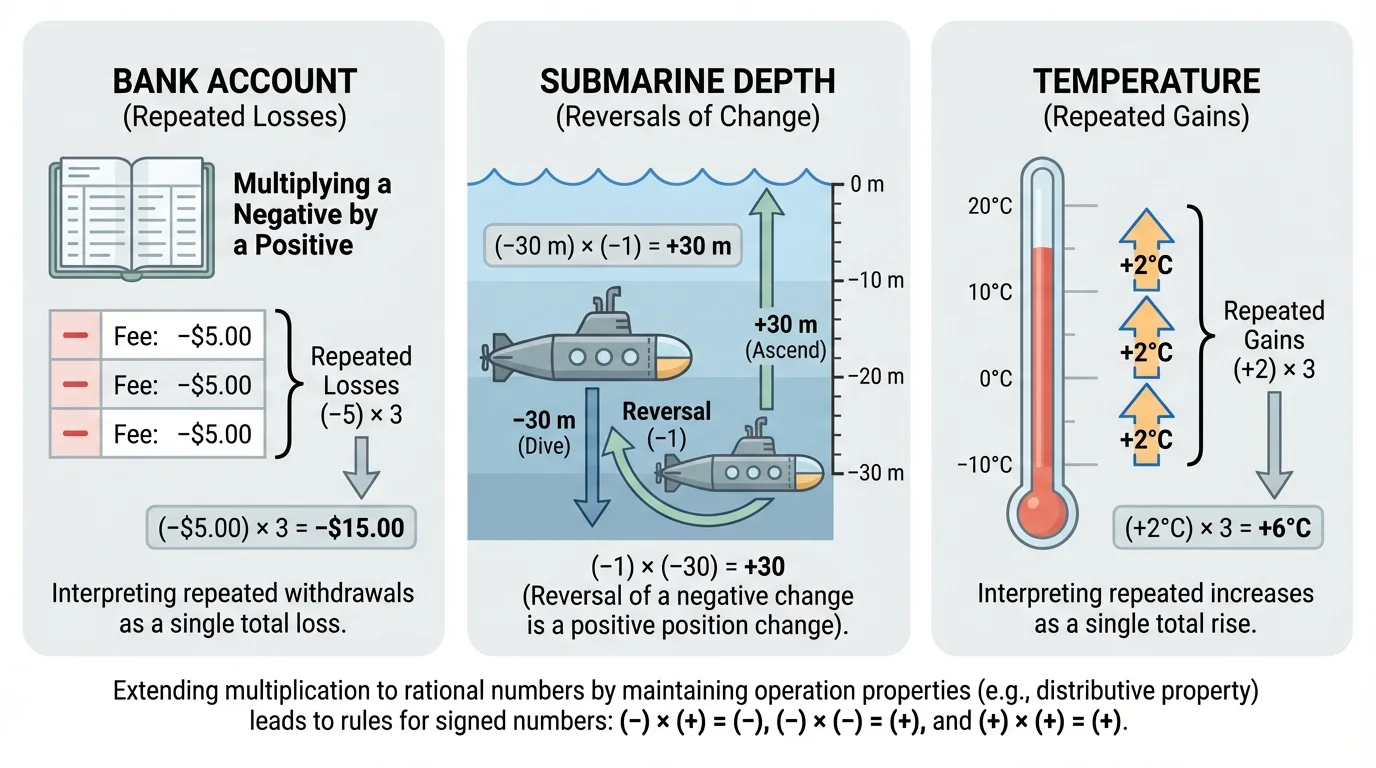
Here is another context: elevation. A submarine descends \(\dfrac{3}{2}\) meters each minute. After \(4\) minutes, the change in elevation is \(4\cdot \left(-\dfrac{3}{2}\right) = -6\) meters. The negative product shows movement below the starting level.
Temperature gives another useful interpretation. If the temperature changes by \(-2.5\) degrees each hour for \(3\) hours, the total change is \(3\cdot (-2.5) = -7.5\) degrees. Again, the negative sign shows an overall decrease.
You can also use signed multiplication to describe direction in science. If "forward" is positive and "backward" is negative, then a negative multiplier can mean reversing direction. That is one reason the idea of two negatives making a positive fits naturally with many real systems.
As shown earlier in [Figure 3], contexts matter. A positive product can mean an overall gain, upward movement, or a reversal of a negative effect. A negative product can mean a loss, downward movement, or repeated decreases.
| Situation | Expression | Meaning of Product |
|---|---|---|
| Loss of $8 for 5 days | \(5(-8)=-40\) | Total loss of $40 |
| Drop of \(2.5\) degrees for 3 hours | \(3(-2.5)=-7.5\) | Total temperature decrease |
| Descend \(\dfrac{3}{2}\) meters per minute for 4 minutes | \(4\left(-\dfrac{3}{2}\right)=-6\) | Total downward change |
| Reverse 5 losses of $8 | \((-5)(-8)=40\) | Overall gain of $40 |
Table 1. Examples of how products of rational numbers can describe repeated change in real-world situations.
One common mistake is thinking that a negative times a negative should stay negative because "negative and negative sound bad." But multiplication is not about mood or wording. It follows the properties of operations, and those properties force the positive result.
Another mistake is forgetting to separate the product sign from the numerical multiplication. In \((-6)(-2)\), first decide the sign: positive. Then multiply \(6\cdot 2 = 12\). So the answer is \(12\), not \(-12\).
Some students also mix up multiplication and addition. For example, \((-3)+(-4)=-7\), but \((-3)(-4)=12\). The operation sign matters. Addition and multiplication follow different rules.
"Same signs, positive; different signs, negative."
— A useful multiplication rule for signed numbers
When fractions are involved, students sometimes apply the sign correctly but forget to simplify. For example, \(\left(-\dfrac{4}{7}\right)\left(-\dfrac{14}{3}\right)\) is positive, and the product is \(\dfrac{56}{21} = \dfrac{8}{3}\), not just \(\dfrac{56}{21}\) left unsimplified.
A final strategy is to check whether your answer makes sense. If you multiply numbers with the same sign and get a negative answer, stop and recheck. If you multiply numbers with different signs and get a positive answer, that is another sign to look again.
Multiplication extends from fractions to all rational numbers by keeping the same operation properties true. The distributive property is especially powerful because it shows that \((-1)(-1)=1\) is not optional. Once that fact is established, the entire set of sign rules follows naturally.
Whether you are multiplying integers, fractions, or decimals, the process is the same: determine the sign, multiply the absolute values, and simplify if needed. Then interpret the result in context. A negative product often represents overall decrease or loss. A positive product can represent overall increase or the reversal of a negative effect.
