A basketball team can be up by a few points, a scuba diver can be down below sea level, and your bank account can rise or fall. All of these situations use numbers greater than zero, less than zero, and sometimes fractions or decimals. The surprising part is that hard-looking problems often become simple when you use the properties of operations wisely. Instead of just calculating from left to right, you can look for structure and make the numbers work for you.
A rational number is any number that can be written as a fraction of two integers in the form \(\dfrac{a}{b}\), where \(b \ne 0\).
Rational numbers include integers like \(-5\) and \(8\), fractions like \(\dfrac{3}{4}\) and \(-\dfrac{7}{2}\), and terminating or repeating decimals like \(0.6\) and \(-1.25\). They all fit on the number line.
When you add and subtract rational numbers, you are not learning a completely new system. You are extending what you already know about whole numbers and fractions. The key new challenge is handling signs correctly and recognizing when a property can simplify the work.
You already know that adding means combining quantities and subtraction can mean finding a difference or taking away. You also know that opposite numbers such as \(5\) and \(-5\) are the same distance from \(0\) on the number line.
Properties matter because they let you change the order or grouping of numbers without changing the value, as long as you apply them correctly. That means a problem like \(-3 + 8 + (-8) + 5\) does not need to be done in a slow, one-step-at-a-time way. You can notice that \(8\) and \(-8\) make \(0\), and then the problem becomes much easier.
[Figure 1] When working with rational numbers, the most useful ideas are the commutative property, associative property, additive inverse, identity property of addition, and rewriting subtraction as addition of the opposite. These ideas help you spot zero pairs and friendly groupings.
Commutative property of addition: You can change the order of addends without changing the sum: \(a + b = b + a\).
Associative property of addition: You can change the grouping of addends without changing the sum: \((a + b) + c = a + (b + c)\).
Additive inverse: A number and its opposite add to \(0\): \(a + (-a) = 0\).
Identity property of addition: Adding \(0\) does not change a number: \(a + 0 = a\).
Subtraction is closely connected to addition. Any subtraction expression can be rewritten using the opposite number:
\[a - b = a + (-b)\]
This is one of the most important ideas in the whole topic. Once subtraction is rewritten as addition, the properties of addition can be used as a strategy.
For example, \(7 - (-3)\) becomes \(7 + 3\), and \(-4 - 6\) becomes \(-4 + (-6)\). In both cases, subtraction turns into addition, but the sign of the second number changes because you are adding its opposite.
Another powerful idea is to look for numbers that cancel. If you see \(2.5 + (-2.5)\), the sum is \(0\). If you see \(-\dfrac{3}{4} + \dfrac{3}{4}\), the sum is also \(0\). Those zero pairs make longer expressions much easier.
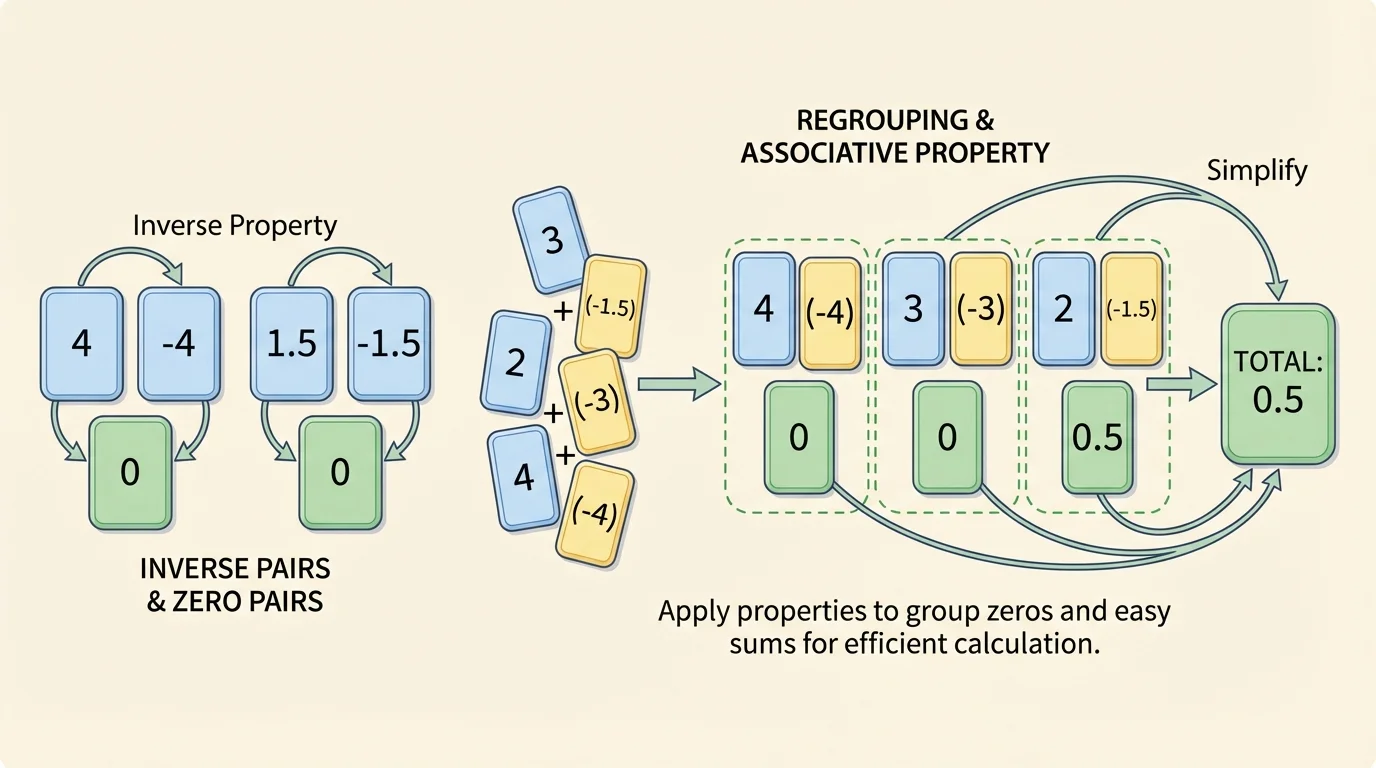
To add rational numbers well, first decide whether the numbers have the same sign or different signs. Then look for a shortcut using the properties of addition.
If the numbers have the same sign, add their absolute values and keep the sign. For example, \(-2.3 + (-1.7) = -4.0\), so the sum is \(-4\).
If the numbers have different signs, think of it as finding the difference between their absolute values and keeping the sign of the number with the greater absolute value. For example, \(6 + (-9) = -3\) because \(9 - 6 = 3\) and the larger absolute value comes from \(-9\).
Looking for structure in a sum
Good strategy means more than following a rule. It means noticing patterns. In an expression like \(-6 + 4 + 6 + (-1)\), you can use the commutative property to reorder the numbers as \(-6 + 6 + 4 + (-1)\). Then use the additive inverse idea to combine \(-6 + 6 = 0\). The expression becomes \(0 + 4 + (-1) = 3\).
You can also group compatible numbers. In \(\dfrac{1}{2} + \left(-\dfrac{7}{2}\right) + 3\), it helps to group \(\dfrac{1}{2}\) and \(3\) by writing \(3\) as \(\dfrac{6}{2}\). Then \(\dfrac{1}{2} + \dfrac{6}{2} = \dfrac{7}{2}\), and \(\dfrac{7}{2} + \left(-\dfrac{7}{2}\right) = 0\).
Decimals work the same way. For example, \(-1.8 + 5.2 + 1.8\) can be reordered as \(-1.8 + 1.8 + 5.2\). The first two numbers make \(0\), leaving \(5.2\).
The biggest mistake students make in subtraction is forgetting that subtracting a number means adding its opposite. Once you rewrite correctly, the problem often becomes easier.
Here are several rewrites:
\(5 - 9 = 5 + (-9)\)
\(-2 - 7 = -2 + (-7)\)
\(4 - (-6) = 4 + 6\)
\(-\dfrac{3}{5} - \left(-\dfrac{2}{5}\right) = -\dfrac{3}{5} + \dfrac{2}{5}\)
After rewriting, use the same addition strategies as before: combine same-sign numbers, compare absolute values for different-sign numbers, or reorder and regroup if there are several terms.
A double negative in subtraction often surprises people. Subtracting a negative number, such as in \(8 - (-2)\), increases the value because it is the same as adding a positive: \(8 + 2 = 10\).
This is why subtraction and addition are deeply connected. If you can add rational numbers confidently, then you can subtract them too by rewriting first.
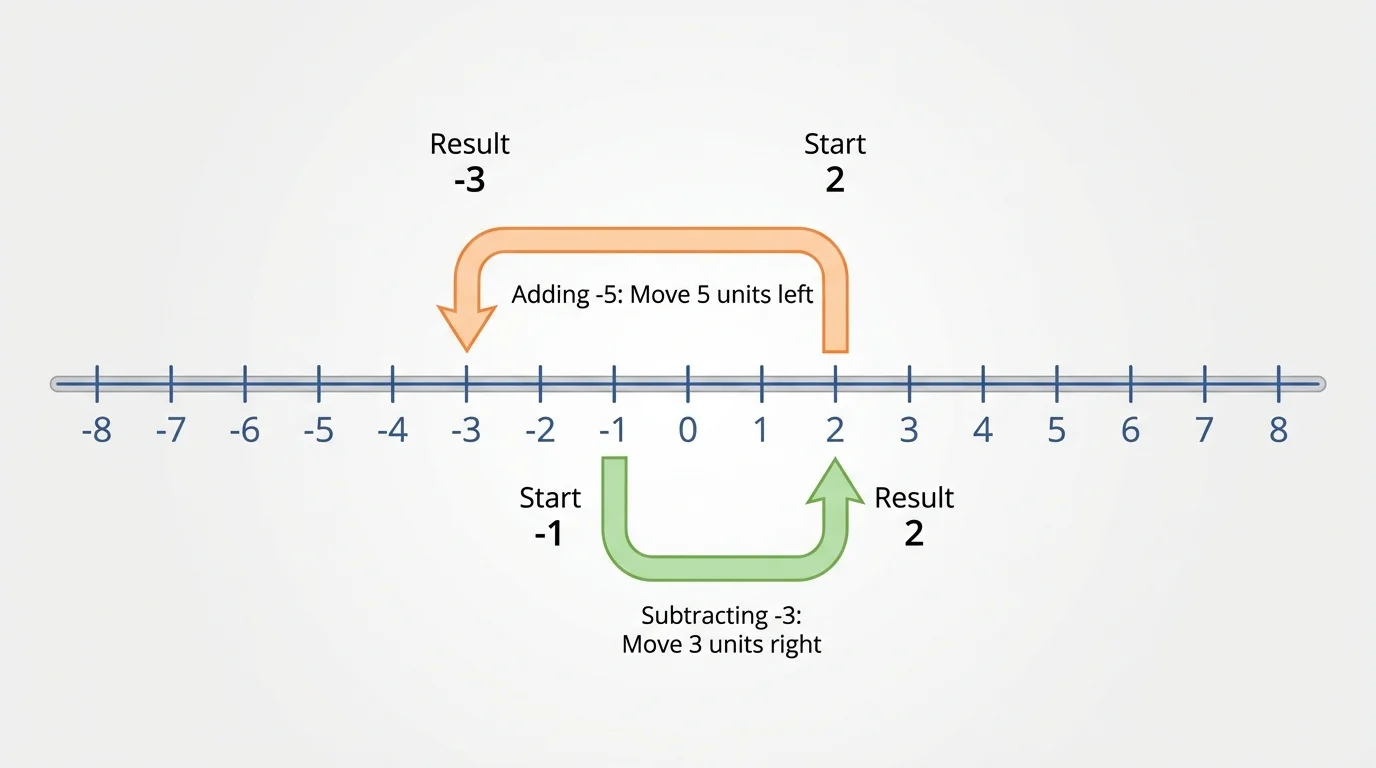
[Figure 2] A number line shows rational-number operations as movement. This model helps you understand why the rules work instead of just memorizing them.
On a horizontal number line, start at the first number. Adding a positive means move right. Adding a negative means move left. Subtracting a number means add its opposite, so subtracting a positive moves left and subtracting a negative moves right.
For example, to show \(2 + (-5)\), start at \(2\) and move \(5\) units left. You land at \(-3\). To show \(-1 - (-3)\), rewrite it as \(-1 + 3\). Start at \(-1\) and move \(3\) units right. You land at \(2\).
On a vertical number line, the same rules apply, but the movement is up and down instead of right and left. This is especially useful for temperature and elevation. Going up means adding a positive amount. Going down means adding a negative amount or subtracting a positive amount.
For instance, if a submarine is at \(-40\) meters and rises \(15\) meters, its new position is \(-40 + 15 = -25\) meters. If it then drops \(10\) more meters, the new position is \(-25 - 10 = -35\) meters.
Later, when you solve real-world problems, remember this motion model: the sign tells the direction, and subtraction changes into adding the opposite.
The best way to learn these strategies is to see them used carefully.
Worked example 1
Find \(-7 + 12 + (-5)\).
Step 1: Look for a helpful grouping.
Use the associative property to group \(12 + (-5)\).
Step 2: Compute the grouped sum.
\(12 + (-5) = 7\).
Step 3: Finish the addition.
\(-7 + 7 = 0\).
The value is \(0\)
Notice how the grouping created a pair of opposites. That is often faster than adding from left to right.
Worked example 2
Find \(4 - (-9) + (-3)\).
Step 1: Rewrite subtraction as addition.
\(4 - (-9) = 4 + 9\).
Step 2: Rewrite the whole expression.
\(4 + 9 + (-3)\).
Step 3: Add strategically.
\(4 + 9 = 13\), and then \(13 + (-3) = 10\).
The value is \(10\)
This example shows that subtracting a negative increases the total because it becomes addition.
Worked example 3
Find \(-\dfrac{3}{4} + \dfrac{5}{4} - \dfrac{2}{4}\).
Step 1: Rewrite subtraction.
\(-\dfrac{3}{4} + \dfrac{5}{4} + \left(-\dfrac{2}{4}\right)\).
Step 2: Use a useful grouping.
Group \(\dfrac{5}{4} + \left(-\dfrac{2}{4}\right) = \dfrac{3}{4}\).
Step 3: Add opposites.
\(-\dfrac{3}{4} + \dfrac{3}{4} = 0\).
The value is \(0\)
Fractions follow the same property-based strategies as integers and decimals.
Worked example 4
Find \(-2.6 - 1.4 + 2.6\).
Step 1: Rewrite subtraction as addition.
\(-2.6 + (-1.4) + 2.6\).
Step 2: Reorder using the commutative property.
\(-2.6 + 2.6 + (-1.4)\).
Step 3: Use the additive inverse.
\(-2.6 + 2.6 = 0\).
Step 4: Finish.
\(0 + (-1.4) = -1.4\).
The value is \(-1.4\)
Here the strategy was to find a zero pair first. That can make decimal problems much cleaner.
One common mistake is thinking that subtraction keeps the same second number. For example, some students change \(6 - (-2)\) into \(6 + (-2)\), but that is incorrect. You must add the opposite of the number being subtracted. The opposite of \(-2\) is \(2\), so \(6 - (-2) = 6 + 2\).
Another mistake is ignoring parentheses. In \(3 + (-7)\), the second number is negative. The parentheses help you see that the sign belongs to the number. Without paying attention, students sometimes read it as \(3 + 7\), which changes the problem completely.
A third mistake is using the commutative property for subtraction. Addition is commutative, but subtraction is not. In general, \(a - b \neq b - a\). That is why rewriting subtraction as addition is so important: it lets you use addition properties correctly.
| Expression | Correct Rewrite or Idea | Result |
|---|---|---|
| \(8 - (-5)\) | \(8 + 5\) | \(13\) |
| \(-4 - 3\) | \(-4 + (-3)\) | \(-7\) |
| \(-2 + 2 + 7\) | Use inverse pair first | \(7\) |
| \(1.2 + (-3.5) + 3.5\) | Group \(-3.5 + 3.5\) | \(1.2\) |
Table 1. Examples of correct rewrites and efficient strategies for adding and subtracting rational numbers.
[Figure 3] Rational numbers describe many real situations. A vertical number line can model changes above and below a reference point such as sea level or zero degrees. Using properties makes these situations easier to calculate.
Temperature: If the morning temperature is \(-6^\circ\) and it rises \(9^\circ\), the new temperature is \(-6 + 9 = 3^\circ\). If it later drops \(4^\circ\), then \(3 - 4 = -1^\circ\).
Money: A debt can be represented by a negative number. If your account balance is \(-15\) dollars and you deposit \(20\) dollars, the new balance is \(-15 + 20 = 5\) dollars. If you then spend \(8\) dollars, the balance becomes \(5 - 8 = -3\) dollars.
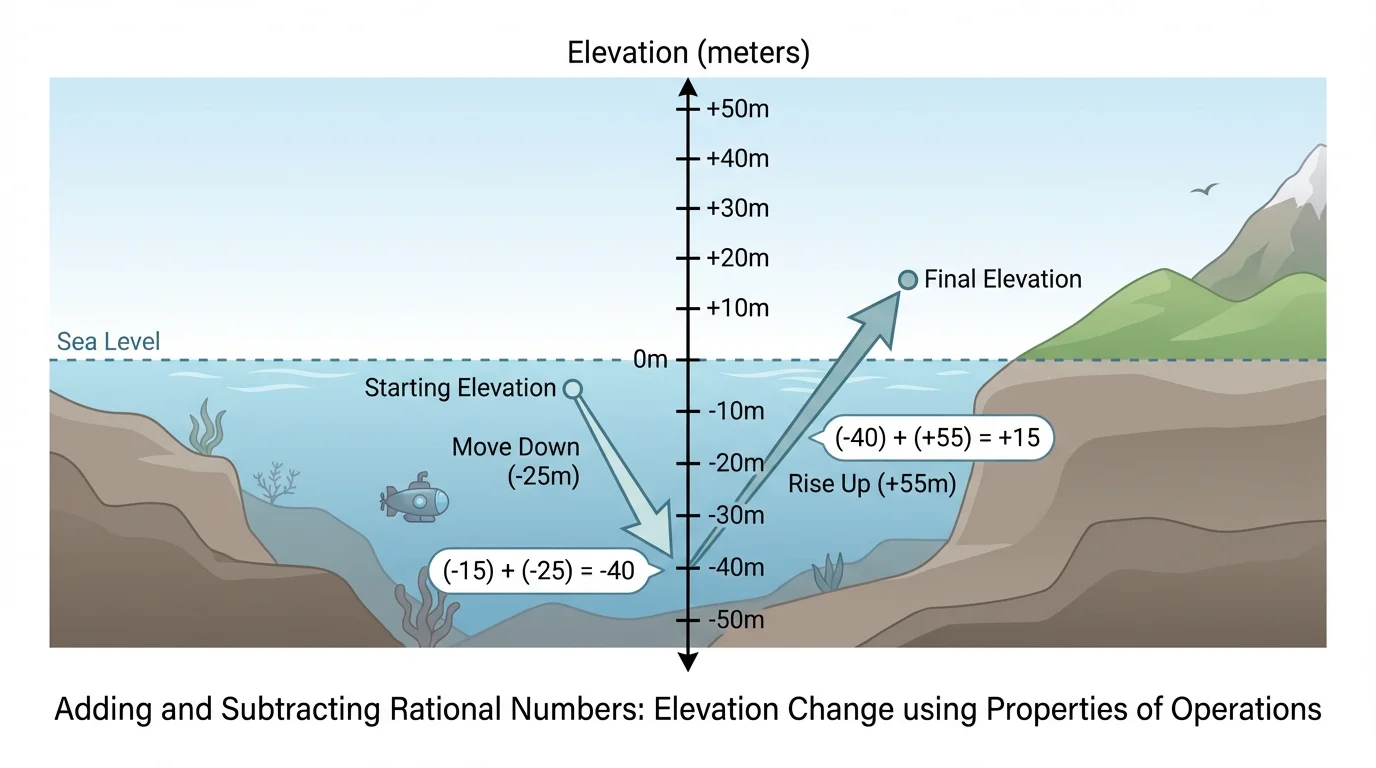
Elevation: A hiker at \(-30\) meters relative to sea level climbs \(45\) meters. The new elevation is \(-30 + 45 = 15\) meters. If the hiker descends \(20\) meters next, the elevation becomes \(15 - 20 = -5\) meters.
Sports statistics: In some sports, gains and losses can be tracked with positive and negative values. If a golfer is at \(-2\), then has one hole at \(+1\) and another at \(-1\), the total change is \(-2 + 1 + (-1) = -2\). The positive and negative changes can cancel.
These examples are easier when you search for opposites or easy groupings, just as the movement model in [Figure 3] helps you interpret direction.
Skilled problem solvers do not just calculate; they look for structure. When you see a long expression, ask yourself a few questions.
Are there any opposites, like \(a\) and \(-a\)? Are there numbers that combine into a friendly total, such as \(\dfrac{1}{4}\) and \(\dfrac{3}{4}\), or \(-2.5\) and \(0.5\)? Would changing the order make the problem clearer?
A strategy checklist
For addition and subtraction of rational numbers, try this order of thinking: rewrite subtraction as addition of the opposite, look for inverse pairs, reorder if helpful, regroup compatible numbers, and then compute. This keeps the focus on structure rather than speed alone.
Consider \(-8 + 2 - (-2) + 8 - 3\). First rewrite subtraction: \(-8 + 2 + 2 + 8 + (-3)\). Now reorder: \(-8 + 8 + 2 + 2 + (-3)\). The inverse pair gives \(0\), and then \(2 + 2 + (-3) = 1\). A problem that looked messy becomes manageable.
This way of thinking is one of the most important habits in mathematics. Properties are not just rules to memorize. They are tools for seeing hidden simplicity.
