A surprising thing about numbers is that division often pushes us beyond the world of integers. For example, \(7 \div 2\) is not an integer, but it is still a perfectly valid number. The moment we ask questions like "How much does each person get?" or "What is the amount per hour?" we enter the world of quotients, and that world is filled with rational numbers.
Suppose you share \(5\) sandwiches equally among \(2\) people. Each person gets \(\dfrac{5}{2}\) sandwiches. That answer is not an integer, but it makes sense. Or suppose a team loses \(12\) points over \(4\) games. The average change is \(-\dfrac{12}{4}=-3\) points per game. Division helps describe equal sharing and unit rates, even when the answer is negative or not a whole number.
That is why division is so important: it connects integers to a larger number system. Integers alone are not enough for all situations. Fractions and quotients allow us to describe partial amounts, fair shares, and rates of change.
You already know that an integer can be positive, negative, or zero, such as \(-4\), \(0\), and \(9\). You also know that a fraction like \(\dfrac{3}{4}\) represents division: \(3 \div 4\).
When we divide one integer by another nonzero integer, we create a number that can always be written as a fraction. That is exactly what makes it rational.
An integer is a whole number or its opposite: \(...,-3,-2,-1,0,1,2,3,...\). In a division expression like \(\dfrac{p}{q}\), the number \(p\) is the dividend and the number \(q\) is the divisor. The result is called the quotient.
Rational number means any number that can be written in the form \(\dfrac{a}{b}\), where \(a\) and \(b\) are integers and \(b \ne 0\).
Nonzero divisor means the number you divide by is not \(0\).
This definition is powerful because it includes many kinds of numbers. A fraction like \(\dfrac{3}{5}\) is rational. An integer like \(6\) is also rational because it can be written as \(\dfrac{6}{1}\). A negative fraction like \(-\dfrac{7}{2}\) is rational too.
The rule \(b \ne 0\) is essential. A denominator of zero is not allowed in a rational number, and a divisor of zero is not allowed in division.
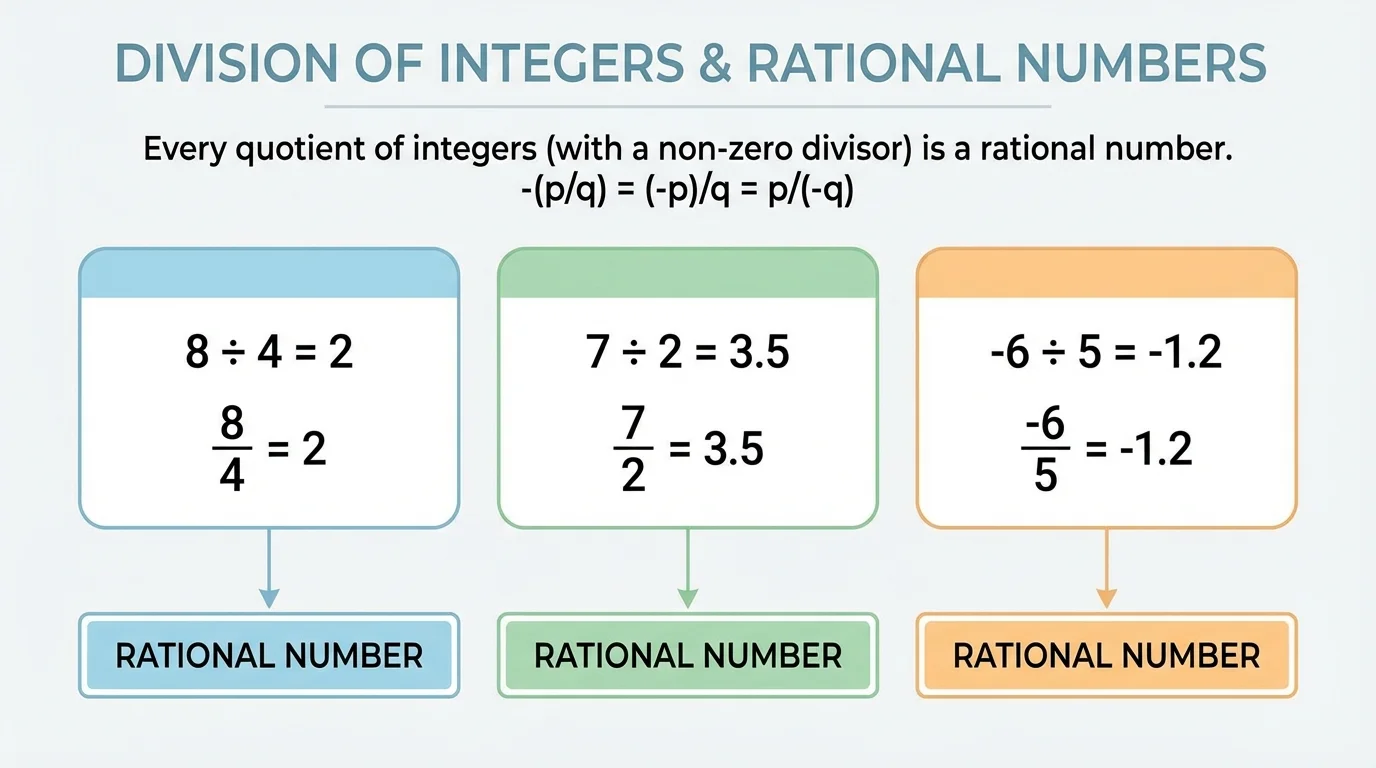
Whenever integers are divided by a nonzero integer, the result can be written as a fraction, so it is rational. Sometimes the answer is an integer, and sometimes it falls between integers, as [Figure 1] shows through different kinds of quotients.
For instance, \(8 \div 4 = 2\). This quotient is rational because \(2 = \dfrac{2}{1}\). Now look at \(7 \div 4\). That quotient is \(\dfrac{7}{4}\), which is also rational. The answer is not an integer, but it still fits the definition.
In general, if \(p\) and \(q\) are integers and \(q \ne 0\), then
\[\frac{p}{q}\]
is a rational number.
This is true whether \(p\) and \(q\) are positive, negative, or one of them is zero. For example, \(\dfrac{0}{5}=0\), and \(0\) is rational. But \(\dfrac{5}{0}\) is not allowed because the divisor is zero.
Later, when you divide rational numbers by rational numbers, you are still staying inside the rational-number system. Rational numbers are closed under division as long as the number you divide by is not zero.
To understand this, ask what \(6 \div 0\) would mean. Division asks, "What number times \(0\) equals \(6\)?" But any number multiplied by \(0\) equals \(0\), never \(6\). So there is no answer.
Now ask what \(0 \div 0\) would mean. Division asks, "What number times \(0\) equals \(0\)?" This time, too many answers seem possible, because \(0 \cdot 1 = 0\), \(0 \cdot 5 = 0\), and \(0 \cdot (-9) = 0\). Since division should give one clear answer, \(0 \div 0\) is also undefined.
Why the nonzero divisor rule matters
Division is connected to multiplication. If \(a \div b = c\), then \(c \cdot b = a\). When \(b = 0\), this relationship breaks down because multiplying by zero does not let us recover different values of \(a\).
So the statement "integers can be divided, provided that the divisor is not zero" is not just a rule to memorize. It comes from how multiplication and division fit together.
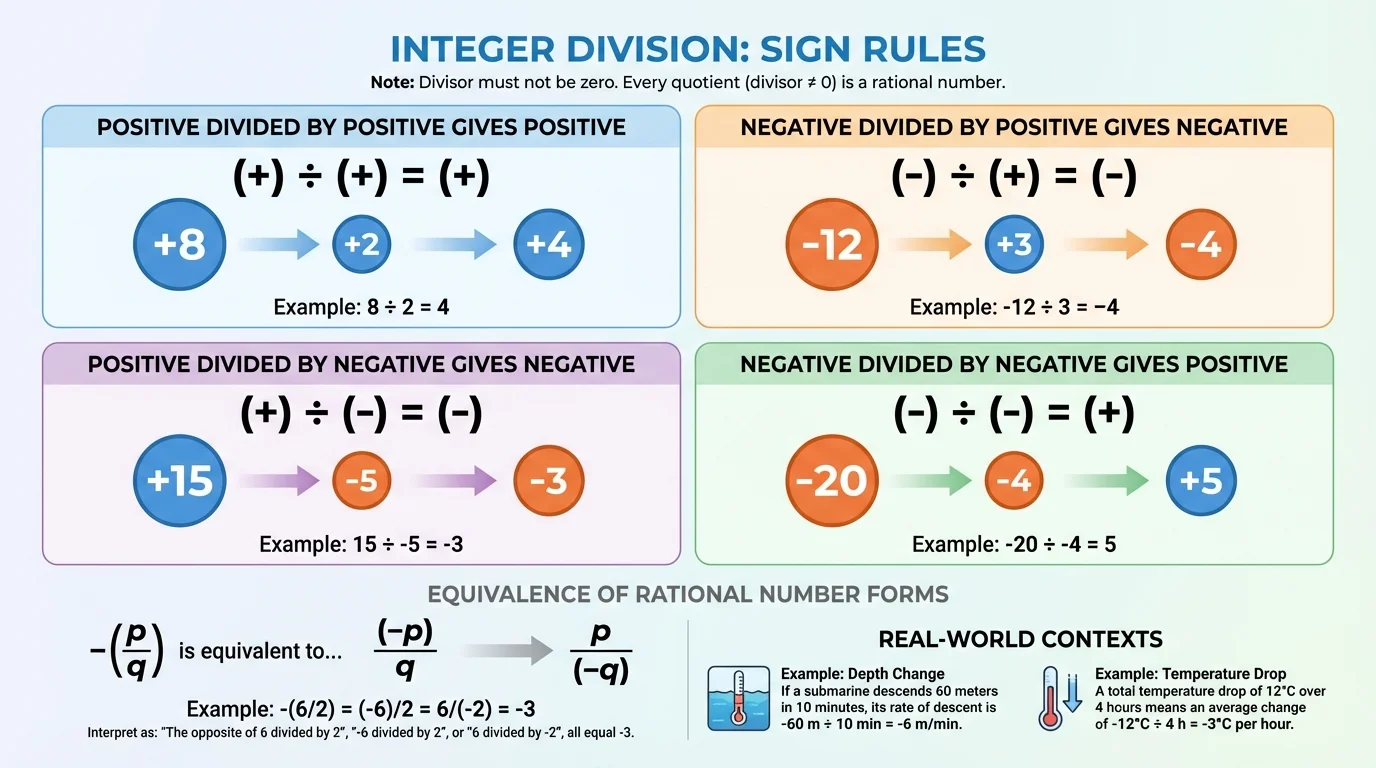
Negative signs in fractions can appear in more than one place, but they can represent the same number. The sign patterns are consistent, as [Figure 2] illustrates with all four positive and negative cases.
If \(p\) and \(q\) are integers with \(q \ne 0\), then
\[-\left(\frac{p}{q}\right)=\frac{-p}{q}=\frac{p}{-q}.\]
These three forms all mean the same thing: the quotient is negative. The negative sign can be written in front of the fraction, in the numerator, or in the denominator.
For example,
\[ -\left(\frac{3}{5}\right)=\frac{-3}{5}=\frac{3}{-5}. \]
Each form equals \(-\dfrac{3}{5}\).
But notice an important difference:
\[\frac{-3}{-5}=\frac{3}{5}.\]
When both the numerator and denominator are negative, the quotient is positive. A negative divided by a negative gives a positive.
| Expression | Sign of quotient | Example |
|---|---|---|
| \(\dfrac{+a}{+b}\) | Positive | \(\dfrac{8}{2}=4\) |
| \(\dfrac{-a}{+b}\) | Negative | \(\dfrac{-8}{2}=-4\) |
| \(\dfrac{+a}{-b}\) | Negative | \(\dfrac{8}{-2}=-4\) |
| \(\dfrac{-a}{-b}\) | Positive | \(\dfrac{-8}{-2}=4\) |
Table 1. Sign patterns for quotients of positive and negative numbers.
As seen earlier in [Figure 1], quotients can be integers or fractions. The sign rules do not change that fact; they only tell whether the result is positive or negative.
Worked examples are useful here because the ideas are simple, but students often mix up the signs or forget the nonzero divisor rule.
Worked example 1
Show that \(\dfrac{-12}{5}\) is a rational number.
Step 1: Check the form of the number.
The number is written as \(\dfrac{p}{q}\), where \(p=-12\) and \(q=5\).
Step 2: Check that both numbers are integers.
Both \(-12\) and \(5\) are integers.
Step 3: Check that the divisor is not zero.
Since \(5 \ne 0\), the fraction is valid.
Therefore, \(\dfrac{-12}{5}\) is a rational number.
This example shows that the quotient does not have to be an integer. It only needs to fit the form \(\dfrac{p}{q}\) with integers and a nonzero denominator.
Worked example 2
Rewrite \(-\left(\dfrac{14}{3}\right)\) in two equivalent ways.
Step 1: Move the negative sign to the numerator.
\(-\left(\dfrac{14}{3}\right)=\dfrac{-14}{3}\).
Step 2: Move the negative sign to the denominator.
\(-\left(\dfrac{14}{3}\right)=\dfrac{14}{-3}\).
So the two equivalent forms are \(\dfrac{-14}{3}\) and \(\dfrac{14}{-3}\).
The important idea is that one negative sign anywhere in the fraction makes the entire quotient negative.
Worked example 3
Find \(\dfrac{3}{4} \div \dfrac{1}{2}\).
Step 1: Rewrite division as multiplication by the reciprocal.
\(\dfrac{3}{4} \div \dfrac{1}{2}=\dfrac{3}{4} \times \dfrac{2}{1}\).
Step 2: Multiply numerators and denominators.
\(\dfrac{3 \cdot 2}{4 \cdot 1}=\dfrac{6}{4}\).
Step 3: Simplify.
\(\dfrac{6}{4}=\dfrac{3}{2}\).
The quotient is \(\dfrac{3}{2}\).
This result makes sense because asking how many halves fit into three-fourths gives an answer greater than \(1\).
Worked example 4
A debt of $18 is shared equally among \(3\) people. Represent each person's share as a quotient and interpret it.
Step 1: Write the debt as a negative number.
The total is \(-18\).
Step 2: Divide by the number of people.
\(-18 \div 3 = -6\).
Step 3: Interpret the result.
Each person is responsible for \(-6\), meaning each person owes $6.
The quotient \(-6\) represents a negative share because the original amount was a debt.
As the sign chart in [Figure 2] shows, a negative total divided by a positive number of groups gives a negative quotient.
So far, we have focused on integer quotients such as \(\dfrac{p}{q}\). But rational numbers can also be divided by rational numbers. For example, \(\dfrac{2}{3} \div \dfrac{5}{6}\) is a quotient of rational numbers.
To divide rational numbers, multiply by the reciprocal of the divisor. The reciprocal of \(\dfrac{a}{b}\) is \(\dfrac{b}{a}\), as long as \(a \ne 0\).
So,
\[\frac{2}{3} \div \frac{5}{6}=\frac{2}{3} \times \frac{6}{5}=\frac{12}{15}=\frac{4}{5}.\]
This stays rational because the result is still a fraction of integers. Division of rational numbers works as long as the divisor is not zero.
Be careful: the divisor here is the entire second rational number. So in \(\dfrac{2}{3} \div \dfrac{5}{6}\), the divisor is \(\dfrac{5}{6}\), which is not zero. But \(\dfrac{2}{3} \div 0\) is undefined.
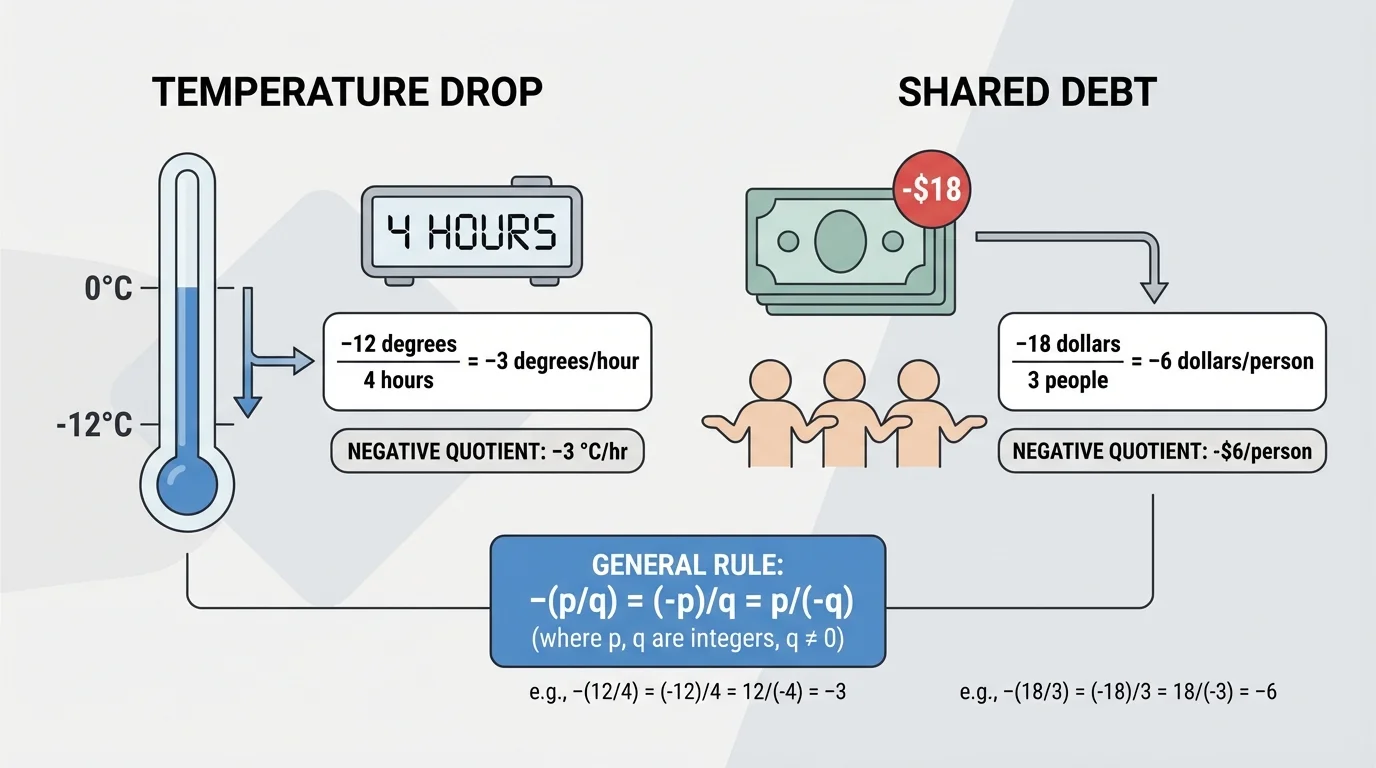
Quotients are not just abstract symbols. They describe real situations involving equal sharing, rates, and changes per unit, as [Figure 3] shows with temperature and debt examples.
If the temperature changes by \(-12\) degrees over \(4\) hours, then the average change each hour is \(\dfrac{-12}{4}=-3\) degrees per hour. The quotient tells the amount of change per hour.
If \(\dfrac{3}{4}\) of a liter of juice is poured equally into \(3\) cups, each cup gets \(\dfrac{3}{4} \div 3 = \dfrac{3}{4} \div \dfrac{3}{1} = \dfrac{3}{4} \times \dfrac{1}{3} = \dfrac{3}{12} = \dfrac{1}{4}\) liter. Here the quotient tells the amount per cup.
Suppose a hiker descends \(\dfrac{5}{2}\) miles in \(\dfrac{1}{2}\) hour. The average rate is \(\dfrac{5}{2} \div \dfrac{1}{2} = 5\) miles per hour. Dividing by a fraction can produce a larger number because you are asking how much happens in one full unit.
In cooking, if \(\dfrac{2}{3}\) cup of flour makes \(4\) small pancakes, then the flour per pancake is \(\dfrac{2}{3} \div 4 = \dfrac{2}{3} \times \dfrac{1}{4} = \dfrac{2}{12} = \dfrac{1}{6}\) cup. The quotient answers a "how much for one?" question.
Looking back at [Figure 3], both examples show the same idea: a quotient can represent an equal share or a unit rate, and the sign tells the direction of the change or whether the amount is a gain or a loss.
Average speed, average cost, and average temperature change all depend on quotients. Every time data is reported "per person," "per item," or "per hour," division is being used.
These contexts help explain why rational numbers matter so much. They let us describe partial amounts and negative amounts accurately in everyday life.
One common mistake is thinking that only fractions like \(\dfrac{3}{4}\) are rational numbers. In fact, integers are rational too because they can be written with denominator \(1\). For example, \(-5 = \dfrac{-5}{1}\).
Another common mistake is moving the negative sign incorrectly. Remember:
\[-\left(\frac{p}{q}\right)=\frac{-p}{q}=\frac{p}{-q},\]
but
\[\frac{-p}{-q}=\frac{p}{q}.\]
A third mistake is forgetting that division by zero is undefined. Expressions like \(\dfrac{7}{0}\) and \(\dfrac{2}{3} \div 0\) do not have values.
Finally, do not confuse a quotient with just a calculator output. Whether the answer is \(2\), \(-3\), \(\dfrac{7}{5}\), or \(1.4\), it is still rational if it can be written as \(\dfrac{p}{q}\) with integers and a nonzero denominator.
"A fraction is not just a piece of a whole; it is also a division waiting to be understood."
That idea ties the whole topic together. Quotients connect fractions, division, integers, and real-world rates into one powerful number system.
