Casinos, sports predictions, and even phone apps that shuffle music all depend on one big idea: if you want to understand chance, you have to know all the possible outcomes. When two chance actions happen together, the number of outcomes grows fast. A coin toss is simple. A coin toss and a die roll is already a compound experiment. The good news is that mathematicians have smart ways to organize all those possibilities so nothing gets missed.
In probability, being organized is not just neatness; it is accuracy. If you leave out outcomes, your probability will be too small. If you count some outcomes twice, your probability will be too large. That is why we use methods such as lists, tables, and tree diagrams to build a complete picture of what can happen.
A sample space is the set of all possible outcomes of a chance experiment. An outcome is one result that can happen. An event is a group of one or more outcomes that match a description. When an experiment has two or more stages, such as flipping a coin and rolling a die, it is a compound experiment.
Sample space means all possible outcomes of an experiment.
Outcome means one possible result.
Event means the set of outcomes that fit a rule or description.
Compound event means an event that combines two or more simple chance processes.
For example, if you roll one standard die, the sample space is \(\{1,2,3,4,5,6\}\). If you roll two dice, the sample space is much larger because each die can show any of the six numbers. We often write outcomes as ordered pairs, such as \((2,5)\), where the first number belongs to the first die and the second number belongs to the second die.
When two actions happen in sequence, the order often matters. If you flip two coins, \((H,T)\) is different from \((T,H)\). They both have one head and one tail, but they happen in a different order. If you roll a red die and then a blue die, \((3,6)\) is different from \((6,3)\).
This is one of the biggest ideas in compound events: each outcome must clearly show what happened first, second, and sometimes third. Good notation keeps the sample space clear.
From earlier probability work, remember that probability compares favorable outcomes to total possible outcomes. Before finding a probability, you need a correct sample space.
If all outcomes are equally likely, then probability can be written as \(\dfrac{\textrm{number of favorable outcomes}}{\textrm{total number of outcomes}}\). To use that correctly, we must first identify every outcome in the sample space and then find which outcomes make up the event.
An organized list is one of the simplest tools for a compound event, and [Figure 1] illustrates how keeping a fixed order prevents mistakes. You choose a pattern and follow it all the way through, instead of writing outcomes randomly.
Suppose the experiment is: flip a coin, then roll a die. Write the coin result first and the die result second. The sample space is:
\[\{(H,1),(H,2),(H,3),(H,4),(H,5),(H,6),(T,1),(T,2),(T,3),(T,4),(T,5),(T,6)\}\]
This list is organized because it keeps the first part fixed for a while. First, list all outcomes that start with \(H\). Then list all outcomes that start with \(T\). Since there are \(2\) coin outcomes and \(6\) die outcomes, there are \(2 \times 6 = 12\) outcomes in all.
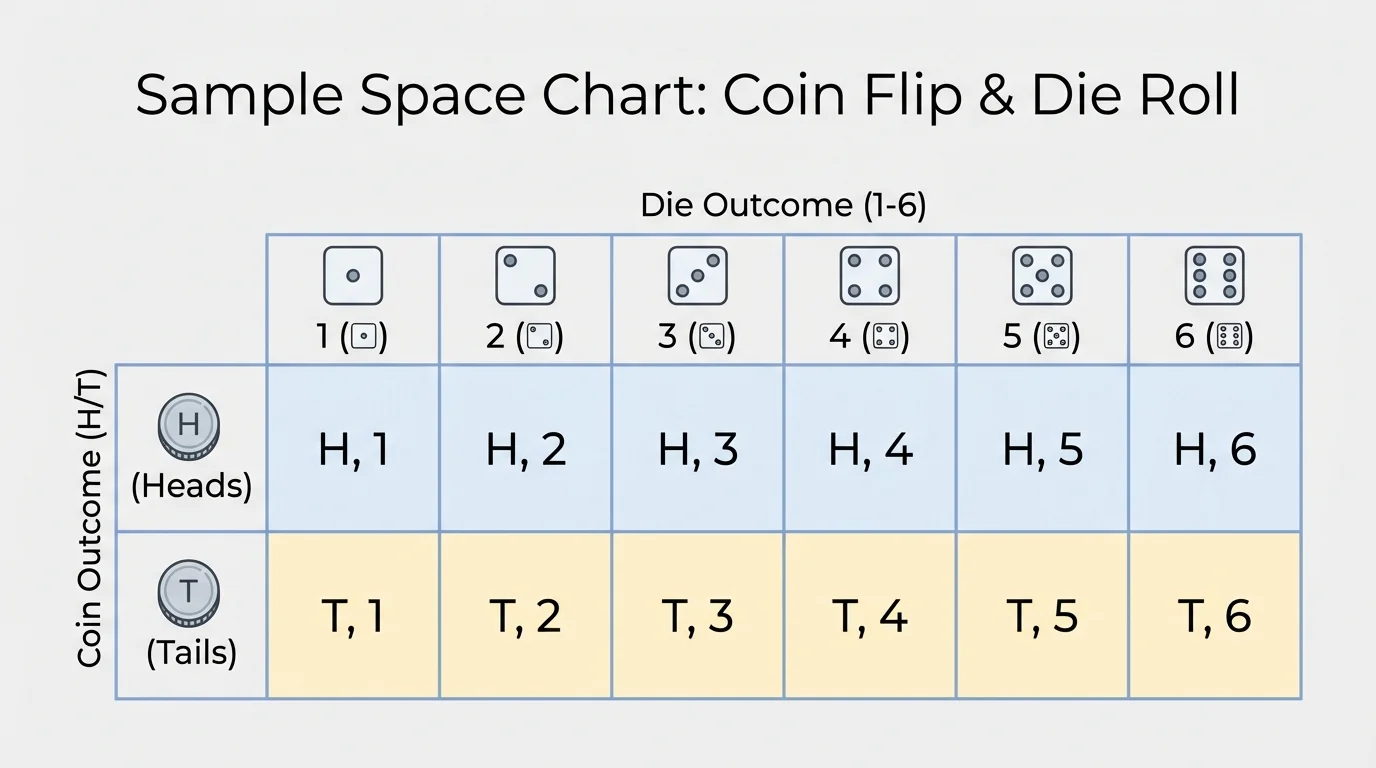
Organized lists work well when the number of outcomes is not too large. They are especially useful when you want to name each outcome carefully. For example, the event "getting a tail and an even number" is made of the outcomes \((T,2)\), \((T,4)\), and \((T,6)\).
Notice that an event is not just a sentence. It is a set of outcomes inside the sample space. Once you can identify those outcomes, you are ready to reason about probability.
A table is excellent for experiments with two parts, especially when each part has several possible results. In a table for two dice, as [Figure 2] shows, rows can represent the first die and columns can represent the second die, making it easy to scan for events such as a sum of \(7\).
If you roll two standard dice, each outcome can be written as an ordered pair \((a,b)\), where \(a\) is the first die and \(b\) is the second die. Since each die has \(6\) possible outcomes, there are \(6 \times 6 = 36\) outcomes total.
| First die | Possible second-die outcomes |
|---|---|
| \(1\) | \((1,1),(1,2),(1,3),(1,4),(1,5),(1,6)\) |
| \(2\) | \((2,1),(2,2),(2,3),(2,4),(2,5),(2,6)\) |
| \(3\) | \((3,1),(3,2),(3,3),(3,4),(3,5),(3,6)\) |
| \(4\) | \((4,1),(4,2),(4,3),(4,4),(4,5),(4,6)\) |
| \(5\) | \((5,1),(5,2),(5,3),(5,4),(5,5),(5,6)\) |
| \(6\) | \((6,1),(6,2),(6,3),(6,4),(6,5),(6,6)\) |
Table 1. Ordered pairs representing the sample space for rolling two dice.
Each cell in a full \(6 \times 6\) table represents one outcome. That is useful because many events can then be picked out by looking for a pattern. For example, the event "rolling double sixes" contains only one outcome: \((6,6)\).
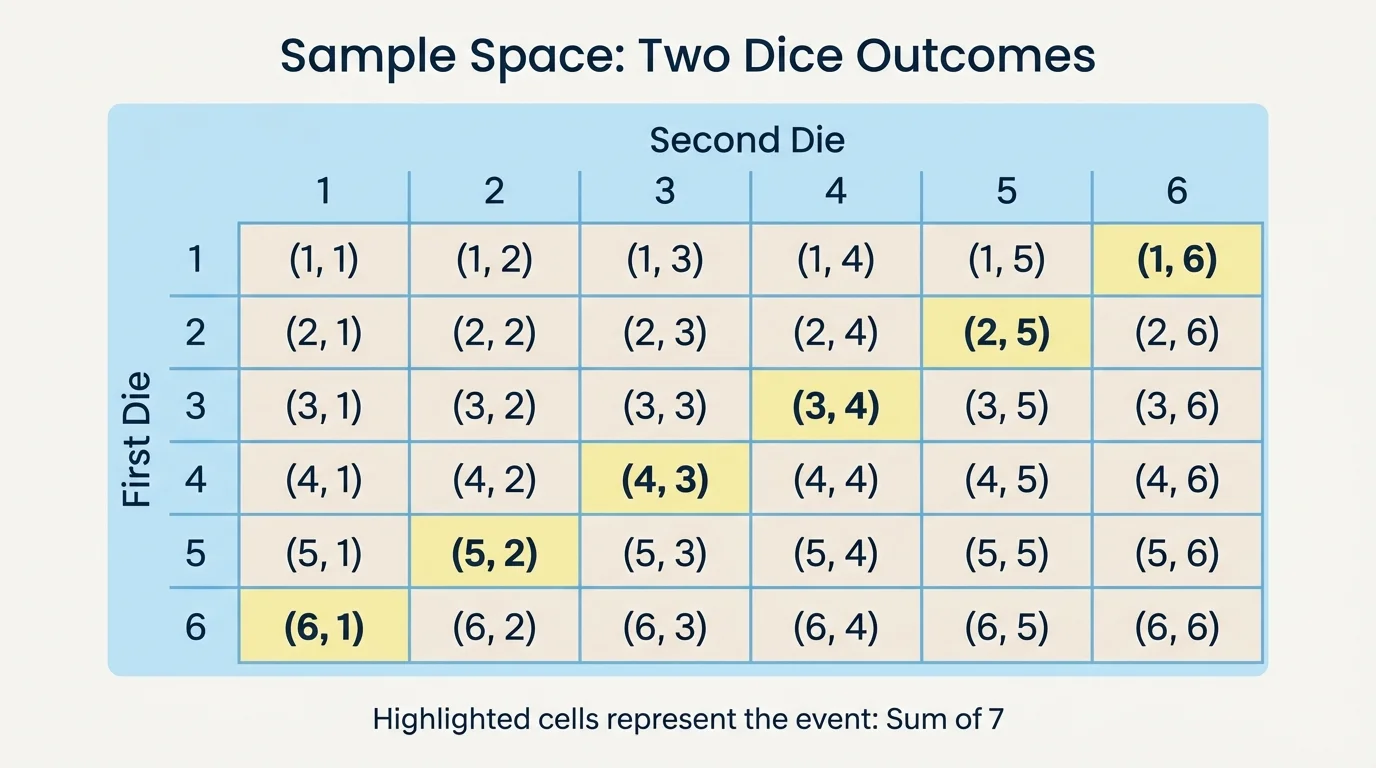
The event "rolling doubles" means both dice show the same number. Its outcomes are \((1,1)\), \((2,2)\), \((3,3)\), \((4,4)\), \((5,5)\), and \((6,6)\). That event has \(6\) outcomes.
The event "sum is \(7\)" contains \((1,6)\), \((2,5)\), \((3,4)\), \((4,3)\), \((5,2)\), and \((6,1)\). These are different ordered pairs, even when they use the same two numbers in a different order. Looking back at [Figure 2], you can see these outcomes form a diagonal pattern across the table.
A tree diagram represents a compound event as a set of branches, and [Figure 3] shows how each path from start to finish makes one complete outcome. This is especially helpful when stages happen in sequence.
Suppose you toss a coin twice. The first toss has two branches: \(H\) and \(T\). From each of those, the second toss also has two branches: \(H\) and \(T\). Following each path gives the sample space:
\[\{(H,H),(H,T),(T,H),(T,T)\}\]
There are \(4\) outcomes because \(2 \times 2 = 4\). A tree diagram shows this clearly by turning each stage into a new set of branches.
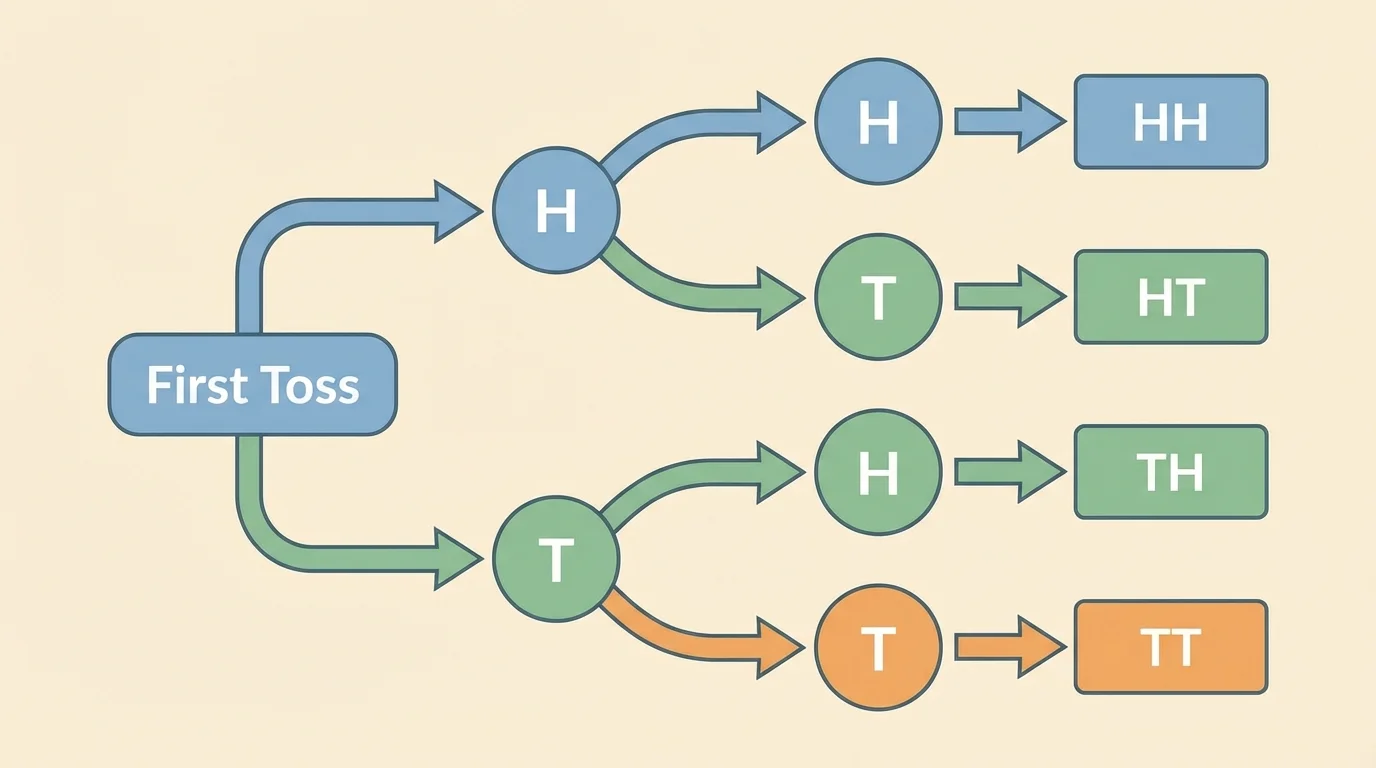
Tree diagrams are useful when the second step depends on the first step or when there are several stages. They help students avoid skipping possibilities because each branch must be completed.
One experiment, many representations
The same sample space can be represented in different ways. A list names outcomes one by one. A table arranges them in rows and columns. A tree diagram shows how outcomes are built step by step. Good mathematicians choose the method that makes the structure easiest to see.
Later, when chance situations become more complex, a tree diagram can also show probabilities on branches. For now, the main job is to represent every outcome exactly once.
Many probability questions are written in ordinary language, not mathematical symbols. Your job is to translate the words into exact outcomes. This is where the sample space becomes powerful.
Take the phrase "rolling double sixes." The word double means both dice show the same number, and sixes means that number is \(6\). So the event is:
\(\{(6,6)\}\)
Now consider "at least one head" when tossing two coins. The sample space is \((H,H)\), \((H,T)\), \((T,H)\), and \((T,T)\). The phrase at least one means one or more. So we include every outcome with at least one \(H\):
\[\{(H,H),(H,T),(T,H)\}\]
Only \((T,T)\) is left out.
The phrase at least one often creates more outcomes than students first expect. It does not mean exactly one; it means one or more.
Another common phrase is "sum less than \(5\)" for two dice. That means add the two numbers and keep the outcomes whose total is \(2\), \(3\), or \(4\). The event is:
\[\{(1,1),(1,2),(2,1),(1,3),(2,2),(3,1)\}\]
You can also translate phrases like "an even number and a tail", "both spinners land on blue", or "one marble is red and the other is blue". In each case, the event is the set of outcomes that fit the words exactly.
Worked examples show how the representation method and the event description fit together. The goal is always the same: build the sample space correctly, then select the outcomes that belong to the event.
Worked example 1: Coin and die
A coin is flipped and a standard die is rolled. List the sample space and identify the event "head and number greater than \(4\)."
Step 1: Write the complete sample space as ordered pairs.
\[\{(H,1),(H,2),(H,3),(H,4),(H,5),(H,6),(T,1),(T,2),(T,3),(T,4),(T,5),(T,6)\}\]
Step 2: Translate the event description.
"Head" means the first part must be \(H\). "Number greater than \(4\)" means the die must show \(5\) or \(6\).
Step 3: Select the matching outcomes.
\[\{(H,5),(H,6)\}\]
The event contains \(2\) outcomes.
This example shows why ordered pairs are useful. The first position tells about the coin, and the second position tells about the die.
Worked example 2: Two dice and everyday language
Two dice are rolled. Identify the event "sum is \(8\)."
Step 1: Think of all ordered pairs \((a,b)\) where \(a+b=8\).
Step 2: List them systematically.
Start with the first die equal to \(2\): \((2,6)\).
Then \((3,5)\), \((4,4)\), \((5,3)\), and \((6,2)\).
Step 3: Write the event as a set.
\[\{(2,6),(3,5),(4,4),(5,3),(6,2)\}\]
The event "sum is \(8\)" has \(5\) outcomes.
Notice that \((2,6)\) and \((6,2)\) are both included because the dice are counted in order. That same idea appears in the two-dice table, as seen earlier in [Figure 2].
Worked example 3: Two coin tosses with a tree diagram
A coin is tossed twice. Identify the event "exactly one head."
Step 1: Write the sample space.
\[\{(H,H),(H,T),(T,H),(T,T)\}\]
Step 2: Interpret the words "exactly one head."
This means one head, not zero heads and not two heads.
Step 3: Choose the matching outcomes.
\[\{(H,T),(T,H)\}\]
The event contains \(2\) outcomes.
The tree diagram from earlier, shown in [Figure 3], makes this event easy to see because the two correct paths end in \((H,T)\) and \((T,H)\).
Worked example 4: Spinner colors
A spinner with colors red, blue, and green is spun twice. Identify the event "both spins are the same color."
Step 1: Write the sample space.
\[\{(R,R),(R,B),(R,G),(B,R),(B,B),(B,G),(G,R),(G,B),(G,G)\}\]
Step 2: Interpret "the same color."
Both positions must match.
Step 3: Select the outcomes.
\[\{(R,R),(B,B),(G,G)\}\]
The event has \(3\) outcomes.
Here the total number of outcomes is \(3 \times 3 = 9\). This shows that the multiplication idea often helps check whether your sample space is complete.
One common mistake is forgetting that order matters. For two dice, some students write \((1,6)\) but forget \((6,1)\). If the dice are treated as first die and second die, these are different outcomes.
Another mistake is using an unsystematic list. Randomly written outcomes are more likely to miss possibilities. An organized list, table, or tree diagram gives a pattern you can follow.
A third mistake is misunderstanding phrases. At least one does not mean exactly one. Both means the condition must happen in every part. Double sixes means one very specific ordered pair, \((6,6)\), not any outcome containing a \(6\).
| Phrase | Meaning | Example outcome set idea |
|---|---|---|
| at least one | \(1\) or more | include all outcomes with the condition appearing once or more |
| exactly one | only \(1\) | include outcomes with the condition once, but not twice |
| both | in every part | for two coins, both heads means only \((H,H)\) |
| sum of \(7\) | add the two numbers to get \(7\) | \((1,6),(2,5),(3,4),(4,3),(5,2),(6,1)\) |
| doubles | same result in both parts | \((1,1),(2,2),...,(6,6)\) |
Table 2. Common probability phrases and how to interpret them in a sample space.
Sample spaces are not just classroom tools. They are used whenever people need to understand combinations of outcomes. Game designers test whether a game is fair. Weather forecasters study combinations of conditions. Engineers test systems with several possible states. Scientists use computer simulations to imitate many outcomes when the sample space is large.
Suppose a video game has two random features: weather can be sunny, rainy, or snowy, and the player can start with one of four tools. The sample space has \(3 \times 4 = 12\) outcomes. Designers may study events such as "snowy and advanced tool" to see how often a difficult start happens.
"Chance favors the prepared mind."
— Louis Pasteur
That quote fits probability well. Chance may be unpredictable in a single trial, but careful organization lets us understand the full set of possibilities. Whether you use a list, a table, or a tree diagram, the goal stays the same: represent the sample space completely and identify the outcomes that make up an event.
