A surprising fact about right triangles is that two different trigonometric functions can give the same value for complementary angles. For example, \(\sin 30^\circ\) and \(\cos 60^\circ\) are equal, even though they involve different functions and different angles. That is not a coincidence. It comes from the structure of every right triangle and from the way its two acute angles are connected.
When engineers design ramps, when surveyors estimate heights, and when a ladder leans against a wall, right triangles appear naturally. In those situations, measuring one acute angle often tells you something about the other one immediately. Understanding that connection makes trigonometry faster, more flexible, and more powerful.
In a right triangle, one angle is always \(90^\circ\). Since the angles in any triangle add to \(180^\circ\), the other two angles must add to \(90^\circ\). Two angles that add to \(90^\circ\) are called complementary angles.
This means that if one acute angle in a right triangle is \(35^\circ\), the other must be \(55^\circ\). If one is \(12^\circ\), the other must be \(78^\circ\). Right away, that creates a strong connection between the trig ratios of those two angles.
You should already know that a right triangle has one \(90^\circ\) angle, and the side opposite that angle is the hypotenuse, the longest side of the triangle.
To understand the relationship fully, we first review how sine and cosine are defined.
For an acute angle in a right triangle, the sine of the angle compares the length of the opposite side to the length of the hypotenuse. The cosine of the angle compares the length of the adjacent side to the length of the hypotenuse.
Sine and cosine in a right triangle
For an acute angle \(\theta\):
\[\sin \theta = \frac{\textrm{opposite}}{\textrm{hypotenuse}}\]
\[\cos \theta = \frac{\textrm{adjacent}}{\textrm{hypotenuse}}\]
The words opposite and adjacent depend on which acute angle you are talking about.
As [Figure 1] helps show, this last idea is crucial. A side that is opposite one acute angle is adjacent to the other acute angle. The hypotenuse is the only side whose role does not change.
That shift in side names is exactly why sine and cosine are linked for complementary angles.
Consider a right triangle with acute angles \(\theta\) and \(90^\circ - \theta\). These two angles are in the same triangle, so they share the same hypotenuse, and the two shorter sides switch roles depending on which angle you choose.
If a side is opposite \(\theta\), then that same side is adjacent to \(90^\circ - \theta\). Likewise, the side adjacent to \(\theta\) becomes the side opposite \(90^\circ - \theta\). This simple switch is the key to the whole relationship.
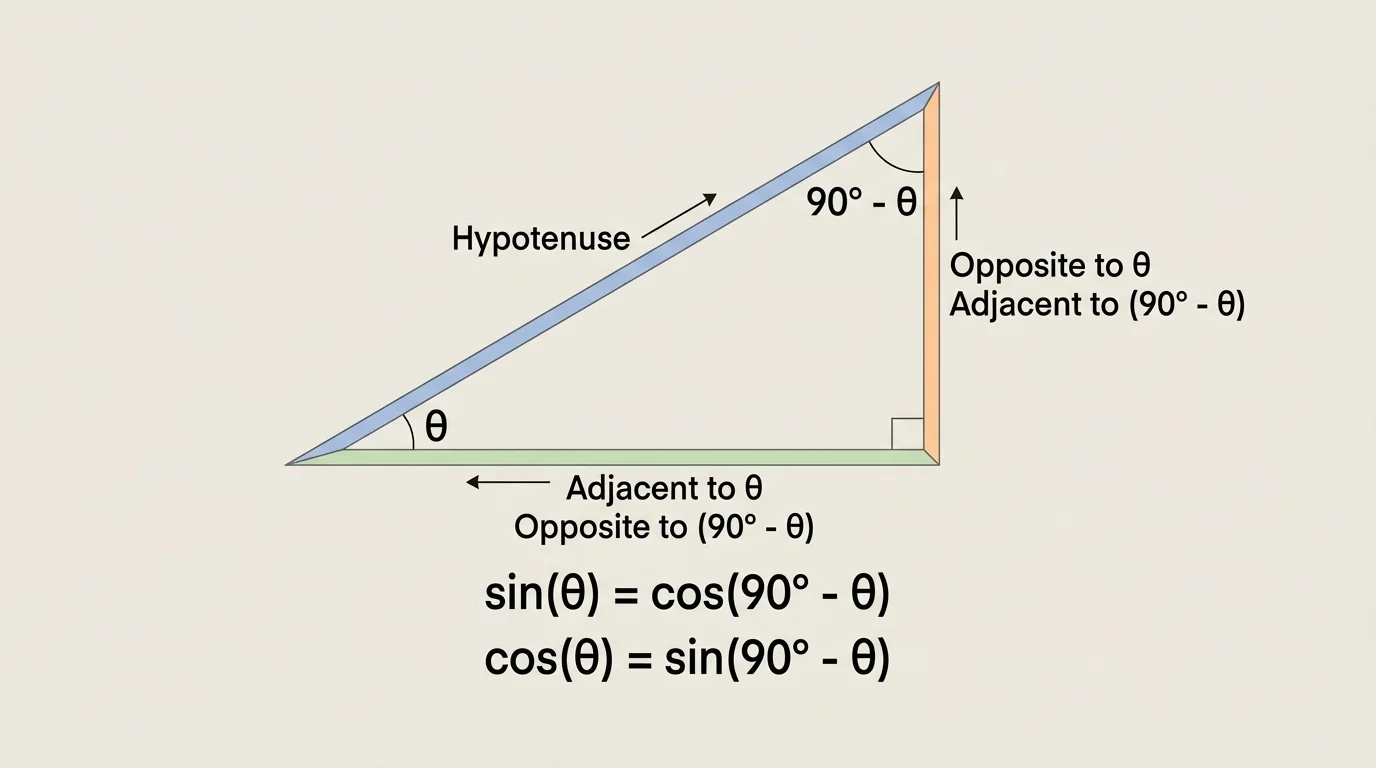
Suppose the triangle has legs of lengths \(a\) and \(b\), and hypotenuse \(c\). Relative to angle \(\theta\), one leg may be opposite and the other adjacent. Relative to the complementary angle, those names reverse. The triangle itself has not changed at all; only your point of view has changed.
This is one of the most elegant ideas in geometry: one figure can produce two apparently different ratios that are actually equal because the same side lengths are compared relative to different angles.
The complementary angles relationship, illustrated in [Figure 2], is often called a cofunction identity. The opposite side for one acute angle becomes the adjacent side for its complement.
If the two acute angles are \(\theta\) and \(90^\circ - \theta\), then
\[\sin \theta = \cos(90^\circ - \theta)\]
and
\[\cos \theta = \sin(90^\circ - \theta)\]
Why is this true? Start with \(\sin \theta\). By definition, \(\sin \theta = \dfrac{\textrm{opposite to }\theta}{\textrm{hypotenuse}}\). But that same side is adjacent to \(90^\circ - \theta\), so \(\dfrac{\textrm{opposite to }\theta}{\textrm{hypotenuse}} = \dfrac{\textrm{adjacent to }(90^\circ - \theta)}{\textrm{hypotenuse}}\). That is exactly \(\cos(90^\circ - \theta)\).
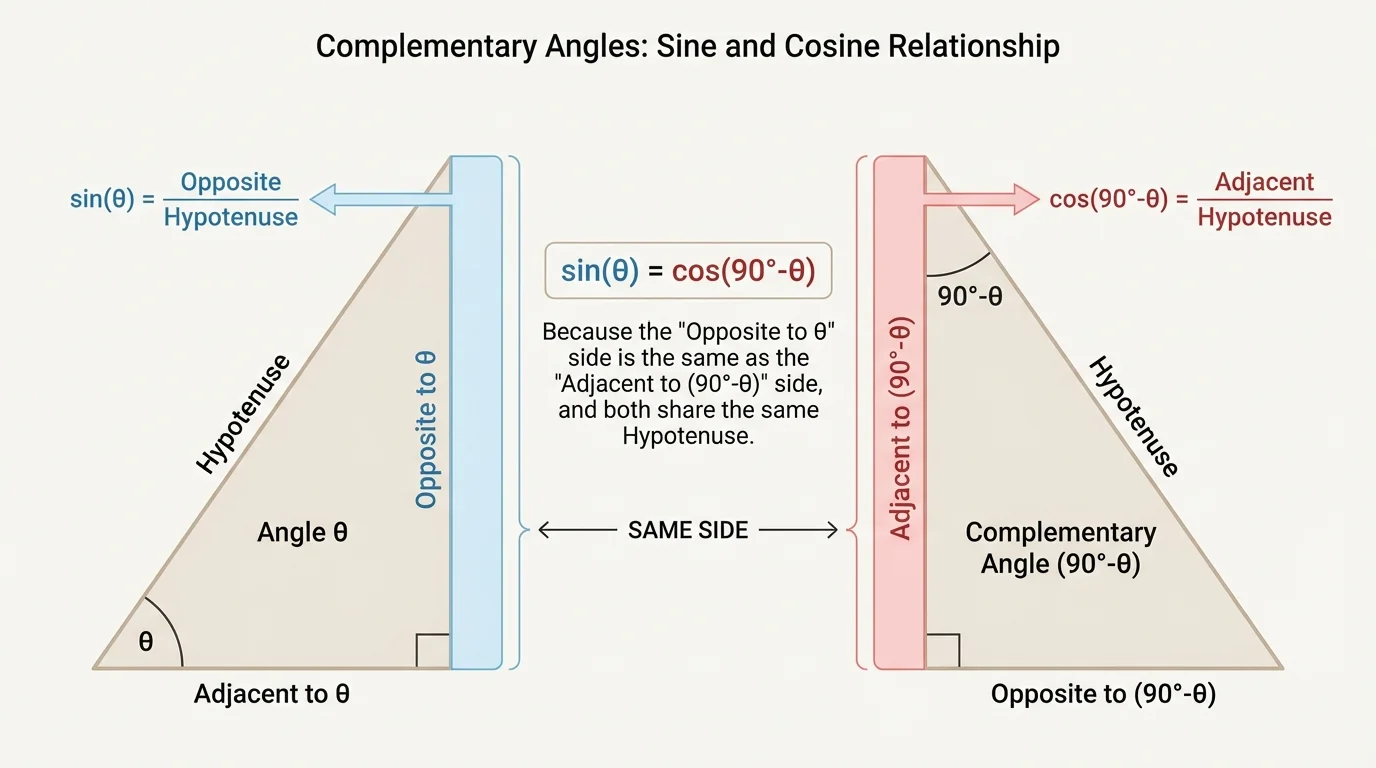
Using the same idea in reverse gives the second identity: the adjacent side for \(\theta\) is the opposite side for \(90^\circ - \theta\), so \(\cos \theta = \sin(90^\circ - \theta)\).
You can test this with familiar angle pairs:
| Angle pair | Sine value | Matching cosine value |
|---|---|---|
| \(30^\circ\) and \(60^\circ\) | \(\sin 30^\circ = \dfrac{1}{2}\) | \(\cos 60^\circ = \dfrac{1}{2}\) |
| \(45^\circ\) and \(45^\circ\) | \(\sin 45^\circ = \dfrac{\sqrt{2}}{2}\) | \(\cos 45^\circ = \dfrac{\sqrt{2}}{2}\) |
| \(20^\circ\) and \(70^\circ\) | \(\sin 20^\circ\) | \(\cos 70^\circ\) |
Table 1. Examples showing that the sine of an angle matches the cosine of its complementary angle.
Even when you do not know the exact decimal value, the identity still holds. For instance, \(\sin 17^\circ = \cos 73^\circ\), because \(17^\circ + 73^\circ = 90^\circ\).
Why the relationship is so useful
Sometimes a problem gives you one acute angle but your equation uses the other. The complementary-angle identities let you switch between sine and cosine without changing the value. That can simplify calculations and help you recognize equivalent expressions.
This relationship also explains why many trig tables and calculator results look paired. As we saw in [Figure 1], the geometry of the triangle forces the match; it is not just a pattern to memorize.
Once you know the identities, you can rewrite expressions quickly. If you see \(\sin 28^\circ\), you can also think of it as \(\cos 62^\circ\). If you see \(\cos 14^\circ\), you can rewrite it as \(\sin 76^\circ\).
This is especially helpful in right-triangle problems. Sometimes the side lengths you know fit a cosine ratio more naturally than a sine ratio, but the angle in the problem is the complement of the one you first thought to use. Instead of starting over, you can switch functions using the complementary-angle relationship.
Solved example 1
Find \(\cos 58^\circ\) using a complementary-angle relationship.
Step 1: Find the complement of \(58^\circ\).
\(90^\circ - 58^\circ = 32^\circ\)
Step 2: Use the identity \(\cos \theta = \sin(90^\circ - \theta)\).
\(\cos 58^\circ = \sin 32^\circ\)
The equivalent expression is
\[\cos 58^\circ = \sin 32^\circ\]
Notice that nothing was approximated. We simply rewrote one trig value as another equal trig value.
Solved example 2
Given that \(\sin x = 0.8\) and \(x\) is acute, find \(\cos(90^\circ - x)\).
Step 1: Recall the complementary-angle identity.
\(\sin x = \cos(90^\circ - x)\)
Step 2: Substitute the given value.
Since \(\sin x = 0.8\), it follows that \(\cos(90^\circ - x) = 0.8\).
So the value is
\[\cos(90^\circ - x) = 0.8\]
This kind of reasoning appears often in algebra, trigonometry, and later calculus, where recognizing equivalent expressions saves time and reduces mistakes.
Solved example 3
A right triangle has one acute angle measuring \(37^\circ\). The hypotenuse is \(10\), and the side adjacent to the \(37^\circ\) angle is \(8\). Use the complementary-angle relationship to find the sine of the other acute angle.
Step 1: Find the other acute angle.
\(90^\circ - 37^\circ = 53^\circ\)
Step 2: Use the identity \(\sin 53^\circ = \cos 37^\circ\).
Step 3: Compute \(\cos 37^\circ\) from the triangle.
\(\cos 37^\circ = \dfrac{\textrm{adjacent}}{\textrm{hypotenuse}} = \dfrac{8}{10} = 0.8\)
Therefore,
\[\sin 53^\circ = 0.8\]
This example shows how a side ratio for one angle becomes a different trig ratio for the complementary angle without needing any new side lengths.
Some complementary pairs are used so often that they are worth knowing well. The pair \(30^\circ\) and \(60^\circ\) appears in equilateral-triangle geometry, and \(45^\circ\) and \(45^\circ\) appears in isosceles right triangles.
Because \(30^\circ\) and \(60^\circ\) are complementary, \(\sin 30^\circ = \cos 60^\circ\) and \(\cos 30^\circ = \sin 60^\circ\). Since \(\sin 30^\circ = \dfrac{1}{2}\), we also know \(\cos 60^\circ = \dfrac{1}{2}\). Since \(\cos 30^\circ = \dfrac{\sqrt{3}}{2}\), we also know \(\sin 60^\circ = \dfrac{\sqrt{3}}{2}\).
For \(45^\circ\), the complement is also \(45^\circ\), so sine and cosine are equal:
\[\sin 45^\circ = \cos 45^\circ = \frac{\sqrt{2}}{2}\]
Radar systems, GPS calculations, and 3D graphics all rely on trigonometric relationships. A small identity such as \(\sin \theta = \cos(90^\circ - \theta)\) becomes part of much larger systems that model direction, slope, and rotation.
These exact-value pairs help you spot equivalent expressions quickly during algebraic simplification and equation solving.
One common mistake is to think that \(\sin \theta = \cos \theta\) for every angle. That is not true. The correct statement is that \(\sin \theta = \cos(90^\circ - \theta)\). The angle must change to its complement.
Another common mistake is forgetting that adjacent side and opposite side are defined relative to a specific angle. In the same triangle, one leg can be opposite one acute angle and adjacent to the other. As shown earlier in [Figure 2], this switch is the whole reason the identity works.
A third mistake is subtracting from the wrong number. To find a complement, subtract from \(90^\circ\), not \(180^\circ\). Subtracting from \(180^\circ\) gives a supplementary angle, which is a different idea.
Solved example 4
Decide whether the statement \(\sin 25^\circ = \cos 25^\circ\) is true or false.
Step 1: Recall the identity.
\(\sin \theta = \cos(90^\circ - \theta)\)
Step 2: Find the complement of \(25^\circ\).
\(90^\circ - 25^\circ = 65^\circ\)
Step 3: Compare correctly.
\(\sin 25^\circ = \cos 65^\circ\), not \(\cos 25^\circ\).
The statement is
\[\textrm{false}\]
Being precise about the angle is just as important as being precise about the function.
In practical geometry, complementary-angle trig appears whenever a right triangle is formed and two angle viewpoints describe the same object.
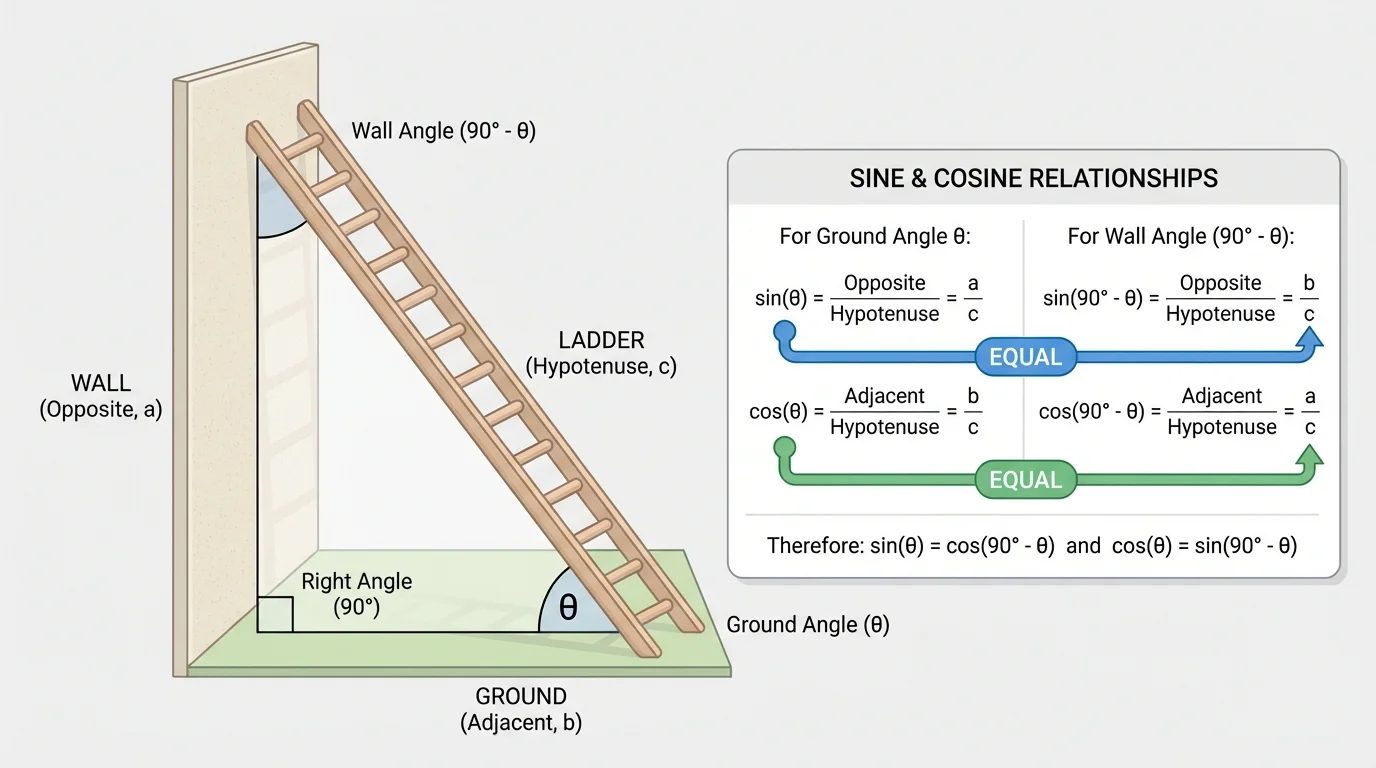
[Figure 3] In a ladder problem, for example, the angle between the ladder and the ground and the angle between the ladder and the wall are complementary.
If you know the ladder makes a \(68^\circ\) angle with the ground, then it makes a \(22^\circ\) angle with the wall. The height the ladder reaches can be described either with \(\sin 68^\circ\) using the ground angle or with \(\cos 22^\circ\) using the wall angle. Those values are equal because the angles are complementary.
The same idea appears in roof design. A roof slope may be given as an angle from the horizontal, while a support beam may be analyzed using the angle from the vertical. Those two acute angles are complementary, so sine and cosine switch naturally.
Surveyors and builders also use this relationship when measuring heights indirectly. If the angle of elevation from the ground is known, then the angle from the vertical line at the object is its complement. Depending on which side lengths are easier to compare, either sine or cosine can be the simpler choice.
Even in sports, camera placement and ball trajectories can create right triangles where one analyst uses the angle from the ground and another uses the angle from a vertical line. The geometry remains the same, so the trigonometric values connect through complementary angles.
The sine-cosine relationship is part of a broader family of trigonometric connections. At a more advanced level, students learn additional cofunction identities, but the core geometric idea is already here: in a right triangle, the two acute angles are linked because they complete the \(90^\circ\) angle together.
You can think of sine and cosine as partner functions. They are not identical, but they mirror each other across complementary angles. If one function describes the ratio from one acute angle's viewpoint, the other function describes the same ratio from the other acute angle's viewpoint.
That is why this relationship belongs naturally in geometry, similarity, and right-triangle trigonometry. It is not only a rule to memorize; it is a consequence of how triangles are built.
