A pilot approaching a runway, an engineer designing a wheelchair ramp, and a person measuring the height of a tree from the ground all rely on the same surprising fact: if a right triangle keeps the same acute angle, its side lengths can change, but their ratios stay fixed. That simple idea turns geometry into a powerful measuring tool. Instead of climbing a tree or directly measuring a distant building, you can use angles and ratios to figure out lengths you cannot easily reach.
Start with a right triangle. It always has one angle of \(90^\circ\), so the other two angles must add up to \(90^\circ\). If you create several right triangles that all share one acute angle, then the third angle is forced to be the same too. That means the triangles have the same angle measures, so they have the same shape. In geometry, triangles with the same shape are called similar triangles.
When triangles are similar, corresponding side lengths are proportional. For example, if one triangle is an enlarged version of another by a scale factor of \(2\), then every side is doubled. If the scale factor is \(3\), every side is tripled. But ratios such as \(\dfrac{\textrm{leg}}{\textrm{hypotenuse}}\) do not change. As [Figure 1] shows, this is the key reason trigonometric ratios work: they depend on the angle, not on the triangle's overall size.
Two triangles are similar if their corresponding angles are equal and their corresponding sides are proportional. In right triangles, if one acute angle matches, then the other acute angle also matches because the angles must total \(180^\circ\).
Suppose one right triangle has side lengths \(3\), \(4\), and \(5\), and a larger similar triangle has side lengths \(6\), \(8\), and \(10\). The second triangle is just a scale copy of the first, so the ratios match:
\(\dfrac{3}{5} = \dfrac{6}{10}\) and \(\dfrac{4}{5} = \dfrac{8}{10}\).
That means if a certain acute angle appears in both triangles, the ratio of a corresponding leg to the hypotenuse is the same in both. Enlarging or shrinking the triangle changes the side lengths but preserves the angle measures and the side ratios tied to those angles.
This is one of the most important ideas in geometry: some properties depend on size, but others depend only on shape. Trigonometric ratios belong to the second category. They are properties of angles.
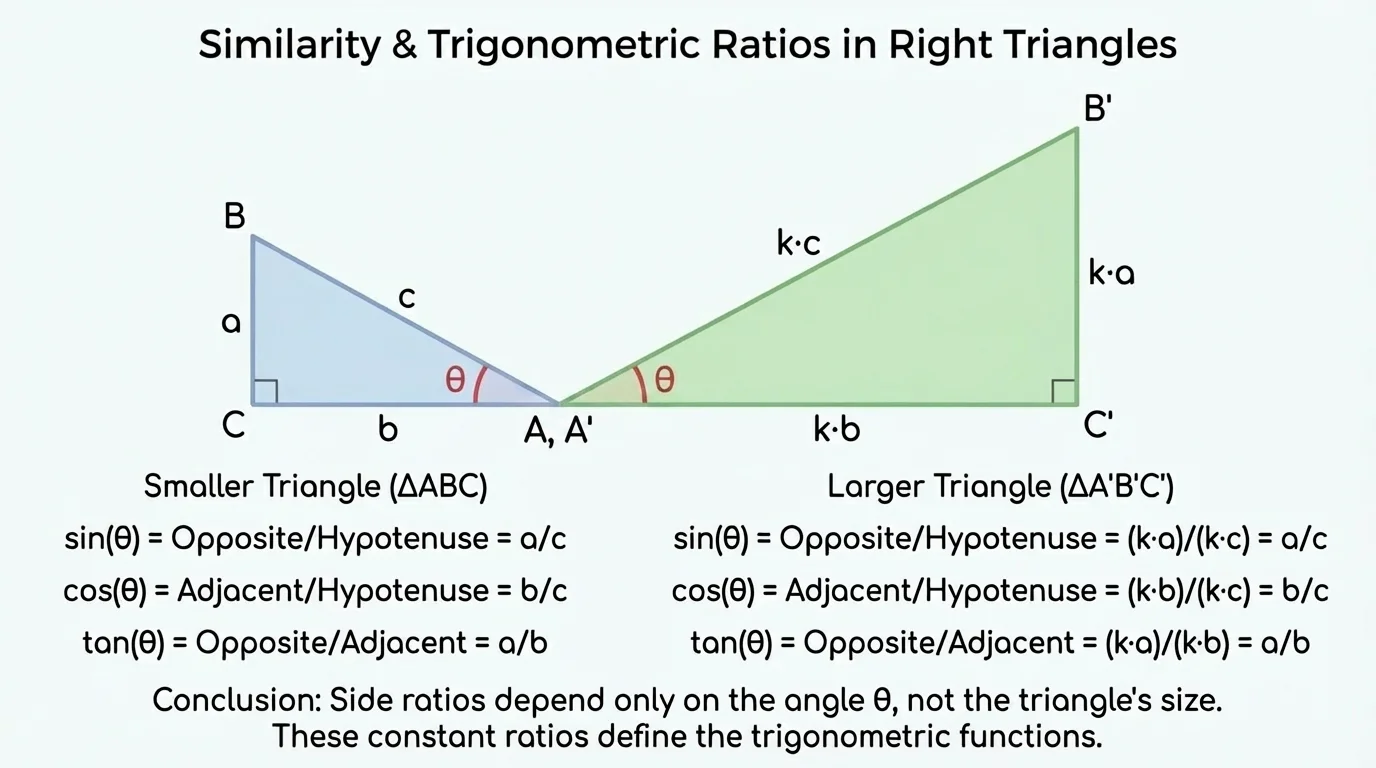
Consider two right triangles, each with an acute angle of \(35^\circ\). Because both have a right angle and a \(35^\circ\) angle, their third angle must be \(55^\circ\). So the triangles are similar. If in the smaller triangle the side opposite the \(35^\circ\) angle is \(7\) and the hypotenuse is \(12.2\), while in the larger triangle the opposite side is \(14\) and the hypotenuse is \(24.4\), then
\(\dfrac{7}{12.2} = \dfrac{14}{24.4}\).
The value of this ratio is about \(0.574\). That number is not an accident. Any right triangle with a \(35^\circ\) angle will have approximately the same ratio of opposite side to hypotenuse. Later, this fixed ratio is named using trigonometry.
We can make the same statement for other pairs of sides. For the same angle, the ratio of adjacent side to hypotenuse is constant, and the ratio of opposite side to adjacent side is also constant. In other words, one acute angle determines several special ratios.
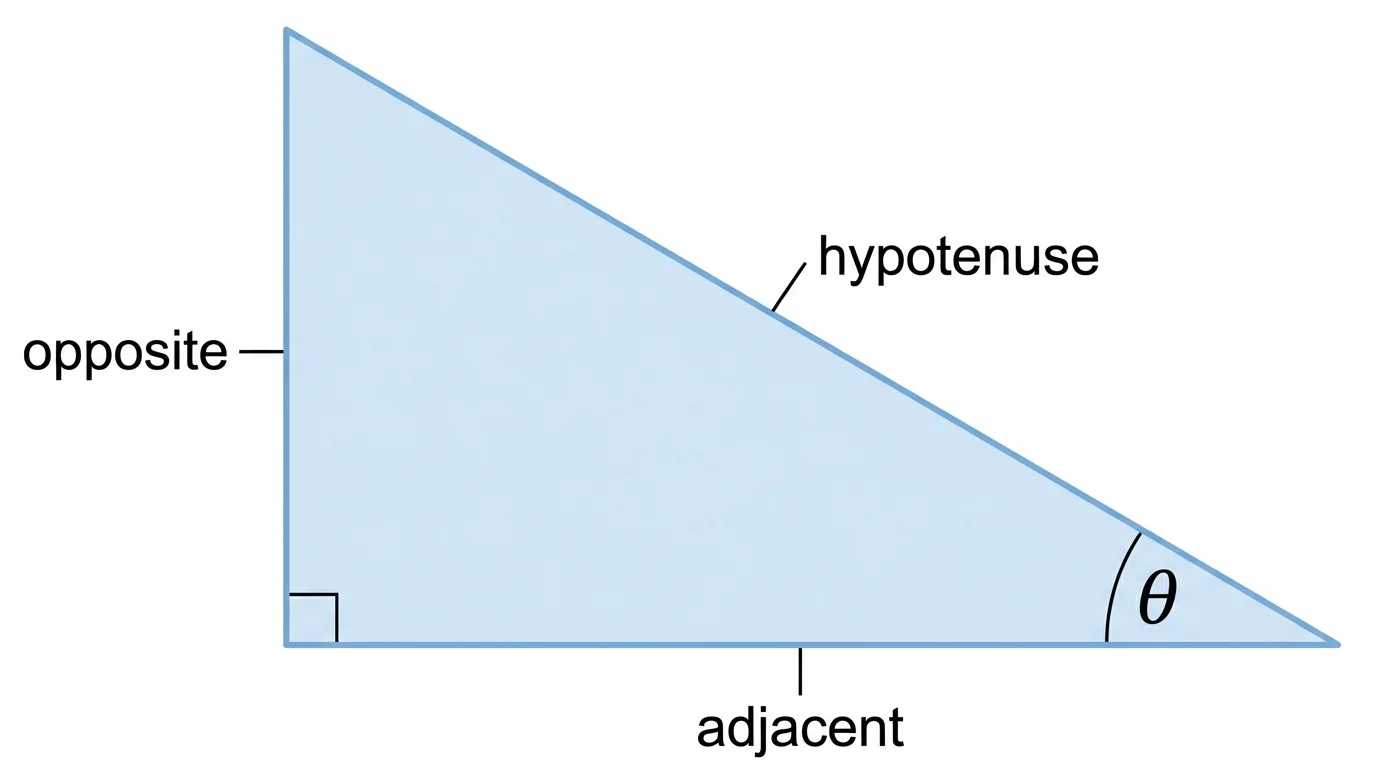
Before defining the ratios, we need precise names for the sides. As [Figure 2] shows, in a right triangle, the side opposite the right angle is always the hypotenuse. It is the longest side.
For one chosen acute angle, the side directly across from that angle is called the opposite side, and the leg next to that angle is called the adjacent side. These labels depend on which acute angle you are talking about. The same side can be adjacent for one acute angle and opposite for the other.
Hypotenuse: the side opposite the right angle in a right triangle.
Opposite side: the side across from the chosen acute angle.
Adjacent side: the leg next to the chosen acute angle that is not the hypotenuse.
Suppose a right triangle has acute angles \(A\) and \(B\). A leg that is opposite \(A\) will be adjacent to \(B\). This switching is important because trigonometric ratios always depend on a reference angle, the specific acute angle you choose.
If students mix up opposite and adjacent, nearly every later calculation becomes wrong. So always identify the chosen angle first, then name the sides from that angle's point of view.
Because side ratios stay constant for similar right triangles, mathematicians give names to the most useful ones. These are the basic trigonometric ratios for an acute angle \(\theta\):
\[\sin(\theta) = \frac{\textrm{opposite}}{\textrm{hypotenuse}}\]
\[\cos(\theta) = \frac{\textrm{adjacent}}{\textrm{hypotenuse}}\]
\[\tan(\theta) = \frac{\textrm{opposite}}{\textrm{adjacent}}\]
Sine, cosine, and tangent are not random formulas. Each one comes directly from similarity. If many right triangles all contain the same acute angle \(\theta\), then each ratio above has the same value in every one of those triangles.
For example, if \(\theta = 30^\circ\), then \(\sin(30^\circ) = \dfrac{1}{2}\). That means in every right triangle with a \(30^\circ\) angle, the opposite side is half the hypotenuse. If the hypotenuse is \(10\), the opposite side is \(5\). If the hypotenuse is \(24\), the opposite side is \(12\).
Angle-based ratios
Trigonometric ratios are best understood as properties of an angle, not as properties of one specific triangle. A triangle may be tiny, huge, steep, or shallow, but if one acute angle has the same measure, then the ratios connected to that angle stay the same. This is why a calculator can give a value such as \(\sin(40^\circ)\) without knowing any side lengths first.
Many students use a memory pattern such as \(\textrm{SOH-CAH-TOA}\): sine is opposite over hypotenuse, cosine is adjacent over hypotenuse, and tangent is opposite over adjacent. The memory aid is helpful, but the real reason these ratios matter is that they come from similar triangles.
Once you know an angle and one side length, you can often find another side by choosing the ratio that connects the known and unknown sides.
Worked example 1
A right triangle has an acute angle of \(40^\circ\) and a hypotenuse of \(12\). Find the length of the side opposite the \(40^\circ\) angle.
Step 1: Choose the correct ratio.
The opposite side and hypotenuse are involved, so use sine:
\(\sin(40^\circ) = \dfrac{\textrm{opposite}}{12}\).
Step 2: Solve for the opposite side.
Multiply both sides by \(12\):
\(\textrm{opposite} = 12\sin(40^\circ)\).
Step 3: Approximate the value.
Using a calculator, \(\sin(40^\circ) \approx 0.643\).
So \(\textrm{opposite} \approx 12(0.643) = 7.716\).
Therefore, the opposite side is approximately \(7.7\).
The result makes sense because the opposite side must be shorter than the hypotenuse. Estimating whether an answer is reasonable is a powerful habit in trigonometry.
Worked example 2
A right triangle has an acute angle of \(28^\circ\) and an adjacent side of \(15\). Find the hypotenuse.
Step 1: Choose the ratio.
Adjacent side and hypotenuse suggest cosine:
\(\cos(28^\circ) = \dfrac{15}{h}\).
Step 2: Solve for \(h\).
Multiply both sides by \(h\): \(h\cos(28^\circ) = 15\).
Then divide by \(\cos(28^\circ)\): \(h = \dfrac{15}{\cos(28^\circ)}\).
Step 3: Compute the value.
Since \(\cos(28^\circ) \approx 0.883\),
\(h \approx \dfrac{15}{0.883} \approx 16.99\).
The hypotenuse is approximately \(17.0\).
Notice that the hypotenuse came out larger than the leg, which is exactly what should happen in a right triangle.
Worked example 3
A right triangle has an acute angle of \(53^\circ\) and an adjacent side of \(9\). Find the opposite side.
Step 1: Choose the ratio.
Opposite side and adjacent side suggest tangent:
\(\tan(53^\circ) = \dfrac{\textrm{opposite}}{9}\).
Step 2: Solve for the opposite side.
\(\textrm{opposite} = 9\tan(53^\circ)\).
Step 3: Approximate.
Since \(\tan(53^\circ) \approx 1.327\),
\(\textrm{opposite} \approx 9(1.327) = 11.943\).
The opposite side is approximately \(11.9\).
Trigonometric ratios also work in reverse. If you know a ratio of side lengths, you can determine the angle. This uses inverse trigonometric functions, often written as \(\sin^{-1}\), \(\cos^{-1}\), and \(\tan^{-1}\).
At this level, it is enough to understand that an inverse trigonometric function answers a question like this: "What angle has this sine, cosine, or tangent value?"
Worked example 4
A right triangle has an opposite side of \(8\) and an adjacent side of \(6\) for an acute angle \(\theta\). Find \(\theta\).
Step 1: Choose the ratio.
Opposite and adjacent suggest tangent:
\(\tan(\theta) = \dfrac{8}{6} = \dfrac{4}{3}\).
Step 2: Use the inverse operation.
\(\theta = \tan^{-1}\left(\dfrac{4}{3}\right)\).
Step 3: Approximate the angle.
\(\theta \approx 53.1^\circ\).
So the angle is approximately \(53.1^\circ\).
If you know one acute angle in a right triangle, you also know the other because the two acute angles add to \(90^\circ\). So if one angle is \(53.1^\circ\), the other is \(36.9^\circ\).
Because the two acute angles in a right triangle are complementary, sine and cosine are closely connected. If one acute angle is \(\theta\), then the other is \(90^\circ - \theta\). The side opposite one angle is adjacent to the other. This leads to the relationship
\[\sin(\theta) = \cos(90^\circ - \theta)\]
and similarly
\[\cos(\theta) = \sin(90^\circ - \theta)\]
This matches what we noticed earlier about side names switching when the reference angle changes, as seen in [Figure 2].
Some trig values come from special right triangles that appear often in geometry.
| Triangle | Angle | Sine | Cosine | Tangent |
|---|---|---|---|---|
| \(45^\circ\textrm{-}45^\circ\textrm{-}90^\circ\) | \(45^\circ\) | \(\dfrac{\sqrt{2}}{2}\) | \(\dfrac{\sqrt{2}}{2}\) | \(1\) |
| \(30^\circ\textrm{-}60^\circ\textrm{-}90^\circ\) | \(30^\circ\) | \(\dfrac{1}{2}\) | \(\dfrac{\sqrt{3}}{2}\) | \(\dfrac{\sqrt{3}}{3}\) |
| \(30^\circ\textrm{-}60^\circ\textrm{-}90^\circ\) | \(60^\circ\) | \(\dfrac{\sqrt{3}}{2}\) | \(\dfrac{1}{2}\) | \(\sqrt{3}\) |
Table 1. Common trigonometric ratios for angles from special right triangles.
These values are useful because they can be found exactly without a calculator. They also reinforce the idea that trig ratios depend on angles.
Surveyors have used triangle-based measurement for centuries to find distances that are hard to measure directly. Long before lasers and drones, angle measurements and proportional reasoning made it possible to map land and estimate heights.
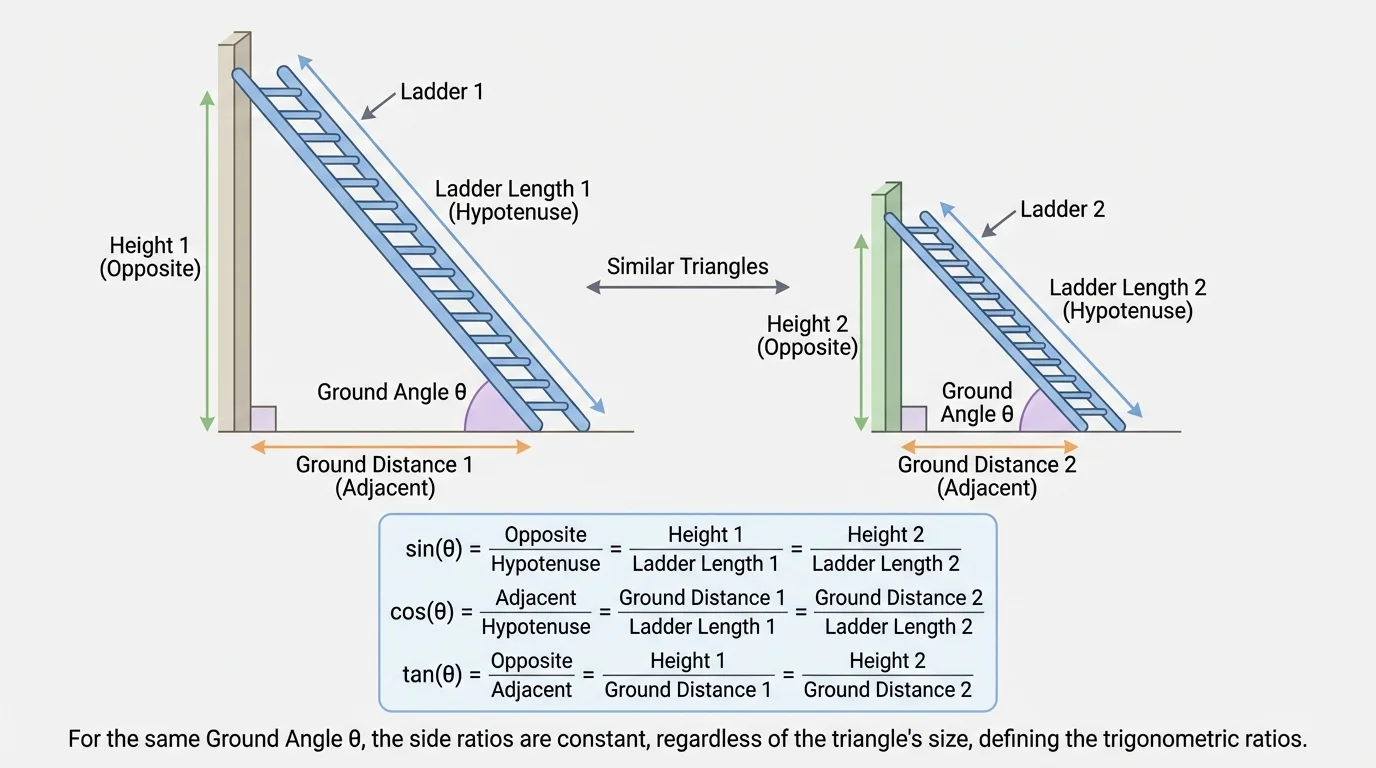
As [Figure 3] shows, right-triangle trigonometry appears whenever a slanted line, a horizontal distance, and a vertical height form a triangle. A ladder against a wall, a wheelchair ramp, a drone rising from the ground, or the line of sight to the top of a building all create this structure. In the ladder situation, the wall is a vertical side, the ground is a horizontal side, and the ladder is the hypotenuse.
If a ladder of length \(20\) feet makes an angle of \(65^\circ\) with the ground, the height it reaches is the side opposite the angle. So
\(\sin(65^\circ) = \dfrac{h}{20}\), which gives \(h = 20\sin(65^\circ) \approx 18.1\).
That means the ladder reaches about \(18.1\) feet up the wall.
Ramps are another important application. Safety rules often limit how steep a ramp may be. If a ramp rises \(1\) meter over a horizontal run of \(12\) meters, then the angle \(\theta\) satisfies \(\tan(\theta) = \dfrac{1}{12}\). So \(\theta \approx \tan^{-1}(\dfrac{1}{12}) \approx 4.8^\circ\). Small angles can still create meaningful elevation changes over long distances.
Engineers, architects, and pilots use these ideas constantly. A pilot might use angle and distance information to determine a descent path. An architect might calculate roof pitch. A cell phone's sensors even rely on angle-based mathematics related to orientation and motion.
The same logic from similar triangles still drives all these situations. As with the ladder in [Figure 3], once the angle is known, the side ratios are fixed, so missing lengths can be calculated instead of measured directly.
One common mistake is forgetting that opposite and adjacent depend on the chosen angle. Always mark the angle first. Then identify the hypotenuse. Only after that should you decide which remaining side is opposite and which is adjacent.
Another common mistake is choosing the wrong ratio. If you know the opposite side and need the hypotenuse, use sine. If you know the adjacent side and need the hypotenuse, use cosine. If you are comparing the two legs, use tangent.
A third mistake is calculator mode. If your problem is measured in degrees, your calculator must be in degree mode, not radian mode.
Finally, remember that trigonometric ratios for acute angles in right triangles are positive and should fit the geometry. For example, the hypotenuse should always be the longest side, and an angle near \(0^\circ\) should have a small sine value because the opposite side is small compared with the hypotenuse.
At the heart of right-triangle trigonometry is a geometric fact, not a calculator trick: similarity makes certain ratios constant. If two right triangles share an acute angle, then they are similar, so corresponding side ratios are equal. That is why \(\sin(\theta)\), \(\cos(\theta)\), and \(\tan(\theta)\) can be defined for an angle \(\theta\).
Once this idea is understood, trigonometry becomes much more than memorizing formulas. It becomes a way of connecting shape, angle, and measurement. Similarity explains why the ratios exist, and those ratios let us solve real problems in geometry and beyond.
