A diagram can fool your eyes. A shape that looks like a rectangle might not really have four right angles, and a point that seems to lie on a circle might be just slightly off. Coordinates give us a powerful way to replace guessing with proof. Once points are placed on a grid, ideas like "parallel," "perpendicular," "same length," and "same distance from the center" become algebra statements that can be checked exactly.
That is why coordinate geometry matters in fields far beyond math class. Architects place corners on digital grids, game designers build worlds from coordinates, and engineers test whether parts line up correctly by comparing slopes and distances. In this lesson, geometry becomes a kind of detective work: use algebraic evidence to prove whether a statement is true or false.
In ordinary geometry, you may prove facts by using angle relationships, congruent triangles, or properties of shapes. In coordinate geometry, you prove facts by assigning coordinates to points and then using formulas. A geometric claim is true only if the calculations support it.
For example, to decide whether a quadrilateral is a rectangle, you do not rely on the picture alone. You check whether opposite sides are parallel and whether adjacent sides are perpendicular. To decide whether a point lies on a circle, you compare its distance from the center to the circle's radius.
You already know several important ideas from earlier geometry: parallel lines have the same slope, perpendicular lines have slopes that are negative reciprocals when both slopes are defined, and the distance between two points comes from the Pythagorean theorem.
Those facts now become proof tools. The coordinate plane lets us translate shape properties into calculations, and once the calculations are complete, the conclusion follows logically.
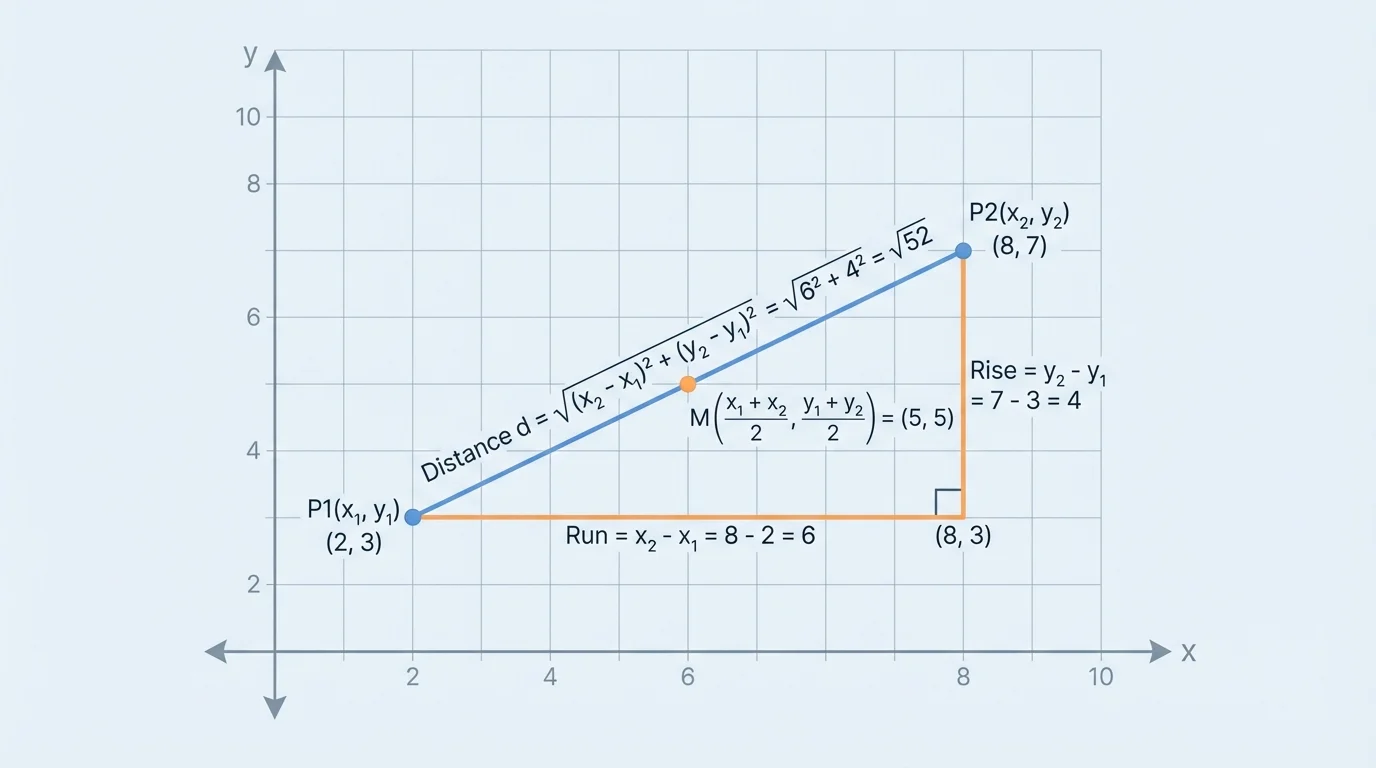
The main tools in coordinate proof are the slope formula, the distance formula, and the midpoint formula. Their relationships on a graph are shown clearly in [Figure 1], where a segment, its rise and run, and its center point all appear on the same coordinate plane.
If two points are \( (x_1,y_1) \) and \( (x_2,y_2) \), then the slope of the line through them is
\[m=\frac{y_2-y_1}{x_2-x_1}\]
This tells how steep the line is. Equal slopes mean lines are parallel, as long as they are distinct lines. If two nonvertical lines have slopes that are negative reciprocals, then they are perpendicular.
The distance between two points is
\[d=\sqrt{(x_2-x_1)^2+(y_2-y_1)^2}\]
This formula comes directly from the Pythagorean theorem. It lets you test whether sides are equal or whether a point is a certain distance from a center.
The midpoint of a segment joining \( (x_1,y_1) \) and \( (x_2,y_2) \) is
\[\left(\frac{x_1+x_2}{2},\frac{y_1+y_2}{2}\right)\]
Midpoints are especially useful for proving that diagonals bisect each other, which is a key property of parallelograms.
Parallel lines are lines in the same plane that never meet and have equal slopes when the slopes are defined.
Perpendicular lines meet to form a right angle; for nonvertical lines, their slopes are negative reciprocals.
Radius is the distance from the center of a circle to any point on the circle.
One more idea matters a lot: exact values. If a point has a coordinate like \(\sqrt{3}\), you should keep it exact instead of changing it to a decimal too early. Exact values make proofs cleaner and prevent rounding errors.
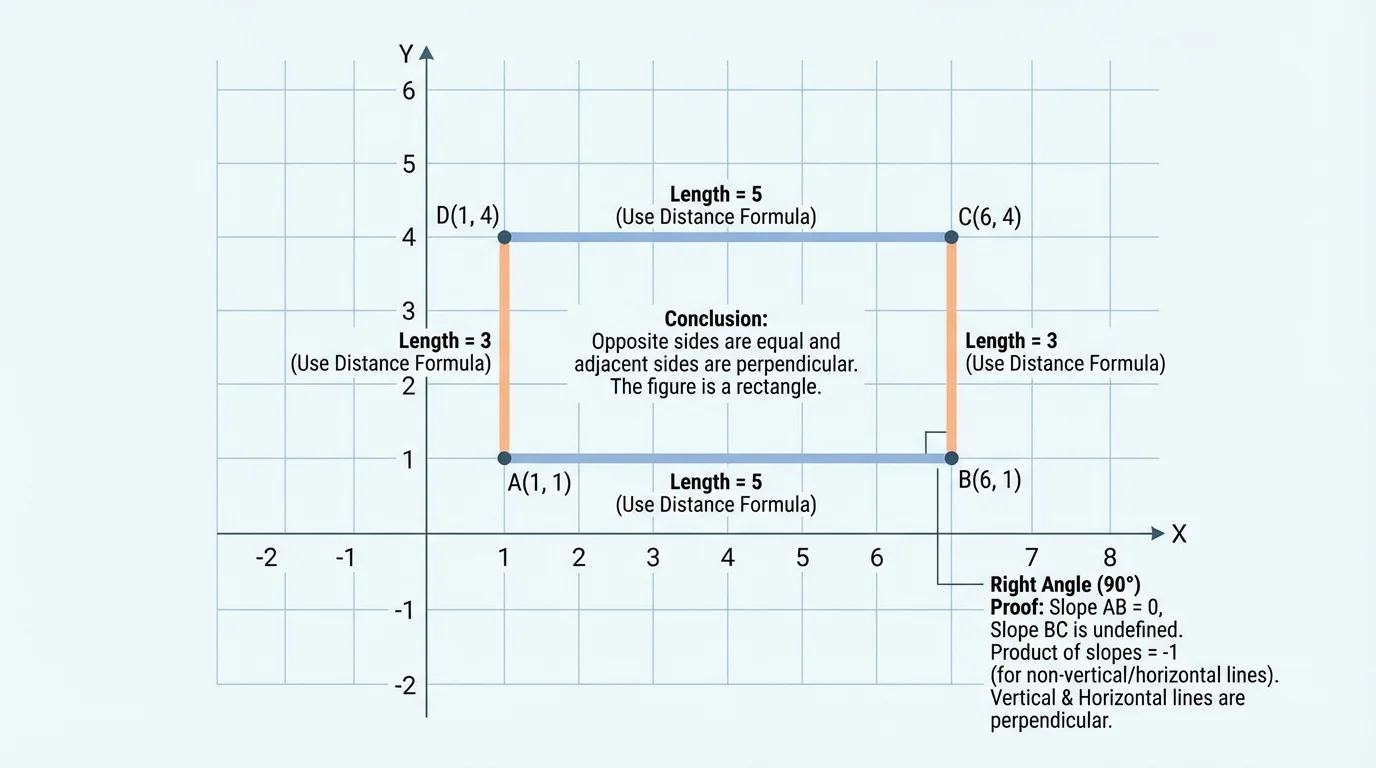
[Figure 2] A quadrilateral can be tested piece by piece. A coordinate diagram helps organize which sides are opposite, which are adjacent, and where right angles appear, but the proof itself comes from the calculations.
Here are some common algebraic tests:
| Geometric property | Algebraic test |
|---|---|
| Opposite sides parallel | Equal slopes |
| Adjacent sides perpendicular | Slopes are negative reciprocals, or one side is horizontal and the other vertical |
| Sides congruent | Equal distances |
| Diagonals bisect each other | Same midpoint |
| Point on a circle | Distance from center equals radius |
Table 1. Algebraic tests that match common geometric properties in coordinate proofs.
To prove a quadrilateral is a rectangle, the most direct method is often this: show one pair of adjacent sides is perpendicular and show opposite sides are parallel. Another strong method is to prove the quadrilateral is a parallelogram and then prove that one angle is a right angle.
Be careful about the order of the points. If four points are given, you must connect them in the intended order around the shape. If you connect them in the wrong order, you may accidentally create crossing segments or test the wrong sides.
Computer-aided design software constantly performs coordinate checks like these. A part that is supposed to be rectangular can be verified numerically before anything is manufactured.
As we saw in [Figure 1], formulas turn visual features into exact numerical tests. That same idea now lets us investigate whole shapes rather than just single segments.
Example 1
Determine whether the quadrilateral with vertices \(A(1,1)\), \(B(5,1)\), \(C(5,4)\), and \(D(1,4)\) is a rectangle.
Step 1: Find the slopes of the sides.
For \(\overline{AB}\), \(m_{AB}=\dfrac{1-1}{5-1}=\dfrac{0}{4}=0\).
For \(\overline{BC}\), \(m_{BC}=\dfrac{4-1}{5-5}=\dfrac{3}{0}\), which is undefined.
For \(\overline{CD}\), \(m_{CD}=\dfrac{4-4}{1-5}=\dfrac{0}{-4}=0\).
For \(\overline{DA}\), \(m_{DA}=\dfrac{1-4}{1-1}=\dfrac{-3}{0}\), which is undefined.
Step 2: Test opposite sides for parallelism.
Since \(m_{AB}=m_{CD}=0\), the top and bottom sides are parallel.
Since both \(\overline{BC}\) and \(\overline{DA}\) have undefined slope, the left and right sides are parallel.
Step 3: Test one angle for a right angle.
Segment \(\overline{AB}\) is horizontal because its slope is \(0\), and segment \(\overline{BC}\) is vertical because its slope is undefined. A horizontal line and a vertical line are perpendicular.
Step 4: Conclude.
The quadrilateral has both pairs of opposite sides parallel and at least one right angle, so it is a rectangle.
Answer: \(ABCD\) is a rectangle.
This is a proof, not just a check. It uses the definition of a rectangle through coordinate properties: parallel opposite sides and a right angle.
Now let us disprove a claim. Suppose someone says that the quadrilateral with points \(P(0,0)\), \(Q(4,1)\), \(R(5,5)\), and \(S(1,4)\) is a rectangle. The coordinates may make it look slanted like a rectangle on a sketch, but the slopes decide the truth.
Example 2
Prove or disprove that \(PQRS\) is a rectangle.
Step 1: Find the slopes of the sides.
\(m_{PQ}=\dfrac{1-0}{4-0}=\dfrac{1}{4}\)
\(m_{QR}=\dfrac{5-1}{5-4}=\dfrac{4}{1}=4\)
\(m_{RS}=\dfrac{4-5}{1-5}=\dfrac{-1}{-4}=\dfrac{1}{4}\)
\(m_{SP}=\dfrac{0-4}{0-1}=\dfrac{-4}{-1}=4\)
Step 2: Check opposite sides.
Since \(m_{PQ}=m_{RS}=\dfrac{1}{4}\), those sides are parallel.
Since \(m_{QR}=m_{SP}=4\), those sides are parallel.
So \(PQRS\) is a parallelogram.
Step 3: Check for a right angle.
If adjacent sides were perpendicular, the slopes would be negative reciprocals. But the negative reciprocal of \(\dfrac{1}{4}\) is \(-4\), not \(4\).
So \(\overline{PQ}\) is not perpendicular to \(\overline{QR}\).
Step 4: Conclude.
The figure is a parallelogram, but it does not have a right angle. Therefore, it is not a rectangle.
Answer: \(PQRS\) is not a rectangle.
This example matters because many students stop after finding parallel opposite sides. But that proves only a parallelogram, not necessarily a rectangle. As the side relationships in [Figure 2] suggest, parallelism alone is not enough; perpendicularity is the extra condition that makes the shape a rectangle.
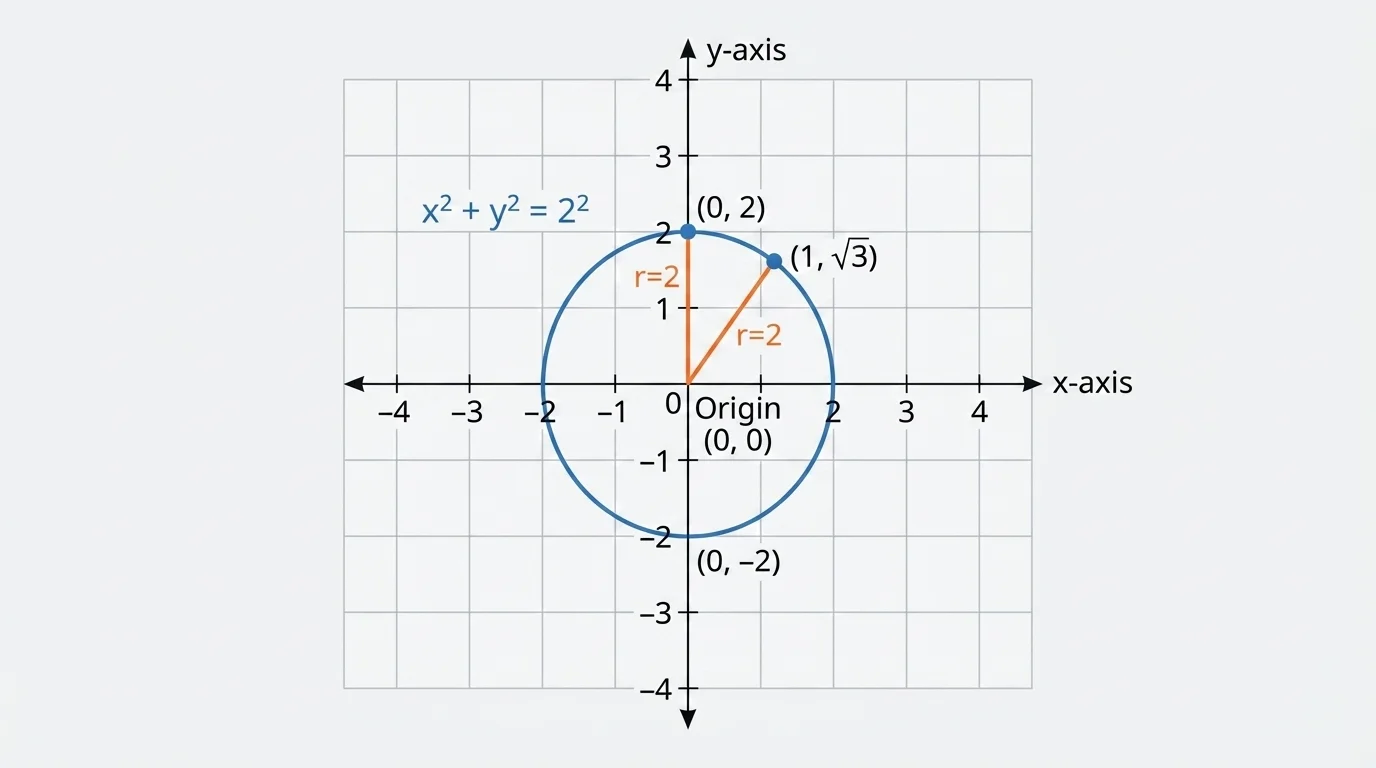
A circle is the set of all points that are the same distance from a fixed center. That single idea is all you need for many coordinate proofs involving circles, and [Figure 3] shows this clearly with a center at the origin and radii drawn to points on the graph.
If a circle is centered at the origin, then any point \( (x,y) \) on the circle must satisfy the distance condition
\[\sqrt{x^2+y^2}=r\]
where \(r\) is the radius. Squaring both sides gives the familiar equation
\(x^2+y^2=r^2\)
If the circle is centered at \( (h,k) \), then the equation becomes
\[(x-h)^2+(y-k)^2=r^2\]
For many proof questions, though, using distance directly is more intuitive than memorizing the full equation. You compare the point's distance from the center with the circle's radius. If they are equal, the point lies on the circle. If they are not equal, the point does not.
Example 3
Prove or disprove that the point \( (1,\sqrt{3}) \) lies on the circle centered at the origin and containing the point \( (0,2) \).
Step 1: Find the radius of the circle.
The center is the origin, \( (0,0) \). The circle contains \( (0,2) \), so the radius is the distance from \( (0,0) \) to \( (0,2) \).
\(r=\sqrt{(0-0)^2+(2-0)^2}=\sqrt{0+4}=2\)
Step 2: Find the distance from the origin to \( (1,\sqrt{3}) \).
\(d=\sqrt{(1-0)^2+(\sqrt{3}-0)^2}=\sqrt{1+3}=\sqrt{4}=2\)
Step 3: Compare the distance to the radius.
Since \(d=r=2\), the point is exactly the same distance from the center as every point on the circle.
Step 4: Conclude.
The point lies on the circle.
Answer: \((1,\sqrt{3})\) lies on the circle.
You can also verify this with the circle equation. Since the radius is \(2\), the equation is \(x^2+y^2=4\). Substituting \(x=1\) and \(y=\sqrt{3}\) gives \(1^2+(\sqrt{3})^2=1+3=4\), so the point satisfies the equation. The geometry and the algebra agree.
Coordinate methods can prove much more than rectangles and circle membership. For example, to prove a quadrilateral is a parallelogram, show that its diagonals have the same midpoint. To prove a figure is a square, show it is both a rectangle and has equal side lengths. To prove a triangle is isosceles, show two side lengths are equal.
Suppose a quadrilateral has vertices \(A(-2,1)\), \(B(2,3)\), \(C(4,-1)\), and \(D(0,-3)\). The midpoint of diagonal \(AC\) is
\[\left(\frac{-2+4}{2},\frac{1+(-1)}{2}\right)=(1,0)\]
The midpoint of diagonal \(BD\) is
\[\left(\frac{2+0}{2},\frac{3+(-3)}{2}\right)=(1,0)\]
Since the diagonals share the same midpoint, they bisect each other, so the quadrilateral is a parallelogram.
Why these methods work
Coordinate geometry works because geometric definitions can be translated into algebraic conditions. "Parallel" becomes "same slope." "Congruent" becomes "same distance." "Bisect" becomes "same midpoint." This translation allows you to prove facts with exact computations instead of visual estimates.
Notice the pattern: every proof starts with a definition. If you know what a rectangle, circle, or parallelogram means, then you know what to calculate.
Coordinate proofs are used in navigation systems, digital maps, and computer graphics. A robot moving through a warehouse may need to verify that its path forms right-angle turns. A graphic designer may need to check that a screen element is truly rectangular, not just close. Satellite systems compare positions by coordinates constantly, and circular regions are used to model signal range around a transmitter.
In engineering, even a tiny error in a coordinate measurement can matter. A machine part that should fit into a rectangular opening may fail if one angle is not exactly \(90^\circ\). A coordinate proof catches that problem before the part is built. The same logic applies to circular gears, wheels, and rotating sensors, where every point on the edge must stay a fixed distance from the center, just as in [Figure 3].
One common mistake is assuming that a picture is drawn perfectly. In coordinate geometry, the calculations decide the result, not the appearance.
Another mistake is checking only one condition. A rectangle needs more than parallel opposite sides; it also needs a right angle. A point on a circle must match the radius exactly, not approximately unless the problem specifically allows approximation.
Students also sometimes mix up undefined slope and zero slope. A horizontal line has slope \(0\). A vertical line has undefined slope. These are different, and together they create perpendicular lines.
Finally, keep radicals exact when possible. For instance, \( (\sqrt{3})^2=3\) exactly. Writing \(\sqrt{3}\) as a rounded decimal too early can make a true statement look false because of rounding.
"In coordinate geometry, a picture suggests; algebra proves."
When you approach a coordinate proof, ask two questions: what geometric property am I trying to prove, and which formula translates that property into algebra? Once those are clear, the path forward becomes much simpler.
