A phone screen can rotate a photo, a map app can slide the view, and a video game can flip a shape across an axis. Even though the picture moves, the straight edges do not suddenly become curves, and a side that was length \(5\) does not become length \(7\). Geometry studies this same idea very carefully. When a figure is moved by certain transformations, lines remain lines, and line segments remain line segments of equal length.
One of the biggest ideas in middle school geometry is that some motions change a figure's position without changing its actual size or shape. These motions are called rigid motions. They help us decide when two figures are congruent, because congruent figures match exactly after a sequence of rigid motions.
If a transformation could bend lines or stretch segments, then it would not preserve shape. But translations, reflections, and rotations do preserve shape. That is why they are so important: they move figures while keeping the geometry intact.
Recall that a line extends forever in both directions, while a line segment has two endpoints. A transformation moves every point of a figure to a new location, called its image.
When geometers say "lines are taken to lines," they mean that if every point on a line is transformed, the set of image points still forms a straight line. When they say "line segments are taken to line segments of the same length," they mean that the endpoints move to new points, and the new segment connecting them has exactly the same length as the original.
A rigid motion is a transformation that preserves distance and angle measure. In this lesson, the focus is on distance. If two points are \(d\) units apart before a rigid motion, then their images are also \(d\) units apart afterward.
The three basic rigid motions are a translation, a reflection, and a rotation.
Translation: a slide in which every point moves the same distance in the same direction.
Reflection: a flip across a line, called the line of reflection, so that each point and its image are the same perpendicular distance from that line.
Rotation: a turn around a fixed point, called the center of rotation.
Because these transformations preserve distances, they cannot stretch a segment. Because they move points in a consistent geometric way, they also cannot turn a straight line into a curve. Those two facts are the heart of this topic.
[Figure 1] A line contains infinitely many points arranged in a straight path. Under a rigid motion, each of those points moves to a new location, and the image points still lie in a straight path. So the image of a line is another line.
Think about drawing a straight road on tracing paper and sliding the tracing paper across a desk. The road moves, but it is still straight. If you flip the tracing paper over a mirror line, the road changes position and maybe direction, but it remains a straight road. If you rotate the tracing paper, the road turns, yet it is still a line.
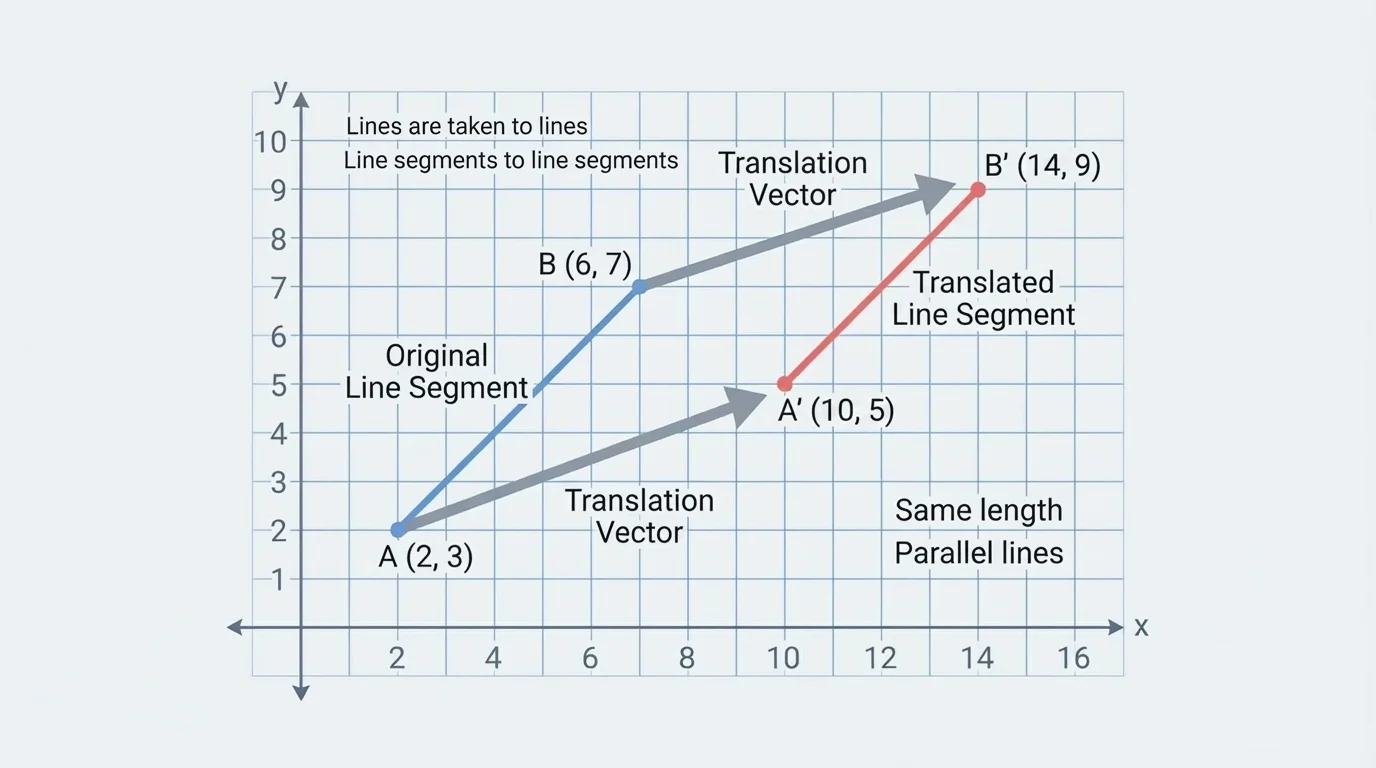
Sometimes the image line is parallel to the original line, such as after many translations. Sometimes it intersects the original line, such as after certain rotations. Sometimes it appears reversed in direction, such as after a reflection. But in every case, the result is still a line, not a curve and not a broken path.
This matters because geometry often depends on preserving basic structures. A triangle is built from line segments, and those segments lie on lines. If lines did not stay lines, many later ideas about congruence and coordinate geometry would fall apart.
[Figure 2] A line segment has two endpoints, so to understand its image, we focus on those endpoints first. If segment \(\overline{AB}\) is transformed, point \(A\) moves to \(A'\) and point \(B\) moves to \(B'\). The image is the segment \(\overline{A'B'}\), and its length is the same as the original.
Because a rigid motion preserves distance, the distance between \(A\) and \(B\) equals the distance between \(A'\) and \(B'\). In symbols, if \(AB = d\), then \(A'B' = d\) as well.
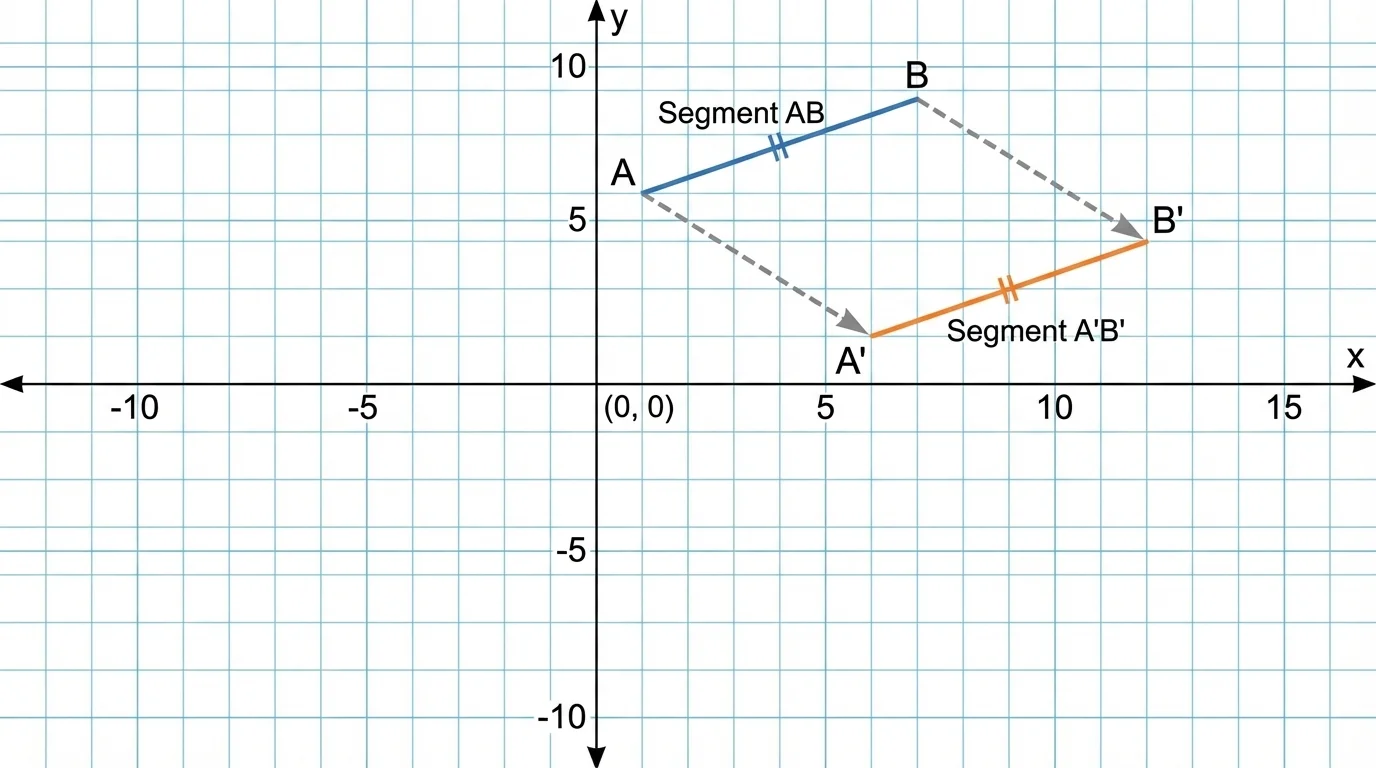
This is true no matter how the segment is moved. The segment might slide, flip, or turn. Its position may change. Its orientation may change. But its length does not change.
That idea gives us a powerful rule:
For any rigid motion, if \(\overline{AB}\) is a segment, then its image is \(\overline{A'B'}\) and
\(AB = A'B'\)
This is one reason rigid motions are called distance-preserving transformations.
With a translation, every point moves the same way. For example, if a point moves \(4\) units right and \(2\) units up, every other point does too. A line stays straight because all of its points shift together in one consistent direction. A segment keeps its length because both endpoints move equally.
If \(A(1,2)\) is translated by \((+4,+2)\), then \(A'(5,4)\). If \(B(6,2)\) is translated by the same rule, then \(B'(10,4)\). The original segment has length \(5\), and the image segment also has length \(5\).
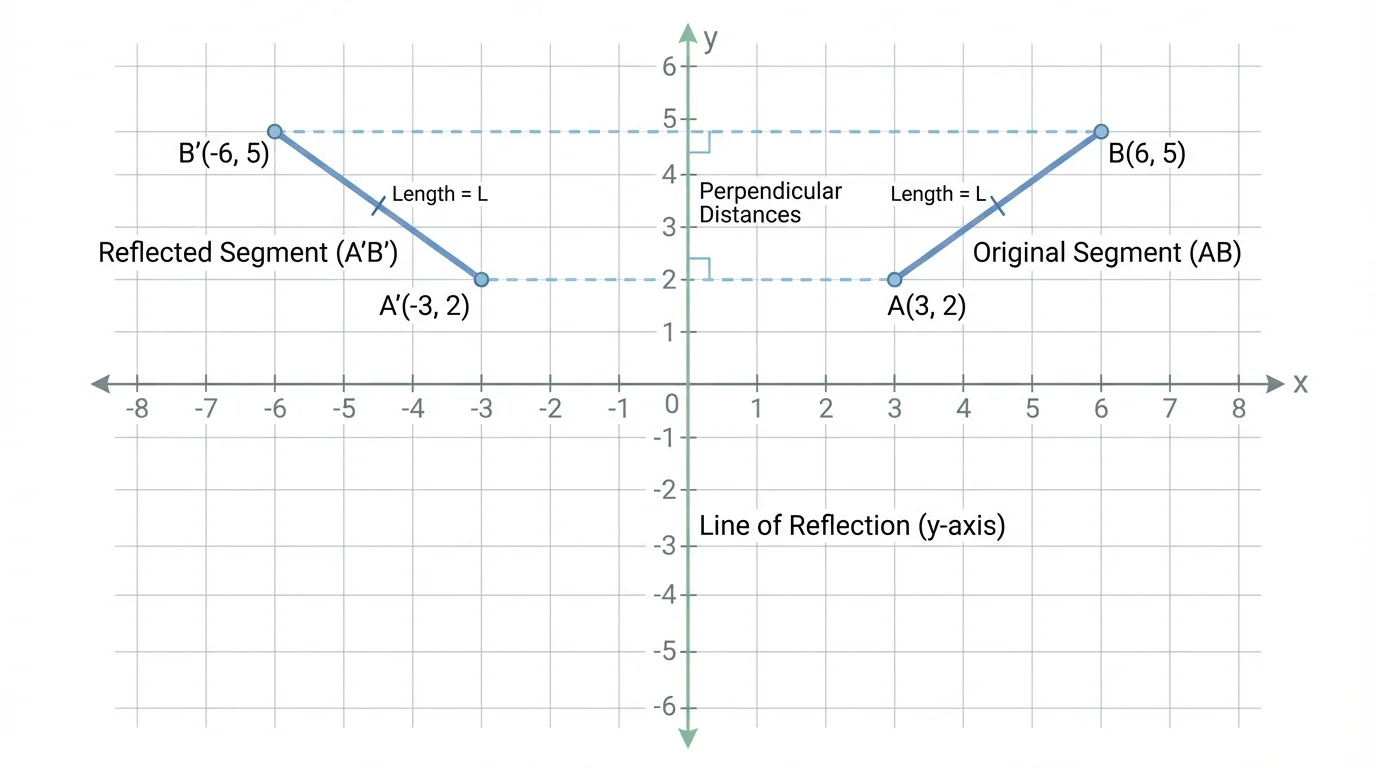
[Figure 3] With a reflection, points move across a mirror line. The image of a segment under reflection is still a segment, and each endpoint lands the same perpendicular distance from the mirror line as before. This shows why lengths stay unchanged even though the figure appears reversed.
For instance, reflecting across the \(y\)-axis changes \((x,y)\) to \((-x,y)\). A horizontal segment remains horizontal, a vertical segment remains vertical, and a slanted segment remains straight. The figure may face the opposite way, but its size stays the same.
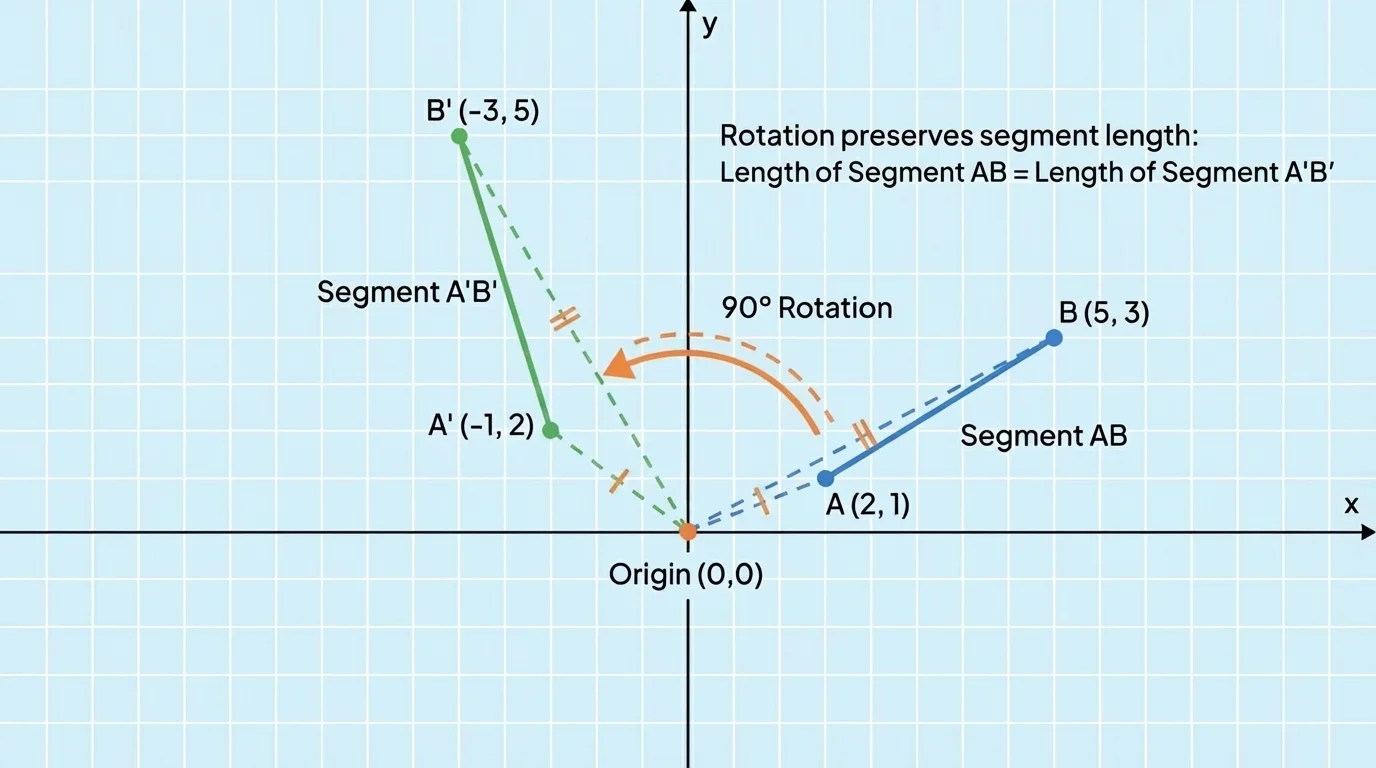
[Figure 4] With a rotation, every point turns around a center by the same angle. The endpoints of a segment trace circular paths around the center, but the distance between the endpoints stays constant. The turned segment remains straight and equal in length to the original segment.
For example, a \(90^\circ\) rotation about the origin sends \((x,y)\) to \((-y,x)\). A segment can change from horizontal to vertical or from one slant to another, yet its length remains the same because rotation is rigid.
Notice a pattern: translations preserve direction, reflections reverse orientation, and rotations turn orientation. But all three preserve distance, so all three take line segments to line segments of the same length.
Why straightness is preserved
A line is determined by points that stay aligned. In a rigid motion, the movement is organized and consistent, not random. That consistency keeps collinear points collinear. So if points start on one straight line, their images also lie on one straight line.
This is why a triangle under a rigid motion remains a triangle. Each side is a segment, each segment keeps its length, and each side still lies on a straight line. The whole structure is preserved.
The best way to see this property clearly is to test it with coordinates.
Worked example 1: Translation of a line segment
Segment \(\overline{AB}\) has endpoints \(A(2,1)\) and \(B(7,1)\). Translate it \(3\) units left and \(4\) units up. Find the image and compare lengths.
Step 1: Move each endpoint by the translation rule.
Moving \(3\) units left means subtract \(3\) from each \(x\)-coordinate. Moving \(4\) units up means add \(4\) to each \(y\)-coordinate.
So \(A'(2-3,1+4)=(-1,5)\) and \(B'(7-3,1+4)=(4,5)\).
Step 2: Find the original length.
The segment is horizontal, so its length is the difference in \(x\)-coordinates: \(7-2=5\).
Step 3: Find the image length.
The image is also horizontal, so its length is \(4-(-1)=5\).
The image is segment \(\overline{A'B'}\) from \((-1,5)\) to \((4,5)\), and the length stays \(5\).
This example shows that a translation changes location but not size. It also shows that a horizontal segment stays a line segment, not anything else.
Worked example 2: Reflection across the \(y\)-axis
Line segment \(\overline{CD}\) has endpoints \(C(3,2)\) and \(D(3,8)\). Reflect it across the \(y\)-axis.
Step 1: Use the reflection rule.
Reflecting across the \(y\)-axis changes \((x,y)\) to \((-x,y)\).
So \(C'(-3,2)\) and \(D'(-3,8)\) are the image points.
Step 2: Find the original length.
The segment is vertical, so its length is \(8-2=6\).
Step 3: Find the image length.
The image is also vertical, so its length is still \(8-2=6\).
The reflected image is a vertical segment of the same length, \(6\). Reflection changes the side of the axis, but not the segment's length.
As shown by the reflected image in [Figure 3], the image lands on the opposite side at equal distances from the reflection line. That is exactly why the figure keeps its size.
Worked example 3: Rotation about the origin
Segment \(\overline{EF}\) has endpoints \(E(1,2)\) and \(F(5,2)\). Rotate it \(90^\circ\) counterclockwise about the origin.
Step 1: Apply the rotation rule.
A \(90^\circ\) counterclockwise rotation sends \((x,y)\) to \((-y,x)\).
So \(E'(-2,1)\) and \(F'(-2,5)\) are the image points.
Step 2: Find the original length.
The original segment is horizontal, so its length is \(5-1=4\).
Step 3: Find the image length.
The image is vertical, so its length is \(5-1=4\).
The rotated image is segment \(\overline{E'F'}\) from \((-2,1)\) to \((-2,5)\), and the length remains \(4\).
This example is especially useful because the segment changes direction. It starts horizontal and ends vertical, as in [Figure 4], but its length is still preserved.
Worked example 4: A line under translation
The line \(y = 2x + 1\) is translated \(1\) unit right and \(3\) units down. Explain why its image is still a line.
Step 1: Focus on the transformation, not just the equation.
A translation moves every point on the original line by the same amount.
Step 2: Track a few points.
Points \((0,1)\), \((1,3)\), and \((2,5)\) lie on the line. After the translation, they become \((1,-2)\), \((2,0)\), and \((3,2)\).
Step 3: Check whether the image points stay aligned.
From \((1,-2)\) to \((2,0)\), the rise is \(2\) and the run is \(1\). From \((2,0)\) to \((3,2)\), the rise is also \(2\) and the run is \(1\). The points are still on one straight line.
The image of a line under a translation is still a line.
These examples all point to the same geometric truth: rigid motions preserve the basic building blocks of figures.
One common mistake is thinking that if a segment changes direction, then its length must have changed. That is not true. Direction and length are different properties. A segment can rotate from horizontal to vertical and still keep the same length.
Another mistake is confusing a line with a segment. A line goes on forever, while a segment has endpoints. Under a rigid motion, a line still extends forever, and a segment still has two endpoints.
Some students also think a reflection "distorts" a figure because it looks reversed. But reversed is not the same as stretched. Reflection changes orientation, not size.
The translated line in [Figure 1] and the segment image in [Figure 2] make this visible: position can change a lot while geometric properties remain the same.
Modern computer graphics depend heavily on transformations. When a game rotates a car or reflects a scene in a mirror, the software uses geometric rules that preserve shapes so objects still look realistic.
That is one reason this topic matters beyond a geometry classroom. These rules describe how objects can move without being reshaped.
In architecture and engineering, drawings are often copied, rotated, or reflected to test layouts. A beam drawn as a straight segment in one position must remain a straight segment of the same length in another position. Otherwise, the plan would be inaccurate.
In manufacturing, parts are designed on coordinate grids and then repositioned by machines. If a metal rod is represented by a segment of length \(12\), a rigid motion can move or turn that design, but it must still represent a rod of length \(12\).
In mapping and navigation, transparent overlays can be shifted or turned to compare routes or building plans. The street edges and boundary lines remain straight, and measured distances stay consistent when rigid motions are used properly.
Even in art and design, mirror symmetry depends on reflections. The two sides may face opposite directions, but corresponding segments must have equal lengths for the design to look balanced.
Two figures are congruent if one can be mapped onto the other by a sequence of rigid motions. That statement works only because lines stay lines and line segments keep their lengths. If a triangle is translated, reflected, or rotated, its three sides remain segments of the same lengths as before.
So when you see a figure move in geometry, ask two questions: Does it stay made of straight pieces? Do corresponding lengths stay equal? For rigid motions, the answer is yes.
This gives a reliable foundation for later ideas such as corresponding parts of congruent figures, coordinate proofs, and transformations in the plane.
"A rigid motion changes where a figure is, not what the figure is."
That single idea explains why straight lines remain straight and why line segments keep their lengths under translations, reflections, and rotations.
