When a company designs a logo, when a phone rotates a photo, or when builders place identical tiles across a floor, they rely on a powerful geometric idea: a shape can move without changing its size or shape. Geometry gives a precise way to talk about these motions. If one figure can slide, turn, or flip to land exactly on another figure, then the figures are not just similar-looking. They are exactly the same shape and the same size.
In geometry, saying two figures are the same is not based on guessing by eye. We need a rule that works every time. That rule is based on motion. If one figure can be moved onto another without stretching, shrinking, or bending, then the figures are congruent. This makes congruence something we can test and describe.
That idea is especially important on a coordinate plane. Instead of saying "these look the same," we can show exactly how a figure moves from one location to another. We can state that a point moves left by \(4\) units, or that a figure rotates \(90^\circ\) about the origin, or that it reflects across the \(y\)-axis. Geometry becomes clear, exact, and visual.
Congruent figures are figures with the same shape and the same size.
Rigid transformations are moves that preserve distances and angle measures. The rigid transformations used to show congruence are translations, rotations, and reflections.
If one figure can be obtained from another by a sequence of rigid transformations, then the figures are congruent.
Because rigid transformations keep lengths and angles the same, a triangle with side lengths \(3\), \(4\), and \(5\) remains a \(3\)-\(4\)-\(5\) triangle after any translation, rotation, or reflection. Its location may change, and its orientation may change, but its actual size and shape do not.
A transformation is a rule that moves a figure in the plane. Some transformations preserve the figure exactly, and some do not. The transformations used for congruence are special because they do not alter side lengths or angle measures.
Suppose one triangle has vertices \(A(1,1)\), \(B(4,1)\), and \(C(2,3)\). If we slide every point right \(5\) units and up \(2\) units, the image has vertices \(A'(6,3)\), \(B'(9,3)\), and \(C'(7,5)\). Every side length stays the same. Every angle measure stays the same. The new triangle is congruent to the original triangle.
If a transformation changes size, then it is not a rigid transformation and cannot be used by itself to prove congruence. For example, enlarging a square with side length \(2\) to a square with side length \(6\) produces a similar figure, not a congruent one.
From earlier geometry, you know that points can be named with coordinates such as \((x,y)\), and that figures are made of points, segments, and angles. In this lesson, every transformation moves every point of a figure according to a rule.
Another important idea is matching parts. When two figures are congruent, each vertex in one figure corresponds to a vertex in the other, each side corresponds to a side of equal length, and each angle corresponds to an angle of equal measure. These are called corresponding parts.
The three rigid transformations work in different ways, as [Figure 1] shows, but all of them preserve the figure's size and shape. Learning to recognize their differences is the key to describing congruence correctly.
A translation slides a figure without turning it or flipping it. Every point moves the same distance in the same direction. If a point moves from \((x,y)\) to \((x+3,y-2)\), then every point of the figure makes that same move.
A rotation turns a figure around a fixed point called the center of rotation. Common rotations on the coordinate plane are about the origin. For example, a \(90^\circ\) counterclockwise rotation about the origin sends \((x,y)\) to \((-y,x)\).
A reflection flips a figure across a line called the line of reflection. The original and image are mirror images. Reflecting across the \(y\)-axis sends \((x,y)\) to \((-x,y)\), and reflecting across the \(x\)-axis sends \((x,y)\) to \((x,-y)\).
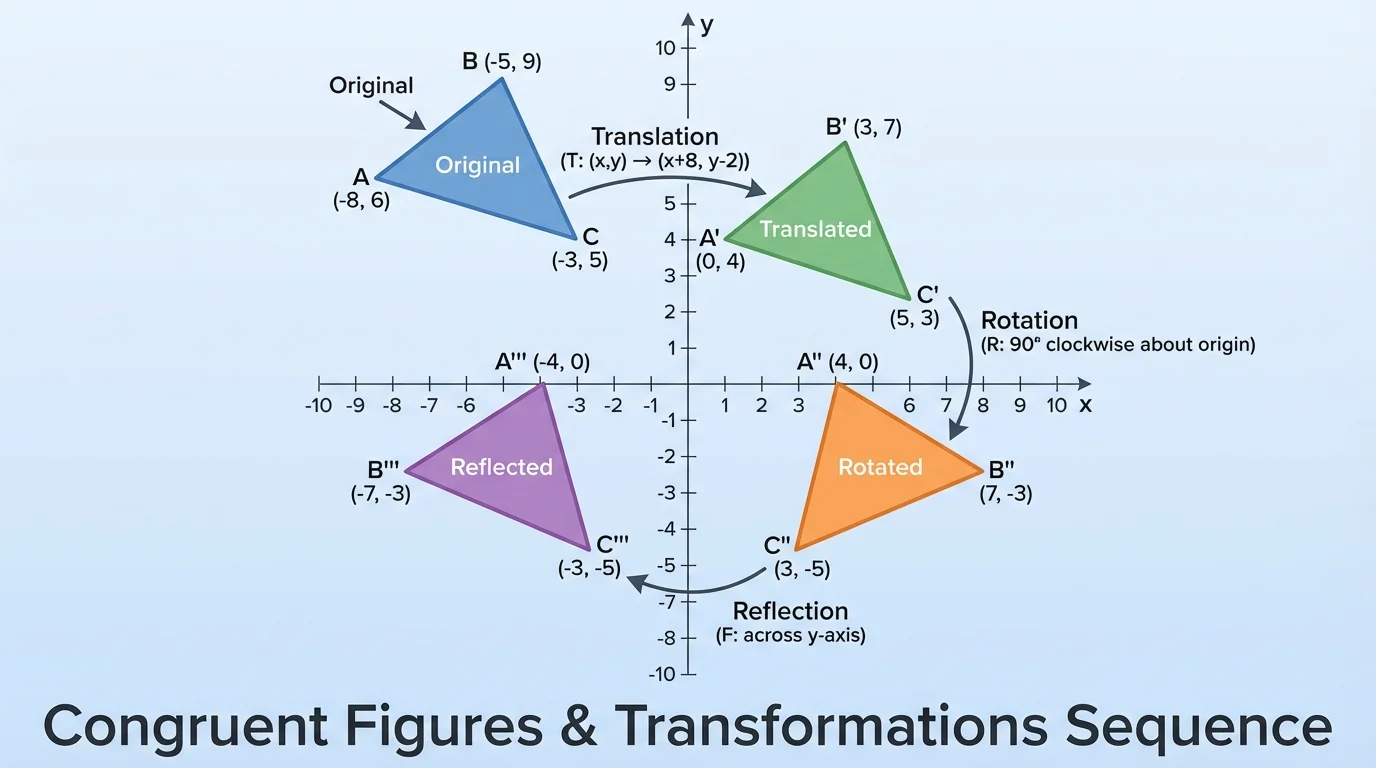
One major clue is orientation. A translation keeps the figure facing the same way. A rotation changes the direction the figure faces, but it does not create a mirror image. A reflection creates a mirror image, so the order of vertices may reverse.
For example, if triangle \(ABC\) is reflected, the image \(A'B'C'\) may appear to go around in the opposite direction. That reversal is often the sign that a reflection happened somewhere in the sequence.
Modern computer graphics use transformation rules constantly. When a game character turns, flips, or shifts across the screen, the software applies motions that are closely related to the transformations studied in geometry.
You can also think of rigid transformations as "perfect moves." A paper cutout of a figure can be slid, turned, or flipped on a desk. As long as the paper is not stretched or folded, the moved shape remains congruent to the original.
Sometimes one transformation is enough, but often a sequence of transformations is needed. As [Figure 2] illustrates, one figure might need to be flipped first to match orientation and then shifted to match position.
For example, two L-shaped figures may be mirror images and also be in different locations. A translation alone will not work, because sliding cannot change orientation. A reflection alone will not work, because even after flipping, the image may still be in the wrong place. But a reflection followed by a translation can make the figures overlap exactly.
The order matters. If you translate first and reflect second, the image may end up in a different location than if you reflect first and then translate. In geometry, a sequence means the moves happen one after another in a specific order.
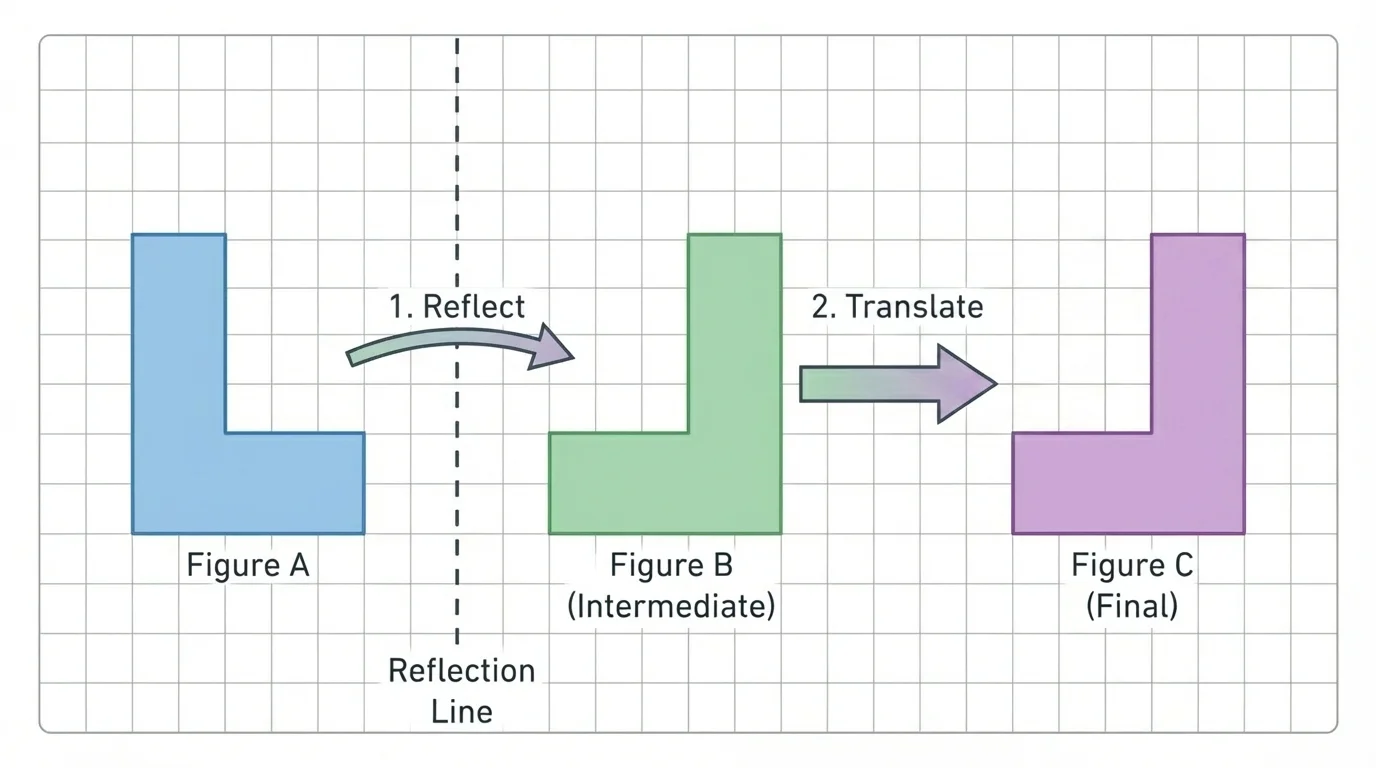
Whenever you are asked to describe a sequence, think like a detective. First ask: do the figures have the same orientation, or is one a mirror image? Then ask: are they turned relative to each other? Finally ask: after orientation matches, how far must the figure slide to line up exactly?
This approach helps you avoid random guessing. Instead of trying many moves without a plan, you compare the figures carefully and choose transformations that solve one difference at a time.
How transformations prove congruence
To prove congruence with transformations, you do not need to measure every side and angle separately. If a sequence of rigid transformations maps one figure exactly onto the other, then all corresponding sides and angles must match automatically, because rigid transformations preserve distance and angle measure.
This is one reason transformations are such a powerful tool in geometry. They turn the idea of "same size and same shape" into something active and testable.
To describe how one figure maps to another, compare corresponding vertices and important features first. On a graph, as [Figure 3] illustrates, labeled points help you decide whether the figure has been slid, turned, flipped, or moved by more than one transformation.
A good description tells what transformation happens and includes the necessary details. For a translation, give the direction and distance, or state the coordinate rule. For a rotation, give the angle, direction, and center of rotation. For a reflection, give the line of reflection.
If there is more than one move, write them in order. For example: "Reflect triangle \(ABC\) across the \(y\)-axis, then translate it right \(4\) units and up \(1\) unit." That is a complete sequence because it tells exactly what to do.
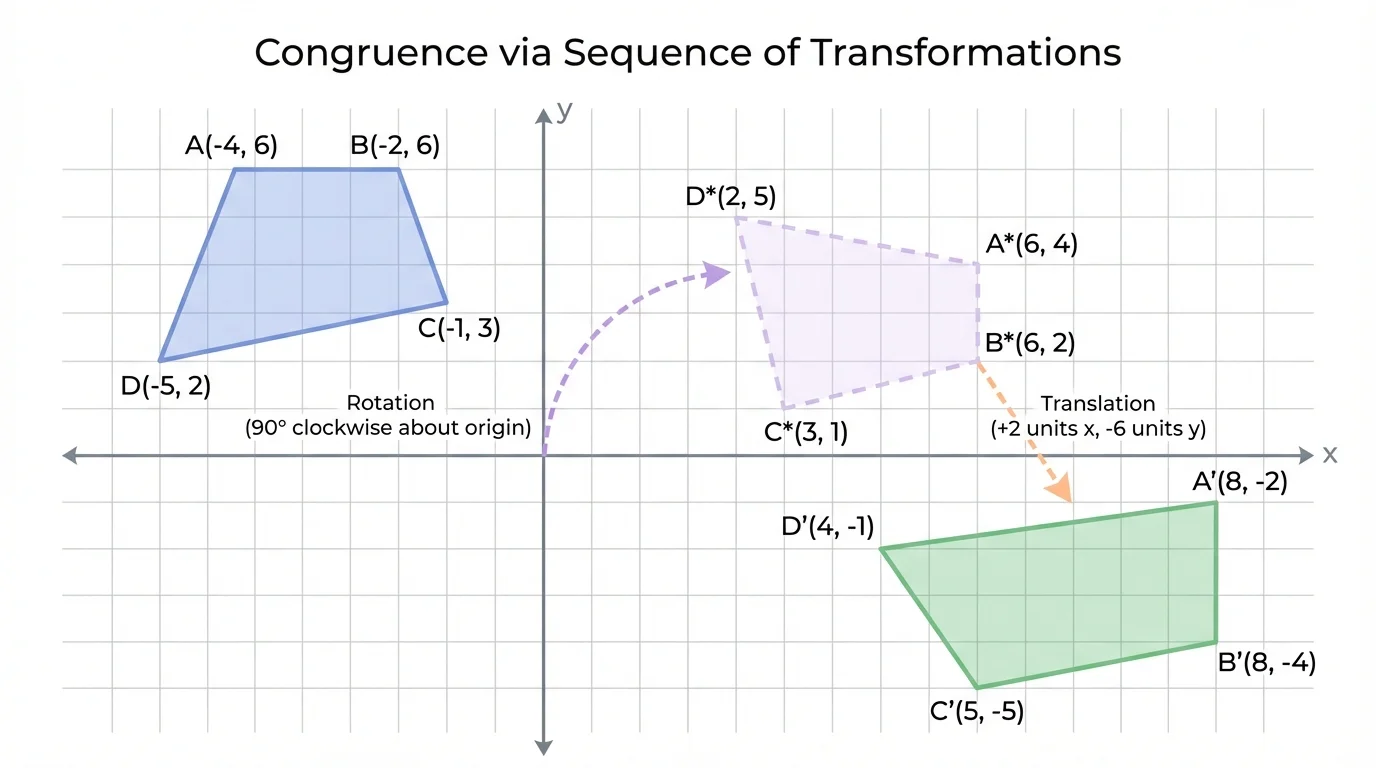
When writing about congruence, it also helps to name corresponding points in the same order. If \(A\) matches \(A'\), \(B\) matches \(B'\), and \(C\) matches \(C'\), then the congruence statement should preserve that order.
For example, if triangle \(ABC\) maps to triangle \(DEF\) with \(A \to D\), \(B \to E\), and \(C \to F\), then we write \(\triangle ABC \cong \triangle DEF\). Writing the letters in the wrong order can incorrectly match the vertices.
Worked example
Triangle \(ABC\) has vertices \(A(1,2)\), \(B(3,2)\), and \(C(2,5)\). Triangle \(A'B'C'\) has vertices \(A'(6,0)\), \(B'(8,0)\), and \(C'(7,3)\). Describe a sequence that shows the triangles are congruent.
Step 1: Compare corresponding points.
Point \(A(1,2)\) moves to \(A'(6,0)\). That is right \(5\) units and down \(2\) units.
Step 2: Check the same move on the other vertices.
Point \(B(3,2)\) goes to \(B'(8,0)\), which is also right \(5\) and down \(2\). Point \(C(2,5)\) goes to \(C'(7,3)\), again right \(5\) and down \(2\).
Step 3: State the transformation.
The sequence is a single translation by the rule \((x,y) \to (x+5,y-2)\).
So triangle \(A'B'C'\) is obtained by translating triangle \(ABC\) right \(5\) units and down \(2\) units.
This example shows an important shortcut: if all corresponding points move the same way, a translation is likely the correct transformation.
Worked example
Triangle \(PQR\) has vertices \(P(1,1)\), \(Q(3,1)\), and \(R(1,4)\). Triangle \(P'Q'R'\) has vertices \(P'(5,1)\), \(Q'(3,1)\), and \(R'(5,4)\). Describe a sequence that shows the triangles are congruent.
Step 1: Look for a reflection.
Comparing the points suggests the figure has been flipped. Reflecting \(PQR\) across the vertical line \(x=2\) sends \(P(1,1)\) to \(P_1(3,1)\), \(Q(3,1)\) to \(Q_1(1,1)\), and \(R(1,4)\) to \(R_1(3,4)\).
Step 2: Check whether a translation finishes the job.
If we now translate the reflected triangle right \(2\) units, then \(P_1(3,1)\) goes to \(P'(5,1)\), \(Q_1(1,1)\) goes to \(Q'(3,1)\), and \(R_1(3,4)\) goes to \(R'(5,4)\).
Step 3: State the sequence clearly.
Reflect triangle \(PQR\) across the line \(x=2\), then translate the image right \(2\) units.
This sequence proves that triangle \(PQR\) is congruent to triangle \(P'Q'R'\).
Notice how this matches the idea from [Figure 2]: the reflection fixes the mirror-image issue, and the translation fixes the location.
Worked example
The vertices of triangle \(LMN\) are \(L(1,0)\), \(M(3,0)\), and \(N(2,2)\). Triangle \(L'M'N'\) has vertices \(L'(4,2)\), \(M'(4,4)\), and \(N'(2,3)\). Describe a sequence that shows the triangles are congruent.
Step 1: Try a rotation about the origin.
A \(90^\circ\) counterclockwise rotation sends \((x,y)\) to \((-y,x)\). Then \(L(1,0)\to(0,1)\), \(M(3,0)\to(0,3)\), and \(N(2,2)\to(-2,2)\).
Step 2: Compare the rotated image to the target triangle.
To move \((0,1)\) to \((4,2)\), translate right \(4\) and up \(1\). Check the other points: \((0,3)\to(4,4)\) and \((-2,2)\to(2,3)\). The same translation works.
Step 3: State the complete sequence.
Rotate triangle \(LMN\) \(90^\circ\) counterclockwise about the origin, then translate it right \(4\) units and up \(1\) unit.
So triangle \(LMN\) maps exactly onto triangle \(L'M'N'\).
In coordinate geometry, checking one likely rotation rule and then testing a translation is often an efficient strategy, especially when the figures appear turned as in [Figure 3].
One common mistake is thinking that congruent figures must be in the same position. They do not. Congruent figures can be anywhere in the plane. They can even face different directions. What matters is whether one can be moved onto the other by rigid transformations.
Another common mistake is forgetting that a reflection creates a mirror image. If the order of the vertices appears reversed, a reflection may be necessary. A rotation cannot create a mirror image.
Students also sometimes use a dilation by accident. A dilation changes size. If a figure becomes larger or smaller, that move does not show congruence. For congruence, the only allowed moves here are translations, rotations, and reflections.
| Transformation | What it does | Preserves size and shape? | Can create a mirror image? |
|---|---|---|---|
| Translation | Slides a figure | Yes | No |
| Rotation | Turns a figure around a point | Yes | No |
| Reflection | Flips a figure across a line | Yes | Yes |
| Dilation | Enlarges or shrinks a figure | No, not for congruence | No |
Table 1. Comparison of common transformations and whether they can be used to show congruence.
A final mistake is giving an incomplete description. Saying "rotate the figure" is not enough. You must say how much, in which direction, and around what point. Saying "reflect the figure" is not enough either. You must name the line of reflection.
Architects and builders use congruent shapes when repeating identical parts of a design. Floor tiles, wall panels, and window shapes often must match exactly. A tile can be rotated or translated during installation, but it still needs to be congruent to the others so the pattern fits.
Manufacturing depends on congruence too. If machine parts are supposed to be identical, rotating one part should not change whether it matches another. Engineers care deeply about exact shape and size because even a small change can make parts fail to fit together.
Digital tools also rely on transformations. In image editing, a sticker or icon may be moved, flipped, or rotated without changing its size. That is exactly the kind of motion geometry studies. The same ideas behind [Figure 1] appear in design software and animation.
"In geometry, motion reveals sameness."
— A guiding idea behind transformation-based congruence
Pattern design is another strong example. Wallpaper patterns and tessellations often repeat congruent shapes by translations, rotations, and sometimes reflections. Artists and designers use these ideas to create order, balance, and visual rhythm.
So congruence is not just about shapes on paper. It is about recognizing when two figures are exactly the same, even after they move.
