A builder knows the area of a square patio is \(49\) square feet, but not the length of one side. A game designer knows a cube-shaped box has volume \(64\) cubic units, but needs the edge length. In both cases, the missing measurement is found by undoing an exponent. That is exactly what square roots and cube roots do. They help us reverse squaring and cubing, and they reveal a surprising fact too: some roots, such as \(\sqrt{2}\), cannot be written as fractions at all.
When you square a number, you multiply it by itself. For example, \(5^2 = 25\). When you cube a number, you multiply it by itself three times. For example, \(4^3 = 64\). Roots work in the opposite direction. If you know the result, a root helps you find the original number.
This idea appears in algebra whenever you solve equations such as \(x^2 = 16\) or \(x^3 = 125\). It also appears in geometry. If the area of a square is known, the side length comes from a square root. If the volume of a cube is known, the edge length comes from a cube root.
Before working with roots, it helps to review powers. A perfect square is a number that can be written as \(n^2\) for some whole number \(n\). A perfect cube is a number that can be written as \(n^3\) for some whole number \(n\).
Some small perfect squares are \(1, 4, 9, 16, 25, 36, 49, 64, 81, 100\), because \(1^2 = 1\), \(2^2 = 4\), \(3^2 = 9\), and so on. Some small perfect cubes are \(1, 8, 27, 64, 125, 216\), because \(1^3 = 1\), \(2^3 = 8\), \(3^3 = 27\), and so on.
Remember: Exponents and roots are inverse operations. Squaring and taking a square root undo each other for nonnegative numbers, and cubing and taking a cube root undo each other for all real numbers.
Knowing common perfect squares and perfect cubes makes algebra much faster. Instead of guessing, you can recognize values immediately.
[Figure 1] The square root of a positive number \(p\) is the number that, when squared, equals \(p\). In geometry, the square root gives the side length of a square with area \(p\). The symbol for square root is the radical symbol, \(\sqrt{\phantom{x}}\).
For example, \(\sqrt{25} = 5\) because \(5^2 = 25\). Notice that \(\sqrt{25}\) means the principal, or nonnegative, square root. Even though \((-5)^2 = 25\) is also true, the notation \(\sqrt{25}\) by itself means \(5\), not \(-5\).
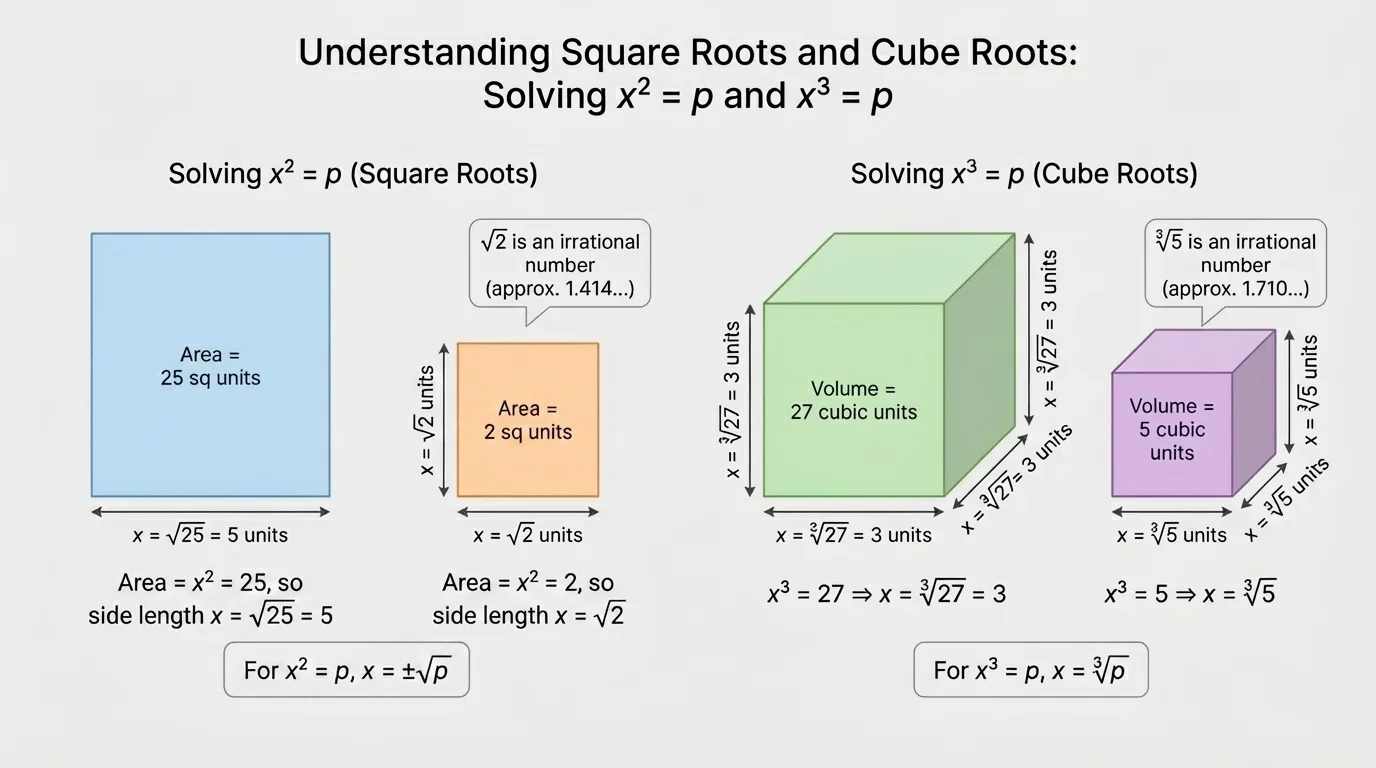
This distinction is extremely important. The expression \(\sqrt{25}\) has one value: \(5\). But the equation \(x^2 = 25\) has two solutions: \(x = 5\) and \(x = -5\). Expressions and equations are not the same thing.
Square root means a number that produces a given value when multiplied by itself.
Radical symbol is the symbol \(\sqrt{\phantom{x}}\), which is used to write roots.
Principal square root is the nonnegative square root of a number.
You can check a square root by squaring it. If \(\sqrt{36} = 6\), then \(6^2 = 36\). If the square does not match the original number, the root is incorrect.
Suppose \(p\) is a positive rational number. To solve \(x^2 = p\), we ask: what numbers square to \(p\)? Since both a positive number and its opposite have the same square, there are two solutions.
The solutions are written as
\[x = \pm \sqrt{p}\]
The symbol \(\pm\) means plus or minus. It tells us there are two values: one positive and one negative.
Solved example 1
Solve \(x^2 = 49\).
Step 1: Identify the number under the square root.
Here, \(p = 49\).
Step 2: Find the square root of \(49\).
Since \(7^2 = 49\), we have \(\sqrt{49} = 7\).
Step 3: Write both solutions.
Because \(x^2 = 49\), the solutions are \(x = 7\) and \(x = -7\).
So the solutions are \(x = \pm 7\).
Here is another example with a rational number that is not a whole number. If \(x^2 = \dfrac{9}{16}\), then the solutions are \(x = \pm \sqrt{\dfrac{9}{16}} = \pm \dfrac{3}{4}\). Both \(\dfrac{3}{4}\) and \(-\dfrac{3}{4}\) work because squaring either one gives \(\dfrac{9}{16}\).
Solved example 2
Solve \(x^2 = \dfrac{1}{25}\).
Step 1: Take the square root of each side.
\(x = \pm \sqrt{\dfrac{1}{25}}\)
Step 2: Simplify the root.
Since \(\sqrt{1} = 1\) and \(\sqrt{25} = 5\), \(\sqrt{\dfrac{1}{25}} = \dfrac{1}{5}\).
Step 3: State both solutions.
\(x = \dfrac{1}{5}\) or \(x = -\dfrac{1}{5}\)
Final answer: \[x = \pm \frac{1}{5}\]
As seen earlier in [Figure 1], square roots are tied to side lengths of squares. That is why solving \(x^2 = p\) can be thought of as finding a side length whose area is \(p\), then remembering that an algebraic variable can also be the opposite number if the equation involves squaring.
[Figure 2] The cube root of a number \(p\) is the number that, when cubed, equals \(p\). In geometry, the cube root gives the edge length of a cube with volume \(p\). The symbol is \(\sqrt[3]{\phantom{x}}\).
For example, \(\sqrt[3]{27} = 3\) because \(3^3 = 27\). Also, \(\sqrt[3]{64} = 4\) because \(4^3 = 64\).
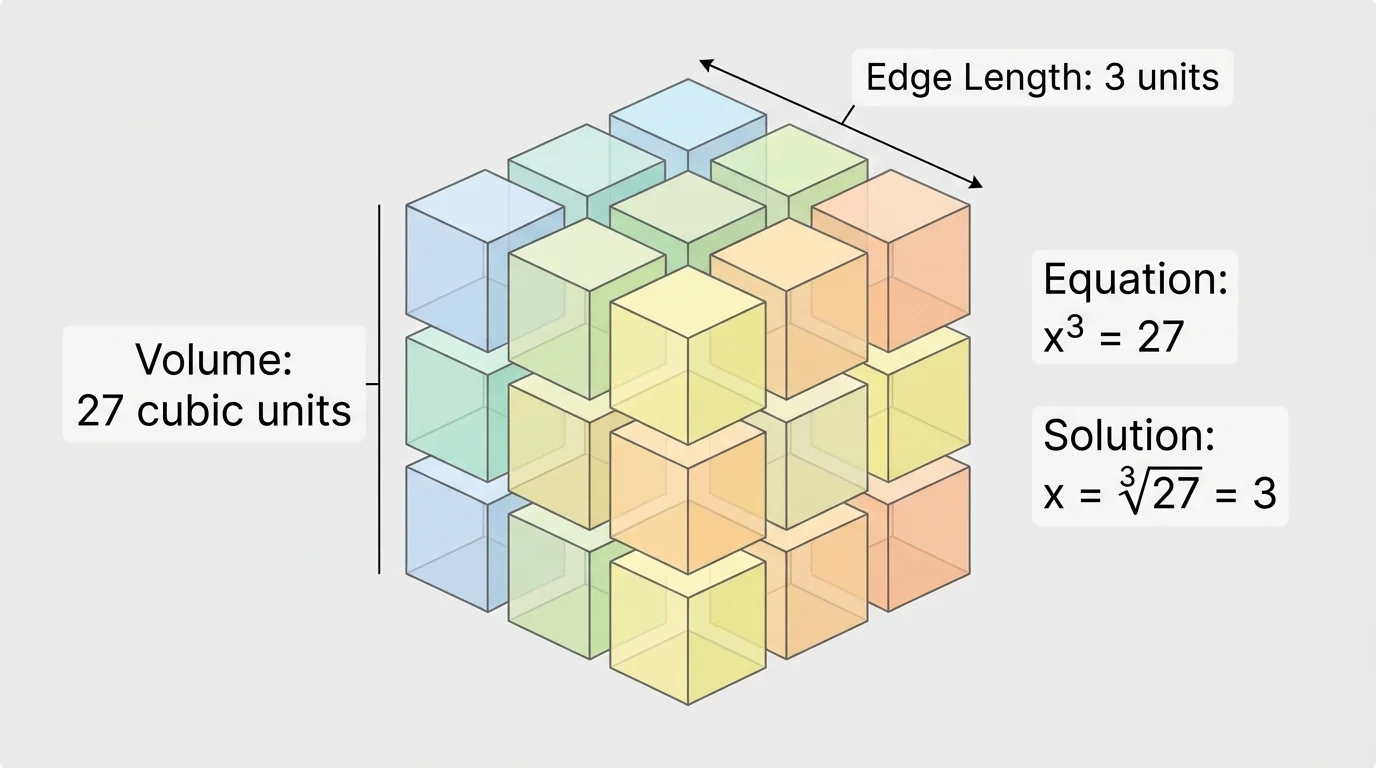
Cube roots behave differently from square roots when solving equations. A positive number has one positive cube root, and a negative number has one negative cube root. For this lesson, we focus on positive rational values of \(p\), so the solution to \(x^3 = p\) is one positive real number.
To solve \(x^3 = p\), find the number whose cube is \(p\). Unlike squaring, cubing does not make both a number and its opposite produce the same result. For example, \(2^3 = 8\), but \((-2)^3 = -8\). That means there is only one real solution when \(p\) is positive.
The solution is written as
\[x = \sqrt[3]{p}\]
Solved example 3
Solve \(x^3 = 125\).
Step 1: Identify the cube root needed.
We need the number whose cube is \(125\).
Step 2: Evaluate the cube root.
Since \(5^3 = 125\), \(\sqrt[3]{125} = 5\).
Step 3: State the solution.
\(x = 5\)
Final answer: \(x = 5\)
Now consider a rational example. If \(x^3 = \dfrac{8}{27}\), then \(x = \sqrt[3]{\dfrac{8}{27}} = \dfrac{2}{3}\), because \(\left(\dfrac{2}{3}\right)^3 = \dfrac{8}{27}\).
Solved example 4
Solve \(x^3 = \dfrac{1}{64}\).
Step 1: Write the cube root expression.
\(x = \sqrt[3]{\dfrac{1}{64}}\)
Step 2: Evaluate numerator and denominator.
\(\sqrt[3]{1} = 1\) and \(\sqrt[3]{64} = 4\).
Step 3: Simplify.
\(x = \dfrac{1}{4}\)
Final answer: \[x = \frac{1}{4}\]
The volume model from [Figure 2] helps explain why cube roots match edge lengths. If a cube has volume \(27\), its dimensions are \(3\) by \(3\) by \(3\), so the edge length must be \(3\).
Memorizing a short list of common roots is worth the effort. These exact values appear constantly in algebra.
| Number | Square Root | Number | Cube Root |
|---|---|---|---|
| \(1\) | \(\sqrt{1} = 1\) | \(1\) | \(\sqrt[3]{1} = 1\) |
| \(4\) | \(\sqrt{4} = 2\) | \(8\) | \(\sqrt[3]{8} = 2\) |
| \(9\) | \(\sqrt{9} = 3\) | \(27\) | \(\sqrt[3]{27} = 3\) |
| \(16\) | \(\sqrt{16} = 4\) | \(64\) | \(\sqrt[3]{64} = 4\) |
| \(25\) | \(\sqrt{25} = 5\) | \(125\) | \(\sqrt[3]{125} = 5\) |
| \(36\) | \(\sqrt{36} = 6\) | \(216\) | \(\sqrt[3]{216} = 6\) |
| \(49\) | \(\sqrt{49} = 7\) | ||
| \(64\) | \(\sqrt{64} = 8\) | ||
| \(81\) | \(\sqrt{81} = 9\) | ||
| \(100\) | \(\sqrt{100} = 10\) |
Table 1. Common perfect squares and perfect cubes with their exact roots.
When a number is a perfect square or a perfect cube, its root is a whole number. When it is not, the root may still exist, but it will not be a whole number.
The number \(64\) is both a perfect square and a perfect cube. That happens because \(64 = 8^2\) and also \(64 = 4^3\).
That fact shows that one number can belong to more than one pattern. Mathematics is full of overlaps like this.
[Figure 3] Not every positive number is a perfect square. The number \(2\), for example, lies between \(1\) and \(4\), so its square root lies between \(1\) and \(2\). On the number line, \(\sqrt{2}\) lies between \(1.4\) and \(1.5\), but it does not land on a rational value.
We know \(1^2 = 1\) and \(2^2 = 4\), so \(\sqrt{2}\) is greater than \(1\) and less than \(2\). A calculator gives an approximation such as \(\sqrt{2} \approx 1.41421356\ldots\), but the decimal continues forever without repeating in a pattern.
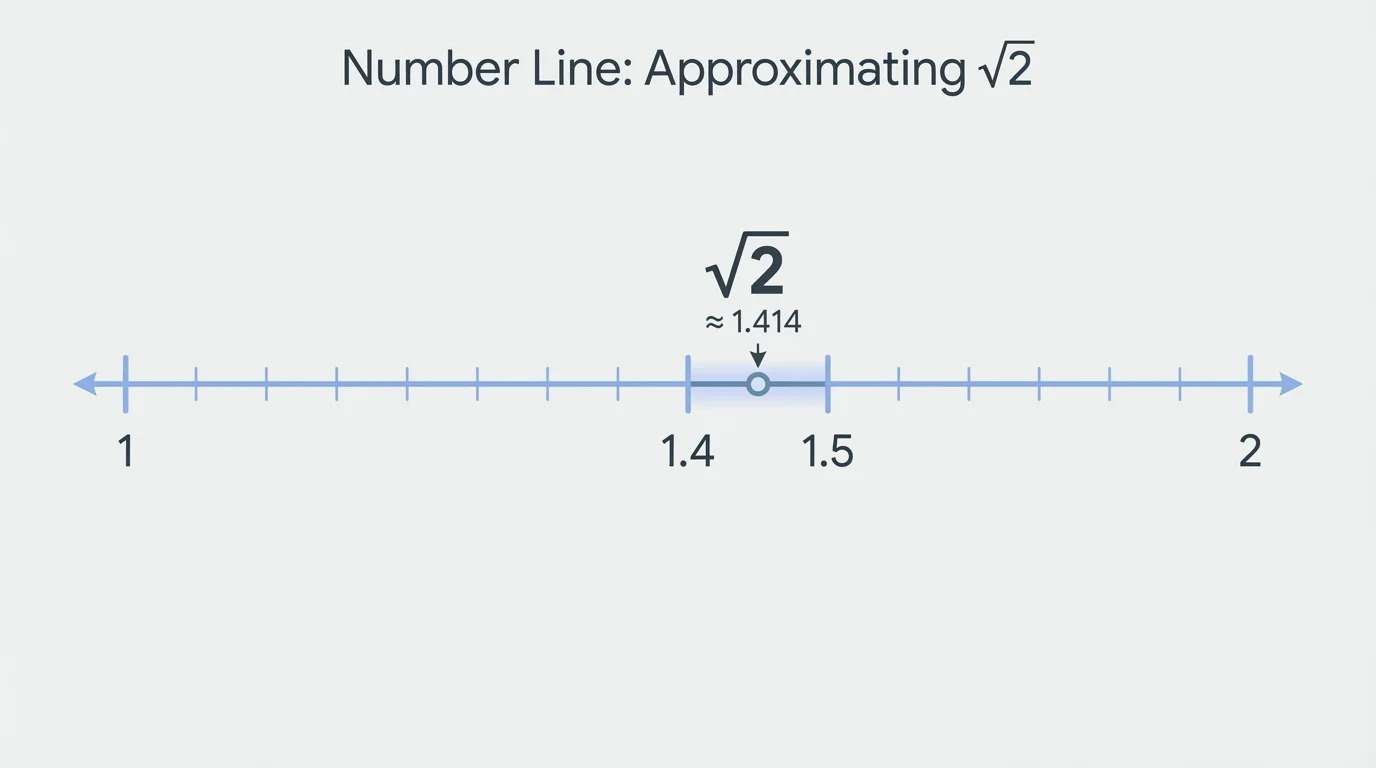
A number like this is called irrational. An irrational number cannot be written as a fraction of two integers. So even though \(2\) is a rational number, \(\sqrt{2}\) is not. This is one of the most important examples of an irrational number.
Why \(\sqrt{2}\) matters
The fact that \(\sqrt{2}\) is irrational means not every point on the number line can be described using fractions. This was a major mathematical discovery long ago, and it shows that roots can create entirely new kinds of numbers.
Later, when you work with geometry, \(\sqrt{2}\) appears often. For example, the diagonal of a square with side length \(1\) has length \(\sqrt{2}\). The location of that diagonal length on the number line matches the idea shown in [Figure 3].
Square roots and cube roots are similar because both undo powers. But they behave differently in equations.
| Feature | Square Root / \(x^2 = p\) | Cube Root / \(x^3 = p\) |
|---|---|---|
| Inverse of | Squaring | Cubing |
| Root symbol | \(\sqrt{p}\) | \(\sqrt[3]{p}\) |
| Example value | \(\sqrt{36} = 6\) | \(\sqrt[3]{27} = 3\) |
| Equation form | \(x = \pm\sqrt{p}\) | \(x = \sqrt[3]{p}\) |
| Number of real solutions for positive \(p\) | Two | One |
Table 2. Comparison of square roots and cube roots in notation and equation solving.
The biggest difference is the number of solutions in equations. If \(x^2 = p\), there are two real solutions when \(p\) is positive. If \(x^3 = p\), there is only one real solution.
Roots are not just algebra symbols. They solve measurement problems. If the area of a square garden is \(121\) square feet, then its side length is \(\sqrt{121} = 11\) feet. If the volume of a cube-shaped storage box is \(343\) cubic inches, then its edge length is \(\sqrt[3]{343} = 7\) inches.
Solved example 5
A square floor tile has area \(81\) square inches. What is its side length?
Step 1: Write the relationship.
If the side length is \(s\), then \(s^2 = 81\).
Step 2: Solve using a square root.
\(s = \sqrt{81} = 9\)
Step 3: Interpret the result.
A side length is a measurement, so we use the positive value.
Final answer: \(s = 9\)
In geometry and design, the positive value often makes sense because lengths cannot be negative. In algebra, though, both solutions must be listed if the equation is simply \(x^2 = p\).
Solved example 6
A cube-shaped gift box has volume \(8\) cubic inches. What is the edge length?
Step 1: Write the relationship.
If the edge length is \(e\), then \(e^3 = 8\).
Step 2: Take the cube root.
\(e = \sqrt[3]{8} = 2\)
Step 3: State the measurement.
The box edge length is \(2\) inches.
Final answer: \(e = 2\)
Engineers, architects, and designers use these ideas often. A known area can lead to a missing side length, and a known volume can lead to a missing edge length.
One common mistake is thinking \(\sqrt{49} = \pm 7\). That is incorrect. The expression \(\sqrt{49}\) equals only \(7\). It is the equation \(x^2 = 49\) that has two solutions, \(x = \pm 7\).
Another mistake is forgetting that cube root equations do not work the same way. For \(x^3 = 27\), the solution is just \(x = 3\), not \(x = \pm 3\).
A third mistake is assuming every square root is rational. But \(\sqrt{2}\) is irrational, and many other square roots, such as \(\sqrt{3}\) and \(\sqrt{5}\), are irrational too.
"A symbol is small, but the idea it represents can be enormous."
— Mathematical thinking in action
Understanding the meaning behind the radical symbol makes equations easier and helps you avoid memorizing rules without reasons.
