A single linear equation can describe a line, but two linear equations together can answer a much more interesting question: where do two different relationships agree? That idea shows up in everyday situations such as comparing phone plans, finding when two moving objects meet, or figuring out the prices of two items from total costs. A system of equations is really a puzzle with two clues, and the goal is to find the one pair of numbers that makes both clues true at the same time.
Suppose one equation tells you the total cost of notebooks and pens, and another equation gives a different purchase with the same two items. One equation alone usually leaves many possibilities. Two equations often narrow those possibilities down to just one answer. That is why systems are useful: they connect two relationships and help you find an exact pair of values.
In grade-level algebra, we focus on systems of two linear equations in two variables, usually written with variables like \(x\) and \(y\). A typical system might be
\[\begin{cases} x + y = 10 \\ x - y = 2 \end{cases}\]
The solution is the ordered pair \((x, y)\) that makes both equations true.
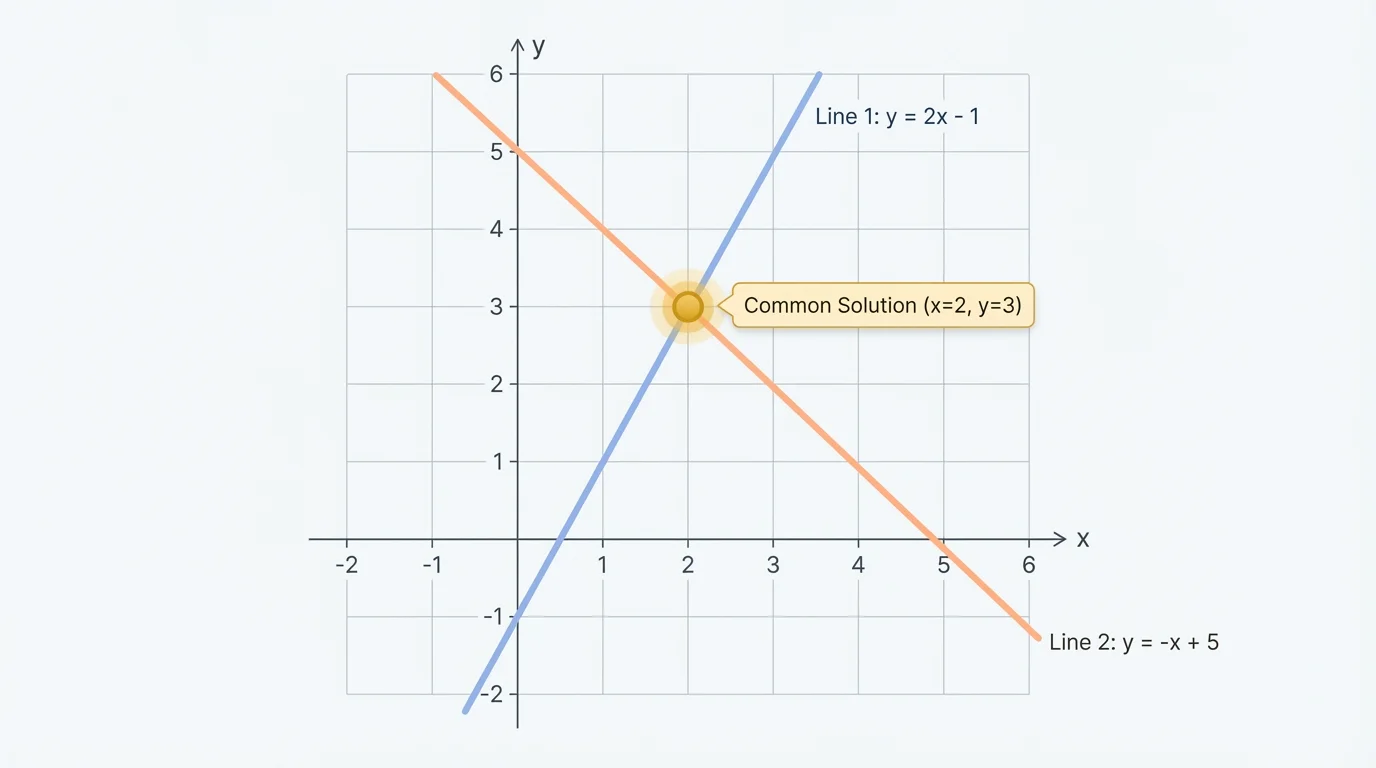
A system of linear equations is a set of two or more linear equations with the same variables that are solved together. A solution is a pair of values that satisfies every equation in the system. On a graph, each linear equation forms a line, and the solution is the point both lines share, as shown in [Figure 1]. If the lines cross, their intersection gives the solution.
For example, consider the system \(y = x + 1\) and \(y = -x + 5\). If \(x = 2\), then the first equation gives \(y = 3\). The second equation also gives \(y = 3\). So \((2, 3)\) is the solution because it works in both equations.
An ordered pair tells the values of \(x\) and \(y\) in a specific order: first \(x\), then \(y\). So \((2, 3)\) means \(x = 2\) and \(y = 3\), not the other way around.
System of two linear equations means two equations with the same variables, solved together.
Solution means the ordered pair that makes both equations true.
Intersection means the point where two graphs meet.
It is important to remember that not every pair of numbers that works for one equation will work for the other. In a system, the answer must satisfy both at once. That is what makes systems different from solving a single equation.
Some systems are so simple that you can solve them just by looking carefully. This is called solving by inspection. You are using patterns in the equations to spot the answer without a full algebraic process.
For example, look at
\[\begin{cases} x + y = 7 \\ x = 3 \end{cases}\]
If \(x = 3\), then the first equation becomes \(3 + y = 7\), so \(y = 4\). The solution is \((3, 4)\).
Sometimes inspection tells you there is no solution. For example,
\[\begin{cases} 3x + 2y = 5 \\ 3x + 2y = 6 \end{cases}\]
These equations have exactly the same left side but different right sides. The expression \(3x + 2y\) cannot be equal to \(5\) and \(6\) at the same time, so the system has no solution.
Sometimes inspection tells you there are infinitely many solutions. For example,
\[\begin{cases} 2x + y = 8 \\ 4x + 2y = 16 \end{cases}\]
The second equation is just the first equation multiplied by \(2\). They describe the same line, so every point on that line is a solution.
To solve systems, you need earlier skills with solving one-variable equations, substituting values, and recognizing slope-intercept form such as \(y = mx + b\).
Inspection works best when one equation already gives a variable's value, or when the relationship between the two equations is obvious. If not, use algebraic methods.
Substitution means replacing one variable with an equal expression from the other equation. This method is especially useful when one equation is already solved for one variable, such as \(y = 2x + 1\) or \(x = 5 - y\).
The general idea is simple: solve one equation for one variable, substitute that expression into the other equation, solve for the remaining variable, and then substitute back.
Worked example 1: Solve by substitution
Solve the system \(y = x + 2\) and \(2x + y = 11\).
Step 1: Substitute the expression for \(y\) into the second equation.
Since \(y = x + 2\), replace \(y\) in \(2x + y = 11\):
\(2x + (x + 2) = 11\)
Step 2: Solve for \(x\).
Combine like terms: \(3x + 2 = 11\)
Subtract \(2\): \(3x = 9\)
Divide by \(3\): \(x = 3\)
Step 3: Substitute back to find \(y\).
Use \(y = x + 2\): \(y = 3 + 2 = 5\)
The solution is \((3, 5)\).
Always check by substituting the ordered pair into both original equations. For \((3, 5)\), the first equation gives \(5 = 3 + 2\), true. The second gives \(2(3) + 5 = 11\), also true.
Substitution also works when neither equation starts in isolated form, but you may need an extra step first.
Worked example 2: Solve by substitution after isolating a variable
Solve the system \(x + y = 9\) and \(x - y = 1\).
Step 1: Isolate one variable in one equation.
From \(x + y = 9\), subtract \(x\): \(y = 9 - x\)
Step 2: Substitute into the other equation.
Replace \(y\) in \(x - y = 1\): \(x - (9 - x) = 1\)
Step 3: Solve for \(x\).
Distribute the minus sign: \(x - 9 + x = 1\)
So \(2x - 9 = 1\)
Add \(9\): \(2x = 10\)
Divide by \(2\): \(x = 5\)
Step 4: Find \(y\).
Use \(y = 9 - x\): \(y = 9 - 5 = 4\)
The solution is \((5, 4)\).
Substitution is often efficient when a variable has a coefficient of \(1\) or \(-1\), because isolating that variable is quick.
Elimination means combining equations so that one variable cancels out. Then you can solve for the other variable. This method is especially useful when the coefficients are already opposites, or can easily be made opposites.
The strategy is to add or subtract the equations. If the coefficients of one variable are opposites, that variable disappears.
Worked example 3: Solve by elimination
Solve the system \(x + y = 10\) and \(x - y = 2\).
Step 1: Add the equations.
\((x + y) + (x - y) = 10 + 2\)
The \(y\) terms cancel, giving \(2x = 12\).
Step 2: Solve for \(x\).
\(x = 6\)
Step 3: Substitute back to find \(y\).
Use \(x + y = 10\): \(6 + y = 10\), so \(y = 4\)
The solution is \((6, 4)\).
Sometimes you must multiply one or both equations first so a variable will eliminate.
Worked example 4: Elimination with multiplication first
Solve the system \(2x + y = 9\) and \(x - y = 3\).
Step 1: Notice that the \(y\)-coefficients are already opposites: \(+1\) and \(-1\).
Add the equations directly:
\((2x + y) + (x - y) = 9 + 3\)
Step 2: Solve for \(x\).
\(3x = 12\), so \(x = 4\)
Step 3: Find \(y\).
Use \(x - y = 3\): \(4 - y = 3\)
Subtract \(4\): \(-y = -1\)
So \(y = 1\)
The solution is \((4, 1)\).
Here is another case where multiplication helps.
Worked example 5: Multiply to create opposites
Solve the system \(x + y = 7\) and \(2x + 3y = 17\).
Step 1: Multiply the first equation by \(-2\) so the \(x\)-terms will cancel.
\(-2(x + y = 7)\) gives \(-2x - 2y = -14\)
Step 2: Add this new equation to the second equation.
\(( -2x - 2y ) + ( 2x + 3y ) = -14 + 17\)
This simplifies to \(y = 3\)
Step 3: Substitute back.
Use \(x + y = 7\): \(x + 3 = 7\), so \(x = 4\)
The solution is \((4, 3)\).
Elimination and substitution both lead to the same correct solution. Often, the smarter method is the one that looks simplest for the particular system in front of you.
Graphing gives a visual way to solve a system. Each equation becomes a line, and the solution is where the lines intersect. When the intersection falls exactly on a grid point, you can read the exact solution. When it falls between grid points, you can estimate the solution, as [Figure 2] shows.
To graph a system well, it helps to write each equation in slope-intercept form, \(y = mx + b\), when possible. Then you can identify the slope and \(y\)-intercept and draw each line on the same coordinate plane.
Suppose the system is \(y = 2x + 1\) and \(y = -x + 4\). If you graph both lines, they cross at \((1, 3)\). That means \((1, 3)\) is the solution.
Now consider \(y = 1.5x + 1\) and \(y = -x + 5\). The lines may intersect between grid points. From the graph, you might estimate the solution is about \((1.6, 3.4)\). A graph is great for understanding the relationship, but algebra is usually better for exact answers.
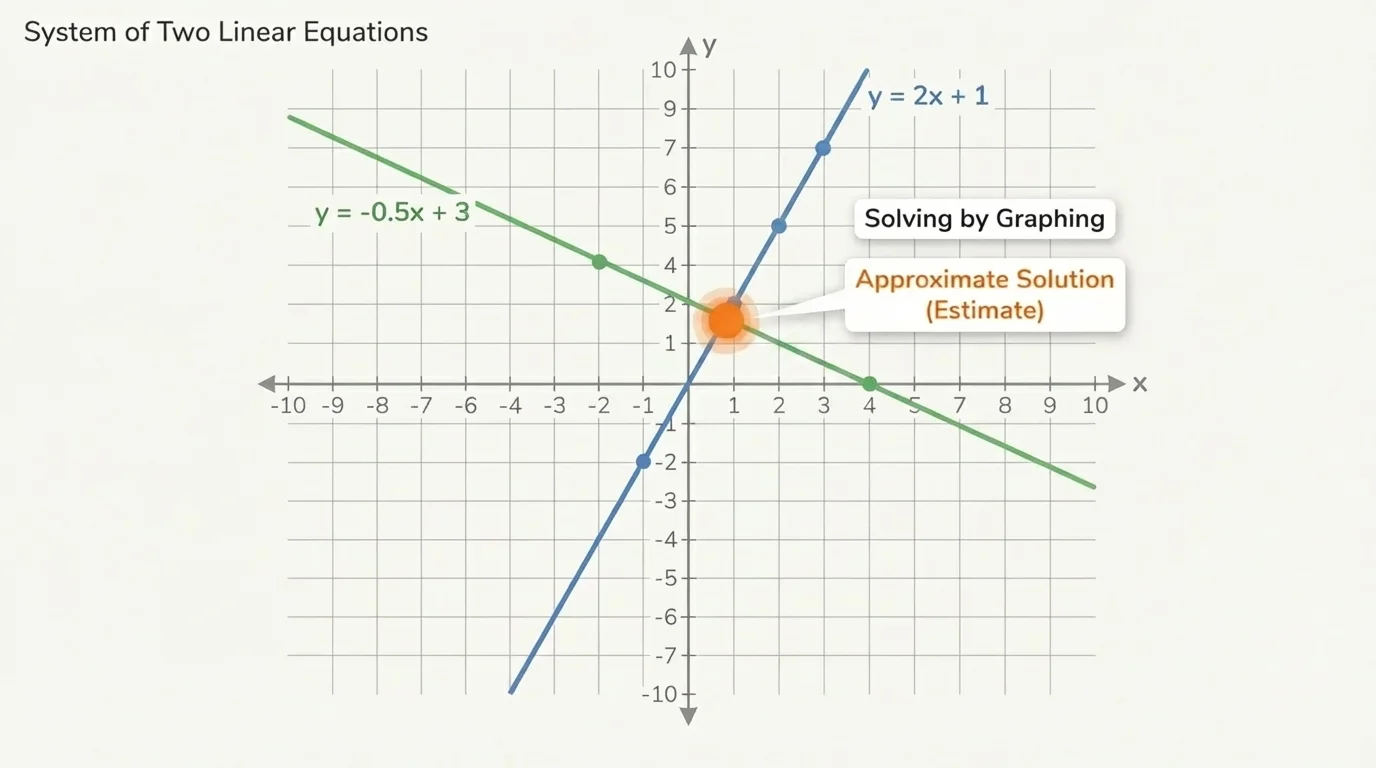
Graphing is especially helpful because it shows more than just the answer. You can see whether the lines cross once, never cross, or lie on top of each other. That visual idea connects directly to the number of solutions.
When you look back at the intersecting lines in [Figure 1], you can see why one shared point means one solution. The graph makes the algebra feel less mysterious.
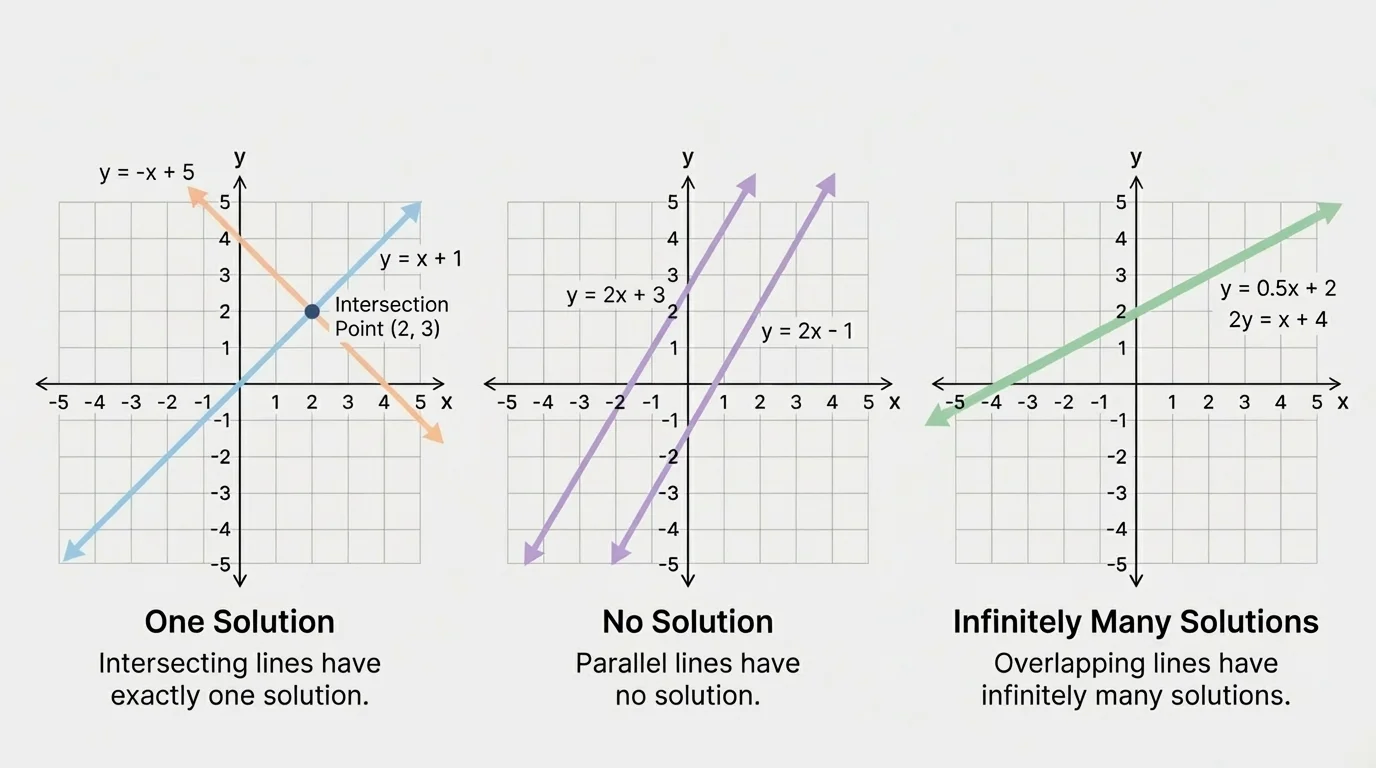
Every system of two linear equations fits one of three cases. The graphs in [Figure 3] display these patterns clearly: intersecting lines, parallel lines, and overlapping lines.
One solution: The lines intersect once. This is the most common case. Example:
\[\begin{cases} y = x + 1 \\ y = -x + 5 \end{cases}\]
These lines have different slopes, so they cross at one point.
No solution: The lines are parallel. They have the same slope but different \(y\)-intercepts, so they never meet. Example:
\[\begin{cases} y = 2x + 1 \\ y = 2x - 3 \end{cases}\]
Infinitely many solutions: The equations represent the same line. Example:
\[\begin{cases} y = 3x + 2 \\ 2y = 6x + 4 \end{cases}\]
If you simplify the second equation by dividing both sides by \(2\), you get \(y = 3x + 2\), the same as the first equation.
How algebra reveals the number of solutions
If solving a system leads to a true statement like \(0 = 0\), the equations are equivalent and the system has infinitely many solutions. If it leads to a false statement like \(0 = 4\), the equations are inconsistent and the system has no solution.
For example, in the no-solution system \(3x + 2y = 5\) and \(3x + 2y = 6\), subtracting the equations gives \(0 = 1\), which is impossible. That tells you the lines are parallel even before graphing.
Later, when you compare graphs and equations, [Figure 3] helps connect the visual pattern to the algebra result. A false statement means parallel lines; a true statement means the same line.
After solving a system, always check your answer in both original equations. This catches arithmetic mistakes and confirms that the ordered pair really is the common solution.
Suppose you found \((4, 3)\) for the system \(x + y = 7\) and \(2x + 3y = 17\). Check:
First equation: \(4 + 3 = 7\), true.
Second equation: \(2(4) + 3(3) = 8 + 9 = 17\), true.
Because the pair works in both equations, it is correct.
Two lines in a plane can only intersect once, never intersect, or completely overlap. That geometric fact is exactly why a system of two linear equations has one solution, no solution, or infinitely many solutions.
If a pair works in only one equation, it is not a solution to the system. The word system means all equations matter.
Systems are not just school exercises. They model situations where two different pieces of information describe the same unknown values.
Suppose a school event sells student tickets and adult tickets. Let \(s\) be the student ticket price and \(a\) be the adult ticket price. If one purchase is \(2s + a = 19\) and another is \(s + 2a = 23\), you can solve the system to find the two ticket prices.
Systems also help compare plans. If one phone plan costs a monthly fee plus a charge per gigabyte, and another plan has a different fee and rate, the system tells when the two plans cost the same. That matching point is the intersection of two linear equations.
In science and engineering, systems can describe two measurements that depend on the same unknown values. In business, they can model cost and revenue. In travel, they can represent distance over time for two moving objects and predict when they meet.
Worked example 6: Real-world ticket problem
A concert sells student tickets for \(s\) dollars and adult tickets for \(a\) dollars. One group buys \(2\) student tickets and \(1\) adult ticket for \(\$19\). Another group buys \(1\) student ticket and \(2\) adult tickets for \(\$23\). Find the ticket prices.
Step 1: Write the system.
\(2s + a = 19\)
\(s + 2a = 23\)
Step 2: Use substitution or elimination.
From \(2s + a = 19\), isolate \(a\): \(a = 19 - 2s\)
Substitute into \(s + 2a = 23\): \(s + 2(19 - 2s) = 23\)
Step 3: Solve for \(s\).
\(s + 38 - 4s = 23\)
\(-3s + 38 = 23\)
\(-3s = -15\)
\(s = 5\)
Step 4: Find \(a\).
\(a = 19 - 2(5) = 9\)
So the student ticket costs \(\$5\) and the adult ticket costs \(\$9\).
This kind of problem shows why systems matter: one equation alone would not tell the prices, but two related equations do.
There is no single best method for every system. Good problem solvers choose efficiently.
| Method | Best used when | What it gives |
|---|---|---|
| Inspection | One value or relationship is obvious | Quick answer or quick classification |
| Substitution | One variable is already isolated or easy to isolate | Exact solution |
| Elimination | Coefficients are opposites or can be made opposites | Exact solution |
| Graphing | You want a visual model or an estimate | Estimated or sometimes exact solution |
Table 1. Comparison of common methods for solving systems of two linear equations.
If you are asked to estimate, graphing is ideal. If you need an exact answer, substitution or elimination is usually better. If the structure of the equations makes the answer obvious, inspection is fastest.
"A solution to a system is not just a number that works once. It is a pair that makes every equation true."
That idea is the heart of the topic. Whether you solve with algebra or read a graph, you are always looking for the same thing: the shared truth of both equations.
