A video game character turns, slides, flips, and is scaled on a screen thousands of times per second, yet each motion follows the same mathematical idea: every point of the figure is sent to a new point. That is the heart of plane transformations. What looks like motion or change is actually a precise rule acting on coordinates.
In geometry, transformations help us describe when figures have the same shape, the same size, or the same geometric structure. They also connect algebra and geometry, because a movement on a graph can be written as a function. When you treat a transformation as a function, each input point such as \( (x,y) \) has exactly one output point such as \( (x+3, y-2) \). This viewpoint makes geometric reasoning more exact and more powerful.
Transformations are not just classroom ideas. Architects use them when repeating design patterns. Engineers use them in computer-aided design. Robotics relies on rotations and translations to describe arm positions. Image-editing software flips, stretches, and rotates pictures using transformation rules. In all of these settings, the geometry of a shape matters: sometimes the shape must stay exactly the same, and sometimes it is intentionally distorted.
One of the most important questions in geometry is whether a transformation preserves distance and angle measure. If it does, the original figure and the image are congruent. If it does not, then the transformation changes size, shape, or both. This distinction helps explain why a translation keeps a triangle identical while a horizontal stretch can turn a square into a rectangle.
Transformation is a rule that assigns each point in the plane to exactly one point in the plane.
Preimage is the original figure before a transformation.
Image is the new figure after the transformation.
Rigid transformation is a transformation that preserves distance and angle, so the image is congruent to the preimage.
A useful way to think about transformations is to imagine transparent paper placed over a coordinate grid. You can slide the paper, turn it, or flip it. Those actions model transformations. Geometry software does the same thing digitally, but with exact coordinates and rules.
A transformation can be understood as a function, as [Figure 1] illustrates. The input is a point in the plane, and the output is another point in the plane. For example, one rule might send a point \(A\) at \( (1,2) \) to \(A'\) at \( (4,2) \), while a different rule might send it to \( (-1,2) \).
This function idea is essential: one input point must lead to exactly one output point. A full figure is transformed by applying the same rule to every point on the figure. So if a triangle has vertices \(A\), \(B\), and \(C\), then the image has vertices \(A'\), \(B'\), and \(C'\), where each prime-labeled point is the output of the transformation.
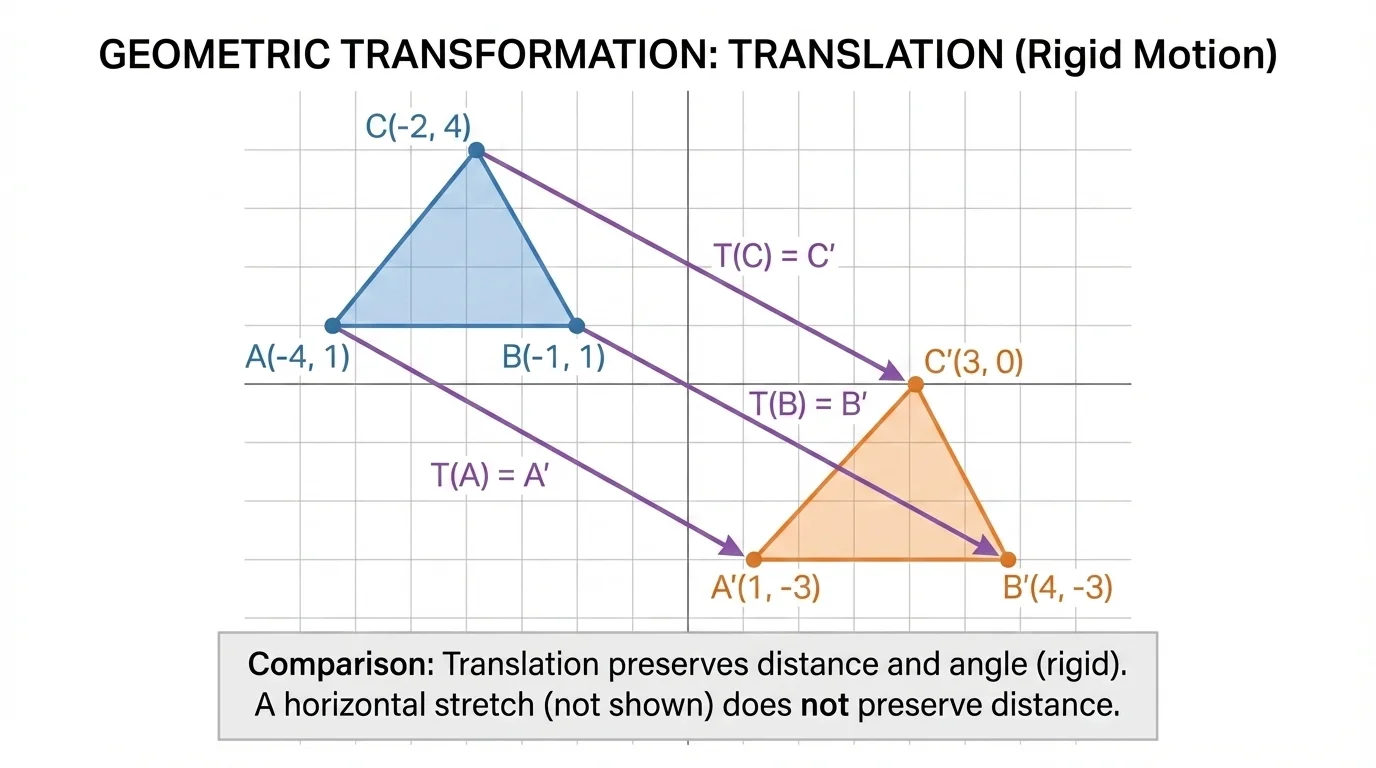
In geometry, naming matters. The original figure is the preimage, and the transformed figure is the image. The notation with primes, such as \(P'\), helps track where points move. If \(P(2,-1)\) becomes \(P'(5,3)\), then the transformation has mapped one point to another in a specific way.
Because transformations are functions, they can be written in coordinate form. A rule such as \( (x,y) \rightarrow (x+4,y-1) \) tells you exactly what happens to every point. The rule is simple, but its effect on a whole figure can be dramatic. As we saw in [Figure 1], once the vertices move according to the rule, the entire figure moves with them.
Rigid transformations move a figure without changing its size or shape, and [Figure 2] shows the three most common ones. These are translation, reflection, and rotation. Since they preserve distance and angle measure, they produce congruent images.
A translation slides a figure. Every point moves the same distance in the same direction. For example, the rule \( (x,y) \rightarrow (x+3, y-2) \) moves points \(3\) units right and \(2\) units down.
A reflection flips a figure across a line called the line of reflection. If you reflect across the \(x\)-axis, points follow the rule \( (x,y) \rightarrow (x,-y) \). If you reflect across the \(y\)-axis, the rule is \( (x,y) \rightarrow (-x,y) \).
A rotation turns a figure around a fixed point called the center of rotation. A \(90^\circ\) counterclockwise rotation about the origin follows the rule \( (x,y) \rightarrow (-y,x) \). A \(180^\circ\) rotation about the origin follows \( (x,y) \rightarrow (-x,-y) \).
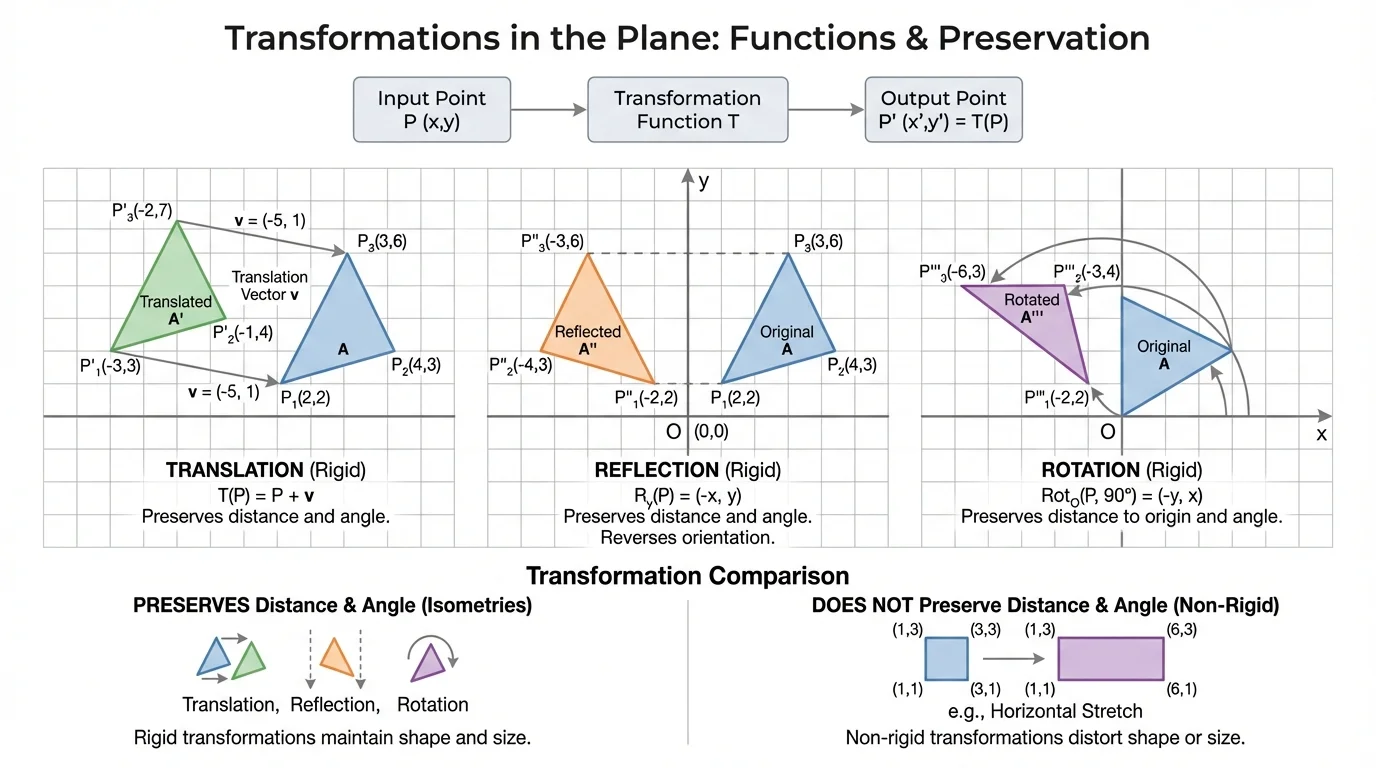
These three transformations preserve side lengths, angle measures, and overall shape. If a triangle is transformed by a translation, reflection, or rotation, the image triangle is congruent to the original. That fact is one foundation of congruence in geometry.
One subtle point is orientation. A translation or rotation keeps the clockwise or counterclockwise order of vertices, but a reflection reverses it. So reflections still preserve distance and angle, but they switch orientation.
Preserving distance and angle
If a transformation preserves distance, then for any two points \(P\) and \(Q\), the distance between \(P\) and \(Q\) is the same as the distance between \(P'\) and \(Q'\). If it preserves angle, then any angle in the preimage has the same measure in the image. Rigid transformations preserve both, which is why they produce congruent figures.
That is why geometric proofs often use rigid transformations. Instead of just saying two figures match, you can show that one can be translated, reflected, or rotated onto the other. The visual idea in [Figure 2] becomes a precise mathematical statement about congruence.
Not all transformations preserve distance and angle. Some change size, and some even change shape. This is where it becomes important to compare transformations carefully, as [Figure 3] makes clear. Two transformations may both make a figure look larger, but they do not necessarily preserve the same properties.
A dilation changes the size of a figure by a scale factor. If the center is the origin and the scale factor is \(k\), then the rule is \( (x,y) \rightarrow (kx,ky) \). For example, if \(k=2\), every coordinate doubles. Distances change by a factor of \(2\), so distance is not preserved, but angle measure is preserved. A dilation keeps shapes similar, though not congruent unless \(k=1\).
A horizontal stretch changes only the \(x\)-coordinates. A rule such as \( (x,y) \rightarrow (2x,y) \) doubles widths but leaves heights unchanged. This does not preserve distance, and it usually does not preserve angle measure either. A square under this transformation becomes a rectangle, so the shape is altered.
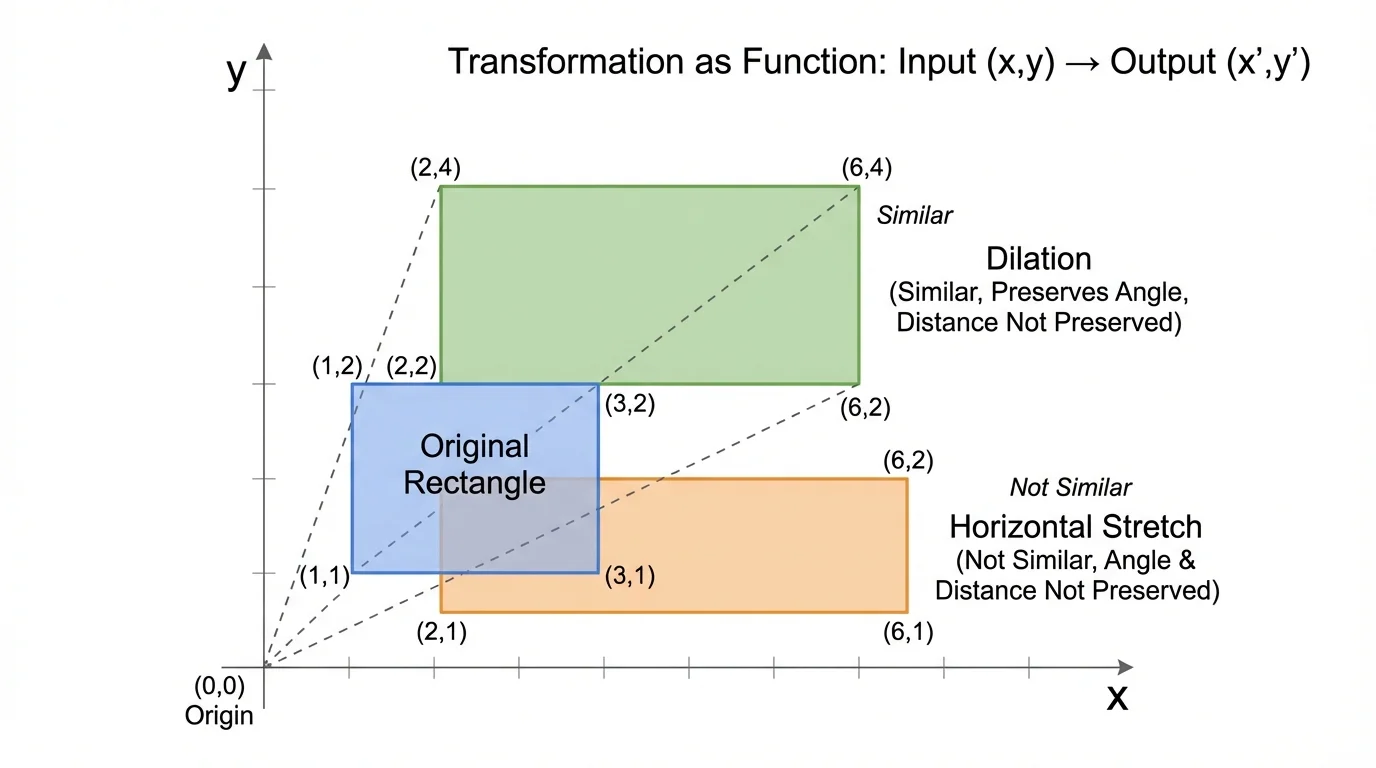
This contrast is important. A dilation changes size uniformly in every direction from a center. A horizontal stretch changes size unevenly, only in one direction. Because of that, dilation preserves angle measure while horizontal stretch typically does not.
Both dilations and stretches preserve some basic geometric structure. For instance, lines still map to lines, and parallel lines remain parallel. But preserving those properties is not enough for congruence. Congruence requires preserved distance and angle, which only rigid transformations provide.
Coordinate rules let us describe a transformation exactly, and [Figure 4] shows why this is so useful. Instead of saying a point "moves somehow," we can write a rule that works for every point on the plane.
Here are several important coordinate rules for transformations about the origin or coordinate axes:
| Transformation | Coordinate rule |
|---|---|
| Translation right \(a\), up \(b\) | \( (x,y) \rightarrow (x+a,y+b) \) |
| Reflection across \(x\)-axis | \( (x,y) \rightarrow (x,-y) \) |
| Reflection across \(y\)-axis | \( (x,y) \rightarrow (-x,y) \) |
| Reflection across \(y=x\) | \( (x,y) \rightarrow (y,x) \) |
| Rotation \(90^\circ\) counterclockwise | \( (x,y) \rightarrow (-y,x) \) |
| Rotation \(180^\circ\) | \( (x,y) \rightarrow (-x,-y) \) |
| Dilation by factor \(k\) | \( (x,y) \rightarrow (kx,ky) \) |
| Horizontal stretch by factor \(k\) | \( (x,y) \rightarrow (kx,y) \) |
Table 1. Common coordinate rules for transformations in the plane.
These rules help connect geometry with algebra. For example, if a point is \( (3,1) \), then a \(90^\circ\) counterclockwise rotation sends it to \( (-1,3) \). A reflection across \(y=x\) sends it to \( (1,3) \). Seeing both on a graph, as in [Figure 4], helps you understand how different rules produce different outputs.
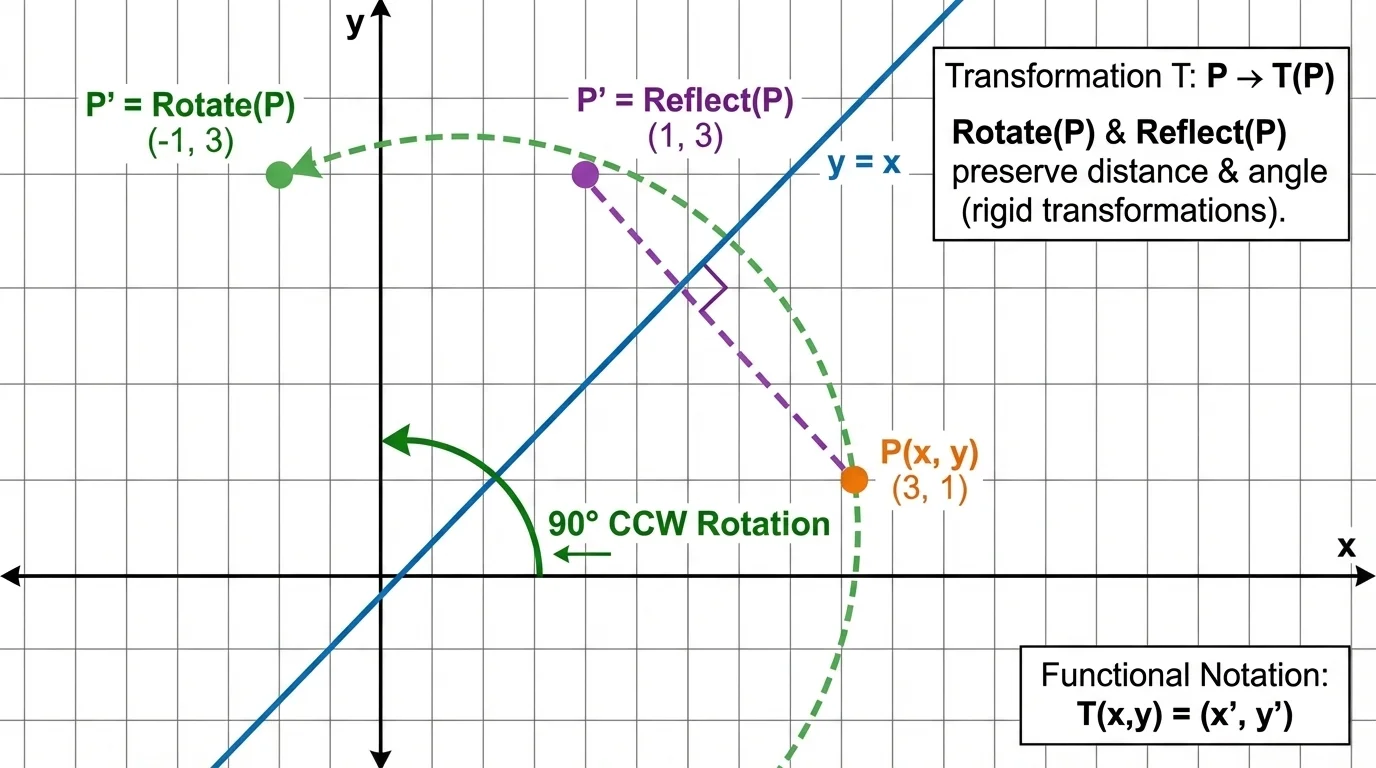
When dealing with a whole figure, apply the rule to every vertex, then connect the image points in the same order. This method is especially efficient for polygons, because the edges follow once the vertices are known.
On a coordinate plane, the distance between two points can be checked with the distance formula, and angle relationships can be judged from slopes or known geometric structure. Those tools help verify whether a transformation is rigid or not.
Another important idea is composition. A figure might be translated and then reflected, or rotated and then dilated. A composition of rigid transformations is still rigid. But if a non-rigid transformation such as a stretch is included, distance preservation is lost.
It is helpful to compare transformations by the properties they preserve. In geometry, the most important preserved properties include distance, angle measure, collinearity, parallelism, and orientation.
| Transformation | Distance preserved? | Angle preserved? | Parallel lines preserved? | Orientation preserved? |
|---|---|---|---|---|
| Translation | Yes | Yes | Yes | Yes |
| Reflection | Yes | Yes | Yes | No |
| Rotation | Yes | Yes | Yes | Yes |
| Dilation | No | Yes | Yes | Yes |
| Horizontal stretch | No | No, in general | Yes | Yes |
Table 2. Comparison of major properties preserved by common plane transformations.
This table shows why translation and horizontal stretch are a useful contrast. Both can move points predictably, and both can be written as coordinate rules. But a translation keeps every length and angle unchanged, while a horizontal stretch changes many lengths and often changes angle measures too.
That difference explains why one transformation can establish congruence and the other cannot. Congruent figures require a perfect match in size and shape. A translation gives that. A horizontal stretch does not.
Worked examples make the function view of transformations more concrete. In each case, start with the rule, apply it to points, and then interpret what geometric properties were preserved.
Worked example 1
Triangle \(ABC\) has vertices \(A(1,2)\), \(B(4,2)\), and \(C(2,5)\). Translate the triangle by the rule \( (x,y) \rightarrow (x+3,y-1) \).
Step 1: Apply the rule to each vertex.
For \(A(1,2)\): \(A'(1+3,2-1)=(4,1)\).
For \(B(4,2)\): \(B'(4+3,2-1)=(7,1)\).
For \(C(2,5)\): \(C'(2+3,5-1)=(5,4)\).
Step 2: State the image.
The translated triangle has vertices \(A'(4,1)\), \(B'(7,1)\), and \(C'(5,4)\).
Step 3: Interpret the result.
Every point moved \(3\) units right and \(1\) unit down, so side lengths and angle measures stay the same.
The image is congruent to the original because translation is a rigid transformation.
The first example shows the power of coordinate rules: one short algebraic rule transforms an entire figure while preserving congruence.
Worked example 2
Point \(P(-2,5)\) is rotated \(90^\circ\) counterclockwise about the origin. Find the image.
Step 1: Recall the coordinate rule.
A \(90^\circ\) counterclockwise rotation about the origin uses \( (x,y) \rightarrow (-y,x) \).
Step 2: Substitute the coordinates.
Since \(x=-2\) and \(y=5\), the image is \( (-5,-2) \).
Step 3: Check the geometry.
The distance from the origin remains the same before and after rotation, which is consistent with a rigid transformation.
The image of \(P\) is \(P'(-5,-2)\).
Rotations can feel less intuitive than translations, but coordinate rules make them precise. The graph in [Figure 4] helps visualize that quarter-turn movement around the origin.
Worked example 3
Square \(QRST\) has vertices \(Q(0,0)\), \(R(2,0)\), \(S(2,2)\), and \(T(0,2)\). Apply the horizontal stretch \( (x,y) \rightarrow (3x,y) \).
Step 1: Transform each vertex.
\(Q'(0,0)\), \(R'(6,0)\), \(S'(6,2)\), and \(T'(0,2)\).
Step 2: Compare side lengths.
The original square has side length \(2\). The image has width \(6\) and height \(2\).
Step 3: Draw a conclusion.
The image is a rectangle, not a square. Distances are not preserved uniformly, and the figure is no longer congruent to the original.
The transformation changes the shape, so it is not rigid.
This example explains why a horizontal stretch differs so sharply from a translation. As [Figure 3] shows, widening only one direction changes proportions.
Worked example 4
Triangle \(DEF\) has vertices \(D(1,1)\), \(E(3,1)\), and \(F(2,4)\). Dilate the triangle from the origin by scale factor \(2\).
Step 1: Use the dilation rule.
For scale factor \(2\), the rule is \( (x,y) \rightarrow (2x,2y) \).
Step 2: Transform the vertices.
\(D'(2,2)\), \(E'(6,2)\), and \(F'(4,8)\).
Step 3: Compare the figures.
All side lengths double, but corresponding angles stay equal. The image is similar to the original, not congruent.
The dilation preserves angle but not distance.
The contrast between this result and Worked Example 3 is central. A dilation enlarges uniformly, preserving shape. A horizontal stretch enlarges unevenly, so shape may change.
Transformations are built into modern technology. In computer graphics, a character moving across a screen uses translations, turning uses rotations, and mirror effects use reflections. Scaling an icon larger is like dilation, while stretching an image sideways is exactly a horizontal stretch.
In manufacturing and architecture, rigid transformations matter because parts must fit exactly. If a metal component is rotated in a design program, its lengths and angles must remain unchanged. A non-rigid change would distort the part and make it unusable.
Maps and navigation systems also rely on transformation ideas. A map image may be translated on a screen as you scroll. A drone changing direction can be described using rotations. In robotics, an arm may rotate at one joint and then translate the position of a tool. Those motions can be modeled as compositions of transformations.
Modern animation software often stores objects as coordinates and then applies transformation matrices to move them efficiently. The mathematics behind what looks smooth and artistic is deeply geometric.
Even in scientific imaging, transformations matter. Doctors compare scans taken at different times, and the images may need to be aligned by translations or rotations before changes can be measured accurately. Preserving shape is crucial when the goal is reliable comparison.
One common mistake is thinking that every transformation preserves shape. That is false. Some preserve shape and size, some preserve shape but not size, and some preserve neither. Translation, reflection, and rotation preserve both shape and size. Dilation preserves shape but changes size. A horizontal stretch often changes shape.
Another mistake is thinking that if parallel lines are preserved, then the transformation must be rigid. But dilations and stretches can also preserve parallel lines while still changing distances.
A third mistake is forgetting that a transformation is a function. Each input point must have exactly one output point. If a rule sent one point to two different places, it would not be a valid transformation in this sense.
Finally, students sometimes memorize coordinate rules without understanding them geometrically. The best understanding comes from combining both views: the rule tells you exactly what happens, and the graph shows why it happens.
