A small change in a phone app can make a shape on the screen suddenly appear twice as large, half as large, or reversed through a point and scaled at the same time. That visual effect is not just a graphics trick. In geometry, it is described by a precise transformation called a dilation, and one of its most important properties is that every line segment changes length according to a fixed ratio. If the scale factor is \(2\), every segment becomes twice as long. If the scale factor is \(\dfrac{1}{3}\), every segment becomes one-third as long. This simple rule is one of the foundations of similarity.
To understand this idea clearly, it helps to separate what changes from what does not. A dilation changes size, but it does not change the basic shape of a figure. Angles stay the same, corresponding sides remain proportional, and line segments are stretched or shrunk by a common multiplier.
A dilation is a transformation that moves points closer to or farther from a fixed center. That fixed point is called the center of dilation. If a point \(A\) is dilated to \(A'\), then \(A'\) lies on the same ray from the center as \(A\). The amount of change is controlled by the scale factor, usually written as \(k\).
If the original segment is \(\overline{AB}\) and its image after dilation is \(\overline{A'B'}\), then the length of the image segment is found by multiplying the original length by the scale factor:
\[A'B' = |k| \cdot AB\]
The absolute value appears because a length is always nonnegative. In many high school examples, the scale factor is positive, so this is often written more simply as
\[A'B' = k \cdot AB\]
when \(k > 0\).
This means the ratio of the image length to the original length is the scale factor:
\[\frac{A'B'}{AB} = |k|\]
That ratio is the key experimental property. If you measure a segment before and after a dilation, the quotient of the new length divided by the old length is always the same for every segment in the figure.
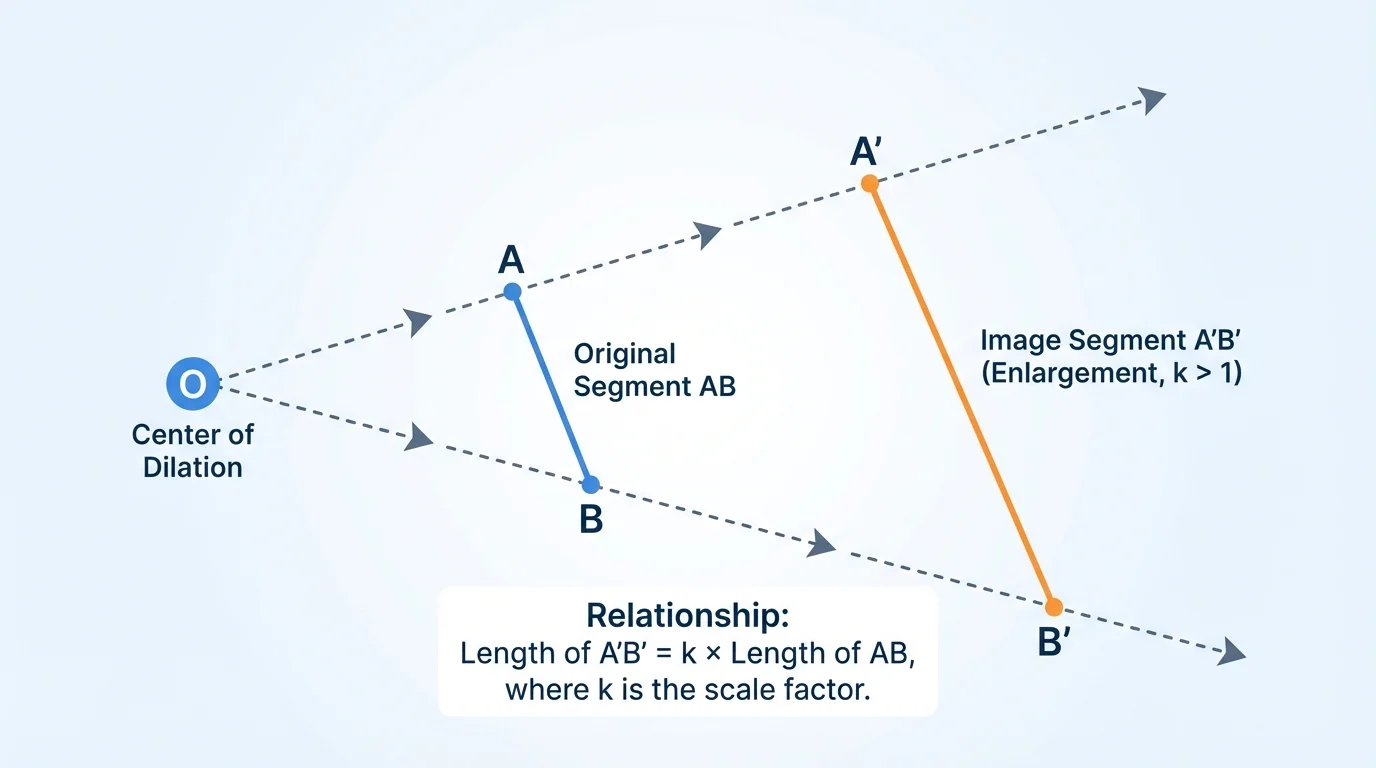
Center of dilation is the fixed point from which distances are measured during a dilation.
Scale factor is the number that tells how much every distance from the center is multiplied.
Image is the transformed figure after the dilation.
Notice an important detail: the segment does not just float randomly to a new location. Each endpoint moves in a way determined by the center. If \(k = 3\), then each image point is three times as far from the center as the original point. If \(k = \dfrac{1}{2}\), then each image point is half as far from the center as the original point.
Suppose you draw a segment \(\overline{AB}\) with length \(5\) units. If you apply a dilation with scale factor \(k = 2\), then the image segment has length \(10\) units, because \(2 \cdot 5 = 10\). If instead the scale factor is \(k = \dfrac{3}{5}\), then the image segment has length \(3\) units, because \(\dfrac{3}{5} \cdot 5 = 3\).
This idea can be tested experimentally with a ruler or with dynamic geometry software. Measure several original segments and their images. Then compute the ratio \(\dfrac{\textrm{image length}}{\textrm{original length}}\). Every time, the result should be the same number: the scale factor.
For example, imagine three original segments with lengths \(4\), \(7\), and \(10\) units. After a dilation with scale factor \(\dfrac{3}{2}\), their image lengths are \(6\), \(10.5\), and \(15\) units. The ratios are
\[\frac{6}{4} = \frac{3}{2}, \quad \frac{10.5}{7} = \frac{3}{2}, \quad \frac{15}{10} = \frac{3}{2}\]
The same ratio appears each time. That is exactly what makes dilation a similarity transformation rather than a random resizing.
From earlier work with ratios and proportions, a ratio compares two quantities by division. In dilation, the most useful ratio is image length divided by original length.
You can also reverse the comparison. If you know both lengths, you can find the scale factor by dividing image length by original length. For a segment that changes from \(8\) units to \(12\) units, the scale factor is \(\dfrac{12}{8} = \dfrac{3}{2}\).
The size of the scale factor determines whether a segment gets larger or smaller. Different values of \(k\) lead to different effects on the segment length.
If \(k > 1\), the image segment is longer than the original. This is called an enlargement. For example, if \(k = 4\), a segment of length \(3\) becomes \(12\).
If \(0 < k < 1\), the image segment is shorter than the original. This is called a reduction. For example, if \(k = \dfrac{1}{4}\), a segment of length \(12\) becomes \(3\).
If \(k = 1\), nothing changes in size. Every segment keeps the same length, because \(1 \cdot AB = AB\).
For a more advanced view, if \(k < 0\), the image lies on the opposite side of the center from the original point, but the length of any segment is still multiplied by \(|k|\). For instance, if \(k = -2\), distances from the center double, and the figure is also reversed through the center.
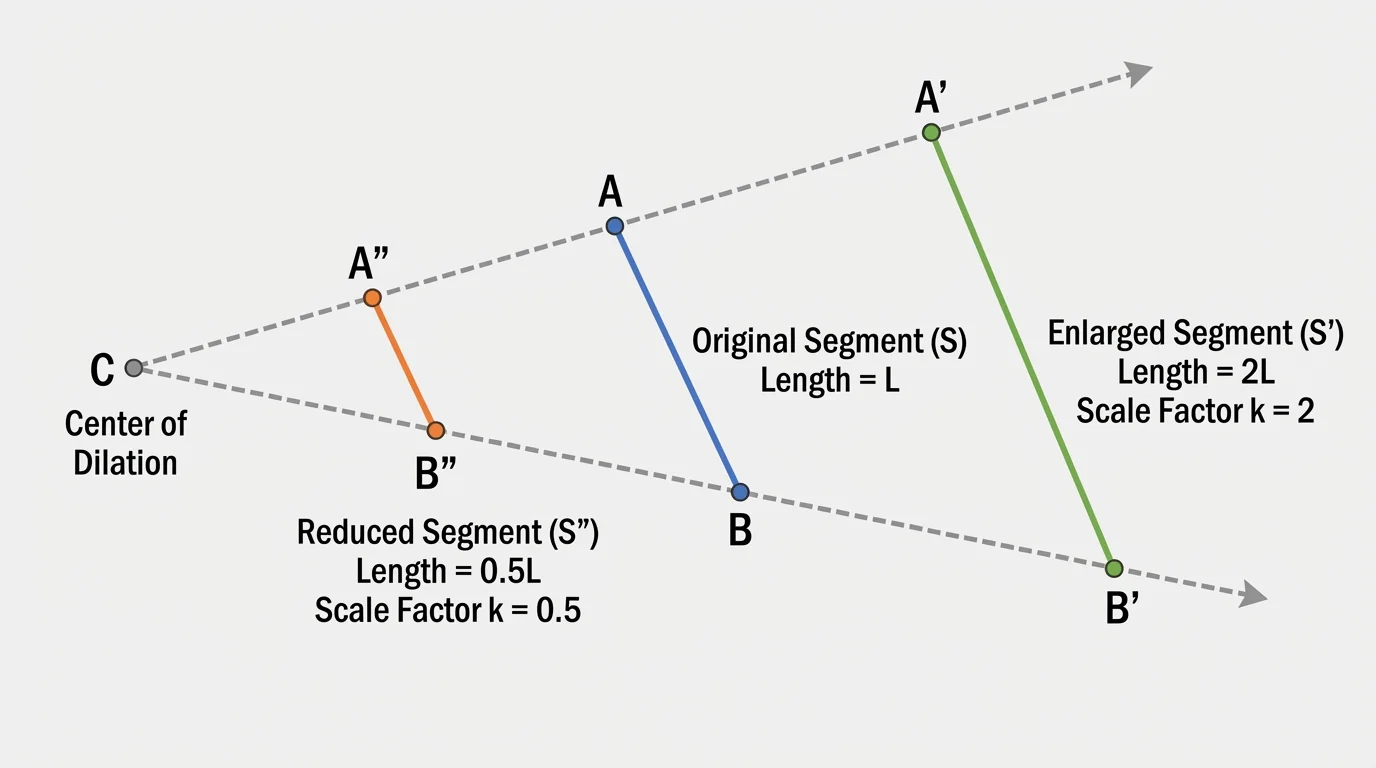
So when the topic says that a dilated line segment is longer or shorter in the ratio given by the scale factor, it means exactly this: the image length and original length form a proportional pair, with multiplier \(k\) when \(k\) is positive, or \(|k|\) if negative scale factors are included.
Coordinates make the rule even more precise. On a coordinate plane, a dilation from the origin follows a simple pattern and shows how each endpoint moves by the same multiplier. If a point \((x,y)\) is dilated from the origin by scale factor \(k\), then its image is
\[(x,y) \rightarrow (kx, ky)\]
That coordinate rule matches the segment-length rule because all distances from the origin are multiplied by \(|k|\).
If the center of dilation is not the origin, the idea stays the same even though the coordinate formula is more involved. Every point still lies on a ray from the center, and every distance from the center is multiplied by the same factor. The resulting segment lengths still obey the same ratio rule.
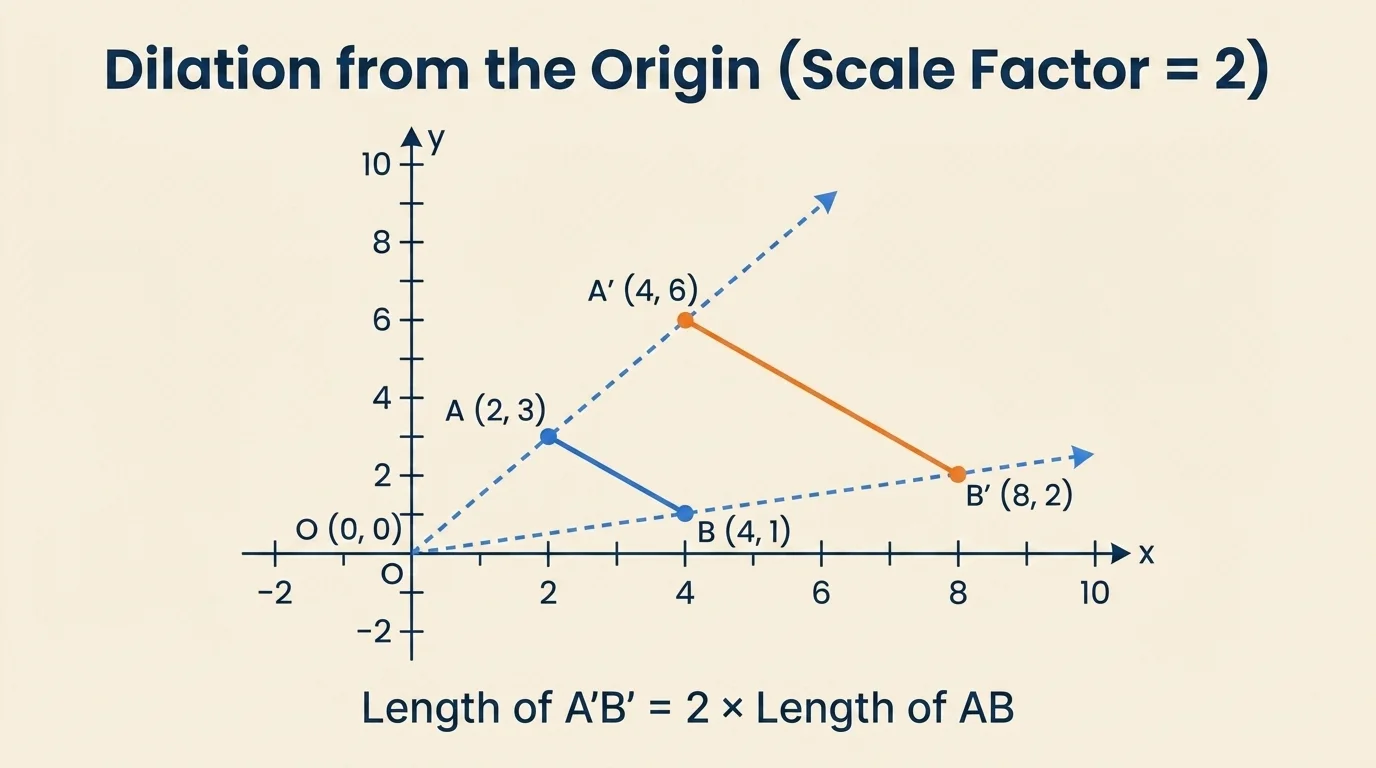
Why coordinates confirm the dilation rule
When both endpoints of a segment are multiplied by the same scale factor from the same center, the entire segment scales proportionally. This is why measuring on a graph gives the same result as measuring with a ruler: the geometry and the algebra agree.
For example, if \(A(1,2)\) and \(B(4,6)\) are dilated from the origin by \(k = 2\), then \(A'(2,4)\) and \(B'(8,12)\). The image segment is twice as long as the original segment.
Worked example 1
A segment has length \(9\) units. It is dilated by a scale factor of \(\dfrac{4}{3}\). Find the length of the image segment.
Step 1: Write the dilation length rule.
Use \(A'B' = k \cdot AB\).
Step 2: Substitute the known values.
The original length is \(9\), so \(A'B' = \dfrac{4}{3} \cdot 9\).
Step 3: Compute the product.
Since \(\dfrac{4}{3} \cdot 9 = 4 \cdot 3 = 12\), the image length is \(12\).
Therefore, the dilated segment is \(12\) units long.
This example is an enlargement because the scale factor is greater than \(1\). The image is longer than the original in the ratio \(\dfrac{4}{3} : 1\).
Worked example 2
The endpoints of a segment are \(A(-2,1)\) and \(B(2,5)\). The segment is dilated from the origin by \(k = \dfrac{1}{2}\). Find the image endpoints and verify that the image segment is shorter in the correct ratio.
Step 1: Dilate each endpoint.
Apply \((x,y) \rightarrow (kx,ky)\).
For \(A(-2,1)\): \(A'(-1, \dfrac{1}{2})\).
For \(B(2,5)\): \(B'(1, \dfrac{5}{2})\).
Step 2: Find the original segment length.
Using the distance formula, \(AB = \sqrt{(2-(-2))^2 + (5-1)^2} = \sqrt{4^2 + 4^2} = \sqrt{32} = 4\sqrt{2}\).
Step 3: Find the image segment length.
After dilation, \(A'B' = \sqrt{(1-(-1))^2 + (\dfrac{5}{2} - \dfrac{1}{2})^2} = \sqrt{2^2 + 2^2} = \sqrt{8} = 2\sqrt{2}\).
Step 4: Compare the lengths.
The ratio is \(\dfrac{A'B'}{AB} = \dfrac{2\sqrt{2}}{4\sqrt{2}} = \dfrac{1}{2}\).
The image segment is half as long as the original, exactly matching the scale factor.
Notice how the coordinate approach and the measurement approach agree. This is the same relationship shown earlier, where both endpoints move by the same multiplier from the origin.
Worked example 3
A line segment is dilated, and its length changes from \(15\) units to \(24\) units. Find the scale factor and state whether the dilation is an enlargement or a reduction.
Step 1: Use the ratio of image length to original length.
The scale factor is \(k = \dfrac{\textrm{image length}}{\textrm{original length}} = \dfrac{24}{15}\).
Step 2: Simplify the fraction.
After simplifying, \(\dfrac{24}{15} = \dfrac{8}{5}\).
Step 3: Interpret the result.
Since \(\dfrac{8}{5} > 1\), the image is longer than the original.
The scale factor is \(\dfrac{8}{5}\), so the dilation is an enlargement.
Finding the scale factor from measurements is often how dilations are checked experimentally in drawings, blueprints, and computer models.
Worked example 4
A segment \(\overline{CD}\) has length \(18\) units. After dilation, its image has length \(6\) units. What is the scale factor?
Step 1: Set up the ratio.
The scale factor is \(k = \dfrac{6}{18}\).
Step 2: Simplify.
After simplifying, \(k = \dfrac{1}{3}\).
Step 3: Interpret the answer.
Because \(0 < \dfrac{1}{3} < 1\), the image is shorter than the original.
The scale factor is \(\dfrac{1}{3}\), so the segment is reduced to one-third of its original length.
A similar figure has the same shape as another figure but not necessarily the same size. Dilation is one of the main ways similar figures are created because it preserves angle measures and multiplies all corresponding lengths by the same factor.
If every side of a triangle is multiplied by \(2\), the new triangle has sides in the ratio \(2:1\) compared with the original, and all corresponding angles remain equal. The same is true for polygons, circles, and any collection of line segments. Because every segment follows the same scale rule, the whole figure remains proportional.
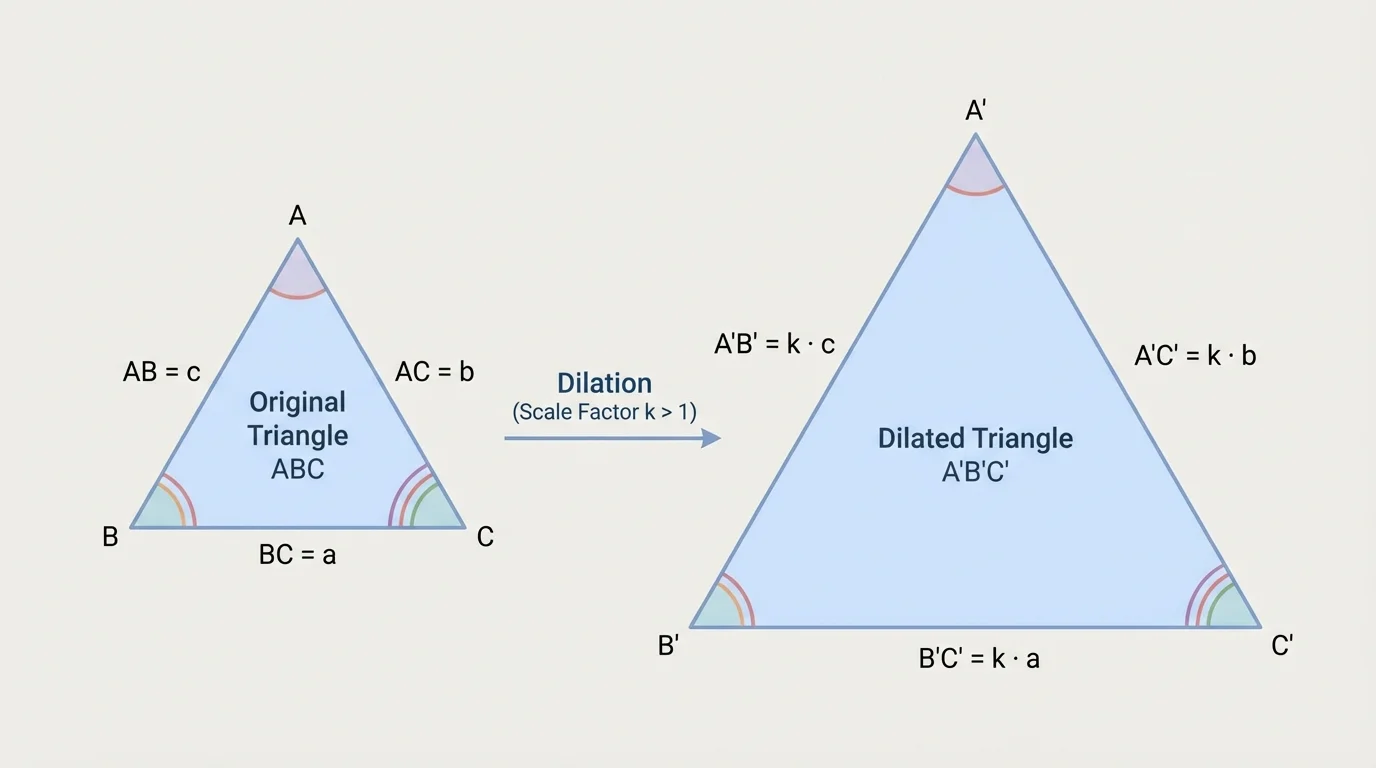
This matters far beyond one isolated segment. If one side of a figure becomes \(1.5\) times as long, then every corresponding side becomes \(1.5\) times as long. That shared ratio is what makes the entire image similar to the original.
Dilations appear anywhere a shape is resized without changing its form. Architects use scale drawings so that a building too large to fit on paper can be represented accurately. If a wall that is \(12\) meters long is shown on a drawing at a scale factor of \(\dfrac{1}{100}\), its drawing length is \(0.12\) meters, or \(12\) centimeters.
Digital design software enlarges and reduces icons, logos, and technical diagrams using the same idea. Engineers reading a CAD model depend on the fact that every segment changes by the same ratio. In mapmaking, a measured path on a map corresponds proportionally to the actual path on land.
Modern phone cameras and editing tools rely constantly on geometric resizing. Every time you pinch to zoom or scale a graphic, the software uses geometric rules closely related to dilation.
Medical imaging, satellite imagery, and manufacturing templates also depend on consistent scaling. If the ratio changed from one segment to another, the image would be distorted rather than similar.
One common mistake is reversing the ratio. The scale factor is image length divided by original length, not the other way around. If a segment changes from \(5\) to \(20\), then \(k = \dfrac{20}{5} = 4\), not \(\dfrac{1}{4}\).
Another mistake is thinking that the center changes the ratio of the segment lengths. The center changes where the image appears, but not the fact that corresponding segment lengths are multiplied by the same factor.
A third mistake is forgetting that a negative scale factor does not create a negative length. Length is always positive, so the segment length is multiplied by \(|k|\). The sign affects direction relative to the center, not the positivity of the measurement.
Finally, students sometimes assume a segment must stay parallel to itself. In many dilations, especially when the segment does not lie on a line through the center, the image segment is parallel to the original. But the deepest fact is not just parallelism. The core fact is proportional length: \(A'B' = |k| \cdot AB\).
This is also why the comparison in [Figure 2] is so useful: regardless of whether the image is an enlargement or a reduction, the segment length changes exactly by the ratio given by the scale factor.
