Have you ever wondered how engineers figure out the height of a cell tower without climbing it, or how pilots determine how far they are from a runway while descending? Many of these questions are answered using right triangles, the Pythagorean Theorem, and trigonometric ratios.
Right triangles appear in architecture, navigation, physics, computer graphics, and even sports. Any time you have a horizontal distance, a vertical height, and something slanted (like a ramp or a ladder), you have the structure of a right triangle.
To analyze these situations, we use two powerful tools:
Together, they allow us to "solve" a right triangle: find missing side lengths and missing angle measures, then interpret those answers in context.
Before using any formulas, we must be clear about the parts of a right triangle. A right triangle has one angle equal to \(90^\textrm{o}\). The side opposite the right angle is called the hypotenuse, and it is always the longest side.
Consider a right triangle with vertices labeled \(A\textrm{, }B\textrm{, }C\), where \(\triangle ABC\) has a right angle at \(C\), and let side lengths be \(a\textrm{, }b\textrm{, }c\), as shown in [Figure 1]. We usually use:
When we focus on one of the acute angles, say angle \(A\textrm{,}\) we also use the words:
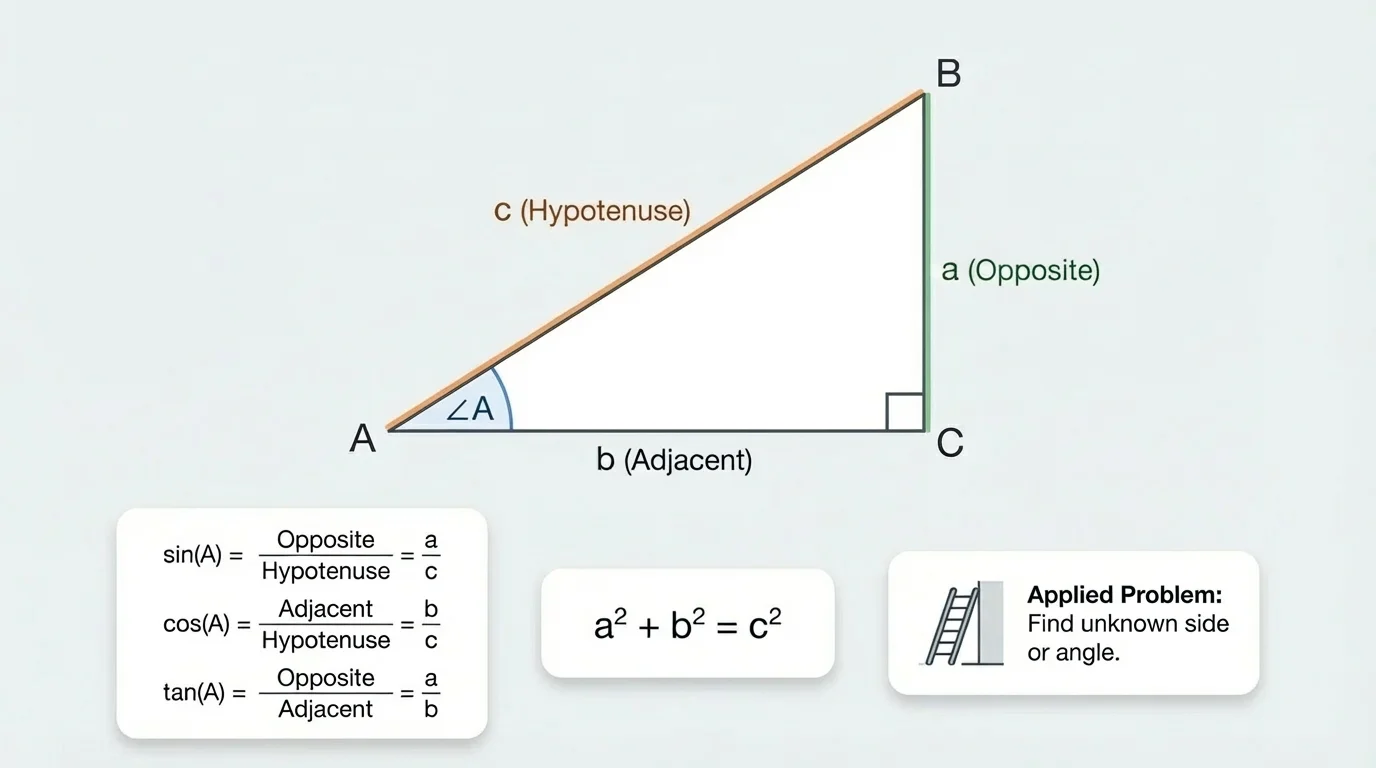
Notice that "opposite" and "adjacent" depend on which acute angle you are talking about. For angle \(A\textrm{,}\) one leg is opposite and the other is adjacent. For angle \(B\textrm{,}\) those labels switch.
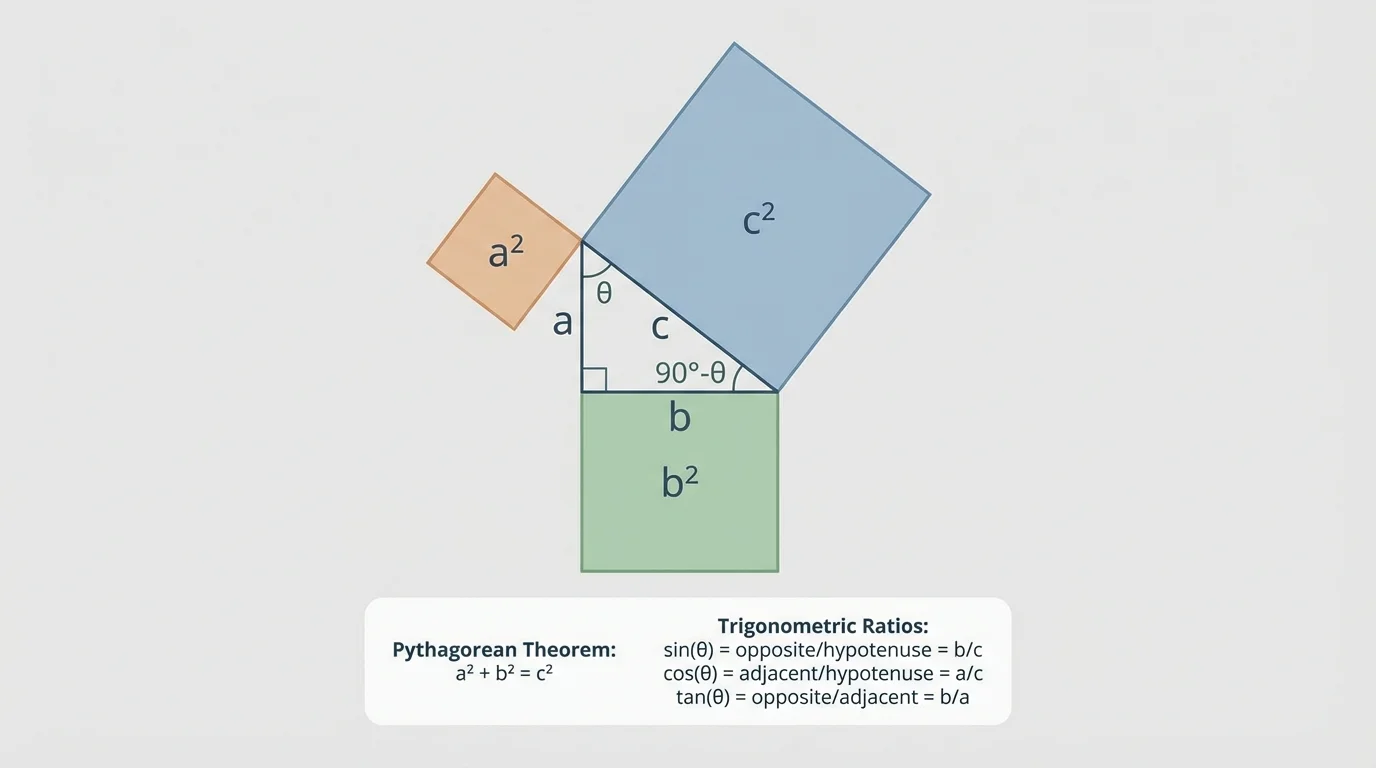
The Pythagorean Theorem is a fundamental relationship between the sides of any right triangle, as shown in [Figure 2]. If a right triangle has legs of lengths \(a\) and \(b\) and hypotenuse of length \(c\), then
\[a^2 + b^2 = c^2\]
This equation says that the sum of the squares of the legs equals the square of the hypotenuse. Geometrically, if you build squares on each side, the area of the largest square (on the hypotenuse) equals the sum of the areas of the other two.
You can use the theorem in three basic ways:
Example 1: Finding the hypotenuse with the Pythagorean Theorem
A ladder reaches from the ground to a window that is \(12 \textrm{ ft}\) high. The foot of the ladder is \(5 \textrm{ ft}\) away from the wall. How long is the ladder?
Step 1: Identify the legs and hypotenuse.
The wall and the ground form a right angle, so the ladder is the hypotenuse. Let \(a = 5\) (distance from wall), \(b = 12\) (height), and \(c\) be the ladder length.
Step 2: Apply the Pythagorean Theorem.
\[a^2 + b^2 = c^2 \Rightarrow 5^2 + 12^2 = c^2\]
i.e. \(25 + 144 = c^2\)\(\textrm{, so }\)\(169 = c^2\)\(\textrm{.}\)
Step 3: Take the square root.
\[c = \sqrt{169} = 13\]
The ladder is \(13 \textrm{ ft}\) long.
Later, when solving triangles with trig ratios, we often use the Pythagorean Theorem at the end to find the third side once two sides are known.
The next big idea is the set of trigonometric ratios that connect angles in a right triangle to the ratios of its sides. These are sine, cosine, and tangent, often abbreviated as \(\sin\), \(\cos\), and \(\tan\).
In a right triangle with an acute angle \(\theta\), as shown in [Figure 3], we define:
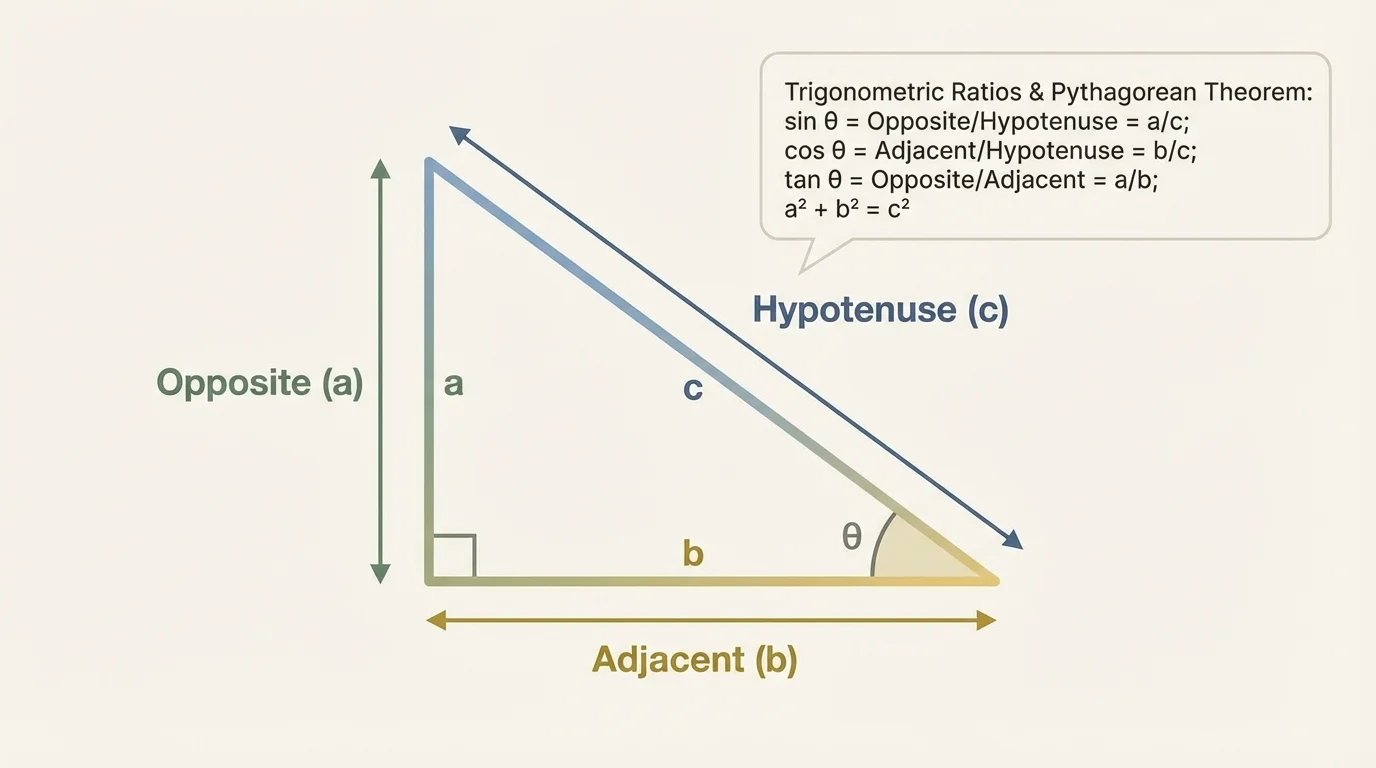
The three main trigonometric ratios are:
\[\sin(\theta) = \frac{\textrm{opposite}}{\textrm{hypotenuse}}\]\[\cos(\theta) = \frac{\textrm{adjacent}}{\textrm{hypotenuse}}\]\[\tan(\theta) = \frac{\textrm{opposite}}{\textrm{adjacent}}\]
A common memory trick is SOH–CAH–TOA:
These ratios depend only on the angle, not on the overall size of the triangle. If two right triangles have the same acute angle \(\theta\), they are similar, so the ratios of corresponding sides are equal. That is why sine, cosine, and tangent are well-defined functions of the angle.
Sine, Cosine, Tangent (for a right triangle) relate an acute angle to fractions formed by the triangle's side lengths: \(\sin\)\(\textrm{ uses opposite/hypotenuse, }\)\(\cos\)\(\textrm{ uses adjacent/hypotenuse, and }\)\(\tan\)\(\textrm{ uses opposite/adjacent.}\)
Throughout problem solving, you will frequently refer back to this relationship between angle, opposite, adjacent, and hypotenuse, much like the labels in [Figure 3].
Trigonometric ratios are extremely useful when you know one side and one acute angle of a right triangle and you want to find another side. You choose \(\sin\), \(\cos\), or \(\tan\) based on which sides are involved.
Example 2: Finding the height of a building using tangent
You stand \(40 \textrm{ m}\) away from a building. The angle between the ground and your line of sight to the top of the building is \(35^\textrm{o}\)\(\textrm{. How tall is the building? (Assume your eyes are at ground level.)}\)
Step 1: Draw and label the right triangle.
The ground and the building form a right angle. The distance from you to the building, \(40 \textrm{ m}\)\(\textrm{, is the adjacent side to angle }\)\(35^\textrm{o}\)\(\textrm{. The building's height, call it }\)\(h\)\(\textrm{, is opposite the angle.}\)
Step 2: Choose the appropriate trig ratio.
We have the opposite side \(h\) and the adjacent side 40, so we use tangent:\[\tan(35^\textrm{o}) = \frac{h}{40}\]
Step 3: Solve for \(h\)\(\textrm{.}\)
Multiply both sides by \(40\)\(\textrm{:}\)\[h = 40 \tan(35^\textrm{o})\]
Using a calculator (in degree mode), \(\tan(35^\textrm{o}) \approx 0.7002\)\(\textrm{, so}\)\[h \approx 40(0.7002) \approx 28.0\]
The building is approximately \(28.0 \textrm{ m}\)\(\textrm{ tall.}\)
When solving for sides with trig, typical steps are:
Sometimes, you find one missing side with trig and then apply the Pythagorean Theorem to find the third side, reinforcing the connection between these tools.
Now suppose you know two sides of a right triangle but do not know an acute angle. You can use inverse trigonometric functions, written as \(\sin^{-1}\), \(\cos^{-1}\), and \(\tan^{-1}\), to "undo" sine, cosine, and tangent.
For example:
Example 3: Finding an angle from side lengths
In a right triangle, the leg opposite angle \(\theta\)\(\textrm{ is }\)\(9 \textrm{ cm}\)\(\textrm{ and the adjacent leg is }\)\(12 \textrm{ cm}\)\(\textrm{. Find }\)\(\theta\)\(\textrm{ to the nearest degree.}\)
Step 1: Choose a trig ratio.
We know opposite and adjacent sides, so we use tangent:\[\tan(\theta) = \frac{9}{12}\]
Step 2: Apply the inverse tangent.
\[\theta = \tan^{-1}\left(\frac{9}{12}\right) = \tan^{-1}\left(0.75\right)\]
Using a calculator, \(\theta \approx 36.87^\textrm{o}\)\(\textrm{.}\)
Rounded to the nearest degree, \(\theta \approx 37^\textrm{o}\)\(\textrm{.}\)
When working these problems, be sure your calculator is in the correct angle mode (degrees for most geometry problems at this level).
To "solve" a right triangle means to find all its side lengths and angle measures. Usually you are given one side and one acute angle, or two sides. Then you combine trig ratios and the Pythagorean Theorem.
Example 4: Complete solution of a right triangle
Right triangle \(\triangle ABC\)\(\textrm{ has a right angle at }\)\(C\)\(\textrm{. Side }\)\(AC\)\(\textrm{ is }\)\(8 \textrm{ cm}\)\(\textrm{ and angle }\)\(A\)\(\textrm{ is }\)\(30^\textrm{o}\)\(\textrm{. Solve the triangle: find sides }\)\(BC\)\(\textrm{ and }\)\(AB\)\(\textrm{ and angle }\)\(B\)\(\textrm{.}\)
Step 1: Find the third angle.
In any triangle, the angles add to \(180^\textrm{o}\)\(\textrm{. We have a right angle at }\)\(C\)\(\textrm{, so }\)\(\angle C = 90^\textrm{o}\)\(\textrm{ and }\)\(\angle A = 30^\textrm{o}\)\(\textrm{. Then}\)\[\angle B = 180^\textrm{o} - 90^\textrm{o} - 30^\textrm{o} = 60^\textrm{o}\]
Step 2: Identify sides relative to angle \(A\)\(\textrm{.}\)
Side \(AB\)\(\textrm{ is the hypotenuse, }\)\(AC = 8\)\(\textrm{ is adjacent to angle }\)\(A\)\(\textrm{, and }\)\(BC\)\(\textrm{ is opposite angle }\)\(A\)\(\textrm{.}\)
Step 3: Use cosine to find the hypotenuse.
Since \(AC\)\(\textrm{ is adjacent to }\)\(A\)\(\textrm{ and }\)\(AB\)\(\textrm{ is the hypotenuse,}\)\[\cos(30^\textrm{o}) = \frac{AC}{AB} = \frac{8}{AB}\]
So \(AB = \dfrac{8}{\cos(30^\textrm{o})}\)\(\textrm{. Because }\)\(\cos(30^\textrm{o}) = \dfrac{\sqrt{3}}{2}\)\(\textrm{,}\)\[AB = \frac{8}{\sqrt{3}/2} = 8 \cdot \frac{2}{\sqrt{3}} = \frac{16}{\sqrt{3}} \approx 9.24\]
Step 4: Use sine or Pythagorean Theorem to find \(BC\)\(\textrm{.}\)
Using sine relative to angle \(A\)\(\textrm{:}\)\[\sin(30^\textrm{o}) = \frac{BC}{AB}\]
But \(\sin(30^\textrm{o}) = 0.5\)\(\textrm{, and }\)\(AB \approx 9.24\)\(\textrm{, so}\)\[0.5 = \frac{BC}{9.24} \Rightarrow BC = 0.5 \times 9.24 \approx 4.62\]
So the solved triangle has \(AB \approx 9.24 \textrm{ cm}\)\(\textrm{, }\)\(BC \approx 4.62 \textrm{ cm}\)\(\textrm{, and angle }\)\(B = 60^\textrm{o}\)\(\textrm{.}\)
In harder real-world problems, you often go through a similar chain: find an angle with inverse trig, then use sine or cosine to get one side, then the Pythagorean Theorem for the remaining side.
Many applied problems use an angle of elevation or angle of depression, as shown in [Figure 4]. These are angles formed relative to a horizontal line.
In both cases, the horizontal line is usually the ground or some level reference (like the surface of the ocean or the floor of a building). The angle and one side often give you enough information to set up a right triangle and solve for a height or distance, similar to Example 2. Notice that the right angle typically occurs where one side is vertical and another is horizontal.
Example 5: Angle of depression from a lighthouse
A lighthouse stands on a cliff \(50 \textrm{ m}\)\(\textrm{ above sea level. A ship is at sea so that the angle of depression from the top of the lighthouse to the ship is }\)\(18^\textrm{o}\)\(\textrm{. How far is the ship from the base of the cliff (horizontally)?}\)
Step 1: Draw the diagram and identify the right triangle.
The line of sight from the top of the lighthouse down to the ship makes an angle of depression of \(18^\textrm{o}\)\(\textrm{ with the horizontal. That angle is equal to the angle of elevation from the ship up to the top (alternate interior angles). The vertical height is }\)\(50 \textrm{ m}\)\(\textrm{ and the horizontal distance from the cliff to the ship, call it }\)\(d\)\textrm{, is the unknown.
Step 2: Set up a trig equation using tangent.
The vertical height is opposite to the angle of elevation and the horizontal distance is adjacent, so\[\tan(18^\textrm{o}) = \frac{50}{d}\]
Step 3: Solve for \(d\)\(\textrm{.}\)
\[d = \frac{50}{\tan(18^\textrm{o})}\]
Using a calculator, \(\tan(18^\textrm{o}) \approx 0.3249\)\(\textrm{, so}\)\[d \approx \frac{50}{0.3249} \approx 153.8\]
The ship is approximately \(153.8 \textrm{ m}\)\textrm{ from the base of the cliff.
These types of problems are common in surveying, aviation, and navigation. They combine the geometry of right triangles with real measurements and instruments like clinometers or radar.
The techniques you are learning appear in many advanced fields:
Example 6: Force on a ramp (conceptual with trig)
A box of weight \(100 \textrm{ N}\)\(\textrm{ sits on a ramp inclined at }\)\(25^\textrm{o}\)\(\textrm{ to the horizontal. The component of its weight parallel to the ramp is }\)\(W_\parallel\)\(\textrm{. In physics, this is found using}\)\[W_\parallel = W \sin(\theta)\]
where \(W\)\(\textrm{ is the weight and }\)\(\theta\)\textrm{ is the ramp angle.
Step 1: Substitute the known values.
\[W_\parallel = 100 \sin(25^\textrm{o})\]
Step 2: Calculate.
\[W_\parallel \approx 100(0.4226) = 42.26\]
So the component of the weight pulling the box down the ramp is about \(42.3 \textrm{ N}\)\textrm{. This calculation uses exactly the same sine function defined earlier from right-triangle ratios.
These examples show how what you learn in geometry directly powers real-world calculations in science and technology.
As you work more problems, watch out for some frequent pitfalls:
When stuck, sketch a quick diagram, label everything you know, mark the angles, and then ask: Which sides are opposite, adjacent, or hypotenuse? Which trig ratio matches? Do I need the Pythagorean Theorem as well? Taking the time to organize the triangle visually dramatically reduces mistakes.
