Triangles can come in many shapes. A rectangle can become long and thin. But a circle has a strange kind of perfection: no matter how large or small it is, it always looks exactly like every other circle except for scale. That claim may sound obvious at first, but in geometry, "obvious" is not enough. We need a proof. The remarkable result is that every circle, from the rim of a coin to the edge of a dinner plate, belongs to a single class of shapes.
When geometers say two figures are similar, they mean one figure can be obtained from the other by resizing, and possibly also moving, rotating, or reflecting it. Similarity is more than a visual resemblance. It is a precise relationship: corresponding lengths have a constant ratio, and corresponding angles match.
For polygons, proving similarity often takes work. You may compare corresponding side-length ratios or angle measures. But for a circle, the proof comes from its definition itself: a circle is the set of all points at a fixed distance from a center. Change that fixed distance, and you do not create a new shape type. You only create a larger or smaller version of the same shape.
A circle with center \(O\) and radius \(r\) is the set of all points in a plane that are exactly distance \(r\) from \(O\). The diameter is \(2r\), the circumference is \(2\pi r\), and the area is \(\pi r^2\).
This idea is why circles are central in geometry, design, physics, and engineering. Wheels, gears, lenses, pipes, and circular tracks all rely on the fact that changing the size of a circle does not change its essential form.
[Figure 1] A dilation is a transformation that changes the size of a figure while preserving its shape. If the scale factor is greater than \(1\), the image is enlarged. If the scale factor is between \(0\) and \(1\), the image is reduced.
Suppose a point \(P\) is a distance \(r\) from the center \(O\). After a dilation centered at \(O\) with scale factor \(k\), the image point \(P'\) lies on the same ray from \(O\), and its new distance from \(O\) is \(kr\). So dilation multiplies all distances from the center by the same factor.
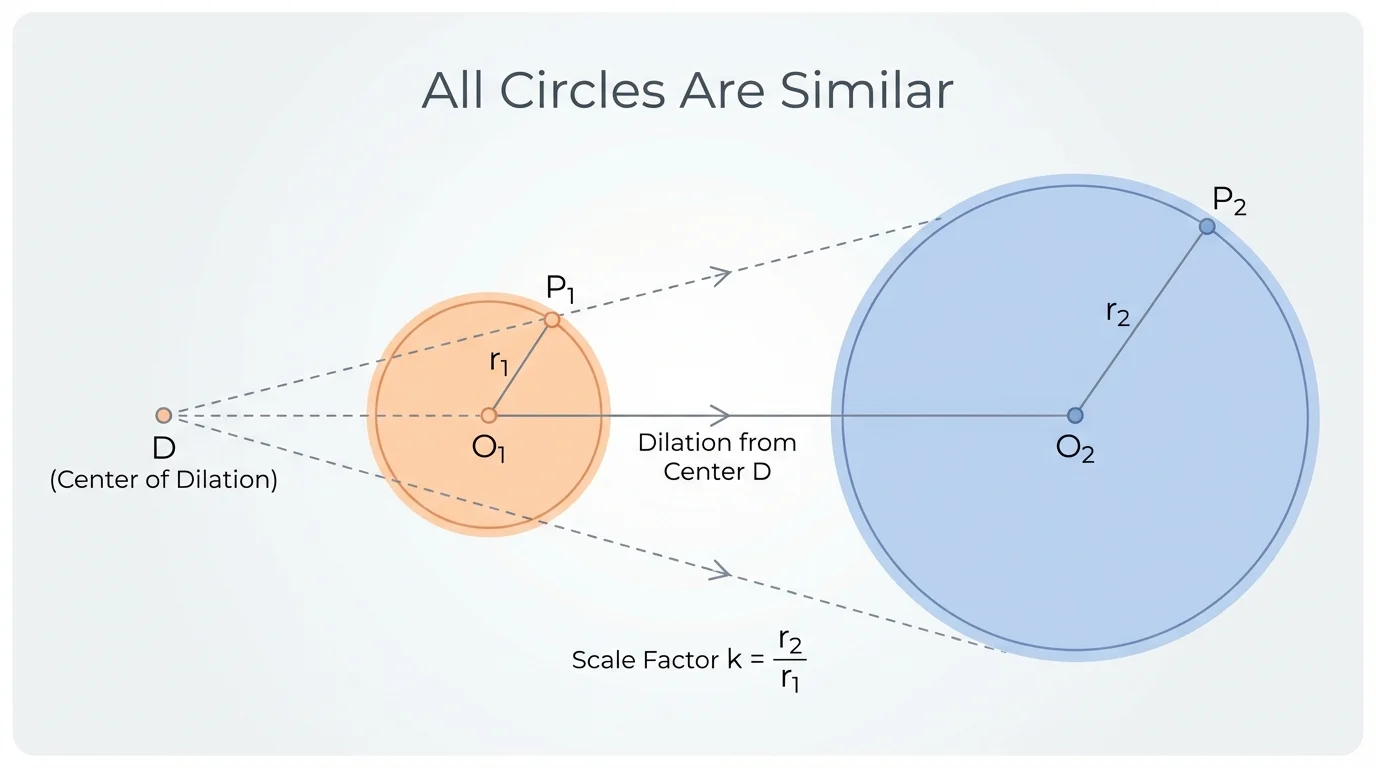
This makes dilation the perfect tool for proving similarity of circles. Since a circle is defined by distance from its center, and dilation multiplies those distances uniformly, dilation naturally turns one circle into another.
Similar figures are figures with the same shape, though not necessarily the same size. One can be mapped onto the other by a sequence of rigid motions and a dilation.
Rigid motions are translations, rotations, and reflections. They preserve lengths and angle measures.
Notice something important: if two circles have different centers, that does not prevent them from being similar. Similar figures do not have to sit in the same place on the plane. We may move one before or after resizing it.
For polygons, the standard definition of similarity usually says that corresponding angles are congruent and corresponding side lengths are proportional. Circles are not polygons, so they do not have sides or angles in the same sense. Still, the transformation definition of similarity works perfectly: if one figure can be carried to the other by rigid motions and a dilation, then the figures are similar.
This transformation-based definition is especially powerful because it applies to curved figures too. A circle does not need sides to be similar. It only needs to be an image of another circle under a similarity transformation.
Why circles are special
Most shapes can vary in more than one way. For example, rectangles can have many different length-to-width ratios, so not all rectangles are similar. Circles have only one defining measurement: radius. Once the radius changes, every part of the figure scales uniformly, and no other shape feature changes.
That is the deep reason all circles are similar: there is no "skinny" circle or "wide" circle. There are only larger and smaller circles.
Now we prove the theorem directly. The central idea, illustrated by [Figure 2], is that every point on a circle is the same distance from the center, so a dilation multiplies that distance by one constant factor.
Let Circle \(A\) have center \(O\) and radius \(r\). Let Circle \(B\) have center \(O\) and radius \(R\). Assume first that the two circles share the same center. We want to show Circle \(A\) is similar to Circle \(B\).
Choose a dilation centered at \(O\) with scale factor:
\[k = \frac{R}{r}\]
Take any point \(P\) on Circle \(A\). Because \(P\) is on Circle \(A\), its distance from the center is \(OP = r\). After the dilation, the image point \(P'\) satisfies \(OP' = k \cdot OP = \dfrac{R}{r} \cdot r = R\).
But every point whose distance from \(O\) is \(R\) lies on Circle \(B\). So the image of every point on Circle \(A\) lies on Circle \(B\). Conversely, every point of Circle \(B\) comes from some point of Circle \(A\) under this dilation. Therefore, the dilation maps Circle \(A\) exactly onto Circle \(B\).
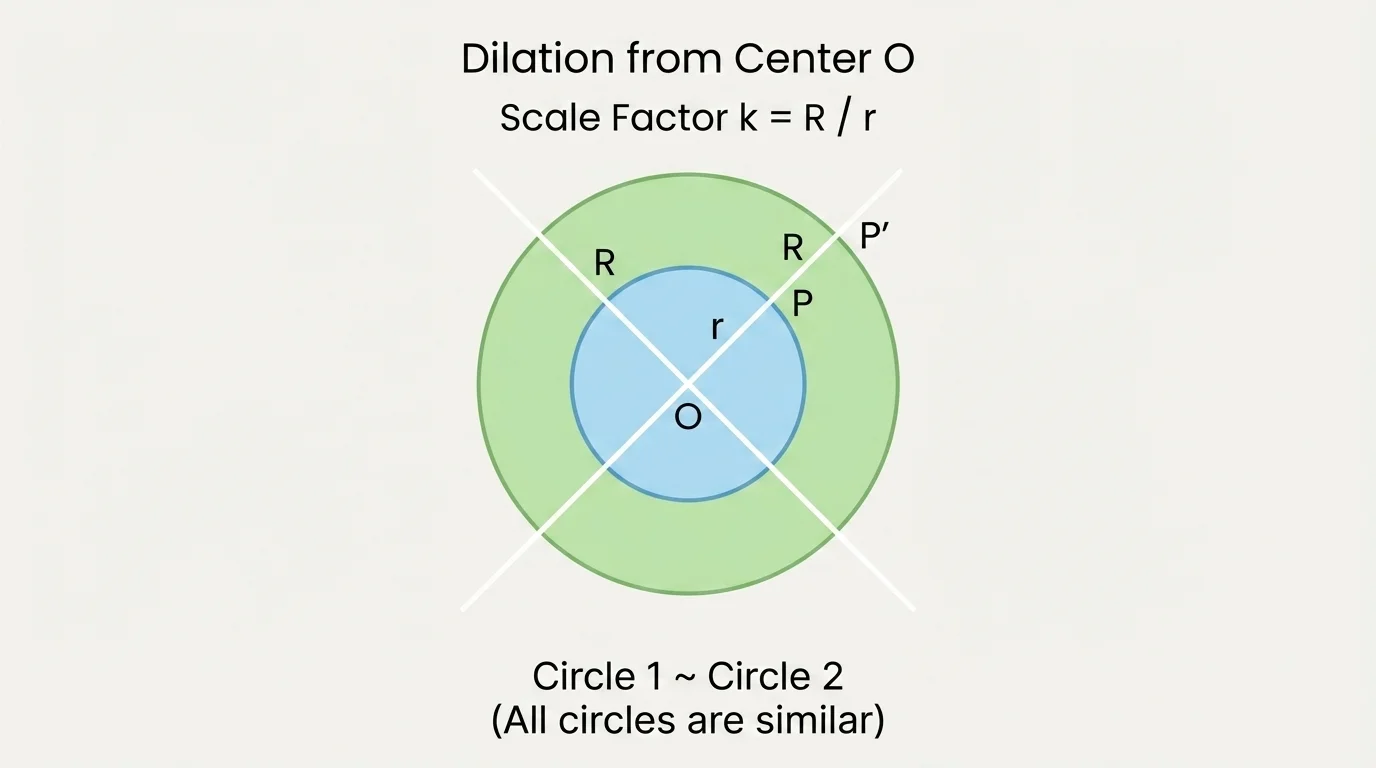
Since a dilation maps one circle onto the other, the two circles are similar.
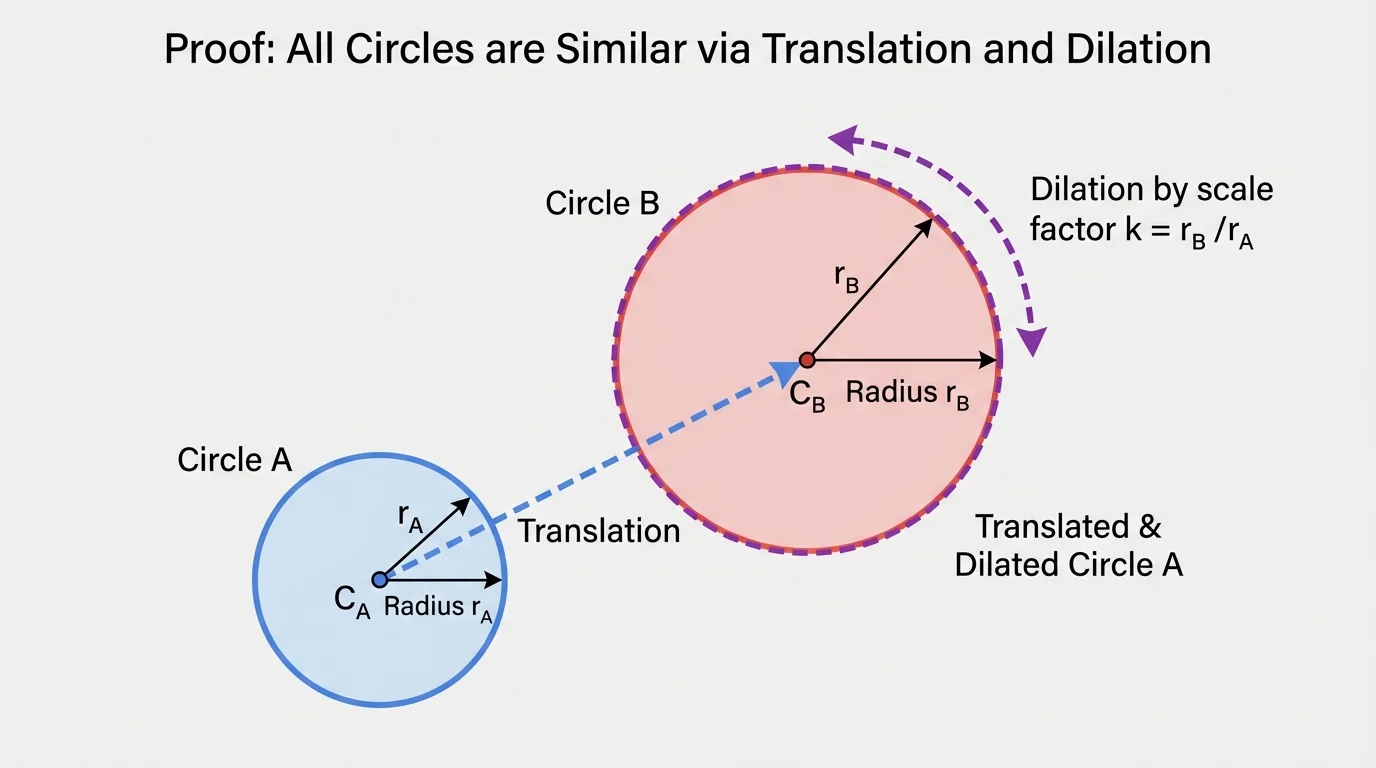
What if the circles have different centers? Then first use a translation to move the center of one circle onto the center of the other. Rigid motions preserve shape and size. After that, apply the dilation above. So any circle can be moved and resized to match any other circle. Therefore:
All circles are similar.
This proof is short, but it is powerful. It uses only the definition of a circle and the meaning of dilation. That is exactly the kind of proof geometry values most: simple ideas used precisely.
The same scaling idea works for spheres in three dimensions. Any sphere can be obtained from any other sphere by a dilation, so all spheres are similar too.
As we saw earlier in [Figure 1], dilation preserves the overall shape while changing every distance by the same factor. For circles, that one fact is enough to settle the theorem completely.
The dilation proof is the formal proof, but formulas for circumference and area also support the result. Suppose two circles have radii \(r_1\) and \(r_2\). Then the ratio of their circumferences is
\[\frac{2\pi r_1}{2\pi r_2} = \frac{r_1}{r_2}\]
So circumference scales in the same ratio as radius. Likewise, the ratio of their areas is
\[\frac{\pi r_1^2}{\pi r_2^2} = \frac{r_1^2}{r_2^2}\]
So area scales by the square of the scale factor. If one circle is enlarged by a factor of \(k\), then its circumference is multiplied by \(k\) and its area by \(k^2\).
This behavior is exactly what similarity predicts. In similar figures, all lengths scale by the same factor. For circles, radius, diameter, and circumference are all lengths, so they scale by \(k\). Area scales by \(k^2\).
| Circle Measurement | Original | After scale factor \(k\) |
|---|---|---|
| Radius | \(r\) | \(kr\) |
| Diameter | \(2r\) | \(2kr\) |
| Circumference | \(2\pi r\) | \(2\pi kr = k(2\pi r)\) |
| Area | \(\pi r^2\) | \(\pi (kr)^2 = k^2(\pi r^2)\) |
Table 1. How circle measurements change under a dilation with scale factor \(k\).
This scaling pattern explains why circular objects of different sizes still behave like the same geometric shape.
The theorem becomes more useful when you apply it to actual measurements.
Worked example 1
A circle has radius \(4\), and a similar circle has radius \(10\). Find the scale factor from the first circle to the second, and compare their circumferences and areas.
Step 1: Find the scale factor.
The scale factor is the ratio of corresponding lengths: \(k = \dfrac{10}{4} = \dfrac{5}{2}\).
Step 2: Compare circumferences.
Because circumference is a length, it scales by \(k\). So the larger circumference is \(\dfrac{5}{2}\) times the smaller circumference.
Step 3: Compare areas.
Area scales by \(k^2\). Thus \(k^2 = \left(\dfrac{5}{2}\right)^2 = \dfrac{25}{4}\).
The scale factor is \(\dfrac{5}{2}\), the circumference ratio is \(\dfrac{5}{2}\), and the area ratio is \(\dfrac{25}{4}\).
This example shows an important pattern: doubling or tripling a radius does not merely double or triple the area. Area grows faster because it depends on the square of the scale factor.
Worked example 2
Circle \(A\) has center \((1,2)\) and radius \(3\). Circle \(B\) has center \((7,-1)\) and radius \(12\). Prove they are similar and state one transformation sequence that maps Circle \(A\) onto Circle \(B\).
Step 1: Compare the radii.
The radii are \(3\) and \(12\), so the needed scale factor is \(k = \dfrac{12}{3} = 4\).
Step 2: Align the centers.
Translate Circle \(A\) so that its center moves from \((1,2)\) to \((7,-1)\).
Step 3: Dilate.
Apply a dilation centered at \((7,-1)\) with scale factor \(4\). The radius changes from \(3\) to \(12\).
After the translation and dilation, Circle \(A\) maps exactly onto Circle \(B\). Therefore the circles are similar.
Here, the circles did not begin with the same center, but that caused no problem. Similarity allows rigid motions as well as dilation.
Worked example 3
A small circular track has circumference \(50\pi\). A larger similar circular track has radius three times as large. Find the larger circumference and the ratio of the areas.
Step 1: Identify the scale factor.
The radius is three times as large, so \(k = 3\).
Step 2: Scale the circumference.
Circumference scales by \(k\), so the larger circumference is \(3 \cdot 50\pi = 150\pi\).
Step 3: Scale the area.
Area scales by \(k^2 = 9\).
The larger circumference is \(150\pi\), and the ratio of the areas is \(9:1\).
Notice how we solved this without first finding either radius. Similarity lets us scale directly from one measurement to another when the scale factor is known.
Worked example 4
Two circles are similar. The area of the smaller circle is \(36\pi\), and the radius of the larger circle is twice the radius of the smaller circle. Find the area of the larger circle.
Step 1: Determine the scale factor.
The radius doubles, so \(k = 2\).
Step 2: Use the area scale factor.
Area scales by \(k^2 = 4\).
Step 3: Multiply the original area by \(4\).
\(4 \cdot 36\pi = 144\pi\).
The area of the larger circle is \(144\pi\).
Students sometimes ask whether circles must have the same center to be similar. They do not. One circle may be translated so its center matches the other, and then dilated to the correct size.
[Figure 3] Another question is whether a rotation or reflection matters. For circles, these motions have no visible effect on shape because a circle looks the same in every direction. Still, rotations and reflections are valid rigid motions in the definition of similarity.
What about concentric circles? These are circles with the same center but different radii. They are similar because one can be obtained from another by a dilation centered at their common center.
What about arcs or sectors from similar circles? If the circles are similar with scale factor \(k\), then arc lengths scale by \(k\), since arc length is a length measure. Sector areas scale by \(k^2\), since they are area measures. The same logic keeps extending.
We can even connect this to the constant \(\pi\). For every circle, the ratio of circumference to diameter is always
\[\frac{C}{d} = \pi\]
This constant ratio is another sign that every circle is the same shape. If circles were not all similar, this ratio could vary from one circle to another, but it never does.
Returning to [Figure 2], the proof works because every radius changes by the same factor. That uniform scaling is the defining fingerprint of similarity.
Similarity of circles is not just a theorem for geometry class. It appears every time engineers or designers scale a circular object. A bicycle wheel, a car tire, and a giant Ferris wheel are all circular shapes related by size. Their radii differ, but their form is the same.
In manufacturing, circular machine parts such as bearings, gears, washers, and pipes are often produced in many sizes. The design principles transfer across sizes because all those circles are similar. If the radius is scaled by \(k\), then the perimeter-related measurements scale by \(k\), while cross-sectional areas scale by \(k^2\).
In optics, camera lenses and telescope openings are circular. If a lens design is enlarged while keeping its shape circular, geometric relationships based on the circle remain consistent. In architecture, domes, round windows, and circular plazas use the same principle when plans are resized.
Why scaling matters in design
If a circular part is enlarged by a factor of \(2\), its edge length doubles, but the amount of material needed for its face grows by a factor of \(4\). Engineers must understand this difference when estimating material use, weight, and cost.
Mapmaking and digital graphics also rely on this theorem. When software enlarges or shrinks a circular icon, it remains a circle because the transformation is a dilation. The object changes size, not shape.
Even in sports, circular regions and equipment matter: center circles on fields, throwing rings in track and field, and circular targets in archery all keep the same geometry at different scales.
It is worth stating the argument in one compact form.
Let two circles have radii \(r\) and \(R\). Translate one circle if necessary so the centers coincide. Then apply a dilation centered at that common center with scale factor \(\dfrac{R}{r}\). Every point originally at distance \(r\) from the center moves to distance \(\dfrac{R}{r} \cdot r = R\). Therefore the first circle maps exactly onto the second. Since a rigid motion followed by a dilation is a similarity transformation, the circles are similar.
This is the theorem: every circle can be transformed into any other circle by a similarity transformation.
