A line that touches a circle at exactly one point can seem almost magical: it meets the circle, but it does not cut through it. That is not just an elegant geometric concept. Engineers use tangent lines when designing wheels, gears, ramps, belts, and curved roads. If you can construct a tangent from a point outside a circle, you are using one of the classic tools of Euclidean geometry to turn a visual idea into a precise result.
Suppose you know the center of a circle and you are given a point outside it. Your goal is to draw a line from that outside point so that the line touches the circle in exactly one place. In fact, from a point outside a circle, there are usually two such lines, one on each side of the circle.
This problem combines several major circle ideas: perpendicular lines, radii, right triangles, and symmetry. It also shows something important about geometry: a construction is not guesswork. Every step is based on a theorem.
Before building the construction, you need the key language and facts that make it work.
Circle: the set of all points in a plane that are the same distance from a fixed point called the center.
Tangent line: a line that touches a circle at exactly one point.
Point of tangency: the point where a tangent line touches the circle.
External point: a point located outside the circle.
Radius: a segment from the center of the circle to a point on the circle.
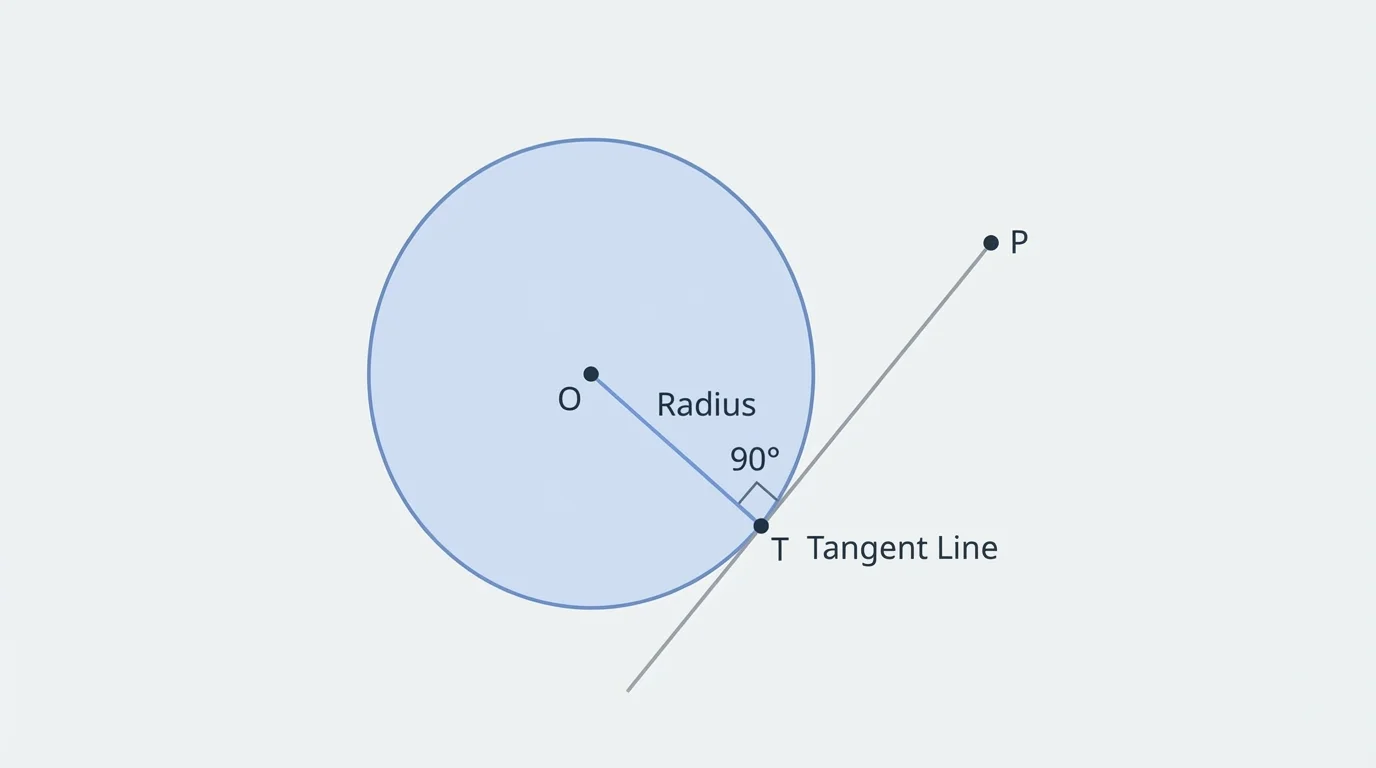
One theorem controls the entire topic: if a line is tangent to a circle at a point, then the radius drawn to that point is perpendicular to the tangent line.
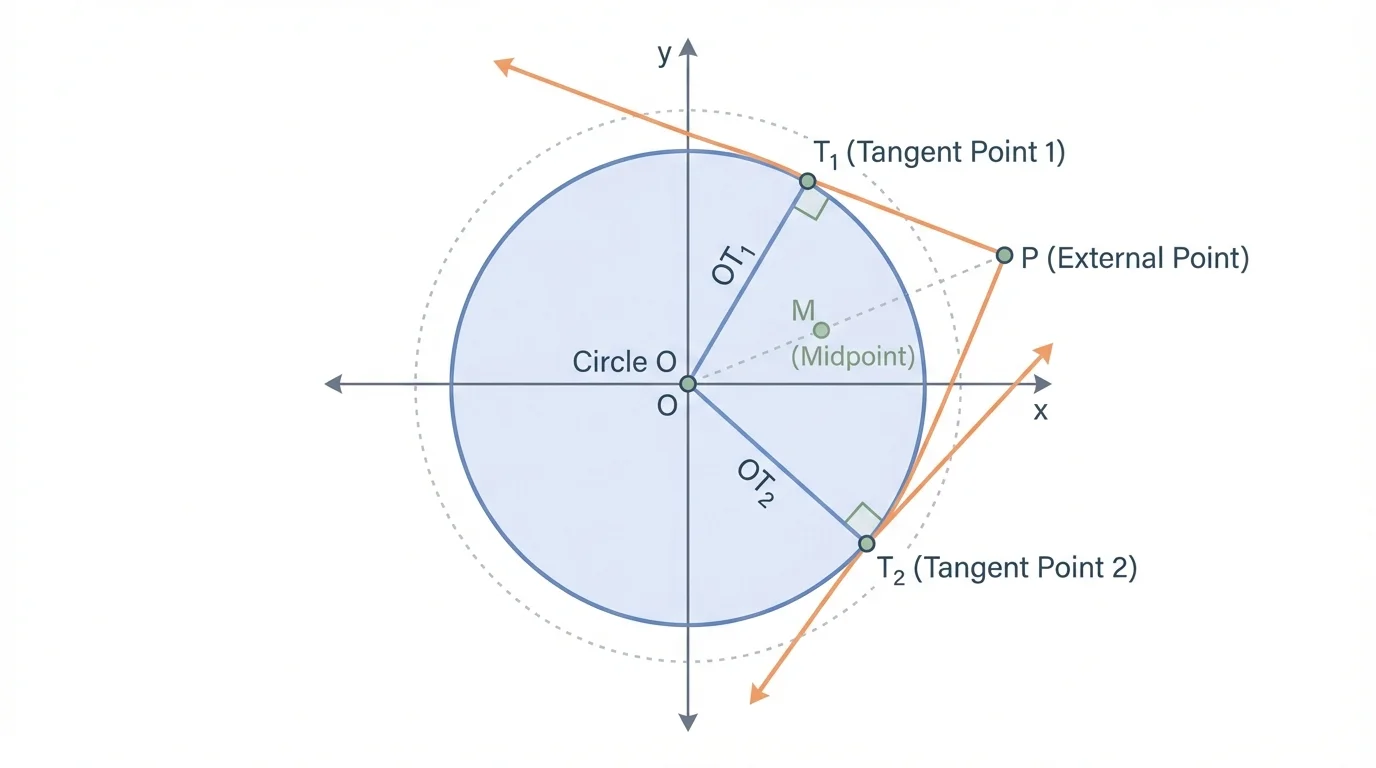
The first big fact, shown in [Figure 1], is that if line \(\ell\) touches a circle at point \(T\), then the radius \(OT\) drawn to the point of tangency is perpendicular to the tangent line. In symbols, if \(OT\) is a radius and \(\ell\) is tangent at \(T\), then \(OT \perp \ell\).
This means that tangent constructions are closely connected to right angles. If you can locate a point on the circle so that the segment from the center to that point forms a right angle with the segment from the external point to that same point, then you have found a tangent point.
There is another useful fact: from the same external point, the two tangent segments to a circle are congruent. If \(P\) is outside the circle and \(T_1\) and \(T_2\) are tangent points, then
\(PT_1 = PT_2\)
This equality follows from the congruence of right triangles, and it helps explain the symmetry of the construction.
Recall two older ideas from geometry. First, a point is the midpoint of a segment if it divides the segment into two equal parts. Second, an angle inscribed in a semicircle is a right angle. That second fact is a version of Thales' theorem, and it plays a central role in the tangent construction.
The central challenge is this: how do you locate the exact point of tangency without already knowing where it is? The construction solves that by creating a second circle whose geometry forces a right angle.
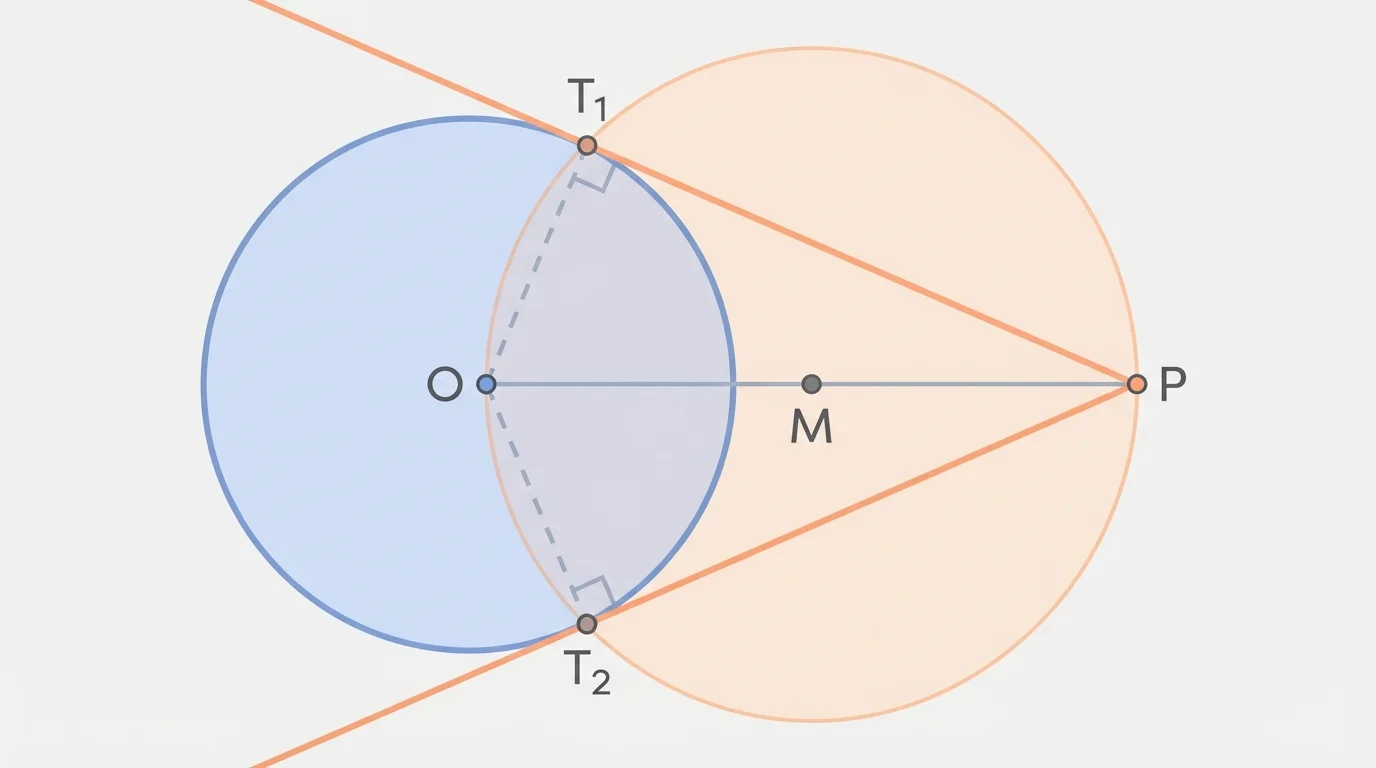
The hidden idea behind the construction, as [Figure 2] illustrates, is to use the segment from the circle's center \(O\) to the external point \(P\). If you find the midpoint \(M\) of \(OP\) and draw a new circle centered at \(M\) with radius \(MP\), then both \(O\) and \(P\) lie on that new circle.
Now suppose this new circle intersects the original circle at points \(T_1\) and \(T_2\). Because \(O\) and \(P\) are endpoints of a diameter of the new circle, any angle subtending \(OP\) on that new circle is a right angle. So \(\angle OT_1P\) and \(\angle OT_2P\) are right angles.
That matters because \(T_1\) and \(T_2\) are also on the original circle. So \(OT_1\) and \(OT_2\) are radii of the original circle. If \(OT_1\) is perpendicular to \(PT_1\), then \(PT_1\) is tangent to the original circle at \(T_1\). The same reasoning shows that \(PT_2\) is tangent at \(T_2\).
This is a beautiful example of geometry using one theorem to unlock another. A right angle created by a diameter becomes the proof that a line is tangent.
You can now perform the full construction, and [Figure 3] shows the main stages in one geometric picture. Assume you are given a circle with center \(O\) and an external point \(P\).
Step 1: Draw the segment \(OP\).
Step 2: Construct the midpoint \(M\) of \(OP\).
Step 3: With center \(M\) and radius \(MP\), draw a new circle. Because \(M\) is the midpoint of \(OP\), this new circle has \(OP\) as a diameter.
Step 4: Mark the points where the new circle intersects the original circle. Call them \(T_1\) and \(T_2\).
Step 5: Draw segments \(PT_1\) and \(PT_2\).
The lines through \(P\) and \(T_1\), and through \(P\) and \(T_2\), are the required tangent lines to the original circle.
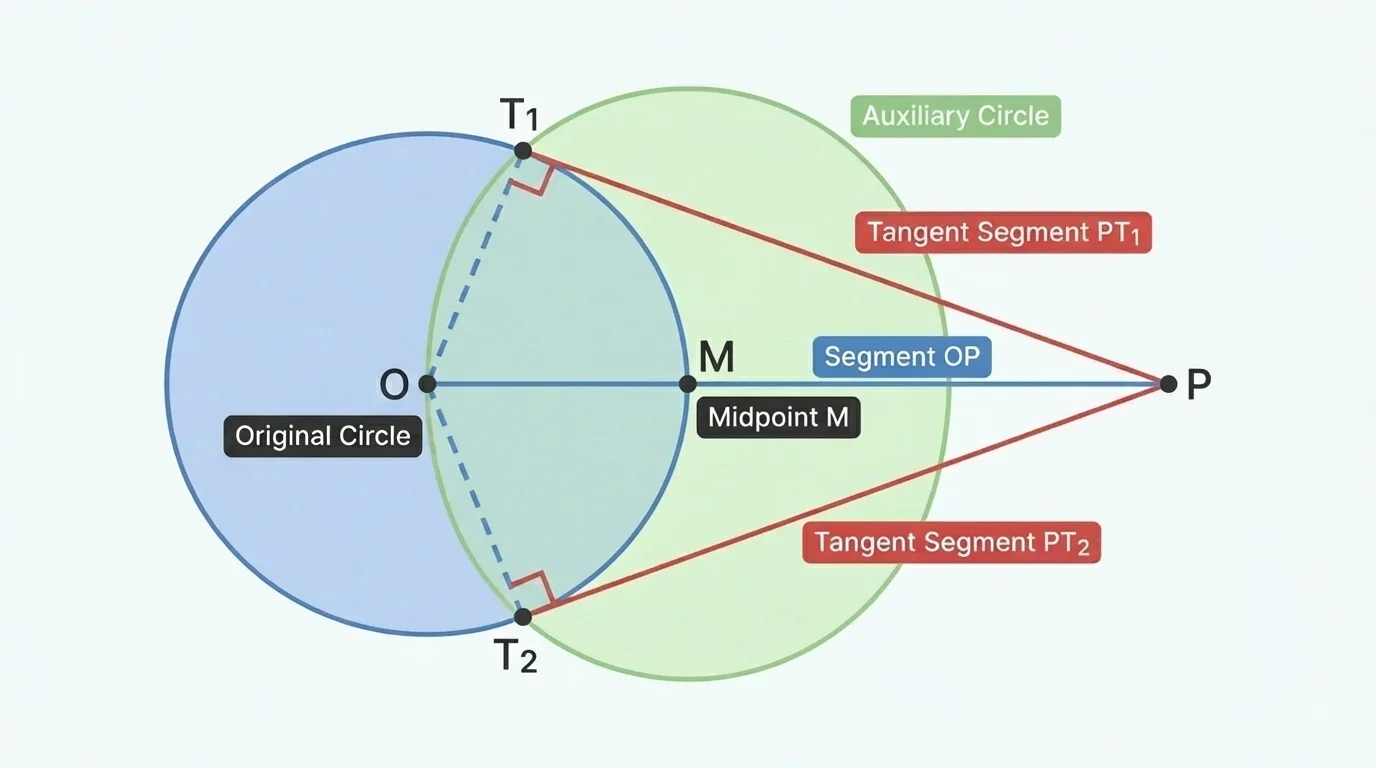
Notice that this construction usually produces two tangents. That makes sense because an outside point can "see" the circle from two sides.
When doing the construction by hand, precision matters. If the midpoint is off even slightly, the auxiliary circle will be wrong, and the tangent points will shift.
A construction in geometry is not finished until you know why it works. Let the original circle have center \(O\), and let \(P\) be the external point. Let \(M\) be the midpoint of \(OP\). Draw the circle centered at \(M\) through \(O\) and \(P\), and let one intersection with the original circle be \(T_1\).
Because \(M\) is the midpoint of \(OP\), segment \(OP\) is a diameter of the auxiliary circle. Since \(T_1\) lies on that auxiliary circle, angle \(OT_1P\) is a right angle.
So
\[OT_1 \perp PT_1\]
But \(T_1\) lies on the original circle, so \(OT_1\) is a radius of the original circle. A line perpendicular to a radius at the point where the radius meets the circle is tangent to the circle. Therefore, \(PT_1\) is tangent to the original circle at \(T_1\).
The exact same reasoning works for \(T_2\). Therefore, the construction gives both tangent lines from \(P\) to the circle.
This proof depends on one of the most powerful habits in geometry: connect a new construction to a theorem you already trust, instead of trying to guess the result from appearance alone.
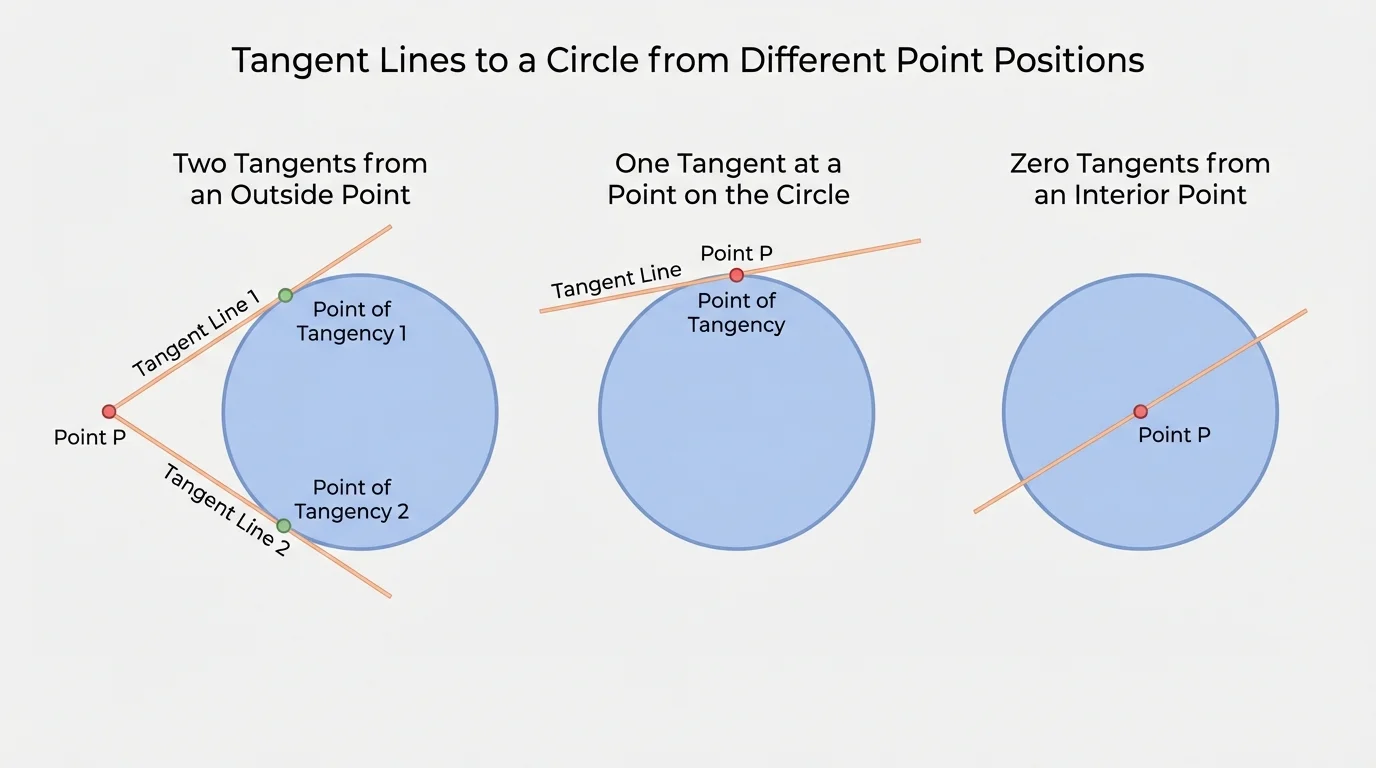
The number of tangents depends on where the point is located, as [Figure 4] shows. Geometry changes sharply when the point moves from outside the circle to on the circle or inside it.
If the point is outside the circle, there are exactly two tangent lines. If the point is on the circle, there is exactly one tangent line, the line perpendicular to the radius at that point. If the point is inside the circle, there is no tangent line through that point, because any line through the point will intersect the circle in two points.
Another important variation is that sometimes you may not be asked to physically construct the tangent, but to justify a diagram that someone else drew. In that case, you still use the same logic: show that the radius to the point of contact is perpendicular to the line.
Common mistakes include drawing a line that only looks tangent, forgetting to construct the midpoint accurately, or using an auxiliary circle that does not have \(OP\) as a diameter. In precise geometry, "almost tangent" is not tangent.
The same tangent idea appears in machine design. A belt wrapped around two pulleys follows tangent paths where it leaves one wheel and reaches the other, because those straight segments touch each pulley at just one point.
The symmetry from [Figure 1] returns here: each tangent point creates a right angle with its radius, and the two tangent segments from the same external point have equal length.
[Figure 5] The examples below mix construction logic with theorem-based calculations. That combination is typical in circle geometry.
Example 1: Explaining why the construction gives a tangent
A circle has center \(O\) and an external point \(P\). You construct midpoint \(M\) of \(OP\), draw the circle with center \(M\) through \(O\) and \(P\), and it intersects the original circle at \(T_1\). Explain why \(PT_1\) is tangent to the original circle.
Step 1: Identify the diameter of the auxiliary circle.
Because \(M\) is the midpoint of \(OP\), segment \(OP\) is a diameter of the auxiliary circle.
Step 2: Use the right-angle theorem.
Point \(T_1\) lies on the auxiliary circle, so angle \(OT_1P\) is a right angle.
Step 3: Connect the right angle to tangency.
Since \(T_1\) is also on the original circle, \(OT_1\) is a radius of the original circle. A line perpendicular to a radius at its endpoint on the circle is tangent, so \(PT_1\) is tangent.
The line \(PT_1\) is tangent because \(OT_1 \perp PT_1\).
This first example is pure reasoning: no measurements are needed, only theorems and a clear sequence of logic.
Example 2: Finding the length of a tangent segment
A circle has center \(O\) and radius 8. An external point \(P\) is 15 units from the center. Find the length of each tangent segment from \(P\) to the circle.
Step 1: Draw the right triangle.
If \(T_1\) is a tangent point, then \(OT_1\) is perpendicular to \(PT_1\). So triangle \(OT_1P\) is a right triangle with hypotenuse \(OP\).
Step 2: Apply the Pythagorean theorem.
Let the tangent length be \(x\). Then \(OT_1 = 8\), \(OP = 15\), and \(PT_1 = x\). So
\(x^2 + 8^2 = 15^2\)
\(x^2 + 64 = 225\)
\(x^2 = 161\)
\(x = \sqrt{161}\)
Step 3: State the result.
Both tangent segments have the same length.
\[PT_1 = PT_2 = \sqrt{161}\]
This result is often written in a more general form. If the distance from the center to the external point is \(OP\) and the radius is \(r\), then the tangent length \(t\) satisfies
\[t = \sqrt{OP^2 - r^2}\]
That formula comes directly from a right triangle.
Example 3: Coordinate geometry interpretation
A circle is centered at the origin with radius 5, so its equation is \(x^2 + y^2 = 25\). An external point is \(P(13,0)\). Find the length of each tangent segment from \(P\) to the circle.
Step 1: Find the distance from the center to the external point.
The center is \(O(0,0)\), so
\(OP = 13\)
Step 2: Use the tangent-length formula.
\(t = \sqrt{OP^2 - r^2} = \sqrt{13^2 - 5^2}\)
\(t = \sqrt{169 - 25} = \sqrt{144} = 12\)
Step 3: Conclude.
Each tangent segment from \(P\) to the circle has length 12.
\[PT_1 = PT_2 = 12\]
In the coordinate view, the geometry is the same as in a classical construction. The graph changes the language, but not the theorem.
You can go further in coordinate geometry and even find the equations of the tangent lines, but the essential idea remains that each tangent is perpendicular to the radius at the point of contact.
Example 4: Identifying whether a tangent is possible
A point \(P\) lies 6 units from the center of a circle of radius 6. How many tangent lines can be drawn from \(P\) to the circle?
Step 1: Compare the distance to the radius.
Since \(OP = r = 6\), the point lies on the circle.
Step 2: Use the location rule.
A point on the circle has exactly one tangent line through it.
Step 3: State the result.
There is one tangent line, and it is perpendicular to the radius at the point of tangency.
Exactly one tangent line can be drawn.
Examples like this connect construction to classification: first decide where the point is, then decide how many tangents are possible.
Tangent constructions appear anywhere a straight path meets a curve smoothly. In road and railway design, a straight section often joins a circular curve in a tangent direction so that the change in motion is controlled. In mechanical systems, belts and chains run along tangent lines between wheels or gears. In computer graphics and robotics, tangent directions help determine smooth paths around curved obstacles.
Suppose a robot must move from a point outside a circular safety zone and travel along the shortest straight path that just avoids entering the zone. The path it needs is tangent to the boundary circle. The geometry tells the robot exactly where that path touches the boundary.
The same idea also appears in optics and motion. Whenever a moving object follows a circular boundary and then leaves it in a straight direction, the exit path is tangent to the circle at the departure point.
Here are the main relationships that organize the whole topic.
| Situation | Geometric fact |
|---|---|
| Line tangent at point \(T\) | Radius \(OT\) is perpendicular to the tangent |
| External point \(P\) | Exactly two tangents can be drawn |
| Point on the circle | Exactly one tangent can be drawn |
| Point inside the circle | No tangent can be drawn through that point |
| Two tangents from the same external point | The tangent segments are congruent |
As we saw earlier in [Figure 2], the auxiliary circle is not random. It is carefully chosen so that \(OP\) becomes a diameter, forcing right angles at the intersection points. That single design choice is what turns a construction into a proof.
"Geometry is not true because we draw it well; we draw it well because its logic is true."
When you construct tangent lines, you are doing more than drawing neat diagrams. You are using theorem-based reasoning to locate exact points that could not be found reliably by sight alone.
