Modern cities, video game maps, and GPS systems all rely on a quiet geometric fact: some lines never meet, and some meet at exact right angles. In coordinate geometry, those visual ideas become algebra rules about slope. Once you understand those rules, you can do much more than graph lines. You can prove that streets are perpendicular, show that opposite sides of a figure are parallel, and write equations for lines that fit a precise geometric condition.
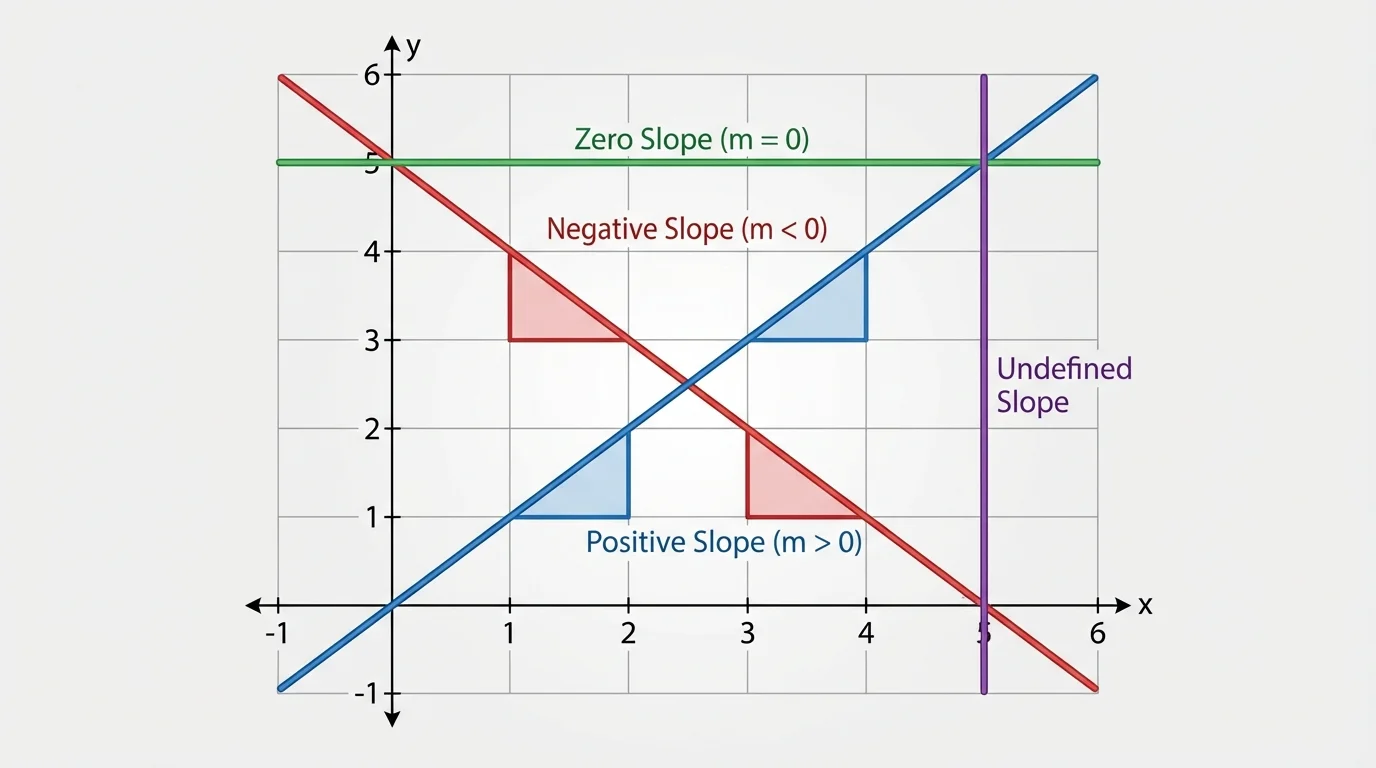
A slope measures how much a line rises or falls as you move from left to right. It tells both steepness and direction. On a graph, as [Figure 1] shows, a line can rise, fall, stay flat, or be vertical, and each case has its own slope behavior.
If a line passes through two points \((x_1, y_1)\) and \((x_2, y_2)\), its slope is
\[m = \frac{y_2 - y_1}{x_2 - x_1}\]
This formula compares change in \(y\) to change in \(x\). You may also hear this called rise over run.
A positive slope means the line rises from left to right. A negative slope means it falls from left to right. A slope of \(0\) means the line is horizontal. An undefined slope means the line is vertical, because division by \(0\) is not defined.
To find the equation of a line, it helps to know the common forms:
If you know a slope and one point, point-slope form is usually the fastest starting point.
Be careful when finding slope from coordinates. The subtraction in the numerator and denominator must match in order. If you compute \(y_2 - y_1\) on top, then the denominator must be \(x_2 - x_1\). Reversing only one subtraction creates the wrong sign.
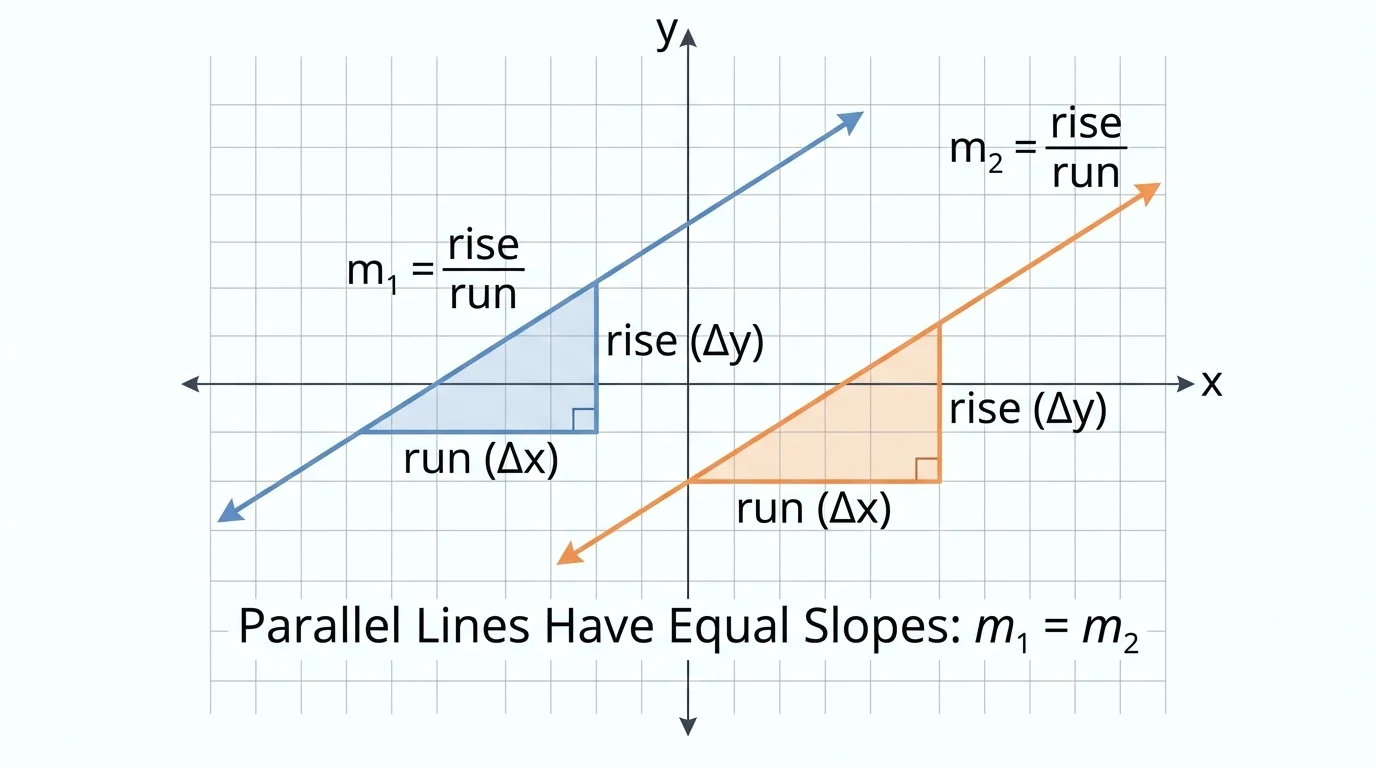
Two nonvertical lines are parallel lines if they never intersect. In the coordinate plane, [Figure 2] illustrates the key idea: if two lines have the same steepness and the same direction, then they have the same slope, so they stay the same distance apart and do not meet.
Suppose line \(\ell_1\) has slope \(m_1\) and line \(\ell_2\) has slope \(m_2\). If the two lines are parallel and neither is vertical, they have identical rise-over-run ratios. That means
\(m_1 = m_2\)
This gives one direction of the criterion: parallel nonvertical lines have equal slopes.
Now prove the converse. Suppose two distinct nonvertical lines have equal slope. Write them in slope-intercept form:
\[y = mx + b_1 \quad \textrm{and} \quad y = mx + b_2\]
They have the same \(m\), so they rise and fall at exactly the same rate. If \(b_1 \ne b_2\), they are distinct lines with the same steepness, so they never meet. Therefore they are parallel.
So the slope criterion is:
\[\textrm{For nonvertical lines, } \ell_1 \parallel \ell_2 \iff m_1 = m_2\]
There is one important special case. Vertical lines do not have slopes, but any two distinct vertical lines are also parallel. For example, \(x = 2\) and \(x = -5\) are parallel even though neither has a numerical slope.
Another way to see this is by contradiction. If two distinct nonvertical lines with equal slope intersected, they would have to share a point while continuing in exactly the same direction. That would make them the same line, not two distinct lines. This is why equal slopes force distinct nonvertical lines to be parallel.
Why equal slopes matter in proofs
In coordinate geometry, visual statements can become algebraic facts. If opposite sides of a quadrilateral have equal slopes, then those opposite sides are parallel. That is enough to prove parts of larger theorems, such as showing that a figure is a parallelogram.
Later, when you compare opposite sides of a polygon, the slope test from [Figure 2] lets you replace a picture-based argument with an algebraic proof.
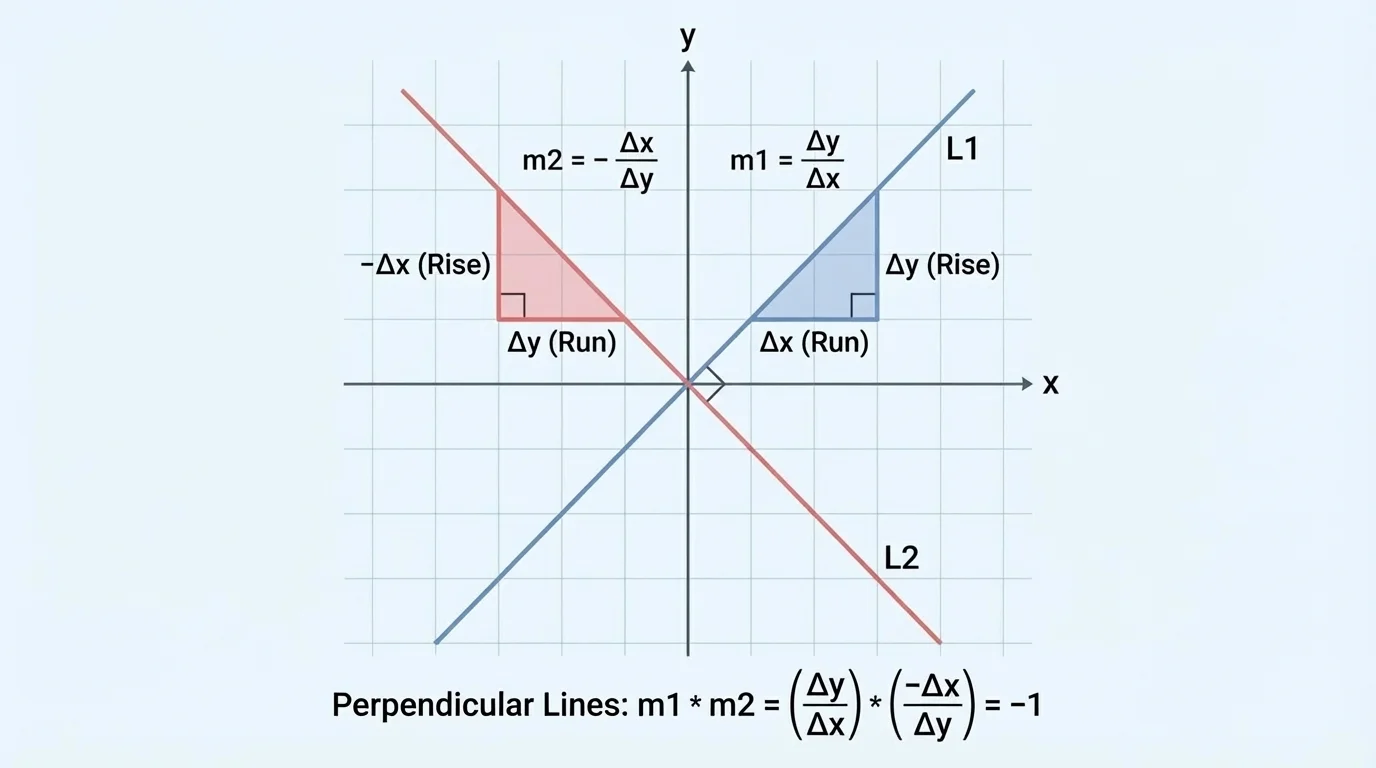
Two lines are perpendicular lines if they meet to form a right angle. For nonvertical and nonhorizontal lines, [Figure 3] shows a striking pattern: the rise and run of one line swap places for the other, and one sign changes. That creates slopes that are negative reciprocals.
If one line has slope \(m\), then a line perpendicular to it has slope
\[m_{\perp} = -\frac{1}{m}\]
provided \(m \ne 0\).
Why is this true? Suppose one line has slope \(m_1 = \dfrac{a}{b}\), where \(a\) is the rise and \(b\) is the run. A perpendicular line must turn that direction by \(90^\circ\). Its rise and run become \(-b\) and \(a\), so its slope is
\[m_2 = \frac{-b}{a}\]
Now multiply the slopes:
\[m_1m_2 = \frac{a}{b} \cdot \frac{-b}{a} = -1\]
So for nonvertical and nonhorizontal lines, perpendicular slopes satisfy
\[\ell_1 \perp \ell_2 \iff m_1m_2 = -1\]
This is equivalent to saying the slopes are negative reciprocals.
There is also a special case here. A horizontal line has slope \(0\), and a vertical line has undefined slope. These two types are perpendicular to each other. So \(y = 4\) is perpendicular to \(x = -1\).
Engineers often think in terms of perpendicular directions when designing buildings, roads, and machine parts. On a blueprint, checking right angles can often be reduced to checking slopes.
A common mistake is to confuse a negative reciprocal with just a negative sign. If a line has slope \(2\), a perpendicular line does not have slope \(-2\). Its slope is \(-\dfrac{1}{2}\). You must both flip the fraction and change the sign.
Once you know the needed slope, you can write the equation of the line through a given point. The most direct method is point-slope form:
\[y - y_1 = m(x - x_1)\]
If the line must be parallel to a given line, use the same slope. If it must be perpendicular, use the negative reciprocal slope, unless the original line is horizontal or vertical.
After writing the equation in point-slope form, you may leave it there or rewrite it in slope-intercept or standard form if needed.
Solved example 1: line parallel to a given line through a point
Find the equation of the line parallel to \(y = 3x - 7\) that passes through \((2, 5)\).
Step 1: Identify the slope of the given line.
The given line is in slope-intercept form, so its slope is \(m = 3\).
Step 2: Use the parallel-line rule.
A parallel line has the same slope, so the new line also has slope \(3\).
Step 3: Use point-slope form with \((2, 5)\).
Substitute into \(y - y_1 = m(x - x_1)\): \(y - 5 = 3(x - 2)\).
Step 4: Simplify if desired.
\(y - 5 = 3x - 6\), so \(y = 3x - 1\).
The equation is
\(y = 3x - 1\)
Notice that the slope stayed the same, but the \(y\)-intercept changed from \(-7\) to \(-1\). That is exactly what happens with distinct parallel nonvertical lines.
Solved example 2: line perpendicular to a given line through a point
Find the equation of the line perpendicular to \(y = -\dfrac{1}{4}x + 6\) that passes through \((8, -2)\).
Step 1: Identify the original slope.
The given slope is \(-\dfrac{1}{4}\).
Step 2: Find the perpendicular slope.
The negative reciprocal of \(-\dfrac{1}{4}\) is \(4\), because \(-\dfrac{1}{4} \cdot 4 = -1\).
Step 3: Substitute into point-slope form.
Using point \((8, -2)\), \(y - (-2) = 4(x - 8)\).
Step 4: Simplify.
\(y + 2 = 4x - 32\), so \(y = 4x - 34\).
The equation is
\(y = 4x - 34\)
Check the result: \(-\dfrac{1}{4} \cdot 4 = -1\), so the lines are perpendicular as expected.
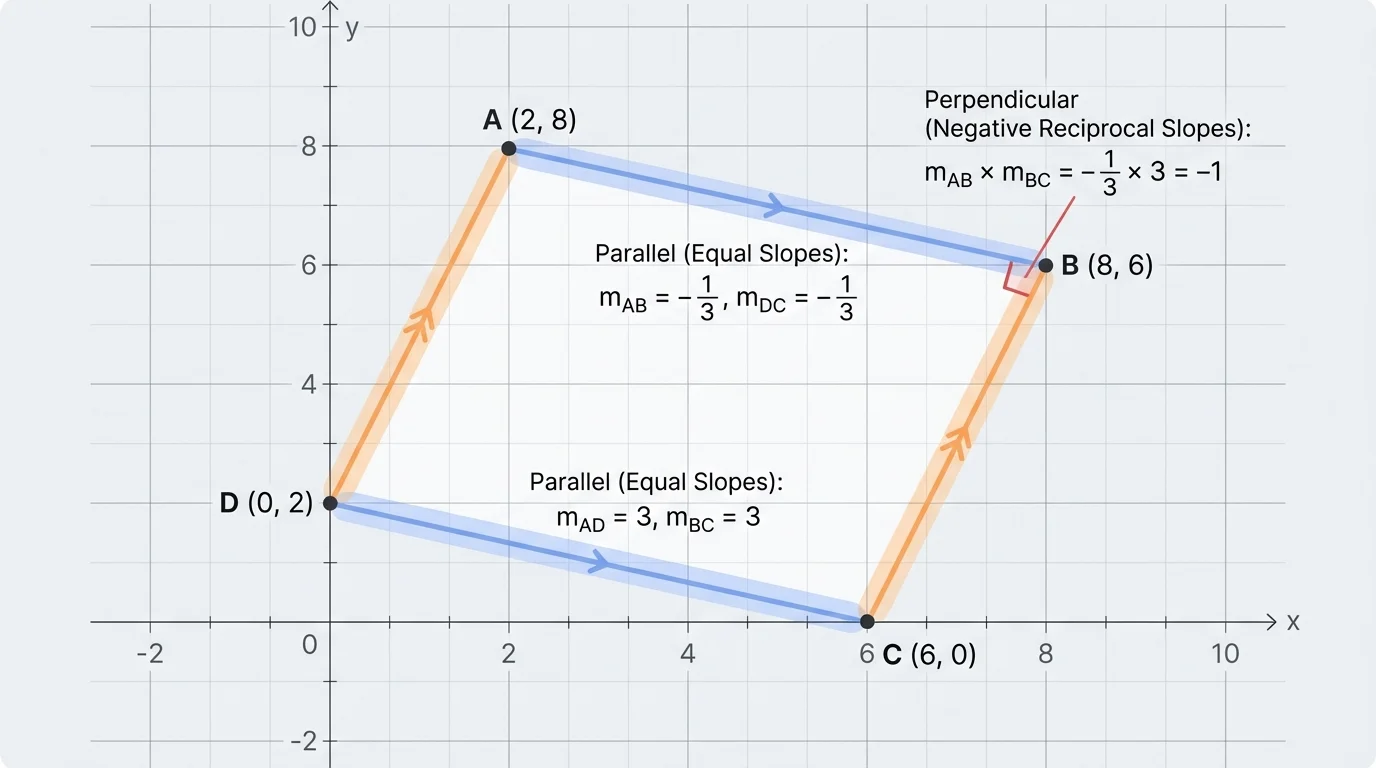
Coordinate geometry turns shapes into algebra. In a figure placed on the coordinate plane, [Figure 4] illustrates how each side becomes a pair of points, each pair of points gives a slope, and those slopes reveal whether sides are parallel or perpendicular. This is one of the simplest ways to prove geometric theorems algebraically.
For example, to show that a quadrilateral is a rectangle, you can prove one pair of opposite sides is parallel, the other pair of opposite sides is parallel, and one angle is a right angle. Slope gives all three tests.
Solved example 3: proving a figure is a rectangle
Given points A\((1, 1)\), B\((5, 3)\), C\((3, 7)\), and D\((-1, 5)\), show that \(ABCD\) is a rectangle.
Step 1: Find the slopes of opposite sides.
\(m_{AB} = \dfrac{3 - 1}{5 - 1} = \dfrac{2}{4} = \dfrac{1}{2}\)
\(m_{CD} = \dfrac{5 - 7}{-1 - 3} = \dfrac{-2}{-4} = \dfrac{1}{2}\)
So \(AB \parallel CD\).
Step 2: Find the slopes of the other pair of opposite sides.
\(m_{BC} = \dfrac{7 - 3}{3 - 5} = \dfrac{4}{-2} = -2\)
\(m_{DA} = \dfrac{1 - 5}{1 - (-1)} = \dfrac{-4}{2} = -2\)
So \(BC \parallel DA\).
Step 3: Check for a right angle.
\(m_{AB} \cdot m_{BC} = \dfrac{1}{2} \cdot (-2) = -1\)
Therefore \(AB \perp BC\).
Step 4: State the geometric conclusion.
Both pairs of opposite sides are parallel, and one angle is a right angle. Therefore \(ABCD\) is a rectangle.
This argument is fully algebraic. No ruler or protractor is needed. As seen in [Figure 4], the picture helps organize the side comparisons, but the proof itself comes from slope calculations.
Solved example 4: special case with a vertical line
Find the equation of the line perpendicular to \(x = 6\) that passes through \((2, -3)\).
Step 1: Interpret the given line.
\(x = 6\) is a vertical line.
Step 2: Use the special perpendicular case.
A line perpendicular to a vertical line is horizontal.
Step 3: Write the equation through the given point.
A horizontal line through \((2, -3)\) has equation \(y = -3\).
The equation is
\(y = -3\)
Special cases matter because the negative-reciprocal rule uses a numerical slope, and vertical lines do not have one. You must recognize when to switch to the horizontal-vertical relationship.
| Relationship between lines | Slope condition | Special case |
|---|---|---|
| Parallel | \(m_1 = m_2\) | Two distinct vertical lines are parallel |
| Perpendicular | \(m_1m_2 = -1\) | A horizontal line and a vertical line are perpendicular |
Table 1. Slope criteria for determining whether lines are parallel or perpendicular.
Architects use perpendicular lines constantly when laying out corners of rooms, support beams, and floor tiles. Surveyors use parallel and perpendicular relationships to mark property boundaries. In computer-aided design, a drawing tool may enforce a slope relationship so that a new segment is exactly parallel or perpendicular to an existing one.
Road networks also rely on these ideas. If one street has slope \(\dfrac{3}{2}\) on a city grid, then a crossing street at a right angle must have slope \(-\dfrac{2}{3}\), unless the streets are aligned as horizontal and vertical. This makes slope a practical way to control direction without physically measuring angles every time.
Wheelchair ramp design, roof pitch, and drainage systems all involve line steepness. Equal slopes indicate matching inclines; negative reciprocal slopes indicate right-angle layout. Algebra gives a precise way to test those conditions before anything is built.
Error 1: Thinking parallel lines have the same \(y\)-intercept. They do not. Distinct parallel lines have the same slope but different intercepts.
Error 2: Forgetting to take the negative reciprocal. If the slope is \(\dfrac{2}{3}\), the perpendicular slope is \(-\dfrac{3}{2}\), not \(-\dfrac{2}{3}\).
Error 3: Using the product rule \(m_1m_2 = -1\) with a vertical line. Vertical lines have undefined slope, so use the horizontal-vertical special case instead.
Error 4: Mixing the order in the slope formula. If you write \(y_2 - y_1\) in the numerator, keep \(x_2 - x_1\) in the denominator.
Error 5: Assuming equal slopes always mean parallel lines. If two equations actually describe the same line, then the lines coincide rather than forming a distinct parallel pair. In geometry problems, check whether the lines are distinct.
"Geometry is algebra made visible, and algebra is geometry made precise."
When you work with coordinates, slope becomes the bridge between shape and equation. A line on a graph is no longer just a picture; it becomes something you can test, prove, and construct precisely.
