A surprising amount of the world can be understood by pretending it is made of perfect shapes. A tree trunk is not a perfect cylinder, a torso is not a perfect cylinder, and a storage tank is not built from ideal mathematical surfaces. Yet geometry lets us describe these objects with enough accuracy to estimate volume, compare sizes, design structures, and solve practical problems. This is one of the most powerful ideas in mathematics: a simpler model can reveal useful insights about a more complicated reality.
To create a geometric model of an object means to represent it using familiar shapes whose properties we understand well. Instead of trying to describe every bump, curve, or irregular detail, we choose a shape such as a cylinder, sphere, cone, prism, or pyramid. Then we use measurements and formulas to answer questions about the object.
This matters because formulas for area and volume are already known. If a tree trunk is modeled as a cylinder with radius \(r\) and height \(h\), then its volume can be estimated with \(V = \pi r^2 h\). If a ball is modeled as a sphere, then its volume can be estimated with \(V = \dfrac{4}{3}\pi r^3\). Geometry turns a messy object into something measurable.
Modeling is always an approximation, not a perfect copy. A good model is useful because it captures the features that matter for the problem at hand. If you want to estimate how much wood is in a log, a cylindrical model may be excellent. If you want to describe the exact texture of the bark, it is not enough.
Modeling with geometry is the process of representing real objects or situations using geometric figures, measurements, and properties so that their size, shape, area, volume, or structure can be analyzed mathematically.
Approximation means using a value or shape that is close to the real one, even if it is not exact.
In science, engineering, medicine, and design, people constantly decide which details to keep and which to ignore. That choice is part of mathematical thinking, not a shortcut around it.
Many everyday objects can be represented by standard solids, as [Figure 1] shows. A cylinder works well for cans, pipes, batteries, tree trunks, and parts of the human body such as an arm, leg, or torso. A sphere can model balls, droplets, planets, and some fruit. A cone can model traffic cones, party hats, or the pointed shape of some mountains.
A prism models objects with a constant cross-section, such as boxes, bricks, and some beams. A pyramid can represent pointed roofs or monuments. In many situations, one shape is not enough, so we build a model from multiple solids. A capsule-shaped pill, for example, can be treated as a cylinder with two hemispherical ends.
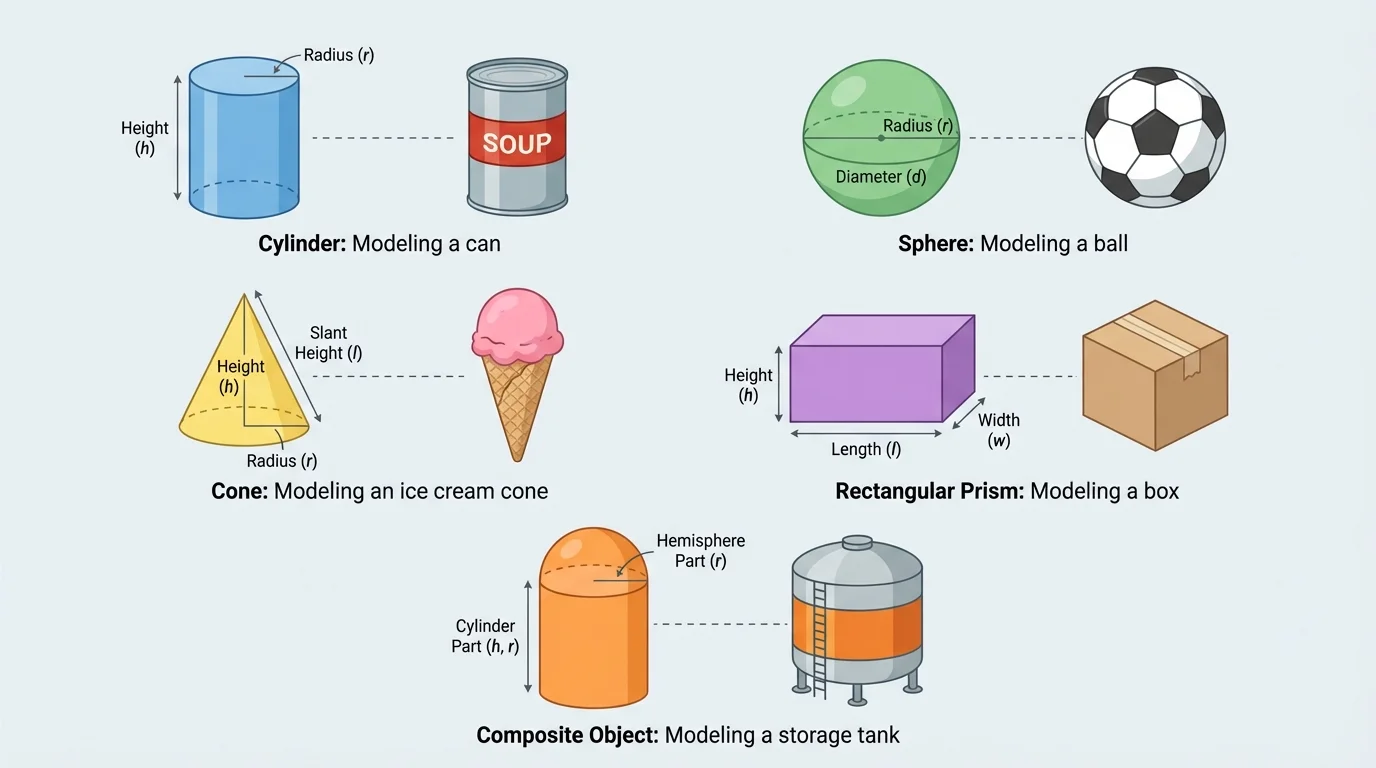
The choice of shape depends on what feature of the object you care about. A soda can is close to a cylinder because it has two parallel circular bases and a constant radius. A basketball is modeled as a sphere because every point on its surface is about the same distance from its center. A roof beam may be modeled as a rectangular prism because its faces are flat and parallel in predictable ways.
Sometimes the same real object can be modeled in more than one way. A tree trunk might be treated as a cylinder for volume, but as a frustum of a cone if its width noticeably changes from bottom to top. Both models may be reasonable; one is simply more detailed.
Medical researchers sometimes estimate the volume of organs or body segments by approximating them with standard solids. Even when computer imaging is available, simple geometric models still provide fast first estimates.
This idea of choosing the right level of detail appears throughout mathematics. The best model is not always the most complicated one. It is the one that answers the question efficiently and accurately enough.
Once an object is matched to a shape, the next step is to identify the relevant measurements. As [Figure 2] illustrates, a cylinder is often described by its radius \(r\), diameter \(d\), and height \(h\). These are related by \(d = 2r\). A cone also has radius and height, and it may include slant height if surface area is being considered.
Some problems focus on volume, the amount of space inside a solid. Others focus on surface area, the amount of material needed to cover it. The formulas depend on the shape:
For a cylinder,
\[V = \pi r^2 h\]
and
\[SA = 2\pi r^2 + 2\pi rh\]
For a sphere,
\[V = \frac{4}{3}\pi r^3\]
and
\[SA = 4\pi r^2\]
For a cone,
\[V = \frac{1}{3}\pi r^2 h\]
and
\[SA = \pi r^2 + \pi r\ell\]
where \(\ell\) is the slant height.
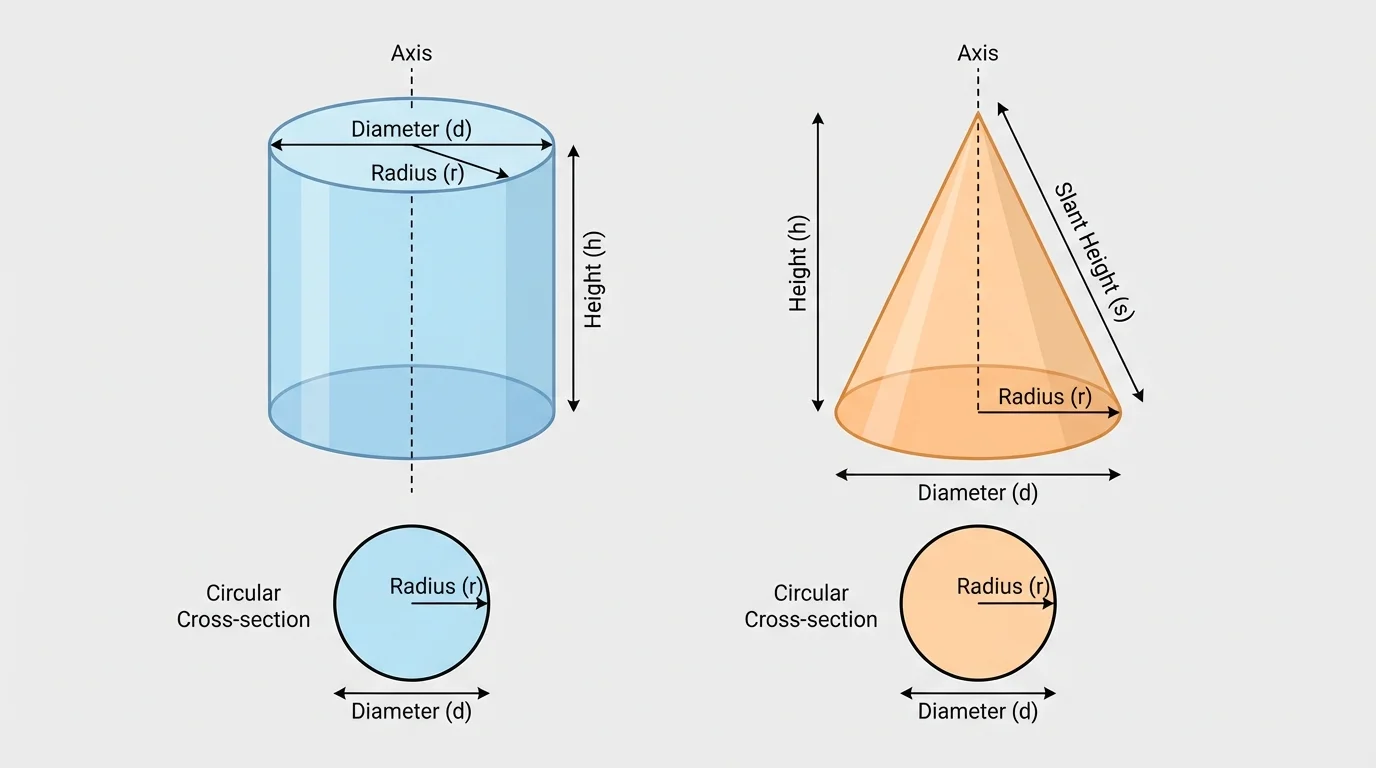
Properties also matter. A cylinder has two parallel congruent circular bases. A prism has parallel congruent bases and flat lateral faces. A sphere has no edges or vertices and is perfectly symmetric in every direction. Those properties help explain why certain formulas work and why certain shapes fit certain objects better.
Another useful idea is the cross-section, which is the shape formed by slicing through a solid. For a cylinder, a horizontal cross-section is a circle. For a rectangular prism, a cross-section parallel to the base is a rectangle. Cross-sections help engineers and designers understand how an object behaves internally and externally.
Measurements depend on purpose
If you want to know how much liquid a bottle can hold, volume is the key measure. If you want to know how much metal is needed to manufacture the bottle, surface area becomes more important. The same object may require different geometric information depending on the question being asked.
This is why geometry is more than naming shapes. It is about connecting shapes, dimensions, and properties to meaningful quantities.
A useful model balances simplicity and accuracy. If a real object is close to a standard solid, the model may be excellent. If the object changes shape a lot from one part to another, a single solid may be too crude and a composite model may work better.
Suppose you are estimating the amount of water in a water tower. A spherical tank and a cylindrical tank require different formulas, so identifying the shape correctly matters. But if the top is rounded, you might model the whole tower as a cylinder plus a hemisphere. The more carefully your model matches the real structure, the better your estimate will be.
Assumptions should always be stated clearly. If you say a torso is modeled as a cylinder, you are assuming its width is fairly constant from top to bottom and that small shape changes are being ignored. Good mathematical communication includes those assumptions.
Area measures two-dimensional space and is expressed in square units such as \(\textrm{cm}^2\) or \(\textrm{m}^2\). Volume measures three-dimensional space and is expressed in cubic units such as \(\textrm{cm}^3\) or \(\textrm{m}^3\).
Reasonableness also matters. A model that produces an impossible answer, such as a negative volume or a torso volume smaller than a hand volume, signals that the chosen dimensions or units are wrong.
A forester measures a tree trunk and finds that its radius is about \(0.25 \textrm{ m}\) and its usable height is \(8 \textrm{ m}\). Model the trunk as a cylinder and estimate its volume.
Worked example
Step 1: Choose the formula for the volume of a cylinder.
\(V = \pi r^2 h\)
Step 2: Substitute the given values.
\(V = \pi (0.25)^2(8)\)
Step 3: Simplify.
First, \((0.25)^2 = 0.0625\).
Then \(0.0625 \cdot 8 = 0.5\).
So \(V = 0.5\pi\).
Step 4: Approximate.
\(V \approx 0.5(3.1416) = 1.57\)
The estimated volume of the trunk is
\[V \approx 1.57 \textrm{ m}^3\]
This answer is an estimate because real trunks are not perfectly cylindrical. If the trunk narrows noticeably, the actual volume would be somewhat less. Still, for planning timber volume, this model can be very useful.
Notice how the cylinder model captures the main feature that matters: a roughly circular cross-section that stays similar along the height, much like the standard cylinder in [Figure 1].
Suppose a torso is approximated by a cylinder with radius \(15 \textrm{ cm}\) and height \(60 \textrm{ cm}\). Estimate its volume.
Worked example
Step 1: Write the cylinder volume formula.
\(V = \pi r^2 h\)
Step 2: Substitute \(r = 15\) and \(h = 60\).
\(V = \pi (15)^2(60)\)
Step 3: Compute the square and product.
\((15)^2 = 225\)
\(225 \cdot 60 = 13{,}500\)
So \(V = 13{,}500\pi\).
Step 4: Approximate.
\(V \approx 13{,}500(3.1416) \approx 42{,}412\)
The estimated torso volume is
\[V \approx 42{,}412 \textrm{ cm}^3\]
Because \(1{,}000 \textrm{ cm}^3 = 1 \textrm{ L}\), this is about \(42.4 \textrm{ L}\). In anatomy or biomechanics, such approximations can help estimate body segment volume, buoyancy, or mass when combined with density.
This does not mean a torso is actually a cylinder. It means the cylinder is close enough to answer a volume question. Modeling depends on purpose, not on claiming perfect geometric identity. The dessert model in [Figure 3] is another example of how combining simple solids can represent a more complicated object.
Some objects are best described by combining shapes. This dessert model separates the cone from the scoop so that each part can be measured and analyzed. Suppose an ice cream cone has a cone of radius \(3 \textrm{ cm}\) and height \(12 \textrm{ cm}\), with one scoop modeled as a sphere of radius \(3 \textrm{ cm}\). Estimate the total volume.
Worked example
Step 1: Find the volume of the cone.
\(V_{\textrm{cone}} = \dfrac{1}{3}\pi r^2 h = \dfrac{1}{3}\pi (3)^2(12)\)
\((3)^2 = 9\), so \(V_{\textrm{cone}} = \dfrac{1}{3}\pi (9)(12) = 36\pi\).
Step 2: Find the volume of the sphere.
\(V_{\textrm{sphere}} = \dfrac{4}{3}\pi r^3 = \dfrac{4}{3}\pi (3)^3\)
\((3)^3 = 27\), so \(V_{\textrm{sphere}} = \dfrac{4}{3}\pi (27) = 36\pi\).
Step 3: Add the two volumes.
\(V_{\textrm{total}} = 36\pi + 36\pi = 72\pi\)
Step 4: Approximate.
\(V_{\textrm{total}} \approx 72(3.1416) \approx 226.2\)
The total modeled volume is
\[V_{\textrm{total}} \approx 226.2 \textrm{ cm}^3\]
This example shows a composite solid, which is a figure made from two or more simpler solids. Composite models are extremely common because many manufactured and natural objects mix shapes.
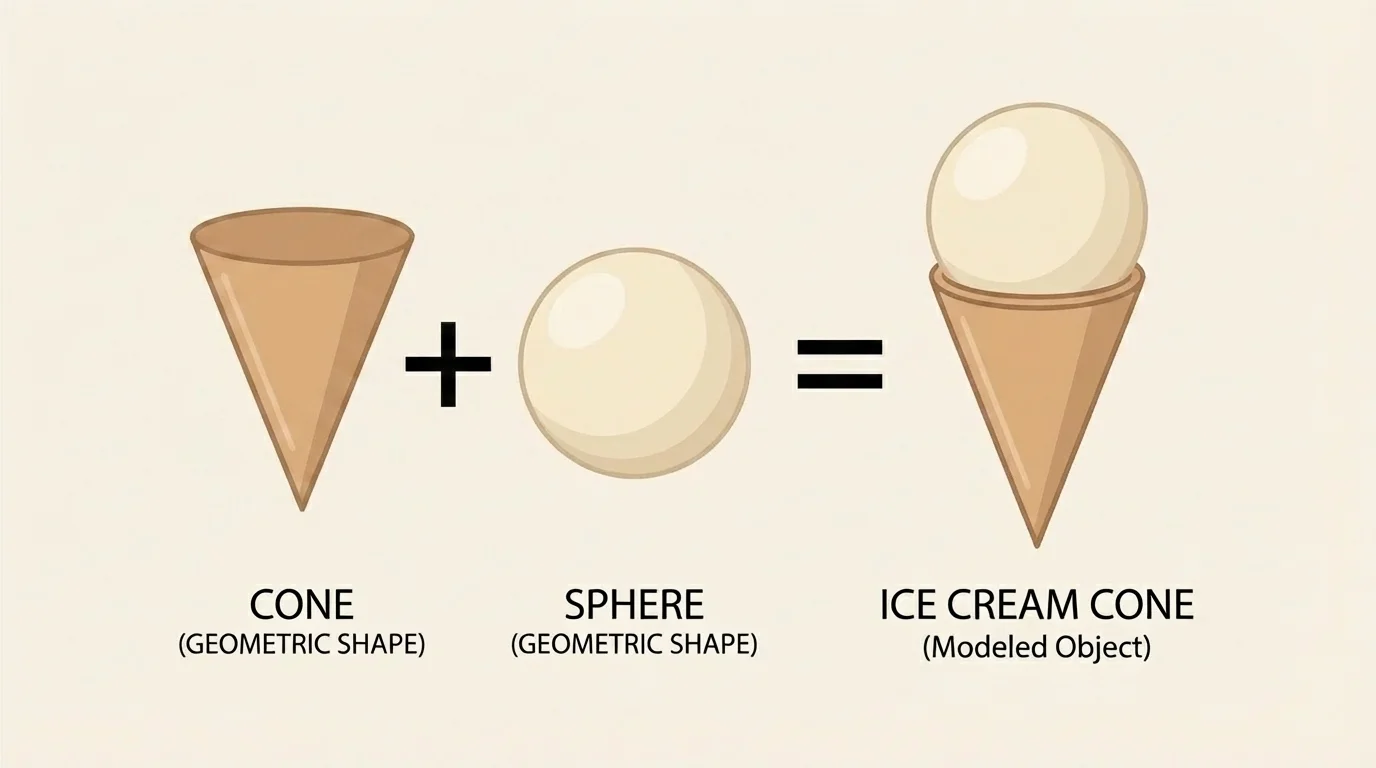
In reality, the scoop may not be a perfect sphere and some ice cream may extend into the cone. But the model gives a clear and useful estimate.
Real objects are often combinations of shapes. A grain silo may be modeled as a cylinder topped by a cone. A greenhouse dome may include cylindrical walls and a hemispherical roof. A rocket nose can be modeled with cones, cylinders, and sometimes spheres or paraboloid-like forms.
In biology, a long bone might be approximated by a cylinder in one region and by tapered forms at the ends. In environmental science, a lake basin might be roughly approximated by layered prisms or frustums to estimate stored water. In architecture, columns are frequently treated as cylinders, while support blocks may be rectangular prisms.
Breaking a complicated object into parts makes measurements manageable. The total volume is the sum of the individual volumes. If part of a shape is removed, then subtraction may be used instead. For example, a hollow pipe can be modeled as a larger cylinder minus a smaller inner cylinder.
Additive modeling
When a real object is made of several recognizable pieces, model each piece with a known solid, compute its measure, and then combine the results. This approach is especially useful for volume and surface area problems in engineering design.
The success of this strategy depends on keeping track of what is included and what is not. Surface area, in particular, requires care because internal touching surfaces usually are not exposed and should not always be counted.
Measurements must use consistent units. If radius is measured in centimeters and height in meters, one value must be converted before using a formula. Otherwise, the numerical result will be misleading even if the algebra is correct.
Precision matters too. A radius measured as \(5 \textrm{ cm}\) might actually mean anything close to that value, depending on the measuring tool. Small changes in dimensions can cause noticeable changes in area and volume, especially when exponents are involved. Because volume often includes squares or cubes of dimensions, measurement error can grow quickly.
For example, if the radius of a sphere is underestimated, the volume estimate changes by a factor related to \(r^3\). That means a small percentage error in radius can lead to a larger percentage error in volume. This is one reason engineers specify tolerances carefully.
Manufacturing companies often test whether a cylindrical part fits design tolerances within fractions of a millimeter. A tiny radius error can affect how much fluid a tank holds or whether machine parts align correctly.
Good modeling always includes attention to units, precision, and whether an answer seems realistic.
One object can have different reasonable models depending on the goal. A football is not a sphere, but if you only want a rough estimate of size, a sphere may be acceptable. If aerodynamics matters, a more specialized shape is needed.
A bottle might be approximated as a cylinder for volume, but a manufacturer designing labels may need a more exact surface model. A tree trunk can be treated as a cylinder for a quick estimate, but as a tapered solid if higher accuracy is required. The choice depends on the question, the available measurements, and the desired precision.
This flexibility is a strength of geometry. Mathematics does not require every model to be exact. It requires the model to be justified.
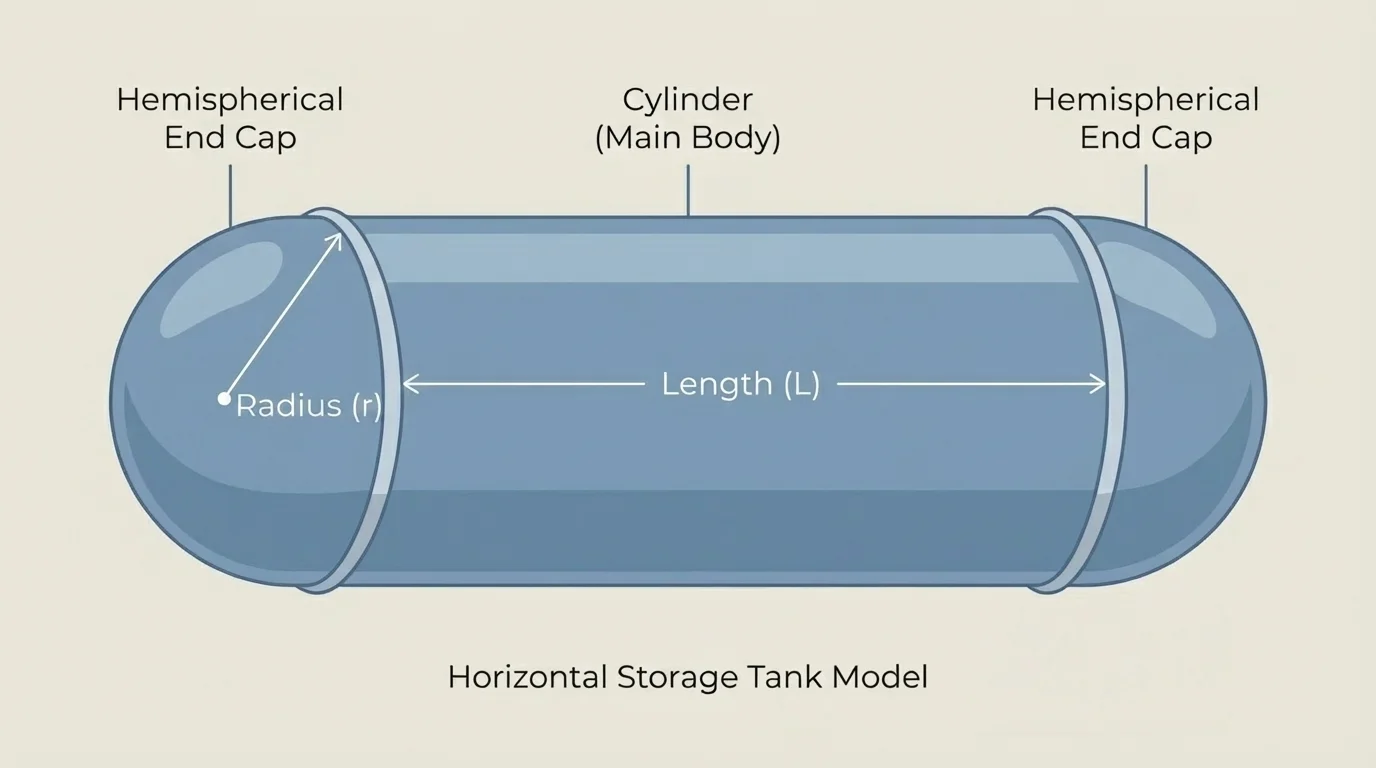
Geometry-based design appears everywhere. Tanks such as the one in [Figure 4] are often designed from standard solids because their capacity, material cost, and structural behavior can all be predicted from geometric properties. Architects use cylinders for columns, prisms for beams, and combinations of solids for domes and towers.
Medicine uses geometric models to estimate organ size, blood vessel capacity, and body segment volume. Environmental scientists estimate the amount of stored water, sediment, or ice using approximated geometric forms. In manufacturing, companies calculate how much material is needed to produce cans, bottles, pipes, and containers. A common example is the industrial tank in [Figure 4], which can be modeled with standard solids to estimate capacity and exterior area.
Sports technology also relies on modeling. Ball design depends on spherical approximations, and equipment dimensions often involve cylinders, cones, and prisms. In computer graphics, complex objects are first built from simple geometric primitives before being refined into detailed forms.
The same idea extends into physics and engineering. Density calculations often start with a geometric volume estimate, since mass and volume are related by \(\rho = \dfrac{m}{V}\). If the volume of a cylindrical tank is known, the mass of the liquid inside can be estimated from its density. This is a good example of how a composite model leads directly to practical decisions about storage and safety.
| Object | Possible geometric model | Main useful measure |
|---|---|---|
| Tree trunk | Cylinder | Volume |
| Torso | Cylinder | Volume |
| Ball | Sphere | Volume or surface area |
| Box | Rectangular prism | Volume or surface area |
| Silo | Cylinder and cone | Total volume |
| Storage tank | Cylinder and hemispheres | Capacity and exterior area |
Table 1. Examples of real objects, their geometric models, and the measures most often studied.
When geometry is used this way, it becomes more than a set of formulas. It becomes a language for describing the world.
