A tanker truck, a grain silo, an ice cream cone, and a basketball look nothing alike, yet geometry connects them through one powerful idea: volume. Volume tells us how much space a three-dimensional object occupies. In engineering, medicine, shipping, and design, getting volume right matters. A small error in a tank calculation can mean wasted material, overflow, or a product that simply does not fit.
In geometry, volume measures the amount of space inside a solid figure. For example, if a box has a volume of \(24 \textrm{ cm}^3\), it occupies \(24\) cubic centimeters of space.
A better way to think about volume is with layers. A solid can often be imagined as many thin slices stacked together. For some shapes, that idea leads directly to a formula. For others, the formula may look less obvious at first, but it still reflects how space is filled in three dimensions.
Volume is the amount of space inside a three-dimensional figure, measured in cubic units such as \(\textrm{cm}^3\), \(\textrm{m}^3\), or \(\textrm{in}^3\).
Radius is the distance from the center of a circle or sphere to its edge. Diameter is twice the radius, so \(d = 2r\).
Height is the perpendicular distance from a base to the opposite face or vertex. For cones and pyramids, this is not the slant height.
Base area is the area of the base of a solid, often written as \(B\).
Units matter. If dimensions are given in centimeters, then volume will be in cubic centimeters. If one measurement is in meters and another is in centimeters, convert first. A formula can be perfect, but if the units are inconsistent, the final answer will be wrong.
Before solving any volume problem, it helps to ask three questions: What is the shape? Which measurements are given? Are the units consistent? That simple checklist prevents many mistakes.
Recall these area formulas because volume formulas often depend on them: for a circle, \(A = \pi r^2\) and for a rectangle, \(A = lw\). If a volume formula uses \(B\), you must first know how to find the base area.
The formulas for many solids are easier to remember when you connect them to simpler ideas. A cylinder is base area times height. A pyramid or cone is one-third of a related prism or cylinder with the same base and height. A sphere uses a different formula, but the radius still controls how quickly the volume grows.
A cylinder has two parallel, congruent circular bases. Its volume can be understood by stacking identical circles through a height. Since each layer has the same area, the volume is simply base area times height.
The general formula is \(V = Bh\). For a cylinder, the base is a circle, so \(B = \pi r^2\). That gives the cylinder formula: \[V = \pi r^2 h\] Here, \(r\) is the radius of the base and \(h\) is the perpendicular height.
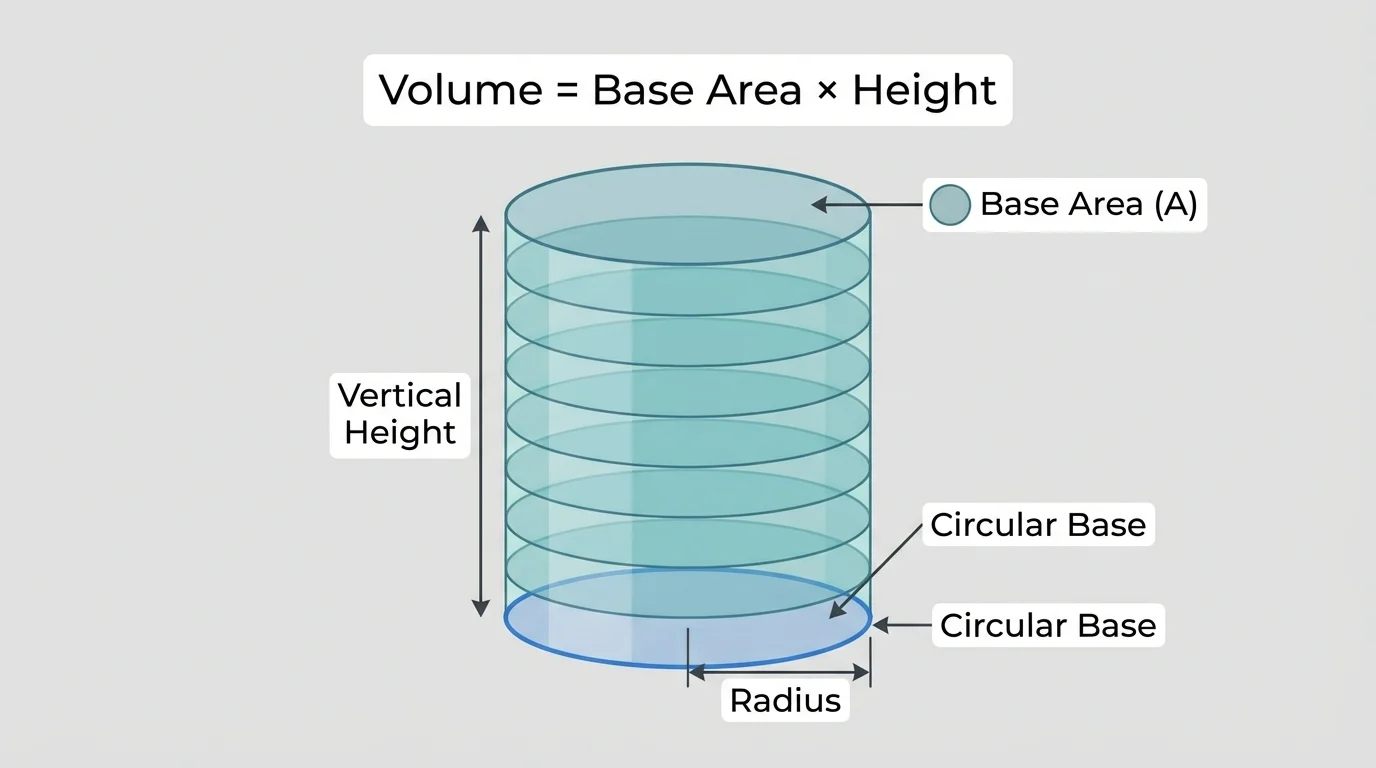
Notice that the exponent is on the radius, not on the height. If the radius doubles while the height stays the same, the volume becomes four times as large because \(r^2\) changes. This is one reason cylindrical tanks and pipes can increase capacity quickly when their diameter increases.
Worked example 1
A cylindrical water tank has radius \(4 \textrm{ m}\) and height \(10 \textrm{ m}\). Find its volume.
Step 1: Write the formula.
For a cylinder, \(V = \pi r^2 h\).
Step 2: Substitute the known values.
\(V = \pi (4)^2(10)\)
Step 3: Simplify.
\(V = \pi (16)(10) = 160\pi\)
Step 4: Approximate if needed.
\(V \approx 160(3.14) = 502.4\)
The volume is \[160\pi \textrm{ m}^3 \approx 502.4 \textrm{ m}^3\]
If a problem gives the diameter instead of the radius, divide by \(2\) first. For example, if the diameter is \(12 \textrm{ cm}\), then the radius is \(6 \textrm{ cm}\). As seen earlier in [Figure 1], the radius runs from the center to the edge, not all the way across the circle.
A pyramid and a cone each come to a point, and that changes how much space they contain. The key idea is that if a pyramid and a prism have the same base area and height, the pyramid has one-third the volume of the prism. The same relationship holds for a cone and a cylinder.
For any pyramid, \[V = \frac{1}{3}Bh\], where \(B\) is the area of the base. For a cone, the base is a circle, so \(B = \pi r^2\), giving \[V = \frac{1}{3}\pi r^2 h\]
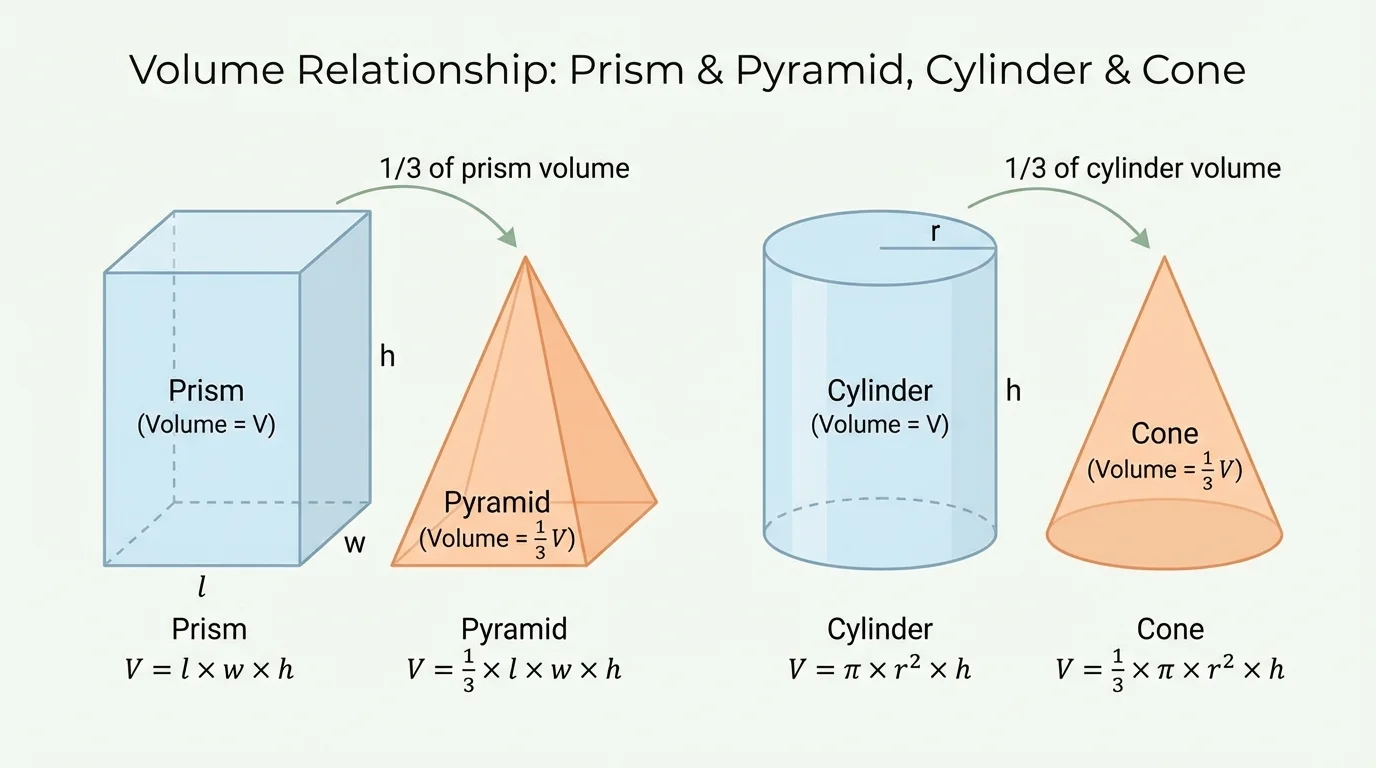
This \(\dfrac{1}{3}\) factor is one of the most important details in the topic. Many students forget it, especially when moving quickly. If the shape comes to a point, that is a clue that the formula may involve one-third.
Worked example 2
A square pyramid has base side length \(9 \textrm{ cm}\) and height \(12 \textrm{ cm}\). Find its volume.
Step 1: Find the base area.
The base is a square, so \(B = 9^2 = 81\).
Step 2: Use the pyramid formula.
\(V = \dfrac{1}{3}Bh = \dfrac{1}{3}(81)(12)\)
Step 3: Simplify.
\(V = \dfrac{972}{3} = 324\)
The volume is \[324 \textrm{ cm}^3\]
For cones, use the same structure but replace base area with the area of a circle. Be careful not to use slant height unless the problem specifically asks for a surface area question. Volume requires the perpendicular height from the center of the base to the vertex.
Worked example 3
A cone has radius \(5 \textrm{ in}\) and height \(9 \textrm{ in}\). Find its volume.
Step 1: Write the formula.
\(V = \dfrac{1}{3}\pi r^2 h\)
Step 2: Substitute values.
\(V = \dfrac{1}{3}\pi (5)^2(9)\)
Step 3: Simplify.
\(V = \dfrac{1}{3}\pi (25)(9) = 75\pi\)
Step 4: Approximate if needed.
\(V \approx 75(3.14) = 235.5\)
The volume is \[75\pi \textrm{ in}^3 \approx 235.5 \textrm{ in}^3\]
One useful comparison is that a cone with the same radius and height as a cylinder holds exactly one-third as much. That is why a cone-shaped cup looks spacious but actually holds less than many students expect.
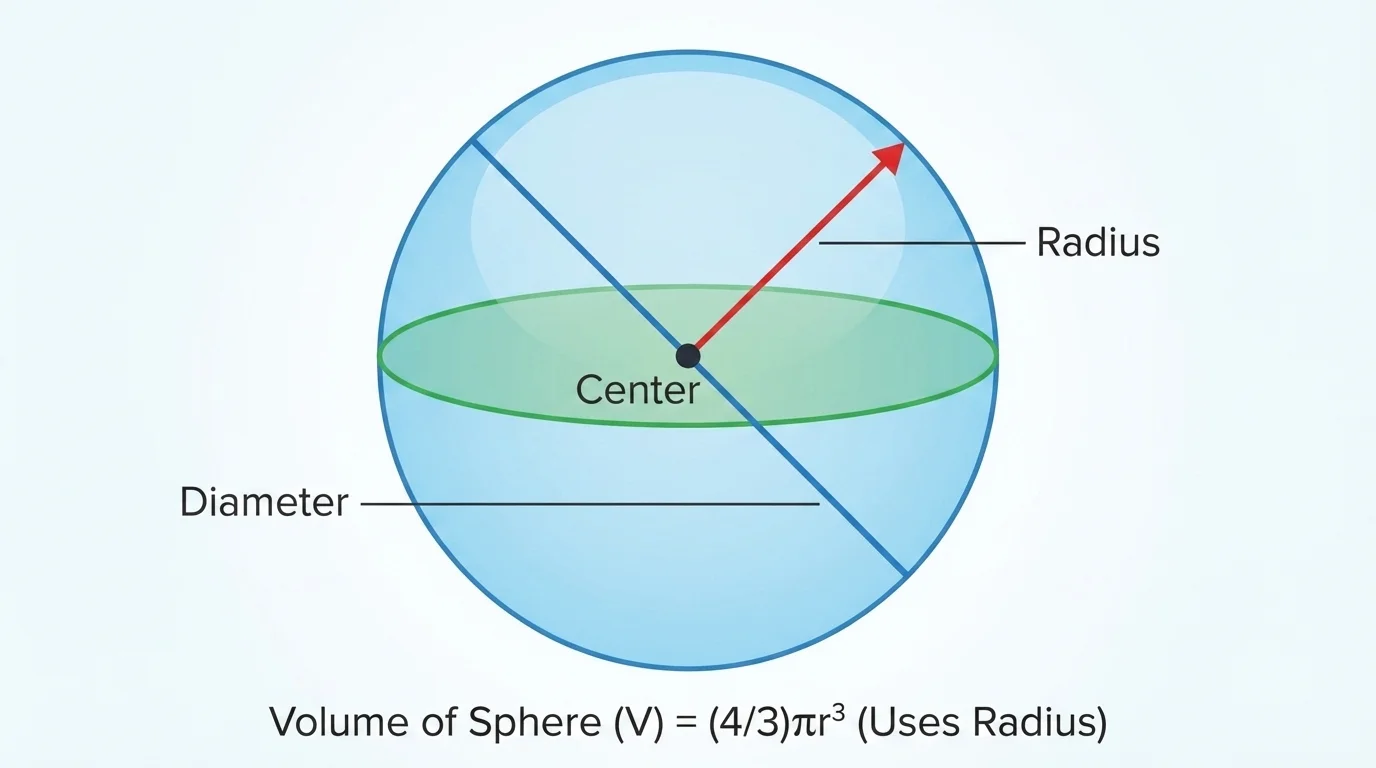
A sphere is perfectly round in three dimensions, and its volume depends on the radius. The formula uses radius, not diameter. The formula is \[V = \frac{4}{3}\pi r^3\]
This formula grows quickly because of the \(r^3\) term. If the radius doubles, the volume becomes \(2^3 = 8\) times as large. That kind of rapid growth appears in many real contexts, such as changes in the amount of air a ball contains or the amount of material needed to make spherical objects.
Worked example 4
A spherical ball has radius \(6 \textrm{ cm}\). Find its volume.
Step 1: Write the formula.
\(V = \dfrac{4}{3}\pi r^3\)
Step 2: Substitute the radius.
\(V = \dfrac{4}{3}\pi (6)^3\)
Step 3: Simplify.
\(6^3 = 216\), so \(V = \dfrac{4}{3}\pi (216) = 288\pi\)
Step 4: Approximate.
\(V \approx 288(3.14) = 904.32\)
The volume is \[288\pi \textrm{ cm}^3 \approx 904.32 \textrm{ cm}^3\]
If a problem gives the diameter as \(14 \textrm{ cm}\), then the radius is \(7 \textrm{ cm}\). This diameter-radius conversion is especially important for spheres, and the labeled line segments in [Figure 3] help keep that distinction clear.
The volume of a sphere increases so fast with radius that a modest change in size can create a dramatic change in capacity. A ball with radius \(10\) does not hold twice the volume of a ball with radius \(5\); it holds eight times as much.
That rapid growth is one reason scaling matters so much in design and manufacturing. Changing a dimension slightly can greatly affect how much a container holds or how much material is needed.
Many real objects are not perfect single solids. Instead, they are combinations of familiar shapes. In problems like this, the strategy is to break the object into simpler parts, find each volume, and then add or subtract.
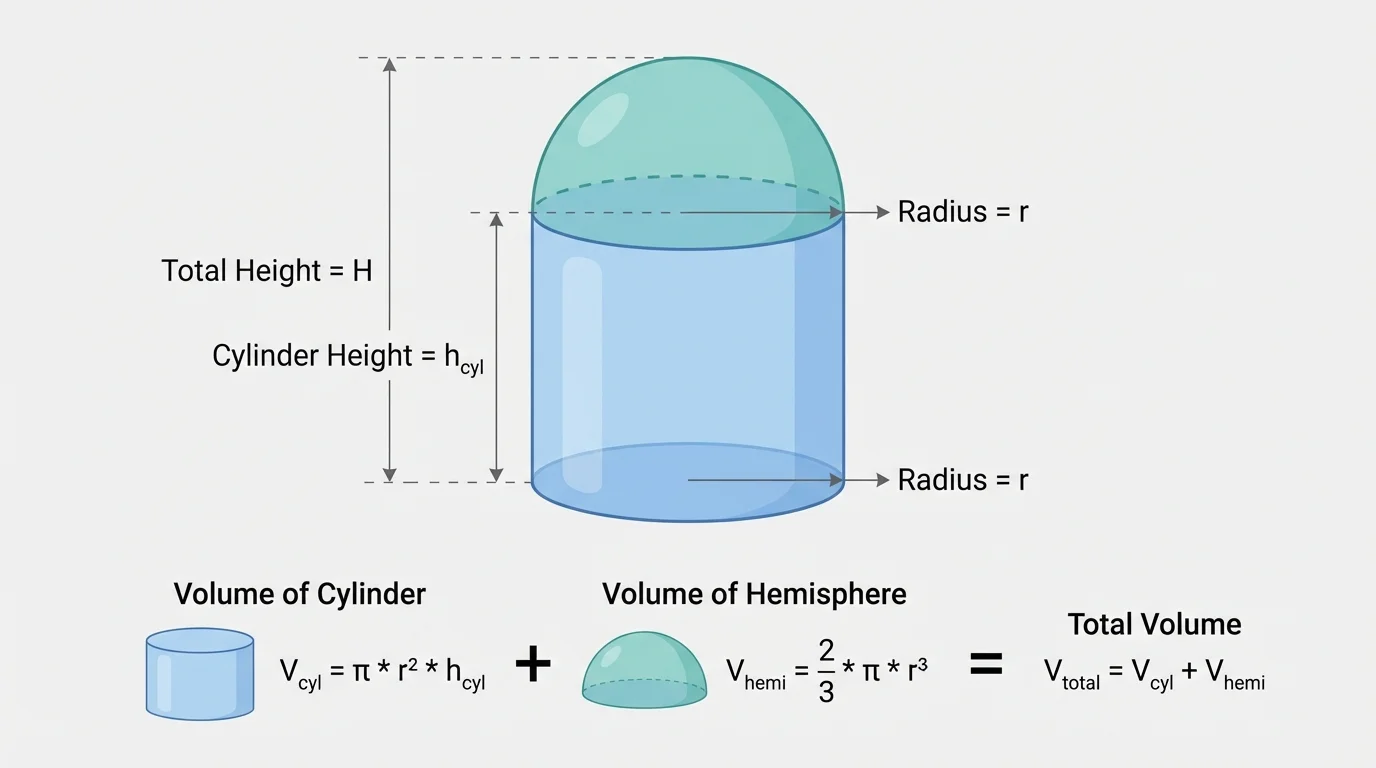
For example, a water tower may be modeled as a cylinder topped by a hemisphere. A decorative object might be a cone on top of a cylinder. A hollow object could require subtraction: find the outer volume, then subtract the inner empty space.
Inverse volume problems sometimes ask for a missing dimension instead of the volume itself. In those cases, start with the correct formula, substitute the known values, and solve the equation. This turns a geometry problem into an algebra problem.
Here is a quick comparison of the main formulas.
| Solid | Formula | Key measurement idea |
|---|---|---|
| Cylinder | \(V = \pi r^2 h\) | Circle base times height |
| Pyramid | \(V = \dfrac{1}{3}Bh\) | One-third of related prism |
| Cone | \(V = \dfrac{1}{3}\pi r^2 h\) | One-third of related cylinder |
| Sphere | \(V = \dfrac{4}{3}\pi r^3\) | Uses radius only |
Table 1. Volume formulas for the four main solids in this lesson.
Worked example 5
A storage container is shaped like a cylinder with a hemisphere on top. The radius is \(3 \textrm{ m}\), and the cylindrical part has height \(8 \textrm{ m}\). Find the total volume.
Step 1: Find the cylinder volume.
\(V_{\textrm{cyl}} = \pi r^2 h = \pi (3)^2(8) = 72\pi\)
Step 2: Find the hemisphere volume.
A hemisphere is half a sphere, so \(V_{\textrm{hemi}} = \dfrac{1}{2}\left(\dfrac{4}{3}\pi r^3\right) = \dfrac{2}{3}\pi r^3\).
Substitute \(r = 3\): \(V_{\textrm{hemi}} = \dfrac{2}{3}\pi (27) = 18\pi\)
Step 3: Add the volumes.
\(V_{\textrm{total}} = 72\pi + 18\pi = 90\pi\)
Step 4: Approximate.
\(V \approx 90(3.14) = 282.6\)
The total volume is \[90\pi \textrm{ m}^3 \approx 282.6 \textrm{ m}^3\]
The decomposition shown earlier in [Figure 4] is a common modeling technique: separate the solid into familiar pieces, calculate carefully, and combine the results with the correct operation.
Worked example 6
A cone has volume \(100\pi \textrm{ cm}^3\) and radius \(5 \textrm{ cm}\). Find its height.
Step 1: Start with the formula.
\(V = \dfrac{1}{3}\pi r^2 h\)
Step 2: Substitute known values.
\(100\pi = \dfrac{1}{3}\pi (5)^2 h\)
Step 3: Simplify.
\(100\pi = \dfrac{25\pi h}{3}\)
Step 4: Solve for \(h\).
Multiply both sides by \(3\): \(300\pi = 25\pi h\)
Divide by \(25\pi\): \(h = 12\)
The height is \[12 \textrm{ cm}\]
Volume formulas are used whenever space, capacity, or material amount must be estimated. A company designing a cylindrical can needs volume to know how much product fits inside. An architect designing a pyramid-shaped skylight needs volume to understand interior space. A sports manufacturer uses the sphere formula when modeling ball size, and a civil engineer may compare cone and cylinder volumes when analyzing funnels, hoppers, or towers.
Medical science also uses volume reasoning. Some pills and containers are approximated with cylinders or combinations of curved solids. In agriculture, grain silos are often cylindrical, sometimes with conical or hemispherical tops. In each case, choosing the correct formula affects cost, safety, and efficiency.
Application example
An ice cream cone has radius \(3 \textrm{ cm}\) and height \(12 \textrm{ cm}\). If a single scoop is modeled as a sphere of radius \(3 \textrm{ cm}\), compare the cone volume and scoop volume.
Step 1: Find the cone volume.
\(V_{\textrm{cone}} = \dfrac{1}{3}\pi r^2 h = \dfrac{1}{3}\pi (3)^2(12) = 36\pi\)
Step 2: Find the sphere volume.
\(V_{\textrm{sphere}} = \dfrac{4}{3}\pi r^3 = \dfrac{4}{3}\pi (27) = 36\pi\)
Step 3: Compare.
The two volumes are equal.
The cone and the spherical scoop each have volume \[36\pi \textrm{ cm}^3\]
That result surprises many students. It also shows that formulas can reveal relationships that are not obvious from appearance alone.
Some errors happen again and again. One is using diameter where the formula needs radius. Another is forgetting the \(\dfrac{1}{3}\) factor for pyramids and cones. A third is confusing slant height with perpendicular height. For cylinders, cones, and pyramids, the volume formula uses the perpendicular distance between the base and the opposite face or apex.
Rounding should usually happen at the end unless the problem says otherwise. If you round too early, the final answer can drift away from the exact value. Leaving answers in terms of \(\pi\), such as \(75\pi\), is often more accurate than using an early decimal approximation.
Always ask whether an answer is reasonable. If a sphere with radius \(2 \textrm{ cm}\) is said to have volume \(500 \textrm{ cm}^3\), something is clearly wrong. Estimation helps catch these mistakes before they become final answers.
"A formula is not just something to memorize; it is a way of seeing structure in a shape."
When you understand why the formula matches the shape, solving problems becomes more than substitution. You begin to see patterns: base times height for cylinders, one-third of that idea for pointed solids, and radius-driven growth for spheres.
