A GPS system tracks location on a map with coordinates. Engineers also track electrical signals, waves, and rotations using coordinates—but often on the complex plane. One of the most powerful ideas in mathematics is that a number like \(3+2i\) is not just a strange expression; it can represent a point, a movement, and even a distance. Once you see complex numbers geometrically, formulas that seem abstract suddenly become visual and logical.
[Figure 1] A complex number has the form \(a+bi\), where \(a\) is the real part and \(b\) is the imaginary part. In the complex plane, the number \(a+bi\) is plotted as the point \((a,b)\). The horizontal axis is the real axis, and the vertical axis is the imaginary axis. This means \(3+2i\) is plotted at \((3,2)\).
This picture turns complex numbers into geometry. The number \(4\) lies at \((4,0)\), the number \(5i\) lies at \((0,5)\), and the number \(-2-3i\) lies at \((-2,-3)\). So every complex number corresponds to exactly one point in the plane.
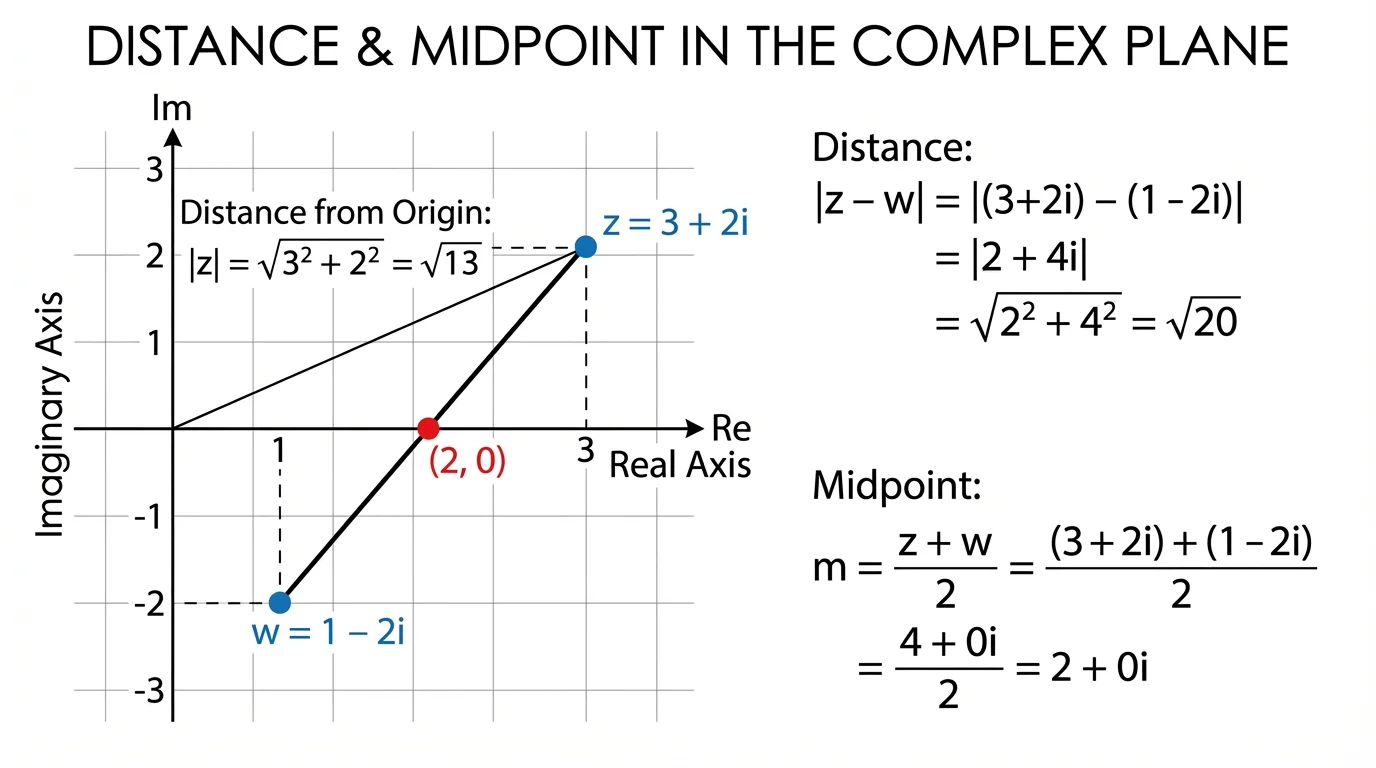
Because a complex number acts like a point, we can use geometric ideas such as length, distance, and midpoint. That is the key to this topic: algebraic operations on complex numbers match familiar coordinate geometry rules.
On the coordinate plane, the distance between \((x_1,y_1)\) and \((x_2,y_2)\) is \(\sqrt{(x_2-x_1)^2+(y_2-y_1)^2}\), and the midpoint is \(\left(\dfrac{x_1+x_2}{2},\dfrac{y_1+y_2}{2}\right)\). In the complex plane, those same ideas appear through subtraction and averaging.
To work fluently, it helps to remember that adding or subtracting complex numbers means combining their real parts and imaginary parts separately. For example, \((2+5i)+(-1+3i)=1+8i\), while \((2+5i)-(-1+3i)=3+2i\).
The modulus of a complex number \(z=a+bi\) is its distance from the origin. It is written \(|z|\) and defined by the formula
Modulus of a complex number: If \(z=a+bi\), then
\[|z|=\sqrt{a^2+b^2}\]
Distance between two complex numbers: If the points are \(z_1\) and \(z_2\), then their distance is
\(|z_1-z_2|\)
This works because subtracting complex numbers gives the horizontal and vertical changes between the two points. If \(z_1=a+bi\) and \(z_2=c+di\), then \(z_2-z_1=(c-a)+(d-b)i\). The modulus of that difference is \(\sqrt{(c-a)^2+(d-b)^2}\), which is exactly the distance formula from coordinate geometry. The geometric relationship appears clearly in [Figure 2].
So the rule is not random. It comes from the fact that the difference \(z_2-z_1\) represents the displacement from one point to the other. Taking the modulus gives the length of that displacement.
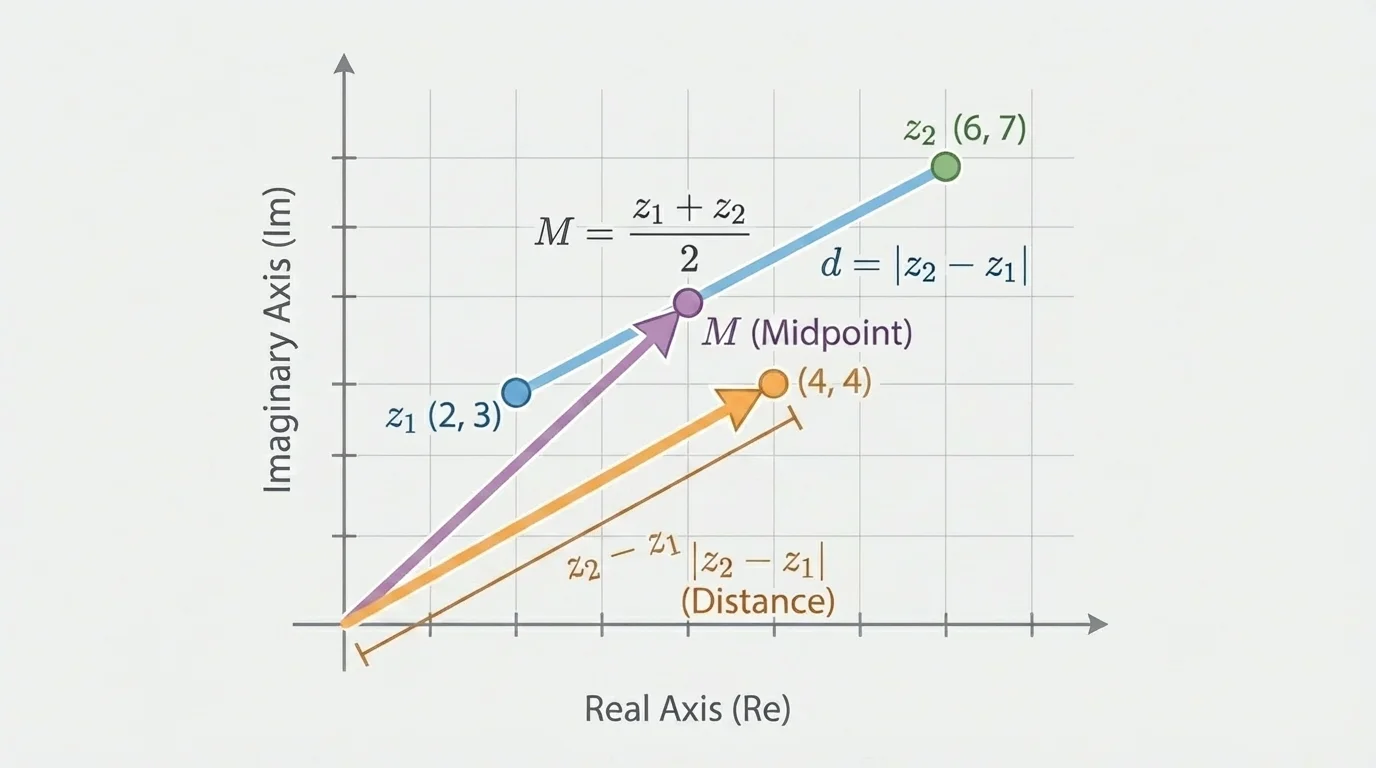
For example, let \(z_1=1+2i\) and \(z_2=4+6i\). Then \(z_2-z_1=3+4i\), so the distance is \(|3+4i|=\sqrt{3^2+4^2}=5\). A famous \(3\)-\(4\)-\(5\) right triangle appears in the complex plane.
Notice something elegant: it does not matter whether you compute \(|z_2-z_1|\) or \(|z_1-z_2|\). Since one difference is the negative of the other, and opposite vectors have the same length, the distance is the same.
The main process is always the same: subtract, simplify, then find the modulus. The algebra must be careful, especially with signs.
Solved example 1
Find the distance between \(z_1=2+3i\) and \(z_2=-1+7i\).
Step 1: Subtract the complex numbers.
Compute \(z_2-z_1=(-1+7i)-(2+3i)=-3+4i\).
Step 2: Find the modulus of the difference.
\(|-3+4i|=\sqrt{(-3)^2+4^2}=\sqrt{9+16}=\sqrt{25}\).
Step 3: State the distance.
\(|z_2-z_1|=5\)
The distance between the two points is \(5\).
This example shows that the real part of the difference gives the horizontal change and the imaginary part gives the vertical change. Even though the real change is negative, squaring removes the sign when finding distance.
Solved example 2
Find the distance between \(z_1=-4+i\) and \(z_2=2-2i\).
Step 1: Subtract.
\(z_2-z_1=(2-2i)-(-4+i)=6-3i\).
Step 2: Apply the modulus formula.
\(|6-3i|=\sqrt{6^2+(-3)^2}=\sqrt{36+9}=\sqrt{45}\).
Step 3: Simplify the radical.
\[|z_2-z_1|=\sqrt{45}=3\sqrt{5}\]
The distance is \(3\sqrt{5}\).
Not every distance is a whole number. Many distances in the complex plane are irrational, just as in the regular coordinate plane.
Solved example 3
Find the distance between \(z_1=5\) and \(z_2=5-8i\).
Step 1: Recognize the points.
\(z_1=5+0i\) and \(z_2=5-8i\). These points have the same real part, so they are vertically aligned.
Step 2: Subtract.
\(z_2-z_1=(5-8i)-5=-8i\).
Step 3: Find the modulus.
\[|-8i|=\sqrt{0^2+(-8)^2}=8\]
The distance is \(8\).
When two points have the same real part, the distance is just the absolute difference of the imaginary parts. When they have the same imaginary part, the distance is the absolute difference of the real parts.
The midpoint of a segment is the point exactly halfway between its endpoints. In the complex plane, if the endpoints are \(z_1\) and \(z_2\), then the midpoint is the average of the two numbers. The point halfway along the segment has coordinates halfway between the endpoints.
[Figure 3] If \(z_1=a+bi\) and \(z_2=c+di\), then averaging gives
\[\frac{z_1+z_2}{2}=\frac{(a+bi)+(c+di)}{2}=\frac{a+c}{2}+\frac{b+d}{2}i\]
That is exactly the coordinate midpoint formula written in complex-number form. The real parts average together, and the imaginary parts average together.
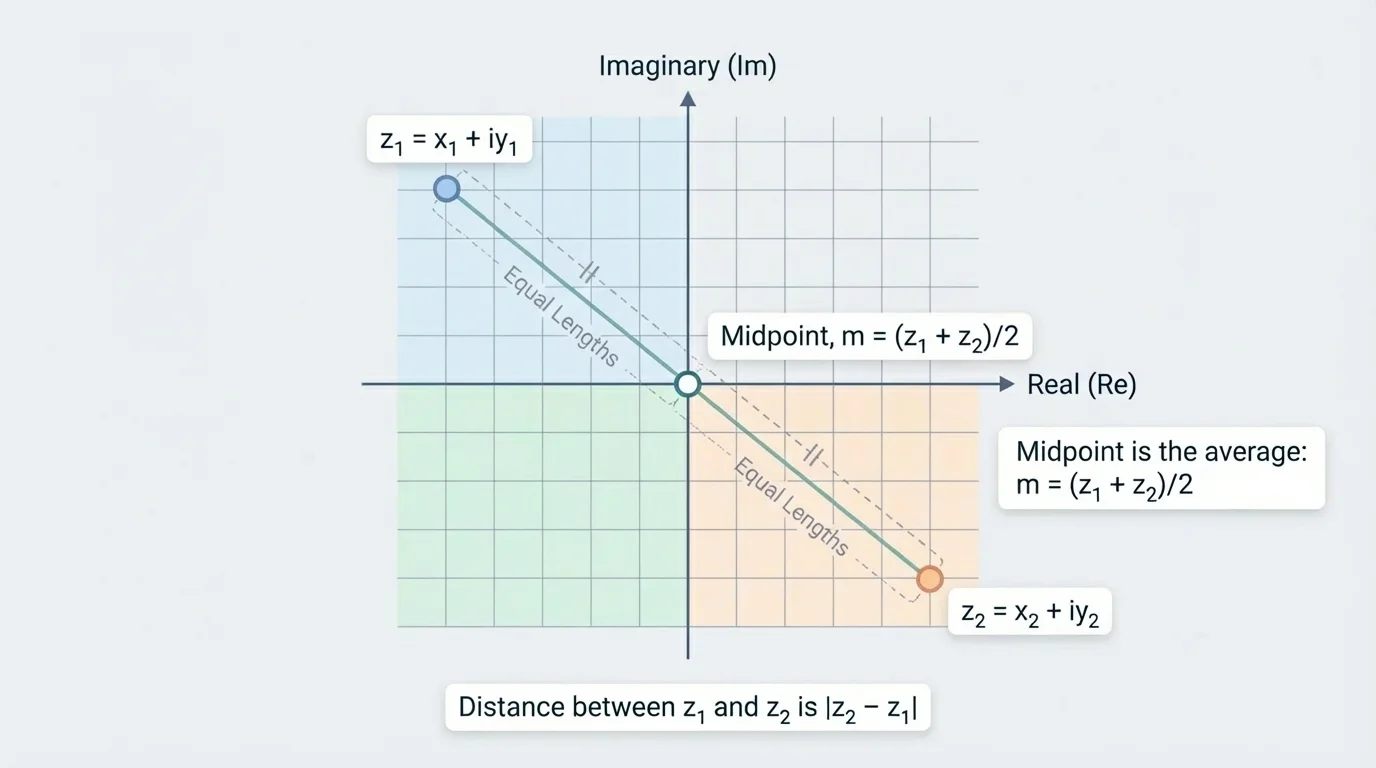
This is a beautiful example of algebra matching geometry. Addition combines position information, and dividing by \(2\) moves to the halfway point. Later, this same averaging idea appears in vectors, physics, and computer graphics.
If one endpoint is \(1+5i\) and the other is \(7-3i\), the midpoint is \(\dfrac{(1+5i)+(7-3i)}{2}=\dfrac{8+2i}{2}=4+i\). The point \(4+i\) is halfway in both the horizontal and vertical directions.
For midpoint problems, the process is add first, then divide by \(2\). Be careful to divide both the real and imaginary parts.
Solved example 4
Find the midpoint of the segment with endpoints \(z_1=2+6i\) and \(z_2=8-2i\).
Step 1: Add the complex numbers.
\(z_1+z_2=(2+6i)+(8-2i)=10+4i\).
Step 2: Divide by \(2\).
\(\dfrac{10+4i}{2}=5+2i\).
Step 3: State the midpoint.
The midpoint is \(5+2i\).
The midpoint is \(5+2i\).
You can check that this makes sense by noticing that \(5\) is halfway between \(2\) and \(8\), and \(2\) is halfway between \(6\) and \(-2\).
Solved example 5
Find the midpoint of the segment joining \(z_1=-3+4i\) and \(z_2=5+10i\).
Step 1: Add the endpoints.
\((-3+4i)+(5+10i)=2+14i\).
Step 2: Divide by \(2\).
\(\dfrac{2+14i}{2}=1+7i\).
Step 3: Write the result.
The midpoint is \(1+7i\).
The midpoint is \(1+7i\).
Fractions are completely normal in midpoint problems. In fact, whenever the coordinates do not add to even numbers, fractional parts appear naturally.
Solved example 6
Find the midpoint of the segment with endpoints \(z_1=1+i\) and \(z_2=4-6i\).
Step 1: Add the complex numbers.
\((1+i)+(4-6i)=5-5i\).
Step 2: Divide each part by \(2\).
\(\dfrac{5-5i}{2}=\dfrac{5}{2}-\dfrac{5}{2}i\).
Step 3: State the midpoint.
The midpoint is \(\dfrac{5}{2}-\dfrac{5}{2}i\).
The midpoint is \(\dfrac{5}{2}-\dfrac{5}{2}i\).
Later, when you compare distances from this midpoint to both endpoints, they turn out to be equal. That is exactly what a midpoint should do.
Some complex-plane situations become much easier when you recognize their pattern. If two points lie on a horizontal line, they have the same imaginary part. If two points lie on a vertical line, they have the same real part. In these cases, distance can be found by a simple absolute difference rather than the full square-root expression.
Conjugates also create interesting geometry. The numbers \(a+bi\) and \(a-bi\) are reflections across the real axis. Their midpoint is \(a\), because
\[\frac{(a+bi)+(a-bi)}{2}=\frac{2a}{2}=a\]
The distance between them is \(|(a+bi)-(a-bi)|=|2bi|=2|b|\). So conjugates are equally far above and below the real axis.
Equal spacing along a segment also works naturally with averages. For three collinear points in the complex plane, the middle point is halfway between the other two exactly when it equals their average. This makes the algebra useful for proving geometric facts.
Why averaging works
A midpoint must be balanced. Averaging the real parts gives the horizontal center, and averaging the imaginary parts gives the vertical center. Because both directions are centered at once, the result is exactly halfway along the segment, not just halfway in one direction.
The same idea can be extended. Although this lesson focuses on the midpoint, points that divide a segment in other ratios can also be written using weighted averages of complex numbers. That is a powerful bridge between geometry and algebra.
Complex numbers are not just classroom objects. They are used in electrical engineering to represent alternating current, in signal processing to analyze sound and images, and in physics to model waves. In such settings, the modulus often represents magnitude or strength, while averaging can represent a balanced state or central value.
In computer graphics, points on a screen can be transformed using algebra that closely resembles complex-number operations. Distances between points matter for collision detection, motion, and scaling. Midpoints matter for drawing line segments, smoothing shapes, and building geometric designs.
Navigation and robotics also rely on coordinate-based reasoning. A robot moving from one location to another needs to measure displacement and distance. The idea in [Figure 2]—that subtraction produces a movement vector—is exactly the same kind of reasoning used in position tracking.
Complex numbers helped engineers develop tools for radio, radar, and digital communication. A concept that begins as a point like \(a+bi\) ends up helping phones, satellites, and audio systems work reliably.
Even the midpoint idea appears in design software and animation. If a motion path must be split exactly in half, averaging coordinates gives the center point instantly. What looks like pure algebra becomes a practical computational shortcut.
A very common error is subtracting without distributing the negative sign correctly. For example, \((2+3i)-(-1+4i)\) is not \(2+3i-1+4i\). The correct subtraction is \(2+3i+1-4i=3-i\).
Another mistake is forgetting that modulus is a distance, so it must be nonnegative. For instance, \(|-3+4i|=5\), not \(-5\). Distances never come out negative.
For midpoints, students sometimes divide only one part by \(2\). If \(z_1+z_2=8+6i\), then \(\dfrac{8+6i}{2}=4+3i\), not \(4+6i\). Both parts must be divided because the entire complex number is being averaged.
It also helps to keep the geometric picture in mind. When your answer seems unreasonable, check whether it fits the diagram mentally. As we saw with the midpoint picture in [Figure 3], the midpoint should lie between the endpoints, not far away from them.
The complex plane turns numbers into locations. Once that idea is clear, distance and midpoint become natural. Distance comes from subtracting two complex numbers and taking the modulus. Midpoint comes from averaging the endpoint numbers.
These are not separate tricks. They are examples of one big principle: operations on complex numbers have geometric meaning. Subtraction describes movement from one point to another, and averaging describes balance between points. That connection is one of the reasons complex numbers are so important in higher mathematics.
