One of the most powerful ideas in algebra is that an expression is not just a string of symbols. It has structure. When you notice that structure, an expression that looks complicated can suddenly become familiar. For example, \(x^4-y^4\) may seem difficult at first, but if you see it as \((x^2)^2-(y^2)^2\), it becomes a difference of squares. That single observation opens the door to rewriting it as \((x^2-y^2)(x^2+y^2)\), and even further as \((x-y)(x+y)(x^2+y^2)\).
Algebra often rewards the student who pauses and asks, "What am I really looking at?" That question matters in solving equations, graphing functions, simplifying formulas, and understanding how expressions are built. Rewriting is not random symbol-moving. It is a way of uncovering meaning.
To identify the structure of an expression means to see how its parts fit together. Consider \(3x^2+12x\). You could view it as two separate terms, or you could notice that both terms share a factor of \(3x\). Then the expression can be rewritten as \(3x(x+4)\). Both forms are equivalent, but each reveals something different.
Similarly, \((x+5)^2\) tells you immediately that the expression is a square. If expanded, it becomes \(x^2+10x+25\). The expanded form shows the separate terms, while the factored form shows the repeated multiplication. Rewriting lets you choose the form that best fits your goal.
Equivalent expressions are expressions that have the same value for every value of the variable, even though they may look different. Rewrite means to express something in a different but equivalent form. Factor means to write an expression as a product of simpler expressions.
Sometimes a rewrite helps you solve an equation. Sometimes it makes a graph easier to interpret. Sometimes it reveals a pattern hidden inside a complicated expression. In advanced mathematics, this habit becomes essential: experts constantly look for useful structure before doing any long calculation.
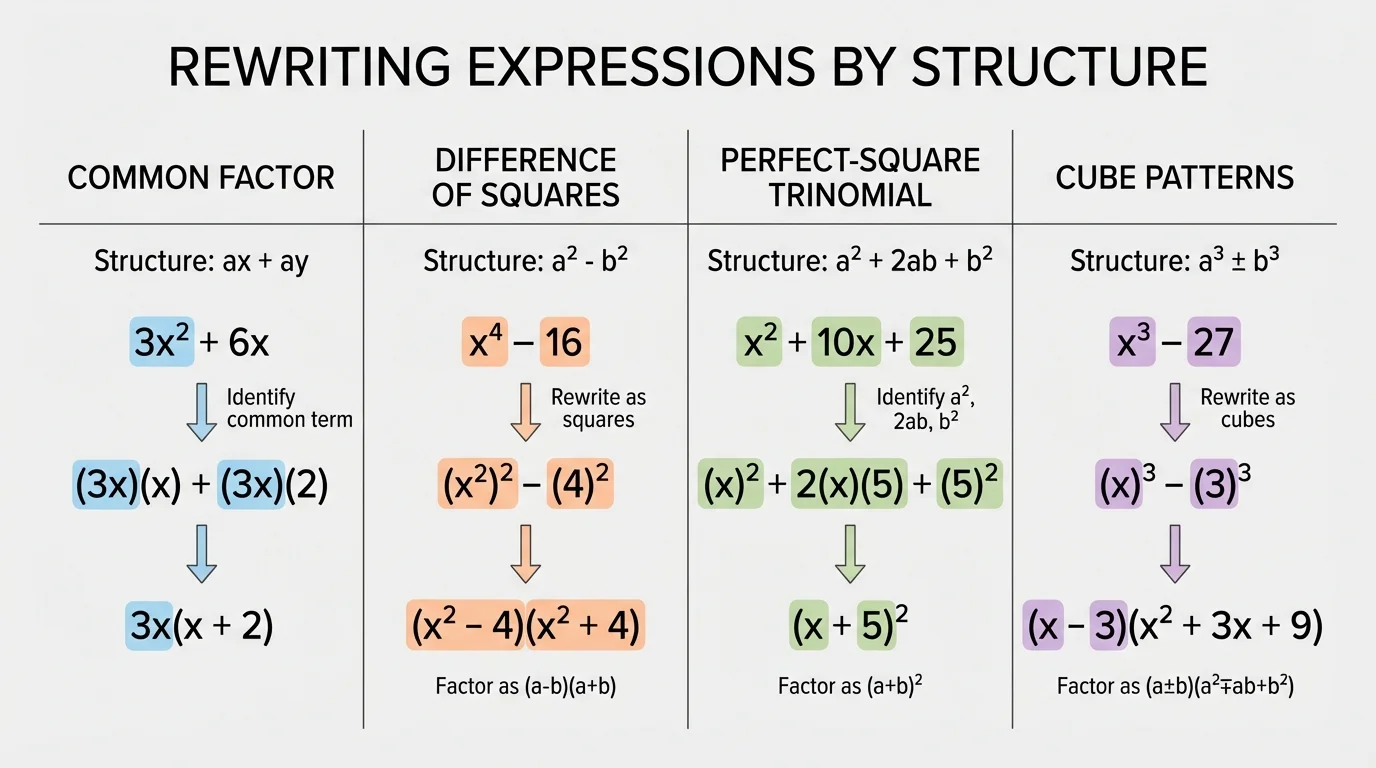
When students become skilled at rewriting expressions, they usually develop a short mental checklist, as shown in [Figure 1]. They look for common factors, powers, repeated groups, and special patterns such as differences of squares or perfect-square trinomials. Pattern recognition is not guessing; it is informed observation.
Here are some structures that appear often:
As you build experience, you stop seeing only surface details. You begin to notice the "shape" of an expression. That is often the difference between a slow solution and a fast, elegant one.
Another useful habit is to ask whether part of the expression can be treated as one object. In \((x^2+1)^2-49\), the quantity \(x^2+1\) acts like a single unit. If you call it \(u\), then the expression becomes \(u^2-49\), which is much easier to recognize.
You already know that multiplication can be reversed by factoring, and that powers such as \(a^2\) and \(a^3\) often create special patterns. This lesson builds on those ideas by focusing on how to notice those patterns quickly.
Not every expression has a special factorization, but many do. The skill is in noticing when a standard pattern applies and when it does not.
[Figure 2] A difference of squares has the form \(a^2-b^2\). This structure matters because it factors in a very specific way. The rule is
\[a^2-b^2=(a-b)(a+b)\]
This works because multiplying the factors gives \((a-b)(a+b)=a^2-b^2\). The middle terms cancel. That cancellation is the reason this pattern is so useful.
The key is that both parts must be squares, and the operation between them must be subtraction. For instance, \(x^2-25\) is a difference of squares because \(x^2=(x)^2\) and \(25=5^2\). So
\[x^2-25=(x-5)(x+5)\]
But \(x^2+25\) is not a difference of squares over the real numbers, because it is a sum, not a difference.
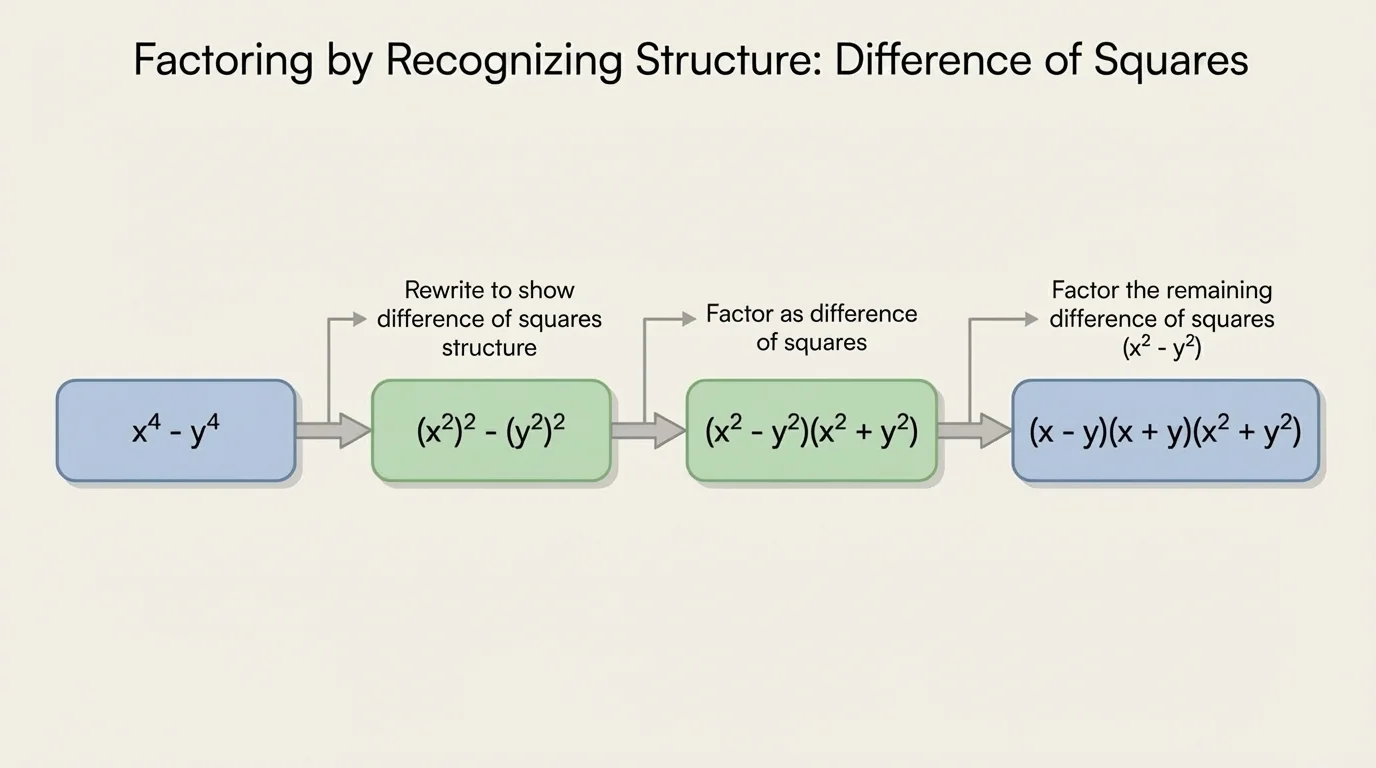
Sometimes the pattern is hidden. Consider \(x^4-y^4\). At first glance, it may not look like \(a^2-b^2\), but if you rewrite it as \((x^2)^2-(y^2)^2\), then the pattern appears immediately:
\[x^4-y^4=(x^2-y^2)(x^2+y^2)\]
And since \(x^2-y^2\) is itself a difference of squares, you can factor again:
\[(x^2-y^2)(x^2+y^2)=(x-y)(x+y)(x^2+y^2)\]
This is a great example of algebraic vision. You are not changing the meaning of the expression. You are revealing what was already there.
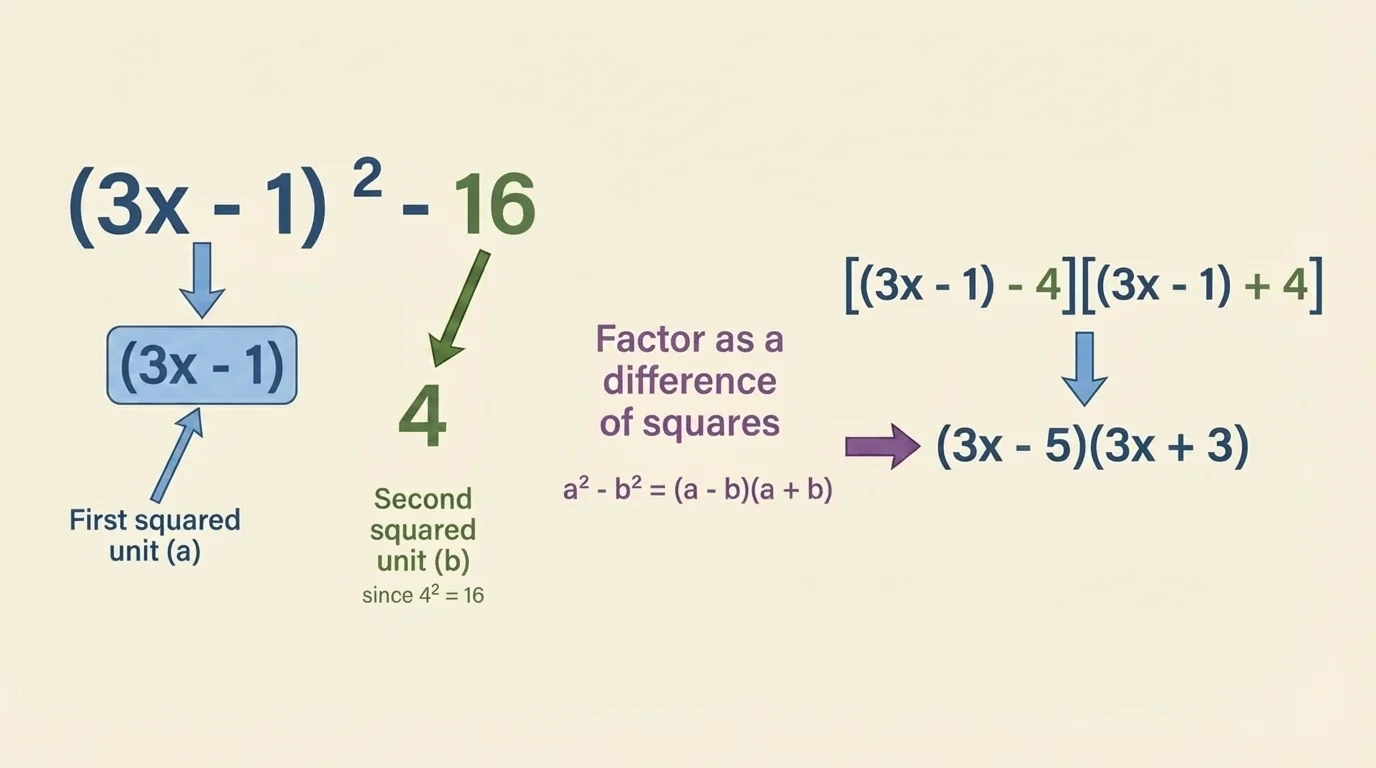
Many expressions become manageable when you treat a complicated part as one unit, as [Figure 3] shows. This strategy is sometimes called recognizing a subexpression. A subexpression is simply a smaller expression inside a larger one.
For example, in \((3x-1)^2-16\), the quantity \(3x-1\) is squared. That means the whole expression has the form \(a^2-b^2\), where \(a=3x-1\) and \(b=4\). Once you notice that, the factoring is straightforward:
\[(3x-1)^2-16=\big((3x-1)-4\big)\big((3x-1)+4\big)\]
Simplifying each factor gives
\[(3x-5)(3x+3)\]
This same idea works in many settings. In \((x+2)^2+6(x+2)+9\), the repeated part is \(x+2\). If you let \(u=x+2\), then the expression becomes \(u^2+6u+9\), which is a perfect-square trinomial:
\[u^2+6u+9=(u+3)^2\]
Replacing \(u\) with \(x+2\) gives
\[(x+2+3)^2=(x+5)^2\]
This kind of substitution is not permanent. It is just a thinking tool that helps you see structure clearly.
Seeing a whole inside the parts
A major algebra skill is deciding when several symbols should be viewed as one object. In \((2x+7)^3\), the base is not just \(x\); it is the entire quantity \(2x+7\). In \((x^2-4)^2-9\), the expression \(x^2-4\) acts as one unit first, and then another familiar pattern may appear. This is why parentheses are so important: they tell you what stays together.
As you continue in algebra, this habit appears in completing the square, solving quadratic equations, and working with function composition. The expression's structure often tells you what to do next.
Difference of squares is only one pattern. Structure also helps with several other important rewrites.
Common factors: In \(8x^3-12x^2\), both terms share \(4x^2\). Rewriting gives \(4x^2(2x-3)\). This exposes the multiplication hidden inside addition and subtraction.
Perfect-square trinomials: Expressions such as \(x^2+14x+49\) can be recognized as \((x+7)^2\) because \(49=7^2\) and the middle term \(14x\) equals \(2(x)(7)\).
Sum and difference of cubes: If you see \(x^3-8\), notice that \(8=2^3\). Then
\[x^3-8=(x-2)(x^2+2x+4)\]
Grouping: In \(ax+ay+bx+by\), the first two terms share \(a\) and the last two share \(b\). Rewriting by grouping gives
\[a(x+y)+b(x+y)=(a+b)(x+y)\]
The same expression can often be rewritten in more than one valid way. The best form depends on the purpose. A graphing problem may prefer vertex form, while a solving problem may prefer factored form.
| Original form | Useful rewrite | What the rewrite reveals |
|---|---|---|
| \(x^2-16\) | \((x-4)(x+4)\) | Zeros at \(x=4\) and \(x=-4\) |
| \(x^2+10x+25\) | \((x+5)^2\) | A repeated factor |
| \(6x+18\) | \(6(x+3)\) | A common factor |
| \(x^4-y^4\) | \((x-y)(x+y)(x^2+y^2)\) | A hidden repeated pattern |
Table 1. Examples of how rewriting an expression can reveal different algebraic features.
The best way to understand structural rewriting is to watch it happen carefully, one decision at a time.
Worked example 1
Rewrite and factor \(x^2-49\).
Step 1: Identify the structure.
The expression is a difference of two squares because \(x^2=(x)^2\) and \(49=7^2\).
Step 2: Apply the pattern \(a^2-b^2=(a-b)(a+b)\).
Substitute \(a=x\) and \(b=7\): \((x-7)(x+7)\).
Step 3: State the final rewrite.
\[x^2-49=(x-7)(x+7)\]
The structure immediately shows two linear factors.
Notice that no long multiplication or guessing was needed. The rewrite came entirely from recognizing a pattern.
Worked example 2
Rewrite \(x^4-81\) completely.
Step 1: Look for a hidden difference of squares.
Since \(x^4=(x^2)^2\) and \(81=9^2\), rewrite the expression as \((x^2)^2-9^2\).
Step 2: Factor the first difference of squares.
\(x^4-81=(x^2-9)(x^2+9)\).
Step 3: Check whether any factor can be factored further.
The factor \(x^2-9\) is also a difference of squares: \(x^2-9=(x-3)(x+3)\).
Step 4: Write the complete factorization.
\[x^4-81=(x-3)(x+3)(x^2+9)\]
The expression unfolds in layers. This is the same kind of structural thinking we used earlier with [Figure 2].
Some expressions require more than one pass. After your first rewrite, ask again whether any new pattern has appeared.
Worked example 3
Rewrite and factor \((2x+5)^2-36\).
Step 1: Treat the repeated group as one unit.
Let \(a=2x+5\). Then the expression becomes \(a^2-6^2\).
Step 2: Apply the difference-of-squares pattern.
\((2x+5)^2-36=((2x+5)-6)((2x+5)+6)\).
Step 3: Simplify each factor.
\((2x-1)(2x+11)\).
Step 4: State the result.
\[(2x+5)^2-36=(2x-1)(2x+11)\]
The key move is seeing \(2x+5\) as one object, just as shown earlier in [Figure 3].
Here is one more example with a different structure.
Worked example 4
Rewrite \(x^2+12x+36\).
Step 1: Check whether it matches a perfect-square trinomial.
\(36=6^2\), and the middle term \(12x\) equals \(2(x)(6)\).
Step 2: Write the square form.
\[x^2+12x+36=(x+6)^2\]
This rewrite highlights that the expression is a repeated product, not just a sum of three terms.
Pattern recognition is powerful, but it must be precise. A common mistake is factoring something that only looks similar to a familiar pattern.
For example, \(x^2+16\) is not a difference of squares because there is no subtraction. Likewise, \(x^2-12\) is not a difference of squares over the integers because \(12\) is not a perfect square.
Another mistake is stopping too early. If you factor \(x^4-y^4\) as \((x^2-y^2)(x^2+y^2)\), that is correct, but it is not fully factored over the real numbers because \(x^2-y^2\) can still become \((x-y)(x+y)\).
A reliable check is to multiply your factors back out. If the product returns the original expression, the rewrite is correct. This reverse check is especially useful during tests when a small sign error can change everything.
Computer algebra systems also rely on pattern recognition. When software factors an expression quickly, it is often identifying structures like the same ones you are learning to recognize by hand.
One more caution: "equivalent" does not mean "looks similar." It means the two expressions have the same value for every allowed input. Algebra values correctness over appearance.
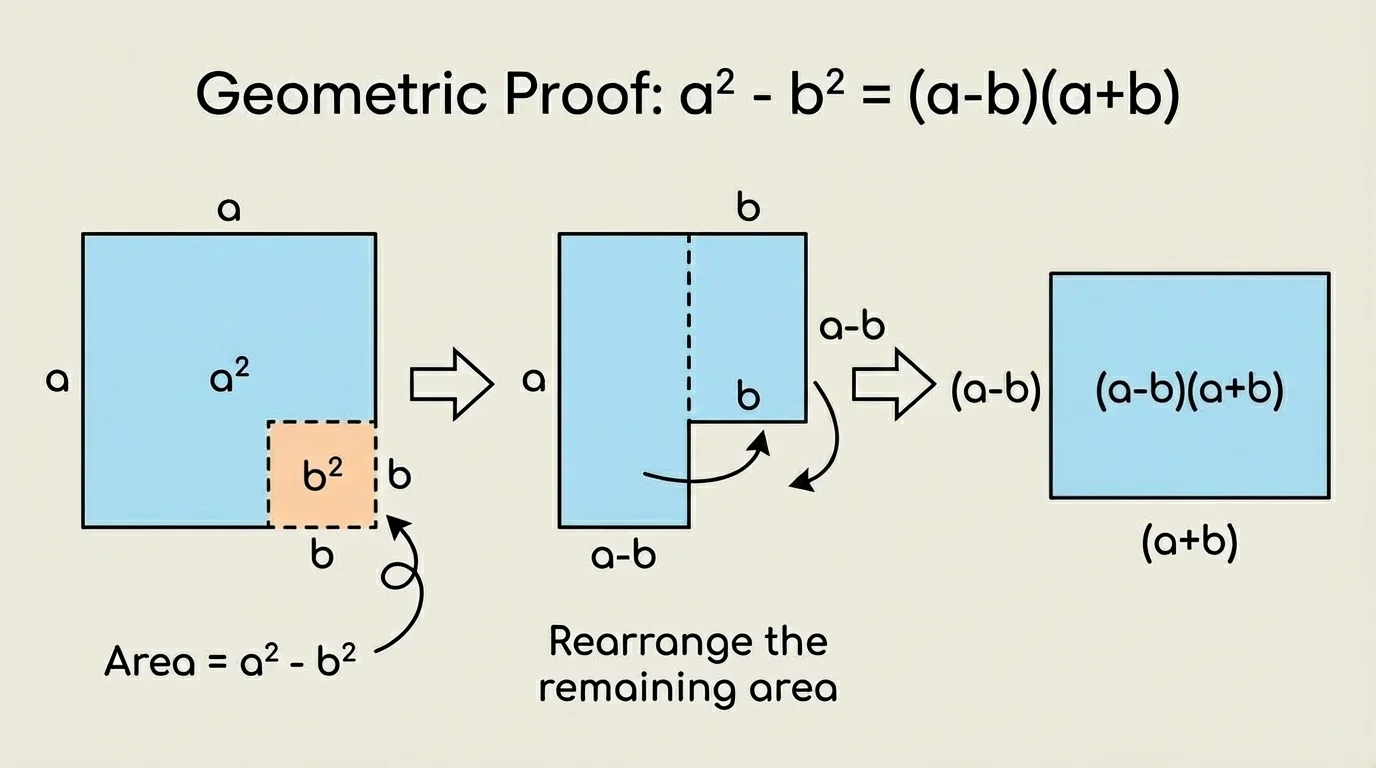
[Figure 4] Structural rewriting is not just a classroom trick. In geometry, engineering, and physics, formulas are often rewritten to make relationships easier to interpret.
The area model shows why the difference-of-squares identity makes sense geometrically: the area of a large square minus a smaller square can be rearranged into a rectangle. If a large square has side length \(a\) and a smaller square has side length \(b\), then the difference in area is \(a^2-b^2\). But that same region can be reorganized into a rectangle with side lengths \(a-b\) and \(a+b\). So the geometry matches the algebra:
\[a^2-b^2=(a-b)(a+b)\]
In physics and applied mathematics, equivalent forms of formulas can reveal different information. A factored form may show when a quantity becomes zero. An expanded form may show rates of change more clearly. A squared form may show symmetry. Choosing the right form can save time and reduce mistakes.
Even in computer graphics and digital modeling, recognizing repeated subexpressions makes calculations more efficient. If a long formula uses the same quantity many times, rewriting around that repeated part can simplify both human work and machine computation.
A strong algebra student does more than memorize formulas. They develop flexibility. When they see \(x^4-y^4\), they can move between forms depending on what they need:
All of these forms are equivalent, but they emphasize different features. One highlights powers, another highlights factors, and another highlights zeros. This is one of the central ideas of algebra: form can reveal function.
As you practice seeing structure, expressions become less like puzzles made of random symbols and more like built objects whose pieces fit together in meaningful ways. That shift in perspective is a major step toward advanced mathematics.
