What makes a solution convincing in mathematics? It is not just getting the number at the end. A correct solution is really a chain of reasons: if the original equation is true for some value, then the next line must also be true, and the next, and the next, until the value of the variable is isolated. Solving an equation is like following a legal argument in court or tracing evidence in a scientific investigation. Every move has to be justified.
When we solve an equation, we usually begin with the assumption that the original equation has a solution. Then we transform the equation step by step in ways that keep both sides equal. If each transformation preserves equality, the final statement tells us what the solution must be. This is why algebra is not only about calculation; it is also about reasoning.
Equation means a statement that two expressions are equal. A solution is a value that makes the equation true. To preserve equality means to perform an operation that keeps two equal quantities equal, such as adding the same number to both sides.
For example, if we know that \(3x + 5 = 17\) is true for some value of the variable \(x\), then subtracting \(5\) from both sides gives \(3x = 12\). This step is valid because equal numbers remain equal when the same number is subtracted from each side. Then dividing both sides by \(3\) gives \(x = 4\). Again, this follows because equal numbers remain equal when both sides are divided by the same nonzero number.
Suppose an equation has a solution, even though we do not yet know its value. From that starting point, we write a sequence of statements, each one logically following from the previous one. The goal is to reach a simpler equation that tells us the value directly.
This idea is important: we are not randomly moving symbols around. We are creating a chain of equivalent equations. Two equations are equivalent if they have the same solution set. If one equation is true for exactly the same values as another, then replacing one with the other is justified.
Reasoning from one line to the next
A good algebra solution can be read as: "If the previous line is true, then this next line is true because I did the same valid operation to both sides." This is what turns a list of algebra steps into a mathematical argument.
You can think of an equation as a promise that the left side and right side name the same number. If you add \(8\) to both sides, the promise is still true. If you multiply both sides by \(-2\), it is still true. But if you divide by an expression that might be \(0\), you may be making a step that is not always allowed. Good reasoning includes knowing not only what works, but also why it works and when it does not.
Equality acts like a balanced scale, as [Figure 1] shows. If the two sides match, doing the same operation to both sides keeps the balance. This is the foundation of equation solving.
The most common equality-preserving operations are these:
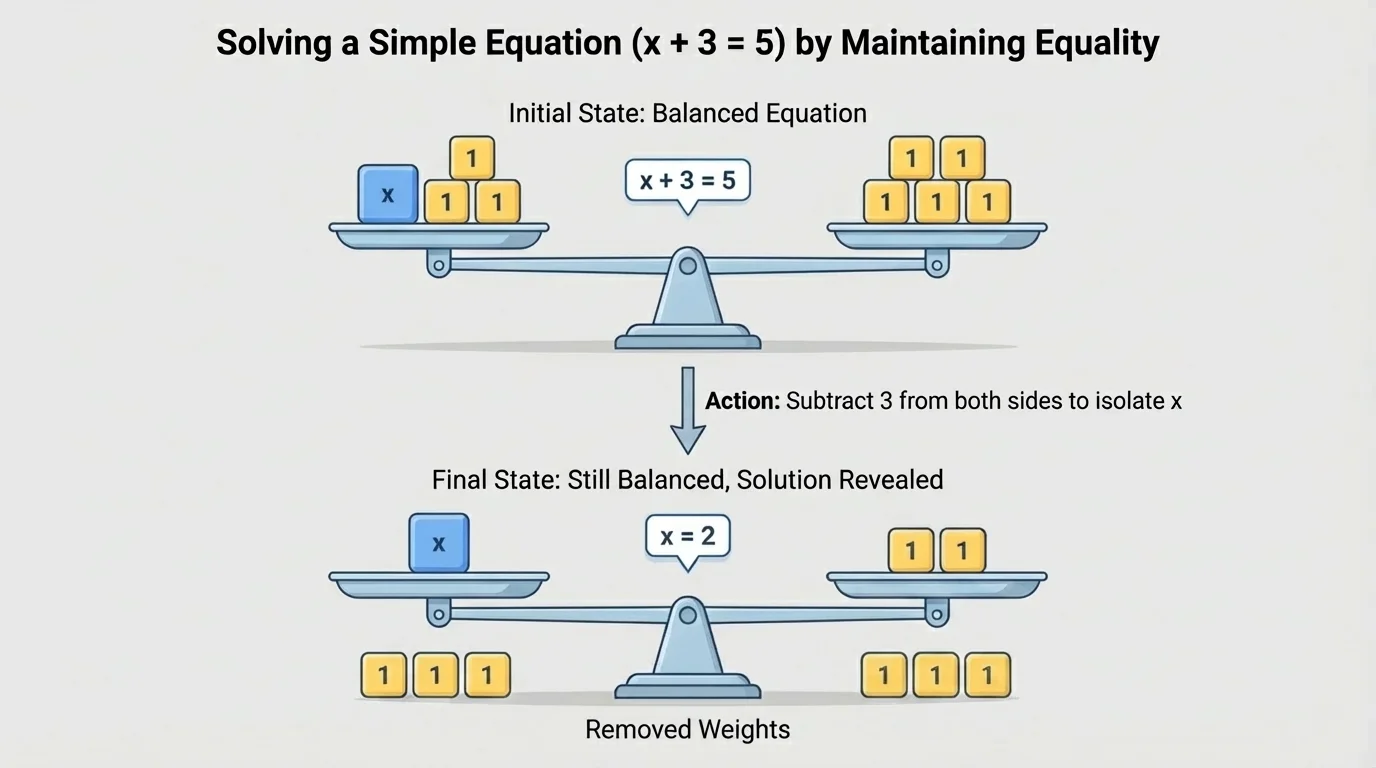
These operations are often called inverse operations when they undo something attached to the variable. For instance, subtraction undoes addition, and division undoes multiplication. If the equation contains \(x + 9\), subtracting \(9\) from both sides helps isolate the variable. If the equation contains \(5x\), dividing both sides by \(5\) helps isolate the variable.
Some operations need caution. Dividing both sides by \(x - 2\), for example, is risky unless you know \(x - 2 \neq 0\). Since the variable's value is not yet known, that step may remove or change solutions. Careful reasoning means paying attention to restrictions.
Before solving equations, remember how to combine like terms, use the distributive property, and work with fractions. These skills support the reasoning, but the main idea is still preserving equality from line to line.
A viable mathematical argument is more than a correct answer. It explains why the method works. When writing a solution, you can mentally attach a reason to each line: subtracting the same number from both sides, combining like terms, distributing, or dividing by a nonzero coefficient.
For example, instead of writing only
\(2x + 7 = 19,\; 2x = 12,\; x = 6\),
you should be able to explain: "From \(2x + 7 = 19\), subtract \(7\) from both sides to get \(2x = 12\). Then divide both sides by \(2\) to get \(x = 6\)." This wording shows that the conclusion follows from valid equality-preserving steps.
Notice that algebra often compresses reasoning into symbols, but the logic is still there. A strong student can move back and forth between symbolic steps and verbal justification.
Simple equations are the best place to see the logic clearly. Each line should follow directly from the previous one.
Worked example 1
Solve \(x - 8 = 15\) and justify each step.
Step 1: Start from the original equation
Assume \(x - 8 = 15\) is true for some value of \(x\).
Step 2: Add \(8\) to both sides
If equal numbers have the same number added to them, they remain equal. So \(x - 8 + 8 = 15 + 8\), which simplifies to \(x = 23\).
Step 3: Check the result
Substitute \(x = 23\) into the original equation: \(23 - 8 = 15\). This is true.
\[\boxed{x = 23}\]
The argument is short, but it is complete. The key idea is not merely "move \(-8\) across." The real idea is "add \(8\) to both sides." That wording explains why the step is valid.
Worked example 2
Solve \(4x + 9 = 29\).
Step 1: Subtract \(9\) from both sides
From \(4x + 9 = 29\), subtracting \(9\) from both sides gives \(4x = 20\).
Step 2: Divide both sides by \(4\)
Because \(4 \neq 0\), dividing both sides by \(4\) preserves equality: \(x = 5\).
Step 3: Verify
Substituting gives \(4(5) + 9 = 20 + 9 = 29\), so the solution works.
\[\boxed{x = 5}\]
Each step has a reason. That is the pattern you should aim for in every equation, even when the algebra becomes more complicated.
Equations with variables on both sides look more complicated, but the same logic applies. As [Figure 2] illustrates, their structure is easier to track visually, with terms grouped on each side before and after simplification.
To solve these equations, we usually collect variable terms on one side and constant terms on the other. This is not magic. It is repeated use of operations that preserve equality.
Worked example 3
Solve \(5x - 4 = 2x + 11\).
Step 1: Subtract \(2x\) from both sides
From \(5x - 4 = 2x + 11\), subtracting \(2x\) from both sides gives \(3x - 4 = 11\).
Step 2: Add \(4\) to both sides
Adding \(4\) to both sides gives \(3x = 15\).
Step 3: Divide both sides by \(3\)
Dividing both sides by \(3\) gives \(x = 5\).
Step 4: Check
Left side: \(5(5) - 4 = 25 - 4 = 21\). Right side: \(2(5) + 11 = 10 + 11 = 21\). Both sides are equal.
\[\boxed{x = 5}\]
This example shows an important habit: when you "move" a term, what you are really doing is adding or subtracting that term on both sides. Using that language makes the reasoning precise.
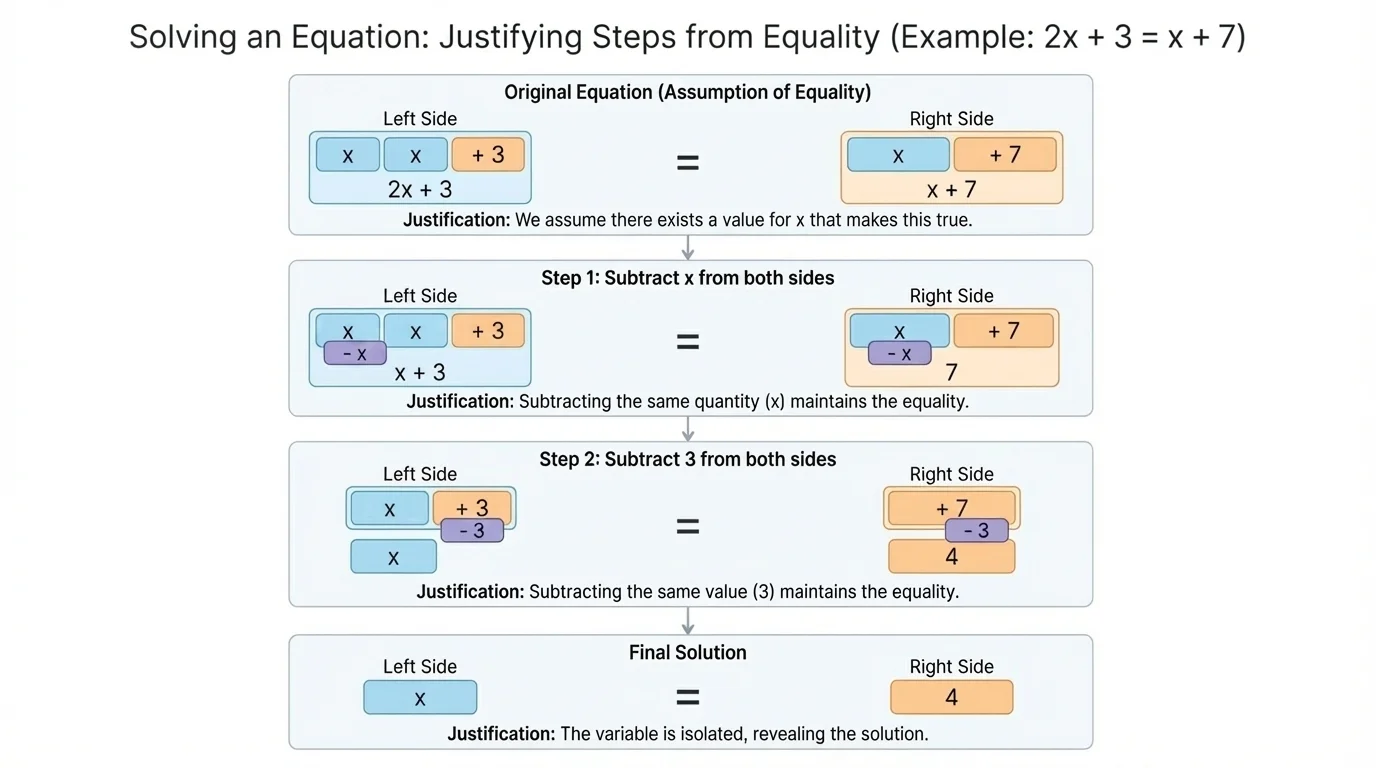
Later, when equations become longer, the same structure still applies. As seen earlier in [Figure 2], the goal is to reduce the equation to a simpler equivalent form without breaking the equality.
Fractions often make students feel that equations are harder than they really are. The reasoning is still the same: use valid operations that preserve equality.
One useful method is to multiply both sides by the least common denominator so that fractions disappear. This is justified because multiplying both sides of an equation by the same nonzero number preserves equality.
Worked example 4
Solve \(\dfrac{x}{3} + 2 = 7\).
Step 1: Subtract \(2\) from both sides
\(\dfrac{x}{3} = 5\)
Step 2: Multiply both sides by \(3\)
Multiplying both sides by \(3\) gives \(x = 15\).
Step 3: Check
\(\dfrac{15}{3} + 2 = 5 + 2 = 7\), so the solution is correct.
\[\boxed{x = 15}\]
Distribution also fits this reasoning framework. If an equation contains \(2(x + 3) = 18\), you may either divide both sides by \(2\) first or distribute first. Both methods can work if each step is justified.
Worked example 5
Solve \(2(x + 3) = 18\).
Method A: Divide first
Divide both sides by \(2\): \(x + 3 = 9\). Then subtract \(3\): \(x = 6\).
Method B: Distribute first
Use the distributive property: \(2x + 6 = 18\). Then subtract \(6\): \(2x = 12\). Divide by \(2\): \(x = 6\).
Both methods produce equivalent equations, so both are valid.
\[\boxed{x = 6}\]
This is part of constructing a viable argument: you can explain why more than one method works, because each method preserves equality at every stage.
Not every algebraic step is automatically safe. Some transformations can create solutions that were not in the original equation, and some can remove valid solutions.
For example, dividing both sides of an equation by an expression containing the variable can be dangerous. If that expression is \(0\) for a possible solution, the step is not valid for that case. A careful solver notices this issue instead of treating every symbol manipulation as harmless.
No-solution and identity cases
Sometimes solving leads to a false statement such as \(4 = 9\). That means the original equation has no solution. Sometimes solving leads to a true statement such as \(6 = 6\). That means the original equation is true for all values in its domain and is called an identity.
Consider \(3x + 2 = 3x + 7\). Subtract \(3x\) from both sides to get \(2 = 7\), which is false. Therefore, there is no solution. On the other hand, if you solve \(4(x + 1) = 4x + 4\), distributing gives \(4x + 4 = 4x + 4\), which is always true. So every real number is a solution.
Another caution appears when squaring both sides or multiplying by expressions involving variables. These steps can produce an extraneous solution, a value that satisfies the transformed equation but not the original one. Even in simple equation work, this idea reminds us why checking matters.
The most reliable check is substitution into the original equation, not a later simplified version. The original equation is the starting claim, so that is where the solution must be tested.
If you solve \(7 - 2x = 1\) and get \(x = 3\), then checking means replacing \(x\) by \(3\): \(7 - 2(3) = 7 - 6 = 1\). Because the equation is true, the solution is confirmed.
Checking is especially valuable when there were fractions, negative signs, or several algebraic steps. It catches arithmetic mistakes and protects against invalid reasoning. In more advanced mathematics, checking can also reveal whether a solution makes sense in the original context.
Professional scientists, engineers, and economists often use the same habit as algebra students: after solving an equation, they test whether the result makes sense in the original situation. A mathematically correct number can still be meaningless if it violates the conditions of the problem.
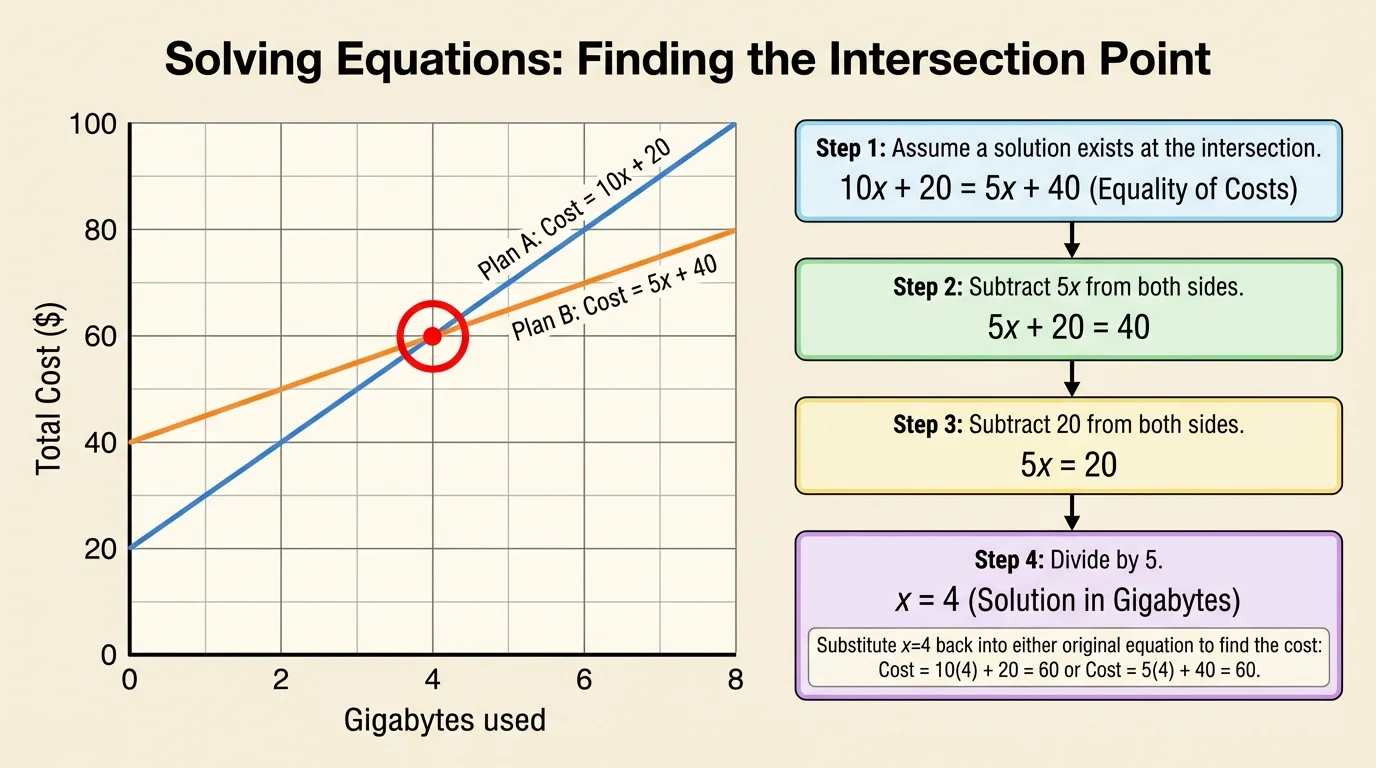
Equations describe moments when two quantities are equal, and that idea appears constantly in real life. A graph of two cost functions turns the algebraic solution into the point where the two totals match.
Suppose one phone plan costs $20 per month plus $5 per gigabyte, and another costs $35 per month plus $2 per gigabyte. As [Figure 3] shows, let \(x\) be the number of gigabytes. The plans cost the same when \(20 + 5x = 35 + 2x\). Solving gives \(3x = 15\), so \(x = 5\). At \(5\) gigabytes, the costs are equal. This is not just algebra; it is a decision point.
Similarly, if one object travels at \(60\) miles per hour and another has a \(30\)-mile head start but moves at \(50\) miles per hour, you can set distances equal to find when the faster object catches up. The equation is \(60t = 50t + 30\), so \(10t = 30\), and \(t = 3\). The solution means they are at the same location after \(3\) hours.
Later, when interpreting graphs or comparing formulas, the visual intersection represents the same reasoning as the algebraic equation: the left side and right side name equal quantities at one particular input value.
In chemistry, finance, medicine, and engineering, equations are trusted only when each transformation is justified. A small reasoning error can produce a wrong dosage, a wrong budget prediction, or a wrong design measurement. That is why algebraic justification matters beyond the classroom.
When you write a solution, aim for language that connects each line to a reason. Short, clear phrases are enough. Examples include "subtract \(4\) from both sides," "combine like terms," "divide by \(3\), since \(3 \neq 0\)," and "check by substitution in the original equation."
A strong written argument often follows this pattern:
This style shows that the final answer is not a guess. It is the conclusion of a logical sequence. In algebra, convincing work is work where every step follows from the previous equality.
"Mathematics is not about symbols alone; it is about the reasons that make each symbol change legitimate."
The more advanced the equations become, the more valuable this habit is. Whether you are solving a basic linear equation or a much harder one later on, the central question stays the same: does this step logically follow from the equality in the previous line?
