When engineers design a bridge or programmers build a graphics engine, they do not work with "almost straight" or "sort of equal" ideas. Geometry becomes powerful because it is precise. A tiny difference in how we define an angle or a circle can change whether a structure is stable, whether a computer animation looks correct, or whether a proof actually works. In geometry, exact language is not just formality; it is the tool that makes reasoning reliable.
Geometry begins with a few basic ideas that are not formally defined but are understood intuitively, as [Figure 1] illustrates. These are the notions of point, line, distance along a line, and distance around a circular arc. A point indicates a location. A line is a straight path extending without end in both directions. We do not define these in simpler geometric language because they are the starting pieces from which other ideas are built.
From these basic notions, we can define more complicated objects. This is similar to how a language uses a few basic words to define many others. In geometry, the precision matters even more because later theorems depend on the exact wording of earlier definitions.
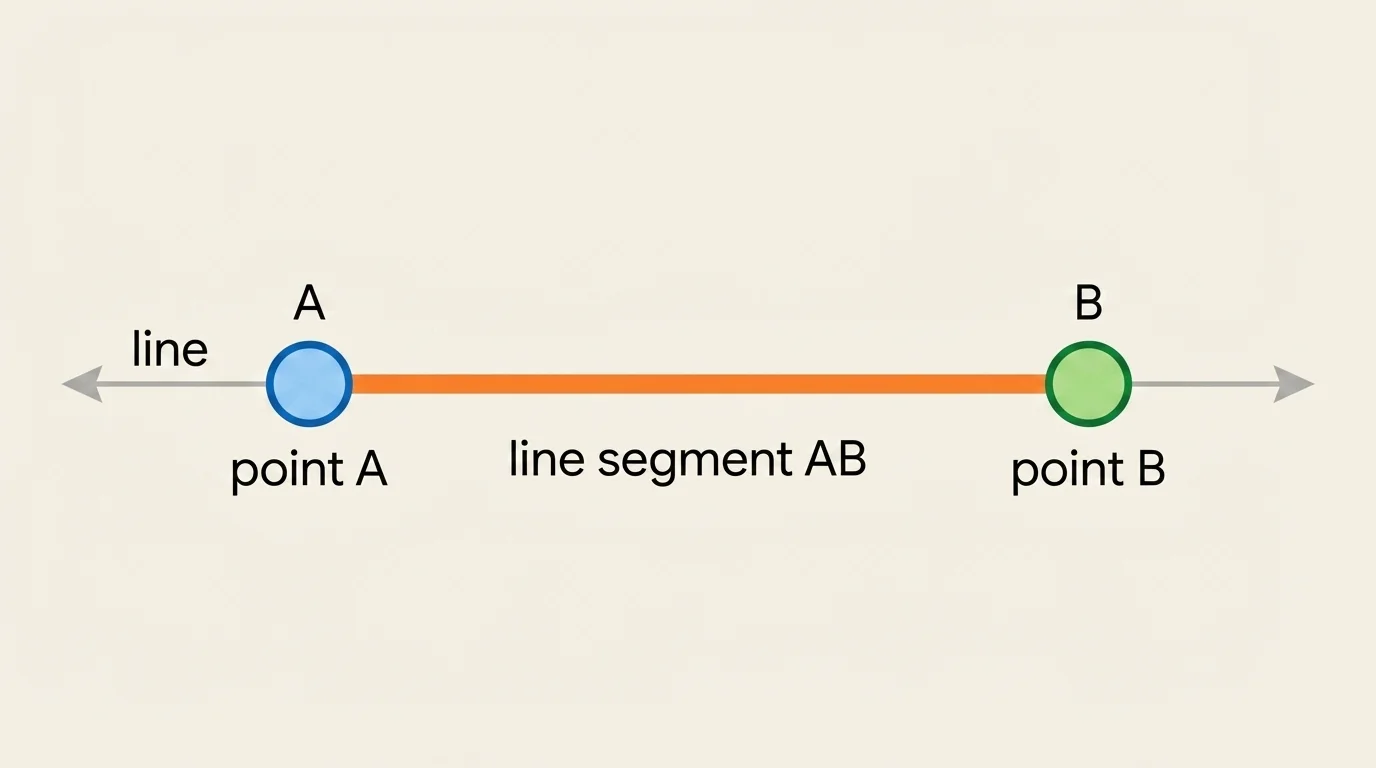
Distance along a line means the length measured from one point on a line to another by moving directly along that line. Distance around a circular arc refers to the length measured along part of a circle. That idea is essential for understanding angle measure, because angles are not just "corners"; they describe how much one ray turns from another.
Earlier geometry often treats terms like point, line, and plane informally. At this level, the goal is to use them as the foundation for exact definitions and logical arguments.
One reason this matters is that transformations in the plane, such as translations, rotations, reflections, and dilations, act on points and preserve certain distances and angle measures. If we know exactly what a segment or an angle is, we can describe exactly what a transformation preserves.
The main objects in this topic are not undefined. They are carefully defined from the basic notions.
Line segment: the part of a line consisting of two endpoints and all points on the line between them.
Angle: the figure formed by two rays with a common endpoint, called the vertex. Its measure describes the amount of rotation from one ray to the other and can be related to distance around a circular arc centered at the vertex.
Circle: the set of all points in a plane that are a fixed distance from a given point, called the center.
Perpendicular lines are lines that intersect to form a right angle, that is, an angle measuring \(90^\circ\).
Parallel lines are coplanar lines that do not intersect.
Each definition includes a key geometric relationship. A segment depends on points being between two endpoints. A circle depends on equal distance from a center. Perpendicular lines depend on a special angle measure. Parallel lines depend on a never-intersecting relationship in the same plane.
Notice that these definitions do not rely on drawings alone. A picture can help, but the picture is not the definition. A hand-drawn circle may look uneven, yet mathematically it still represents the set of all points whose distance from the center is constant.
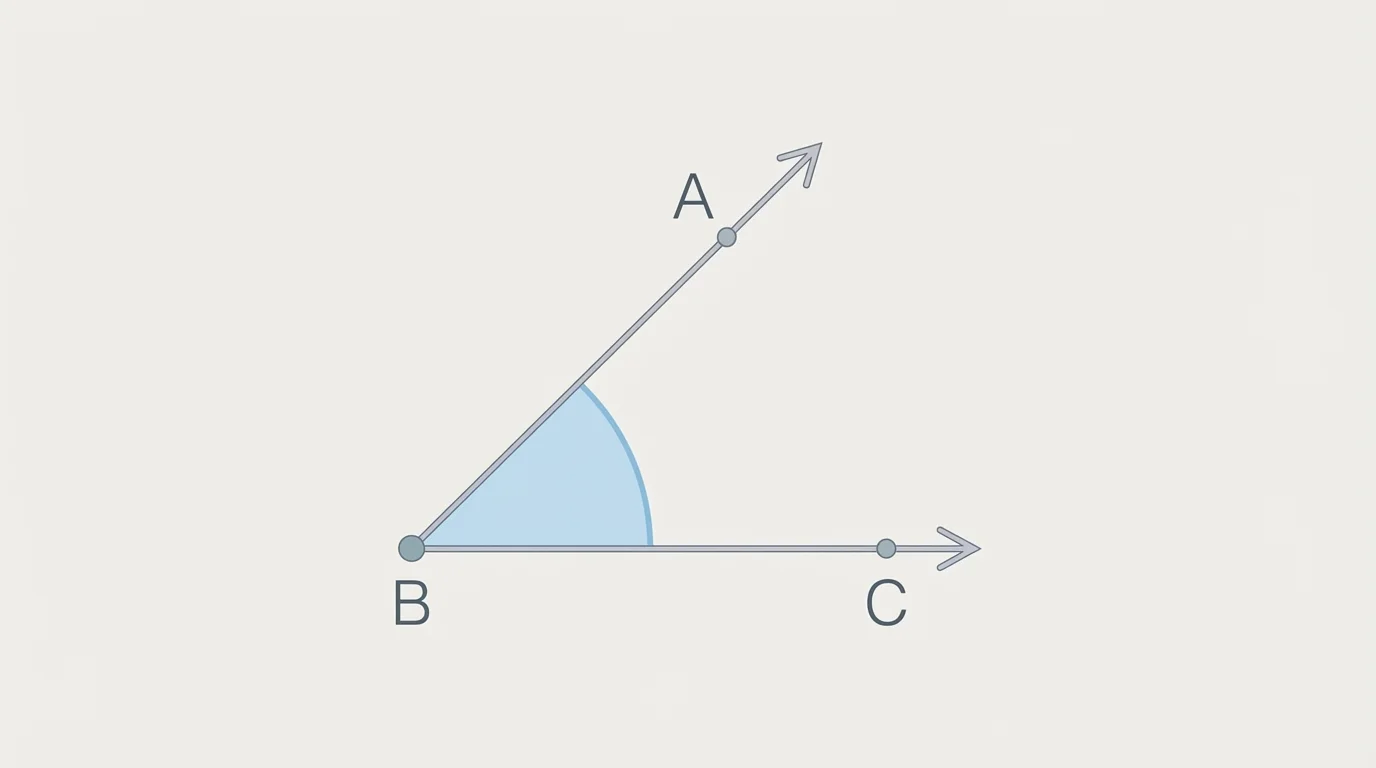
As shown in [Figure 2], an angle is formed by two rays sharing a common endpoint. If the rays are \(\overrightarrow{BA}\) and \(\overrightarrow{BC}\), then they form \(\angle ABC\), with vertex \(B\). The amount of opening between the rays is the angle's measure. This idea connects to turning: if you stand at the vertex and rotate from one ray to the other, the amount of turn determines the angle measure.
The connection to circular arcs is especially important. Suppose a point moves along a circle centered at the vertex. The larger the turn, the longer the arc traced on the circle. So angle measure is tied to distance around a circular arc, not to the lengths of the rays. That is why a small angle drawn with short rays and the same angle drawn with long rays still have equal measure.
For example, if two rays form a quarter-turn, the angle measure is \(90^\circ\). If they form a half-turn, the angle measure is \(180^\circ\). The degree is a unit for describing how much rotation occurs from one side of the angle to the other.
Angles can be classified by measure. An acute angle has measure less than \(90^\circ\). A right angle has measure exactly \(90^\circ\). An obtuse angle has measure greater than \(90^\circ\) but less than \(180^\circ\). A straight angle has measure \(180^\circ\). These classifications are useful, but the core definition always returns to two rays and a common endpoint.
Later, when studying rotations as transformations, the exact idea of angle measure becomes crucial. A rotation preserves the measure of every angle. That fact depends on having a precise definition of what an angle is and how its measure is determined.
Why arc distance helps define angle measure
If you draw different circles centered at the same vertex, a larger angle always cuts off a larger arc on each circle. This makes angle measure a consistent way to describe turning, independent of how long the rays are drawn. Geometry uses this consistency to compare and preserve angles under transformations.
As we saw earlier in [Figure 2], the arc drawn near the vertex is not decoration. It is a visual reminder that angle measure comes from turning around the vertex.
A line segment is more than a short line drawn on paper. It is a specific part of a line: the two endpoints and every point between them. If the endpoints are \(A\) and \(B\), the segment is written \(\overline{AB}\).
The length of \(\overline{AB}\) is the distance along the line from \(A\) to \(B\). This distinction matters: \(\overline{AB}\) names the geometric object, while \(AB\) often names its length. In careful geometry writing, object and measure are related but not identical.
A segment has finite length, but a line extends forever in both directions. A ray begins at one endpoint and extends forever in one direction. These differences matter in definitions. An angle uses rays, not segments, because the sides of an angle extend outward from the vertex.
The segment highlighted in [Figure 1] shows the idea of "all points between two endpoints." Without the idea of betweenness and distance along a line, the definition of segment would be incomplete.
A circle is the set of all points in a plane that are a fixed distance from a center. If the center is \(O\) and the fixed distance is \(r\), then every point \(P\) on the circle satisfies \(OP = r\).
This fixed distance is called the radius. Because every point on the circle is exactly the same distance from the center, a circle is perfectly balanced around that center. The word "set" is important here: the circle includes all such points, not just a few marked ones.
If \(r = 5\), then the circle consists of every point exactly \(5\) units from the center. A point \(4.9\) units away is inside the circle, and a point \(5.1\) units away is outside it. Only points exactly \(5\) units away lie on the circle.
Ancient astronomers and architects relied on circles long before modern algebra existed. Their work succeeded because the geometric definition of a circle is based on equal distance, a concept people can construct and test physically.
Circles also connect directly to angle measure. When an angle is drawn with vertex at the center of a circle, the rays cut off an arc. Comparing those arcs helps compare the measures of the angles.
As shown in [Figure 3], two of the most important relationships between lines are perpendicular lines and parallel lines. These relationships appear everywhere in coordinate grids, building frames, road design, and computer graphics.
Perpendicular lines intersect to form a right angle. Since a right angle measures \(90^\circ\), perpendicular lines meet in the most symmetric possible way: they create four equal angles around the intersection point. If one angle at the intersection is \(90^\circ\), then all four are \(90^\circ\).
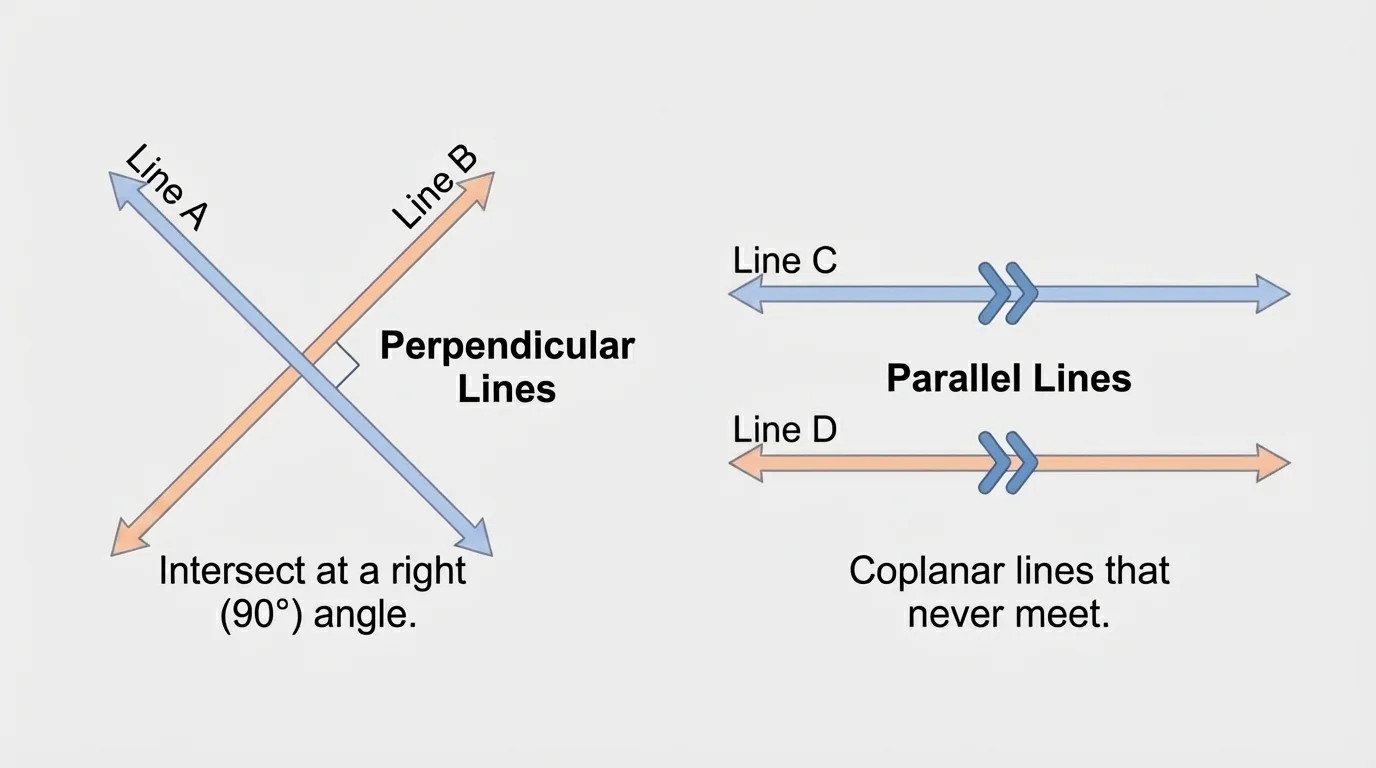
Parallel lines are coplanar lines that never intersect, no matter how far they are extended. The word coplanar is essential. Two lines in different planes may not intersect either, but they are not called parallel unless they lie in the same plane.
Parallel lines preserve a constant separation in the plane. In many geometric arguments, especially those involving translations, this idea matters because a translation moves every point the same distance in the same direction, sending lines to parallel lines.
The contrast shown in [Figure 3] is important: perpendicular lines are defined by how they intersect, while parallel lines are defined by the fact that they do not intersect.
| Object or Relationship | Key Feature | Built From |
|---|---|---|
| \(\overline{AB}\) | Two endpoints and all points between | Point, line, distance along a line |
| \(\angle ABC\) | Two rays with common endpoint | Point, ray, distance around a circular arc |
| Circle | All points a fixed distance from a center | Point, plane, distance |
| Perpendicular lines | Intersect to form \(90^\circ\) | Line, angle measure |
| Parallel lines | Coplanar and never intersect | Line, plane |
Table 1. Definitions and the foundational ideas each one depends on.
Precise definitions become useful when we use them to decide whether a geometric statement is true.
Worked example 1
Points \(A\) and \(B\) lie on a line. Describe exactly what \(\overline{AB}\) means.
Step 1: Identify the type of object.
\(\overline{AB}\) is a line segment, not an entire line and not just a distance.
Step 2: Apply the definition.
A line segment consists of its two endpoints and all points on the line between them.
Step 3: State the result precisely.
So \(\overline{AB}\) is the part of the line containing points \(A\), \(B\), and every point between \(A\) and \(B\).
This description uses the exact definition rather than an informal phrase like "the short line from \(A\) to \(B\)."
The value of the definition is that it removes ambiguity. Geometry depends on that level of exactness.
Worked example 2
Two rays form an angle with measure \(90^\circ\). What can you conclude if each ray lies on a different line that intersect at the vertex?
Step 1: Use the angle information.
The rays form a right angle because the angle measure is \(90^\circ\).
Step 2: Connect to the line relationship.
If the rays lie on two intersecting lines and one of the angles formed is a right angle, then the lines intersect to form a right angle.
Step 3: Name the relationship.
The lines are perpendicular.
This follows directly from the definition of perpendicular lines.
Many geometry proofs are exactly this kind of reasoning: identify a definition, match the facts to it, and conclude the correct classification.
Worked example 3
A set of points in a plane are all exactly \(7\) units from point \(O\). What geometric figure do these points form?
Step 1: Look for a distance condition.
Every point is the same distance, \(7\), from a fixed point \(O\).
Step 2: Match the condition to a definition.
A circle is the set of all points in a plane that are a fixed distance from a given center.
Step 3: State the figure.
The points form a circle centered at \(O\) with radius \(7\).
The exact wording "set of all points" is essential. If only a few points were chosen, they would not make the entire circle.
Definitions often work in reverse too: if you know a figure is a circle, you know every point on it is the same distance from the center.
Worked example 4
In a coordinate plane, line \(\ell_1\) has slope \(2\), and line \(\ell_2\) has slope \(-\dfrac{1}{2}\). Explain why the lines are perpendicular.
Step 1: Recall the slope relationship.
In the coordinate plane, nonvertical lines are perpendicular when their slopes are negative reciprocals.
Step 2: Compare the slopes.
The negative reciprocal of \(2\) is \(-\dfrac{1}{2}\).
Step 3: Conclude using geometry.
Therefore, the lines meet to form a right angle, so they are perpendicular.
This algebraic shortcut still depends on the geometric definition of perpendicular lines as lines that form \(90^\circ\).
Coordinate geometry is powerful because it translates geometric definitions into equations while keeping the meanings intact.
As shown in [Figure 4], transformations in the plane make precise definitions even more important. A translation moves every point the same distance in the same direction. A rotation turns points around a center. A reflection flips points across a line. In each case, geometric properties are preserved in predictable ways.
For example, a rotation preserves angle measure. If two rays form \(\angle ABC\), then after a rotation, the image rays form an angle congruent to \(\angle ABC\). This works because the amount of turning stays the same. Likewise, a translation sends a line to a parallel line or to itself, preserving straightness and distance between corresponding points.
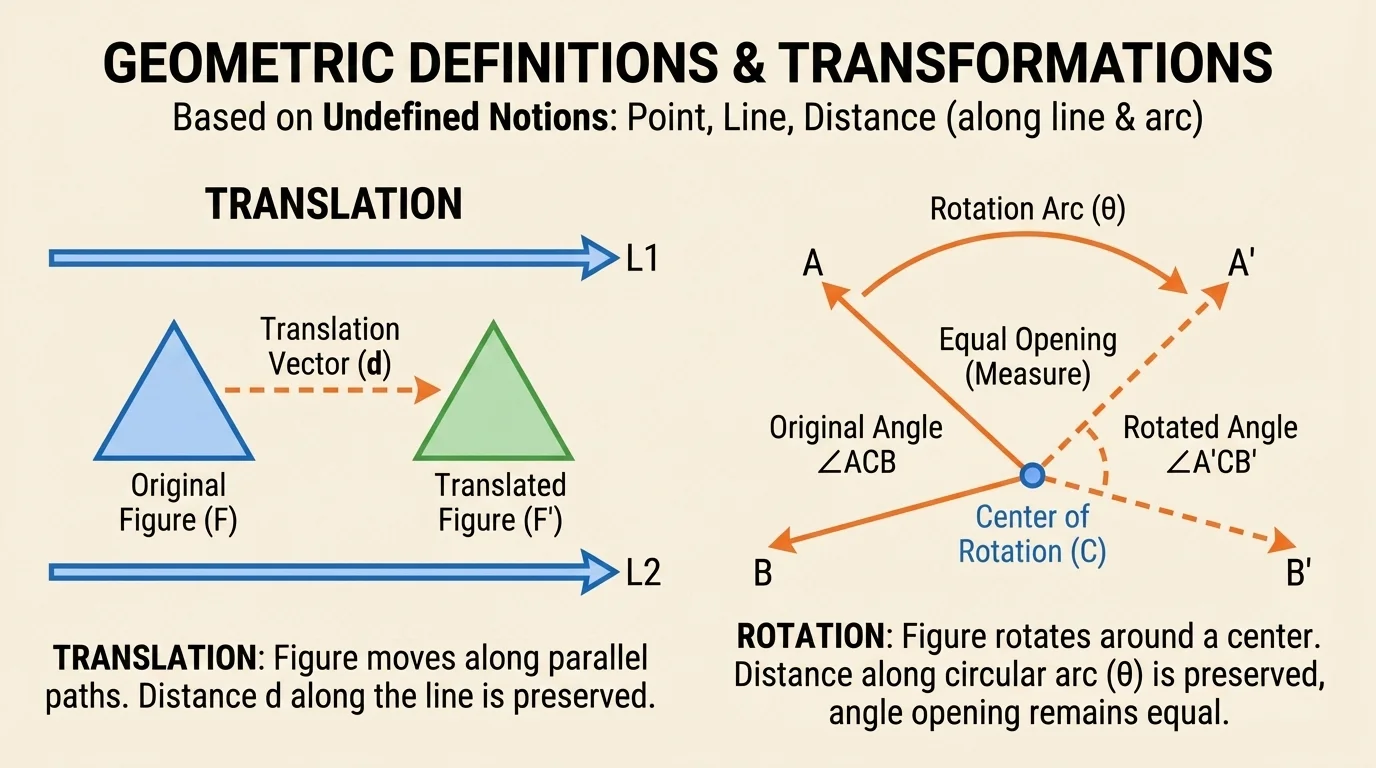
Circles are also preserved under rigid motions. If a circle has center \(O\) and radius \(r\), then after a translation, rotation, or reflection, the image is still a circle with the same radius. The reason is that all points remain the same distance from the image of the center.
This is why congruence in geometry is deeply connected to definitions. If a transformation preserves distance and angle measure, then segments remain the same length, angles remain the same size, circles remain circles, perpendicular lines remain perpendicular, and parallel lines remain parallel.
The motion relationships in [Figure 4] show that geometry is not only about static drawings. It is also about what remains unchanged when figures move in the plane.
"Geometry is the art of correct reasoning from incorrectly drawn figures."
— A common geometric principle
This saying captures an important truth: even if a sketch is imperfect, correct definitions let us reason accurately.
Precise geometric definitions appear in many fields. In architecture, perpendicular lines help ensure walls meet floors at right angles. Parallel lines guide the spacing of beams, rails, and window frames. In road and bridge design, angle measures determine safe turns and structural alignment.
In computer-aided design, a circle is not "something round-looking." It is generated from points at a fixed distance from a center. If the software used an imprecise idea instead, machine parts might not fit together. In robotics and animation, rotations depend on exact angle measures so that movement appears smooth and physically correct.
Surveying and navigation also use these ideas. A change in direction can be described by an angle, while map grids rely on parallel and perpendicular relationships. These are not just classroom definitions; they are the language of spatial accuracy.
Even sports technology uses geometry. Cameras tracking a soccer ball or a basketball shot rely on coordinate models, line segments for distance, and angles for direction. The mathematics behind the software works only because geometric terms have exact meanings.
