A triangle is more rigid than it first appears. If someone tells you the lengths of two sides, many different triangles might be possible. But if someone tells you two angle measures, the entire shape is locked in. The size can still change, but the shape cannot. That idea is one of the most elegant facts in geometry, and it leads directly to one of the most useful tests for triangle similarity: if two angles of one triangle match two angles of another, then the triangles are similar.
Triangles have a special property: their angle measures always add to \(180^\circ\). Because of that, once you know any two angles, the third is automatically determined. For example, if a triangle has angles \(50^\circ\) and \(60^\circ\), then the third angle must be \(180^\circ - 50^\circ - 60^\circ = 70^\circ\).
This means that information about angles is extremely powerful. If two triangles share two angle measures, they actually share all three angle measures. But equal angles alone do not mean the triangles are congruent, because one triangle may be a larger or smaller version of the other. That is exactly what similar figures are: same shape, not necessarily same size.
Recall that two figures are congruent if a sequence of rigid motions maps one exactly onto the other. Rigid motions include translations, reflections, and rotations, and they preserve lengths and angle measures.
Similarity is broader than congruence because it also allows a dilation, which changes size while preserving shape.
In triangle geometry, this matters because many problems do not give complete side lengths. Instead, they give angle relationships. The AA criterion lets you conclude similarity from that angle information alone, and then proportional side lengths follow.
A similarity transformation is a composition of rigid motions and a dilation. As [Figure 1] shows, this kind of transformation preserves angle measures while multiplying every length by the same scale factor. So the image of a figure has the same shape as the original figure.
A dilation changes distances from a center by a constant factor. If the scale factor is \(k\), then every side length is multiplied by \(k\). If \(k > 1\), the figure enlarges. If \(0 < k < 1\), the figure shrinks. Most importantly for this lesson, dilations preserve angle measure.
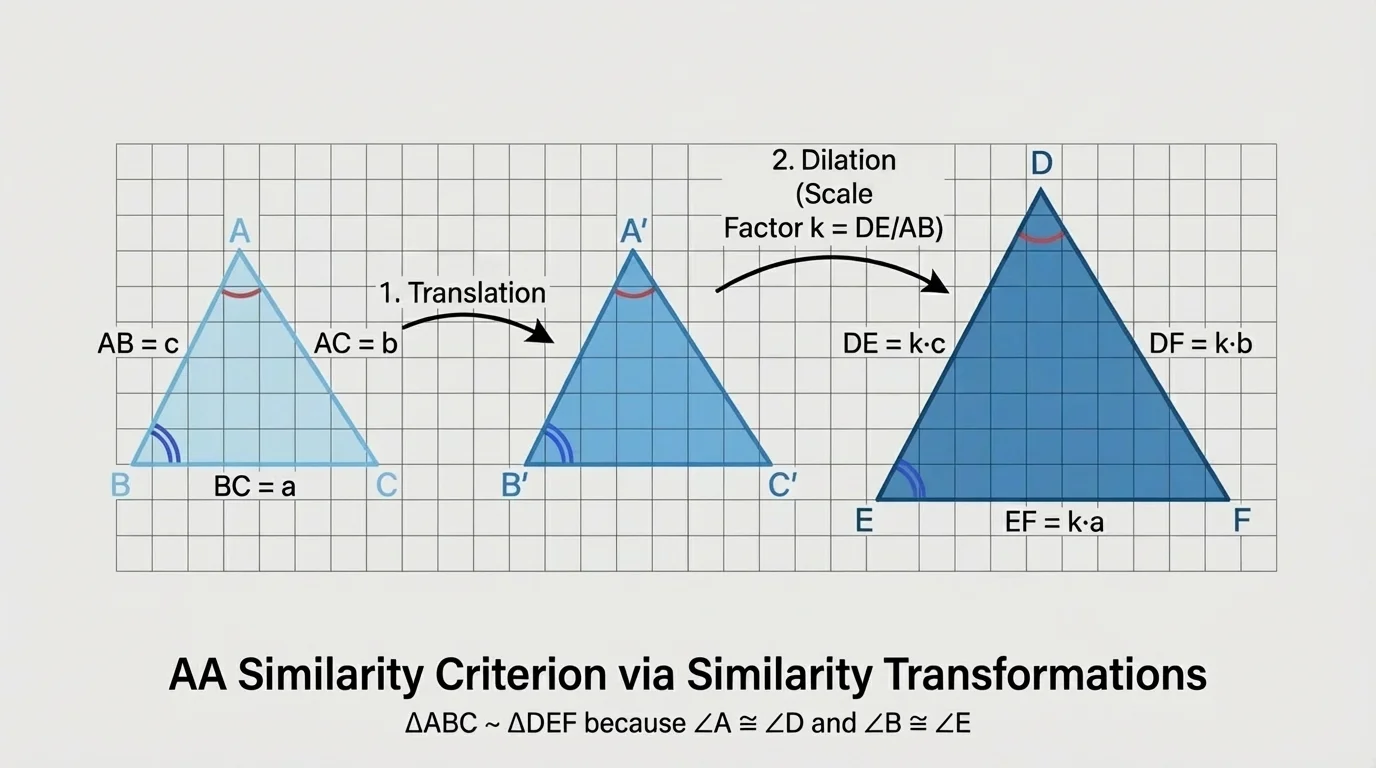
Because rigid motions preserve both length and angle, and dilations preserve angles while scaling lengths proportionally, any similarity transformation preserves all angle measures and keeps corresponding sides proportional. That is why similarity can be described either by transformations or by equal angles and proportional sides.
Similar figures are figures for which one can be mapped to the other by a similarity transformation.
Corresponding angles are angles that occupy matching positions in similar figures.
Corresponding sides are sides opposite corresponding angles, and their lengths are in the same ratio.
Scale factor is the constant \(k\) by which all lengths are multiplied in a dilation.
For triangles, this relationship becomes especially strong. Since a triangle is determined by its angle structure, preserving the angles already determines the shape, and a dilation handles the size difference.
If triangle \(ABC\) is similar to triangle \(DEF\), we write
\[\triangle ABC \sim \triangle DEF\]
This statement means that angle \(A\) corresponds to angle \(D\), angle \(B\) corresponds to angle \(E\), and angle \(C\) corresponds to angle \(F\). It also means the corresponding side lengths satisfy
\[\frac{AB}{DE} = \frac{BC}{EF} = \frac{AC}{DF}\]
The order of the letters matters. A correct similarity statement gives the correct correspondence between vertices, angles, and sides. If the order is wrong, the side ratios will be matched incorrectly.
When triangles are similar, one triangle can be obtained from the other by some rigid motion followed by a dilation, or by a dilation followed by rigid motions. This transformational viewpoint is the key to understanding why the AA criterion is true.
The AA criterion says that if two angles of one triangle are congruent to two angles of another triangle, then the triangles are similar. The visual strategy of the proof, as [Figure 2] illustrates, is to use rigid motions and a dilation to line up one triangle with the other.
Suppose \(\triangle ABC\) and \(\triangle DEF\) satisfy \(\angle A \cong \angle D\) and \(\angle B \cong \angle E\). Because the angles in a triangle sum to \(180^\circ\), the third angles must also be congruent:
\[\angle C \cong \angle F\]
So the two triangles have the same three angle measures.
Now use a rigid motion to move \(\triangle ABC\) so that vertex \(A\) lands on vertex \(D\), and side \(AB\) lies along side \(DE\). Rigid motions preserve lengths and angles, so the moved image of \(\triangle ABC\) still has the same angle measures as before.
Next apply a dilation centered at \(D\) so that the image of side \(AB\) has the same length as \(DE\). After this dilation, the image of \(A\) remains at \(D\), and the image of \(B\) lands at \(E\), because the image lies on the same ray and has the required length.
At this stage, the transformed image has one vertex at \(D\), another at \(E\), and angle measures matching those of \(\triangle DEF\). The third side must therefore lie along the ray that forms angle \(D\) with \(DE\) and also along the ray that forms angle \(E\) with \(ED\). Those two rays intersect at exactly one point, which must be \(F\). So the transformed image of \(\triangle ABC\) coincides with \(\triangle DEF\).
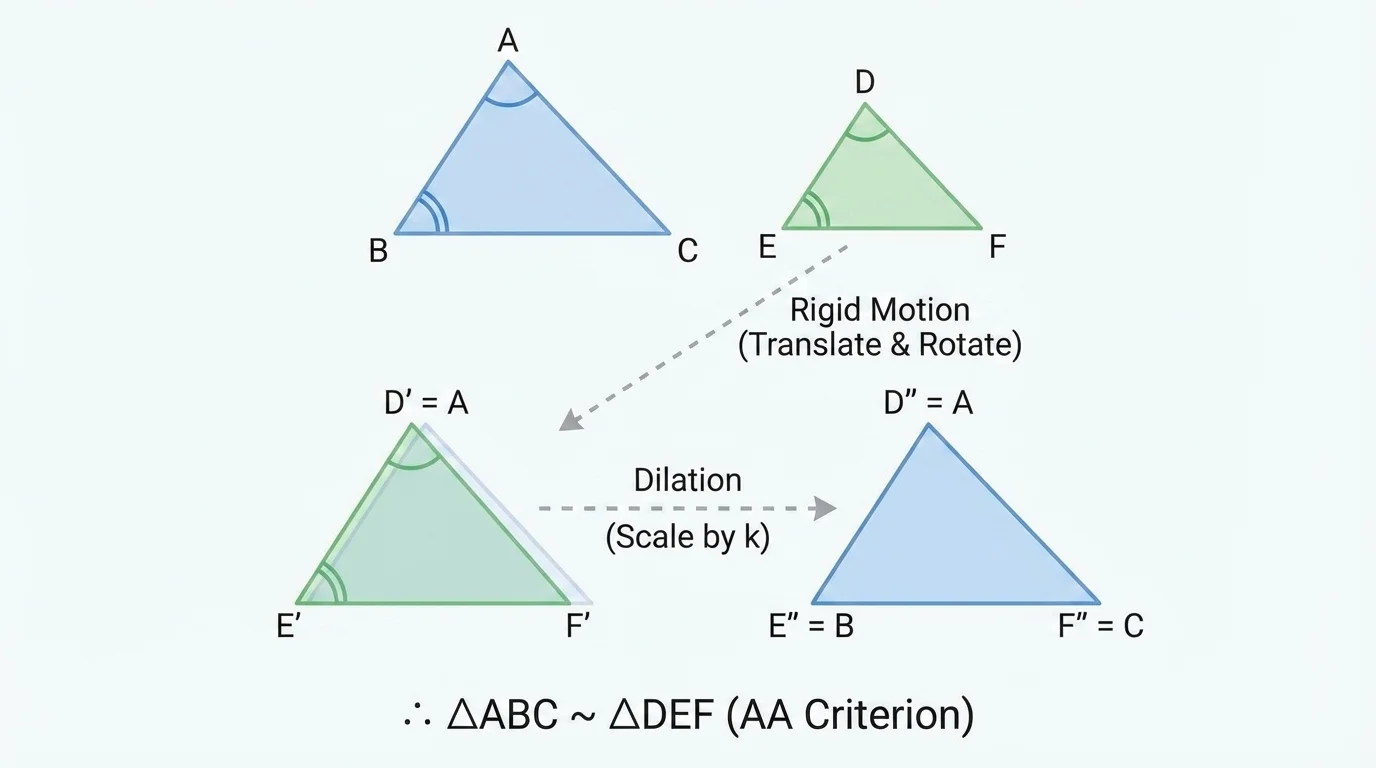
Since a sequence of rigid motions and a dilation maps one triangle onto the other, the triangles are similar. That establishes the AA criterion.
Why AA is enough
For general polygons, knowing a few angles is usually not enough to guarantee similarity. But triangles are special because three sides close the shape in a rigid way, and the angle sum is fixed at \(180^\circ\). Once two angles are fixed, the third is fixed too, so every triangle with those angle measures has the same shape. The only remaining difference is size, and a dilation accounts for that difference.
This is why the AA criterion works so efficiently: equal angles determine shape, and similarity transformations explain the size change.
It is worth noticing that the proof does not begin by assuming side ratios. Instead, it creates them. Once the dilation matches one corresponding side, all other lengths in the transformed triangle are multiplied by the same factor, so the side ratios automatically become equal.
If the dilation scale factor is \(k = \dfrac{DE}{AB}\), then after the dilation, every side of \(\triangle ABC\) is multiplied by \(k\). Therefore the transformed triangle has side lengths \(kAB\), \(kBC\), and \(kAC\). Since it lands exactly on \(\triangle DEF\), we get
\[DE = kAB, \quad EF = kBC, \quad DF = kAC\]
Dividing each equation by the corresponding side of \(\triangle ABC\) gives the common ratio:
\[\frac{DE}{AB} = \frac{EF}{BC} = \frac{DF}{AC} = k\]
So the AA criterion not only proves similarity; it also explains why corresponding sides are proportional.
Now apply the criterion in several settings. In each example, pay attention to the correspondence between vertices before writing any proportions.
Worked Example 1: Deciding whether two triangles are similar
In \(\triangle PQR\), \(\angle P = 45^\circ\) and \(\angle Q = 70^\circ\). In \(\triangle XYZ\), \(\angle X = 45^\circ\) and \(\angle Z = 65^\circ\). Are the triangles similar?
Step 1: Find the missing angle in \(\triangle PQR\).
\(\angle R = 180^\circ - 45^\circ - 70^\circ = 65^\circ\).
Step 2: Find the missing angle in \(\triangle XYZ\).
\(\angle Y = 180^\circ - 45^\circ - 65^\circ = 70^\circ\).
Step 3: Match corresponding angles.
\(\angle P \leftrightarrow \angle X\), \(\angle Q \leftrightarrow \angle Y\), and \(\angle R \leftrightarrow \angle Z\).
Therefore, \(\triangle PQR \sim \triangle XYZ\) by the AA criterion.
Notice that the second given pair was not written in matching order at first. You had to compute the third angles and then identify the correct correspondence.
Worked Example 2: Finding a missing side length
Suppose \(\triangle ABC \sim \triangle DEF\), with \(AB = 6\), \(BC = 9\), and \(DE = 10\). Find \(EF\).
Step 1: Use the order of the similarity statement.
From \(\triangle ABC \sim \triangle DEF\), side \(AB\) corresponds to \(DE\), and side \(BC\) corresponds to \(EF\).
Step 2: Find the scale factor from the first triangle to the second.
\(k = \dfrac{DE}{AB} = \dfrac{10}{6} = \dfrac{5}{3}\).
Step 3: Apply the scale factor to \(BC\).
\(EF = k \cdot BC = \dfrac{5}{3} \cdot 9 = 15\).
The missing side length is
\(EF = 15\)
Because similar triangles come from a dilation, multiplying by one constant scale factor always works for corresponding sides.
Worked Example 3: Writing a correct similarity statement
Triangle \(RST\) has angles \(30^\circ\), \(60^\circ\), and \(90^\circ\) at \(R\), \(S\), and \(T\), respectively. Triangle \(LMN\) has angles \(90^\circ\), \(30^\circ\), and \(60^\circ\) at \(L\), \(M\), and \(N\), respectively. Write a valid similarity statement.
Step 1: Match equal angles.
\(\angle R = 30^\circ\) matches \(\angle M = 30^\circ\).
\(\angle S = 60^\circ\) matches \(\angle N = 60^\circ\).
\(\angle T = 90^\circ\) matches \(\angle L = 90^\circ\).
Step 2: Write the vertices in corresponding order.
\(R \leftrightarrow M\), \(S \leftrightarrow N\), \(T \leftrightarrow L\).
A correct statement is
\[\triangle RST \sim \triangle MNL\]
Another equivalent statement is \(\triangle TSR \sim \triangle LMN\), as long as the order preserves correspondence.
Correct ordering is not a small detail. It controls which sides you compare and which proportions are valid.
Worked Example 4: Using AA when only one angle pair is obvious
In triangles \(\triangle JKL\) and \(\triangle MNP\), \(\angle J\) and \(\angle M\) are right angles. Also, \(\angle K = 35^\circ\) and \(\angle N = 35^\circ\). If \(JK = 8\) and \(MN = 14\), find the scale factor from \(\triangle JKL\) to \(\triangle MNP\).
Step 1: Use the angle information.
One pair of angles is \(90^\circ\), and another pair is \(35^\circ\), so the triangles are similar by AA.
Step 2: Match the corresponding vertices.
\(J \leftrightarrow M\), \(K \leftrightarrow N\), so side \(JK\) corresponds to \(MN\).
Step 3: Compute the scale factor.
\(k = \dfrac{MN}{JK} = \dfrac{14}{8} = \dfrac{7}{4}\).
The scale factor from \(\triangle JKL\) to \(\triangle MNP\) is
\[\frac{7}{4}\]
Right triangles produce some of the most important examples of AA similarity. [Figure 3] One classic picture is a right triangle with an altitude drawn from the right-angle vertex to the hypotenuse. This creates two smaller right triangles inside the original one.
Suppose \(\triangle ABC\) is right at \(C\), and \(CD\) is an altitude to hypotenuse \(AB\). Then \(\angle ACB = 90^\circ\), and each smaller triangle, \(\triangle ACD\) and \(\triangle CBD\), also has a right angle at \(D\). In addition, \(\angle A\) is shared by \(\triangle ABC\) and \(\triangle ACD\), while \(\angle B\) is shared by \(\triangle ABC\) and \(\triangle CBD\).
So by AA,
\[\triangle ABC \sim \triangle ACD \sim \triangle CBD\]
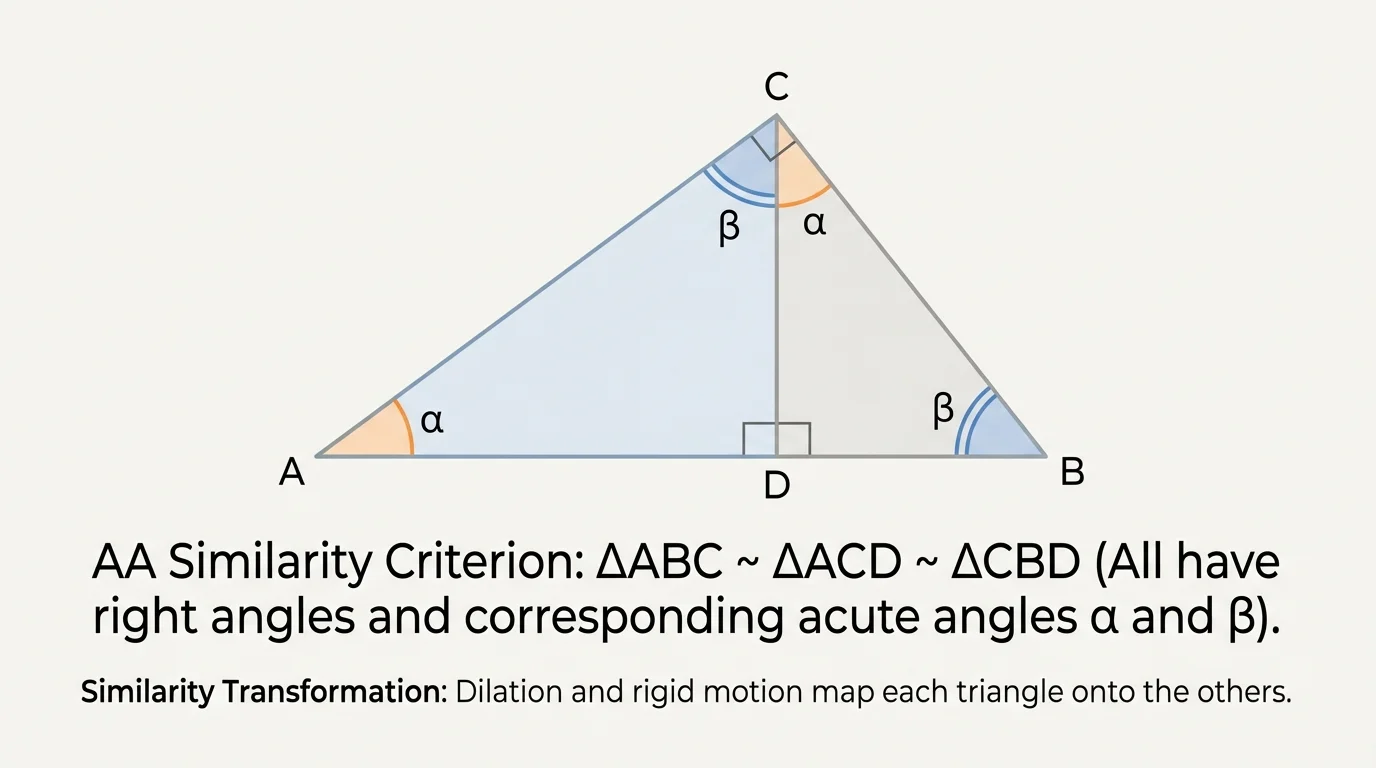
This result is the foundation of several right-triangle relationships, including geometric mean theorems. It also helps explain why trigonometric ratios depend only on angle measure: all right triangles with the same acute angles are similar.
Looking back at [Figure 1], you can connect this to dilations: any two right triangles with the same acute angles differ only by scale, so their side ratios stay constant. That is why \(\sin\), \(\cos\), and \(\tan\) are well defined for a given acute angle.
Surveyors and engineers often rely on similar triangles because angle measurements are easier to obtain at a distance than direct length measurements. A safe measurement can then be scaled into a difficult or dangerous one.
The right-triangle case is especially common in navigation, ramps, roof design, and camera perspective, where angle-based shape information determines proportional lengths.
One common error is to claim triangles are similar after finding only one equal angle. One angle is never enough. You need at least two pairs of equal angles for AA, unless some other similarity criterion is given.
Another common error is mismatching corresponding vertices. If \(\angle A\) matches \(\angle D\), then side \(AB\) must match the side adjacent to \(\angle D\) that corresponds to \(\angle B\). Always use angle correspondence first, then side correspondence.
A third error is to assume that if two triangles "look alike," they are similar. Diagrams can be misleading unless angle measures, side ratios, parallel lines, or a formal criterion supports the conclusion.
| Situation | Valid conclusion | Reason |
|---|---|---|
| Two pairs of corresponding angles are congruent | Triangles are similar | AA criterion |
| All three pairs of corresponding angles are congruent | Triangles are similar | This includes AA automatically |
| Only one angle pair is congruent | Not enough information | Many different triangles can share one angle |
| Triangles are related by a rigid motion and dilation | Triangles are similar | Definition of similarity |
Table 1. Valid and invalid conclusions about triangle similarity.
Later, when solving for side lengths, check whether your proportions compare corresponding sides in the same order. For similar triangles, a correct setup might be \(\dfrac{AB}{DE} = \dfrac{BC}{EF}\), but not \(\dfrac{AB}{EF} = \dfrac{BC}{DE}\) unless the correspondence has been shown to match that order.
AA similarity is not just a theorem for textbook triangles. It appears whenever a shape is viewed at different sizes but from the same geometric structure.
In photography and computer vision, objects farther from the camera appear smaller, but their angle structure can still identify them as the same shape. Software that detects objects often relies on geometric invariants and proportional reasoning closely tied to similarity.
In architecture, scale drawings depend on similar figures. If two corners of a triangular roof support create matching angles in a drawing and the full structure, the drawing can be enlarged by a scale factor to predict actual lengths.
In surveying, if the angle of elevation to the top of a building is measured from two positions, or if a mirror method creates equal angle relationships, similar triangles can determine heights that are impossible to measure directly.
The right-triangle altitude picture from [Figure 3] also appears in structural design, where supports divide larger triangular frames into smaller triangles with the same shape. Engineers value this because shape consistency helps transfer loads predictably.
Even in trigonometry, the entire idea that a \(35^\circ\) angle has a single sine value depends on AA similarity. Any right triangle with a \(35^\circ\) acute angle is similar to any other such right triangle, so the ratio \(\dfrac{\textrm{opposite}}{\textrm{hypotenuse}}\) stays the same.
"Equal angles determine a triangle's shape; dilation determines its size."
That principle is the heart of the AA criterion. The geometry of the angles fixes the form, and the transformation changes only scale.
