A small turn of a bicycle wheel and the same small turn of a Ferris wheel do not cover the same distance along the rim. This makes sense once we notice that the arc length depends not only on how much you turn, but also on the size of the wheel. Geometry turns this everyday fact into a powerful idea: for a fixed angle, the length of the arc grows exactly in proportion to the radius. That idea leads to one of the most important angle measurements in mathematics, the radian.
When two circles have the same central angle measure, the "opening" of the angle has the same shape, even if one circle is larger than the other. The rays forming the angle point in the same directions, and the arc cut off by the angle sits farther from the center in the larger circle. Because the larger circle is a scaled-up version of the smaller one, the intercepted arc is also scaled up.
This is one of the places where geometry and similarity connect beautifully. If every length in a figure is multiplied by the same scale factor, then corresponding lengths in the new figure are also multiplied by that factor. Circles behave this way under a dilation: if a circle of radius \(r\) is enlarged by scale factor \(k\), the new radius becomes \(kr\), and every arc becomes \(k\) times as long.
A circle with radius \(r\) has circumference \(2\pi r\), and its area is \(\pi r^2\). Also, similar figures have corresponding lengths in a constant ratio.
That means a central angle does not determine one exact arc length by itself. Instead, it determines a ratio: arc length compared to radius. This ratio stays the same for all circles cut by the same central angle.
Take two circles with radii \(r\) and \(R\), and in each circle draw the same central angle. The larger circle is a scaled copy of the smaller one. Since the scale factor is \(\dfrac{R}{r}\), the intercepted arc in the larger circle must also be \(\dfrac{R}{r}\) times the intercepted arc in the smaller circle.
As shown in [Figure 1], let the corresponding arc lengths be \(s\) in the smaller circle and \(S\) in the larger circle. Similarity gives
\[\frac{S}{s} = \frac{R}{r}.\]
Rearranging, we get
\[\frac{s}{r} = \frac{S}{R}.\]
This is the key fact: for a fixed central angle, the ratio of arc length to radius is constant. In other words, if the angle stays the same, then arc length is proportional to radius.
That proportionality can be written as
\(s = kr\)
where \(k\) depends only on the angle, not on the size of the circle. A larger radius gives a longer arc, but the quotient \(\dfrac{s}{r}\) remains unchanged for that angle.
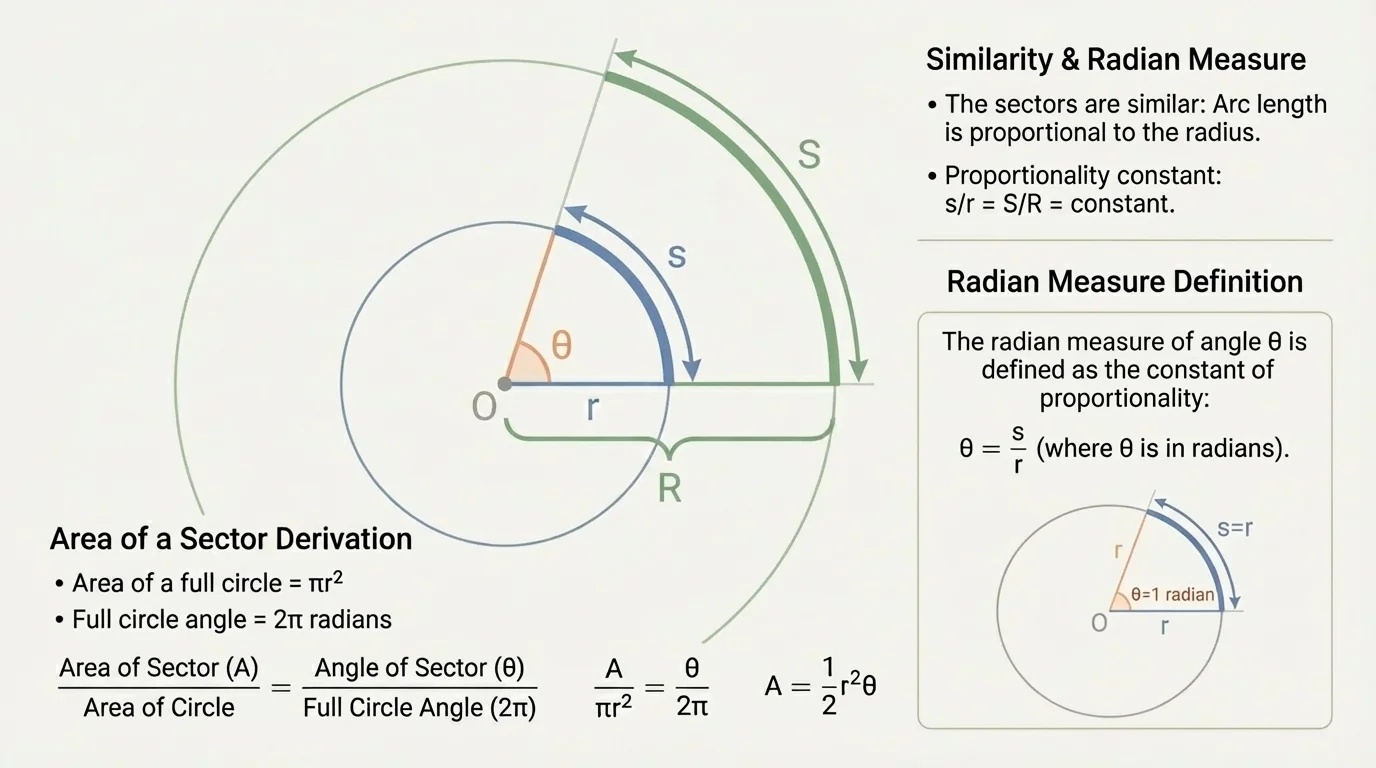
This result is deeper than it may first appear. It says that an angle can be measured by how much arc it cuts off relative to the radius. That is exactly how radian measure is defined.
Arc length is the distance along part of a circle. A sector is the region enclosed by two radii and the intercepted arc. A central angle is an angle whose vertex is at the center of the circle.
Notice that this reasoning depends on the angle being a central angle. The formulas we derive use the radius directly because the sides of the angle are radii.
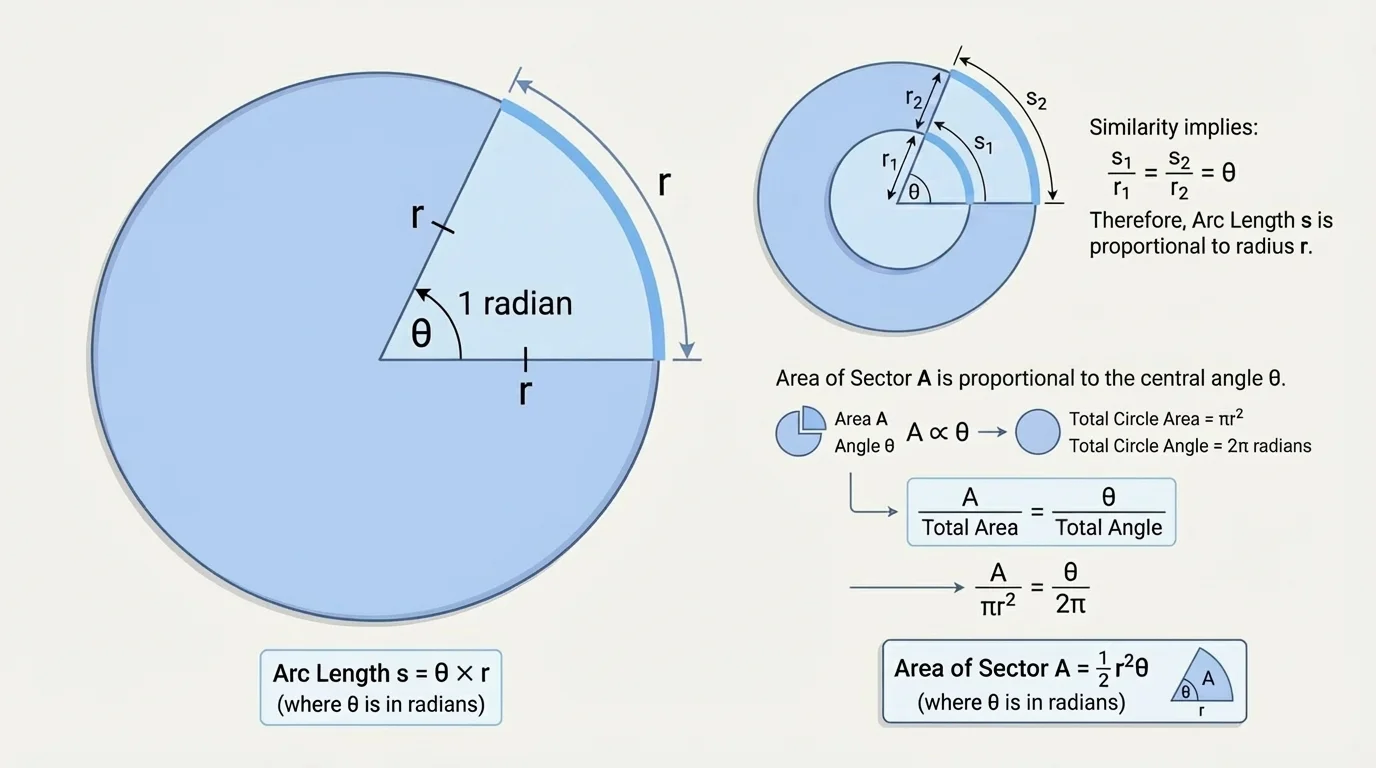
A natural way to measure an angle is to use the constant ratio \(\dfrac{s}{r}\). One important case occurs when the intercepted arc has the same length as the radius. That angle is defined to have measure 1 radian.
As shown in [Figure 2], more generally, if a central angle intercepts an arc of length \(s\) in a circle of radius \(r\), then the angle's radian measure \(\theta\) is defined by
\[\theta = \frac{s}{r}.\]
This definition is powerful because the ratio is dimensionless. If \(s\) and \(r\) are both measured in centimeters, the centimeters cancel. The number \(\theta\) tells how much turning has occurred, independent of circle size.
Solving the definition for arc length gives the main arc-length formula in radians:
\[s = r\theta.\]
If \(\theta = 1\), then \(s = r\), which matches the meaning of one radian.
Now consider a full circle. Its arc length is the entire circumference, \(2\pi r\). Using \(\theta = \dfrac{s}{r}\), the angle for one full turn is
\[\theta = \frac{2\pi r}{r} = 2\pi.\]
So one complete revolution is \(2\pi\) radians. Since a full revolution is also \(360^\circ\), we get the degree-radian relationship
\[2\pi \textrm{ radians} = 360^\circ.\]
From this,
\[\pi \textrm{ radians} = 180^\circ,\]
which leads to the conversion rules
\[\textrm{radians} = \textrm{degrees} \cdot \frac{\pi}{180}\]
and
\[\textrm{degrees} = \textrm{radians} \cdot \frac{180}{\pi}.\]
As we saw with [Figure 2], radian measure is not based on an arbitrary division of a circle into \(360\) parts. It comes directly from geometry and similarity, which is why it appears so often in higher mathematics, physics, and engineering.
The number \(2\pi \approx 6.28\) means that just over six radii laid end to end match the circumference of a circle. That is why a full turn measures a little more than \(6\) radians.
When you use \(s = r\theta\), the angle must be in radians. If the angle is in degrees, convert it first unless you are using a separate degree-based formula.
The formula \(s = r\theta\) is compact, but it contains several useful variations. If you know the arc length and radius, then
\[\theta = \frac{s}{r}.\]
If you know the arc length and the angle, then
\[r = \frac{s}{\theta}.\]
Using degrees, you may also write arc length as a fraction of the circumference:
\[s = \frac{\theta}{360} \cdot 2\pi r,\]
where \(\theta\) is measured in degrees. This formula agrees with \(s = r\theta\) after converting degrees to radians.
For example, if \(\theta = 60^\circ\), then in radians \(\theta = \dfrac{\pi}{3}\), so
\[s = r\cdot \frac{\pi}{3} = \frac{\pi r}{3}.\]
Using the degree form gives the same result:
\[s = \frac{60}{360} \cdot 2\pi r = \frac{1}{6} \cdot 2\pi r = \frac{\pi r}{3}.\]
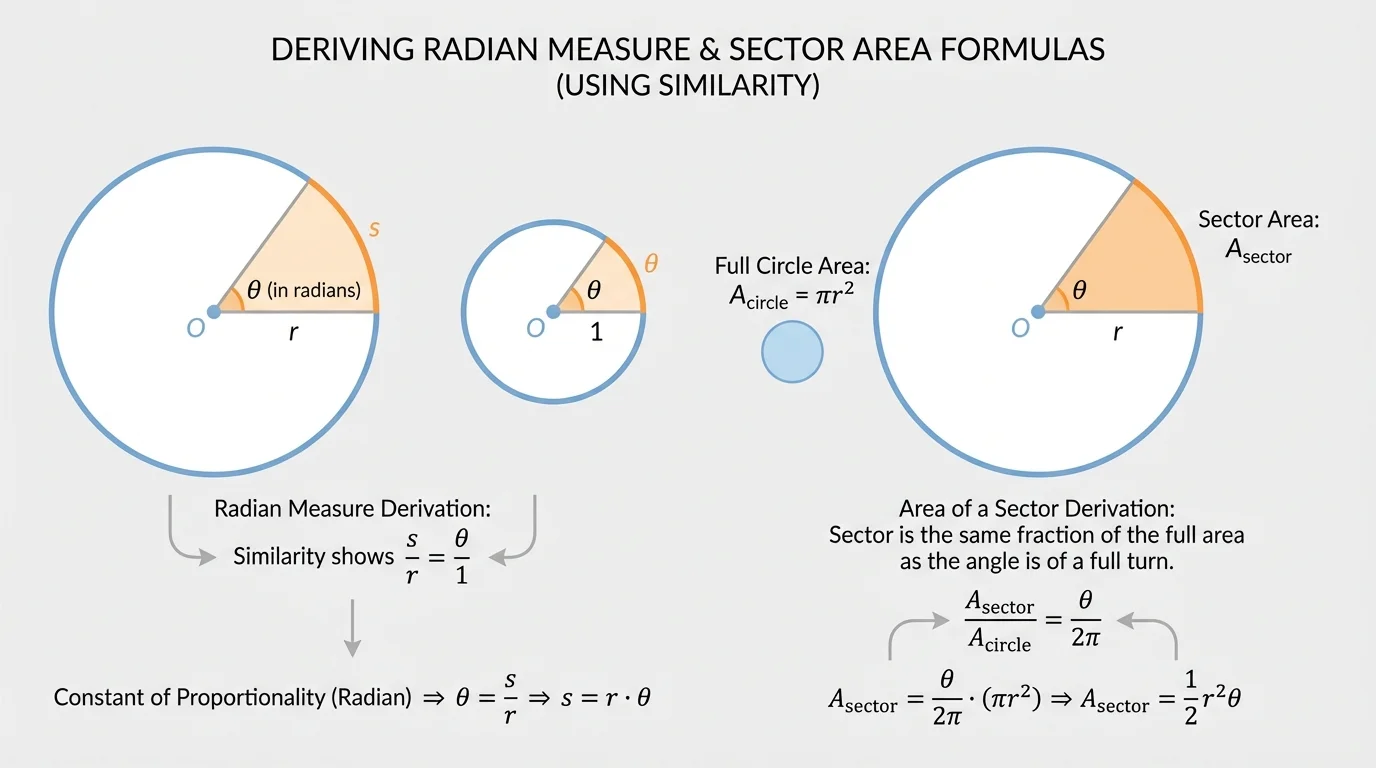
Arc length is not the only quantity controlled by the angle. The sector cut off by a central angle also takes a fixed fraction of the whole circle. As [Figure 3] illustrates, if a central angle is a certain fraction of a full turn, then the sector's area is the same fraction of the circle's total area.
As [Figure 3] illustrates, if a central angle measures \(\theta\) radians, and a full circle is \(2\pi\) radians, then the sector is the fraction \(\dfrac{\theta}{2\pi}\) of the entire circle. Since the area of the full circle is \(\pi r^2\), the area \(A\) of the sector is
\[A = \frac{\theta}{2\pi} \cdot \pi r^2.\]
Simplifying, we obtain
\[A = \frac{1}{2}r^2\theta.\]
This is the sector-area formula when \(\theta\) is measured in radians.
You can also connect this formula to arc length. Since \(s = r\theta\), substitute \(\theta = \dfrac{s}{r}\) into the area formula:
\[A = \frac{1}{2}r^2\left(\frac{s}{r}\right) = \frac{1}{2}rs.\]
So another useful sector formula is
\[A = \frac{1}{2}rs,\]
where \(r\) is the radius and \(s\) is the arc length of the sector.
In degrees, the sector area can be written as
\[A = \frac{\theta}{360} \cdot \pi r^2,\]
where \(\theta\) is measured in degrees. Again, this is fully consistent with the radian formula after conversion.
The formulas become much easier to trust when you see them at work.
Example 1: Finding arc length from radius and angle
A circle has radius \(8 \textrm{ cm}\) and central angle \(\dfrac{3\pi}{4}\) radians. Find the arc length.
Step 1: Use the arc-length formula.
Since the angle is already in radians, use \(s = r\theta\).
Step 2: Substitute the values.
\(s = 8\left(\dfrac{3\pi}{4}\right)\).
Step 3: Simplify.
\(8 \cdot \dfrac{3\pi}{4} = 2 \cdot 3\pi = 6\pi\).
\[s = 6\pi \textrm{ cm}\]
The intercepted arc is \(6\pi \textrm{ cm}\).
This example shows why radians are efficient. The calculation is direct: multiply radius by angle.
Example 2: Finding radian measure from arc length
An arc has length \(15 \textrm{ m}\) in a circle of radius \(6 \textrm{ m}\). Find the central angle in radians.
Step 1: Start with the definition of radian measure.
\(\theta = \dfrac{s}{r}\).
Step 2: Substitute.
\(\theta = \dfrac{15}{6} = \dfrac{5}{2}\).
Step 3: State the result.
\[\theta = \frac{5}{2} \textrm{ radians}\]
The angle measure is \(\dfrac{5}{2}\) radians.
Because the ratio \(\dfrac{s}{r}\) defines the angle, this answer does not depend on any degree conversion.
Example 3: Finding the area of a sector
A sector has radius \(10 \textrm{ cm}\) and central angle \(1.2\) radians. Find its area.
Step 1: Use the sector-area formula in radians.
\(A = \dfrac{1}{2}r^2\theta\).
Step 2: Substitute.
\(A = \dfrac{1}{2}(10)^2(1.2)\).
Step 3: Compute.
\((10)^2 = 100\), so \(A = \dfrac{1}{2}(100)(1.2) = 50(1.2) = 60\).
\[A = 60 \textrm{ cm}^2\]
The sector area is \(60 \textrm{ cm}^2\).
Notice how the formula uses \(r^2\), which makes sense because area depends on two-dimensional scaling.
Example 4: Starting with degrees
A sector in a circle of radius \(12 \textrm{ in}\) has a central angle of \(150^\circ\). Find both the arc length and the sector area.
Step 1: Convert the angle to radians.
\(150^\circ \cdot \dfrac{\pi}{180} = \dfrac{5\pi}{6}\).
Step 2: Find the arc length.
Use \(s = r\theta\): \(s = 12\left(\dfrac{5\pi}{6}\right) = 2 \cdot 5\pi = 10\pi\).
\[s = 10\pi \textrm{ in}\]
Step 3: Find the sector area.
Use \(A = \dfrac{1}{2}r^2\theta\): \(A = \dfrac{1}{2}(12)^2\left(\dfrac{5\pi}{6}\right)\).
Since \((12)^2 = 144\), this becomes \(72 \cdot \dfrac{5\pi}{6} = 12 \cdot 5\pi = 60\pi\).
\[A = 60\pi \textrm{ in}^2\]
The arc length is \(10\pi \textrm{ in}\) and the sector area is \(60\pi \textrm{ in}^2\).
Later, when you study trigonometry and calculus, these radian formulas will appear again because they make many relationships cleaner and more natural than degree-based formulas.
One common mistake is mixing degrees with radian formulas. The formulas \(s = r\theta\) and \(A = \dfrac{1}{2}r^2\theta\) require \(\theta\) in radians. If you use degrees directly, your answer will be incorrect unless you use the degree versions of the formulas.
Another mistake is confusing radius and diameter. These formulas use the radius \(r\), not the diameter. If the diameter is given, divide by \(2\) first.
Be careful when interpreting a central angle. A minor arc corresponds to the smaller angle, while a major arc corresponds to the larger one. For example, an angle of \(\dfrac{\pi}{3}\) radians intercepts the minor arc, but the corresponding major arc has angle \(2\pi - \dfrac{\pi}{3} = \dfrac{5\pi}{3}\).
That difference matters in calculations. In the same circle, the major arc is much longer, and the major sector has much larger area. The geometry in [Figure 3] helps explain why: a larger fraction of the full turn means a larger fraction of the full area.
| Quantity known | Formula | Angle unit required |
|---|---|---|
| Arc length from radius and angle | \(s = r\theta\) | Radians |
| Radian measure from arc length | \(\theta = \dfrac{s}{r}\) | Result in radians |
| Sector area from radius and angle | \(A = \dfrac{1}{2}r^2\theta\) | Radians |
| Arc length with degrees | \(s = \dfrac{\theta}{360} \cdot 2\pi r\) | Degrees |
| Sector area with degrees | \(A = \dfrac{\theta}{360} \cdot \pi r^2\) | Degrees |
Table 1. Common formulas for arc length, radian measure, and sector area, with the required angle units.
Arc length and sector area appear whenever a turning motion sweeps out part of a circle. Engineers use arc length to determine how far a wheel rolls during a rotation. If a tire of radius \(r\) turns through \(\theta\) radians without slipping, the distance traveled is exactly \(r\theta\).
In road and railway design, curved sections are built from circular arcs. The sharper the turn, the smaller the radius; the longer the curve for a fixed turn angle, the larger the radius. That relationship is the same proportionality derived from similarity in [Figure 1].
Sector area matters in rotating sensors, radar sweeps, and irrigation systems. If a sprinkler rotates through a certain angle, the watered region is a sector. The amount of ground covered depends on both the radius of the spray and the central angle, following \(A = \dfrac{1}{2}r^2\theta\).
Even slicing food uses the same geometry. A pizza slice is a sector, and the curved crust is an arc. If two pizzas have the same angle slice but different sizes, the larger pizza has a longer crust and more area because both arc length and sector area scale with radius.
Why radians matter beyond geometry
Radian measure connects angle directly to distance and area, which is why it becomes the standard in advanced mathematics. Formulas involving circular motion, waves, and trigonometric functions are simpler and more natural in radians because radian measure is built from the geometry of the circle itself.
So the story is not just about circles. It is about choosing a measurement system that comes naturally from proportionality and similarity.
